AAA Innate Awakening Therapy – Unlocking the Body’s Innate Healing Potential Through Clinical Mudra Naturopathy and Integrative Wellness – Three Daily Practices for Holistic Wellness – AAA Innate Meditation • AAA Innate Cleaning • AAA Innate Prayer – Clinical Mudra Naturopathy | Mind–Body Wellness | Integrative Self-Care -By Mani Gandhi
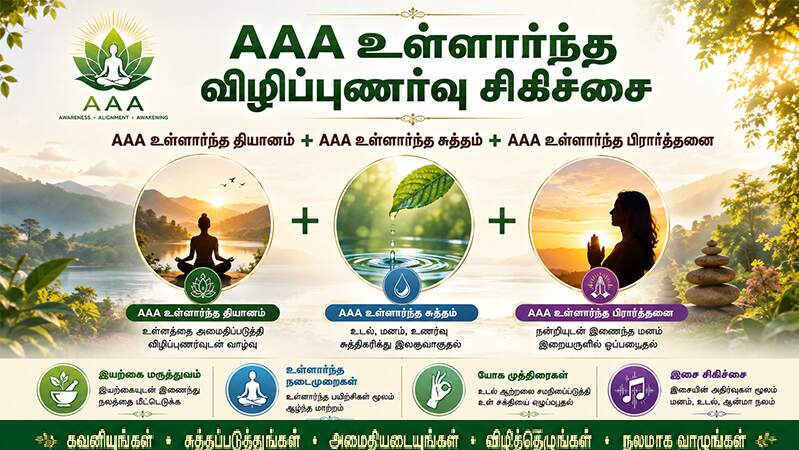
AAA INNATE AWAKENING THERAPY
Naturopathy • Inner Practices • Yoga Mudras • Music Therapy
Body • Mind • Emotion • Intuition
In Harmony with Nature,
A holistic wellness journey that reconnects you with yourself
A CALL FOR A NEW APPROACH TO WELLNESS
Human life is a continuous journey of interacting with the outer world. We work, learn, build relationships, take on responsibilities, make plans, and strive to achieve. Every day brings us different experiences, emotions, challenges, and opportunities.
But in the midst of this fast-moving journey through life, one important connection can gradually be left behind.
Our connection with ourselves.
What is our body telling us?
How is our breathing?
What state is our mind in?
What emotions are moving within us?
What do we truly want?
What direction gives meaning to our lives?
The answers to these questions cannot always be found outside ourselves. Some answers arise from quiet inner attention.
AAA INNATE AWAKENING Therapy is designed as a structured daily practice for cultivating that inner attention.
It is not based on the idea of an immediate “solution” for a particular disease. Rather, it is an integrated approach that encourages self-awareness, mental calm, body awareness, emotional balance, inner order, and healthy lifestyle habits in everyday life.
WHAT IS AAA INNATE AWAKENING?
At the heart of AAA Innate Awakening Therapy is a simple idea:
First, observe yourself.
Then understand yourself.
Then learn to live in harmony with yourself.
The body, mind, emotions, and intuition are not separate worlds. They are interconnected dimensions of human experience.
Physical fatigue can influence our state of mind.
Mental stress can change bodily sensations.
Emotional experiences can be reflected in our breathing and behaviour.
Quiet attention can help us see our inner experience more clearly.
Therefore, the AAA approach presents an integrated perspective:
Observe the body.
Observe the mind.
Observe the emotions.
Listen to your inner voice.
Through this, we develop the habit of seeing our outer life and inner life as part of one continuous experience.
THE 42-MINUTE DAILY INNER JOURNEY
The core structure of the AAA method is:
14 + 14 + 14 = 42 MINUTES
For people who may not be able to set aside 42 minutes at one time, the daily practice is divided into three simple sections so that it can be followed more easily.
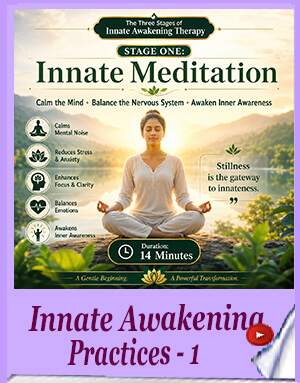
MORNING — 14 MINUTES
AAA INNATE MEDITATION + THERAPEUTIC MUDRA + MUSIC
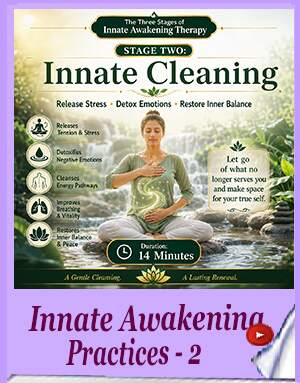
EVENING — 14 MINUTES
AAA INNATE CLEANSING + THERAPEUTIC MUDRA + MUSIC
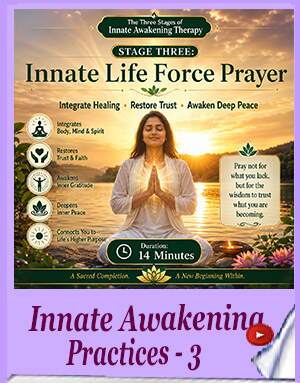
NIGHT — 14 MINUTES
AAA INNATE PRAYER + THERAPEUTIC MUDRA + MUSIC
These three times represent three different inner phases of the day:
BEGINNING • TRANSITION • COMPLETION
Morning — a time to enter into yourself.
Evening — a time to release the experiences of the day.
Night — a time to return to stillness with gratitude.
PART ONE
MORNING — 14 MINUTES
AAA INNATE MEDITATION
Begin the day with yourself
Morning is the time when the mind and body prepare to move into a new day.
Instead of immediately giving the first few minutes of the day to the phone, messages, tasks, or external activity, we can reserve a few minutes for ourselves.
AAA Innate Meditation does not have to be complicated.
A comfortable seated position.
Gentle breathing.
Observing bodily sensations.
Watching thoughts.
Sensing the inner state.
Settling into a chosen mudra.
Experiencing the gentle flow of music alongside it.
Together, these small actions create a peaceful inner space for the morning.
PURPOSES OF THIS PRACTICE
Mental calm
Self-awareness
Innate Awakening
Focused attention
Beginning the day with balance
The purpose of meditation is not to force thoughts to stop.
Thoughts may come.
They may go.
We can observe them.
We can return to the breath and the present experience.
Through this, a small space may arise between the “thought” and “the one who observes the thought.”
That space may be the beginning of Innate Awakening.
AAA INNATE MEDITATION MUDRA
A mudra appropriate for the meditation practice may be selected.
Mudras such as Jnana Mudra, which traditionally support calmness and attention, may be incorporated.
The important point is not simply to practise the mudra with the belief that it is a specific “therapy.”
Rather:
BODY POSTURE + BREATH + ATTENTION + INTENTION
The key is to bring these together around one point of awareness.
AAA INNATE MEDITATION — MUSIC THERAPY
Gentle, peaceful, structured music may be used as a supportive medium for creating the environment for practice.
Listening to music is not the only objective.
We can feel the breath along with the sound of the music.
We can observe how the body responds.
We can notice what emotions arise.
We can experience stillness.
In this way, music moves from being merely background sound to becoming an environment that supports inner attention.
PART TWO
EVENING — 14 MINUTES
AAA INNATE CLEANSING
Turn inward from the burdens of the day
Throughout a day, we encounter countless experiences.
Hundreds of thoughts may pass through the mind within a short period.
Some conversations may continue to remain in our memory.
Some tasks may remain unfinished.
Some emotions may remain inside without being expressed.
The evening does not have to be a time when we simply put these things aside and move on to the next activity.
It can also be a time of inner transition.
AAA Innate Cleaning does not refer only to cleansing the body.
It also includes observing our mental and emotional experiences.
What happened?
What did I feel?
Where is there tension in my body?
Which thoughts keep returning?
What am I now ready to release?
There is no need to answer these questions.
Simply observing them may be enough.
WHAT DOES “RELEASING” MEAN?
Releasing does not mean denying an experience.
Rather, it means saying inwardly:
“This happened.”
“I experienced this.”
“Now I am creating space to gently let this go.”
This may be the inner intention of the AAA evening practice.
Let the body rest.
Let the breath become softer.
Let the mind gradually settle.
Rather than carrying the end of one day immediately into the burdens of the next, allow a space to emerge between the two.
AAA INNATE CLEANSING MUDRAS
In the evening practice, mudras such as Apana Mudra, Prithvi Mudra, and Varuna Mudra may be selected based on traditional yogic applications.
Here, mudras are used as supportive practices to:
- Observe bodily sensations
- Maintain inner attention
- Stay connected with the breath
- Create an atmosphere of evening relaxation
AAA INNATE CLEANSING — MUSIC THERAPY
Evening music may create a different inner atmosphere from the music used during morning meditation.
It may support greater calmness, gentleness, and a gradual process of inner transition.
Remaining in silence for a few moments after the music ends may also be considered part of the practice.
MUSIC → STILLNESS → ATTENTION → RELEASE
A natural flow can emerge.
PART THREE
NIGHT — 14 MINUTES
AAA INNATE PRAYER
Complete the day with gratitude
Night is not only an ending.
It is also a beginning that creates inner space for the following day.
Rather than repeatedly dwelling harshly on mistakes made during the day, accepting them, remembering the good moments, expressing gratitude for the support received, and completing the day with love may create a gentle transition for the mind.
AAA Innate Prayer can also be presented as a gratitude practice that can be used beyond religious boundaries.
A person may pray according to their own faith.
Or they may express gratitude to nature.
Or gratitude to life.
Or simply spend a few minutes with their own inner stillness.
What matters is:
COMPLETING THE DAY WITH GRATITUDE.
AAA INNATE PRAYER MUDRAS
Hridaya Mudra, Anjali Mudra, and Shakti Mudra may be selected as supportive practices for the inner practice at night.
They can help create an environment in which we become aware of qualities such as:
Love
Gratitude
Acceptance
Inner peace
AAA INNATE PRAYER — MUSIC THERAPY
Night-time music may create a different inner atmosphere from the music used during morning meditation.
It may support greater calmness, gentleness, and gradual inner transition.
Remaining in silence for a few moments after the music ends may also be considered part of the practice.
MUSIC → GRATITUDE → ACCEPTANCE → INNER PEACE
A natural flow can emerge.
YOGA MUDRAS — THE AAA APPROACH
Mudras are specific positions of the hands and fingers that have been used for a long time within Indian yogic traditions.
The AAA approach views mudras as:
MUDRA = A BODY LANGUAGE THAT INTEGRATES ATTENTION
In other words, the physical structure of a mudra provides an anchor for our attention.
We focus on the hands.
We feel the breath.
We observe subtle sensations in the body.
Alongside this, we observe the state of the mind.
This process transforms a mudra from simply being a finger position into an Innate Awakening practice.
KEY MUDRAS THAT MAY BE INCLUDED IN AAA
JNANA MUDRA
Attention • Knowledge • Meditation
The tips of the thumb and index finger are brought together while the other fingers remain naturally positioned.
It is traditionally regarded as a mudra used in meditation and self-awareness practices.
VAYU MUDRA
Attention • Gentleness • Body Awareness
The index finger is folded and gently supported by the thumb.
It may be combined with practices that involve observing bodily sensations.
SURYA MUDRA
Fire • Transformation • Awareness
The ring finger is folded and supported by the thumb.
In traditional yogic explanations, it is associated with the solar or fire principle.
LINGA MUDRA
Warmth • Energy • Focused Attention
The fingers of both hands are interlocked, with one thumb positioned upward.
It should be practised only with consideration for physical comfort.
PRITHVI MUDRA
Stability • Grounding • Balance
The tips of the ring finger and thumb are brought together.
It may be used during meditation as a supportive practice for developing stability and a sense of being “here and now.”
PRANA MUDRA
Vital Energy • Awareness • Enthusiasm
The tips of the little finger and ring finger are brought together with the tip of the thumb.
It may be combined with breathing and body-awareness practices.
APANA MUDRA
Release • Stability • Innate Cleaning
The tips of the middle and ring fingers are brought together with the tip of the thumb.
It may be traditionally associated with evening “release” practices.
SHUNYA MUDRA
Space • Listening • Stillness
The middle finger is folded and supported by the thumb.
It may be combined with practices of sitting quietly and observing sounds.
HRIDAYA MUDRA
Love • Compassion • Heart Awareness
The index finger is folded while the middle and ring fingers are brought together with the tip of the thumb.
It may be used during nighttime gratitude and inner-prayer practices.
VARUNA MUDRA
Water • Gentleness • Balance
The tips of the little finger and thumb are brought together.
It may be used as a supportive mudra for gentle body–mind awareness practices.
ANJALI MUDRA
Gratitude • Respect • Unity
The two palms are brought together.
It naturally fits practices of prayer, gratitude, and completing the day.
VISHNU MUDRA
Breath Regulation • Balance • Attention
It is used to position the hand during certain traditional pranayama practices.
When integrated with breathing practice within the AAA method, it may support focused attention during the practice.
SHAKTI MUDRA
Rest • Inner Energy • Stillness
It may be included among traditional mudras used during gentle nighttime practices.
MORE IMPORTANT THAN THE MUDRA — YOUR AWARENESS
The purpose of the AAA approach is not to expect a specific disease to disappear immediately simply by practising a mudra.
A mudra is a doorway to attention.
Through that doorway, we:
Return to the body.
Feel the breath.
Observe the mind.
Accept our emotions.
Create space for stillness.
This is the central perspective of AAA Innate Awakening.
MUSIC THERAPY
SOUND → VIBRATION → ATTENTION → EXPERIENCE
Music has a place in every dimension of human life.
Gentle music can awaken memories.
A rhythm can move the body.
A peaceful sound can help the mind relax.
Within the AAA approach, music is viewed as the environment and attentional support for inner practice.
Morning music — supports awareness.
Evening music — supports transition and release.
Night music — supports gratitude and stillness.
In this way, each of the three times develops its own distinct inner quality.
LIVING IN CONNECTION WITH NATURE
AAA Innate Awakening Therapy does not end with mudra and meditation sessions.
It should continue as part of everyday lifestyle.
Experience natural light.
Feel clean air.
Develop the habit of drinking sufficient water.
Maintain natural food habits.
Give the body the movement it needs.
Allow sufficient time for rest.
Create a regular environment for sleep.
Spend time with nature.
These should not all be viewed as “therapy.”
Rather, they can be approached as components of a lifestyle that supports wellness.
THE FIVE INNER STATES OF AAA
01 — OBSERVE
First, look at yourself.
The body.
The breath.
The thoughts.
The emotions.
02 — ACCEPT
There is no immediate need to change everything happening inside.
First, feel it.
Learn to observe it without resisting it.
03 — CLEANSE
Gradually create space from mental burdens that are no longer needed.
04 — BECOME STILL
Practise being in stillness, even if only for a few minutes.
05 — LIVE WITH AWARENESS
The awareness experienced during meditation should also be reflected in other areas of life.
In your speech.
In your relationships.
In your food.
In your work.
In your rest.
In your decisions.
In your lifestyle.
ONE DAY — ONE INNER CYCLE
MORNING
I BEGIN WITH MYSELF.
Meditation.
Breath.
Mudra.
Music.
Attention.
EVENING
I GATHER MYSELF BACK FROM THE DAY.
Observation.
Cleansing.
Release.
Mudra.
Music.
NIGHT
I COMPLETE THE DAY WITH GRATITUDE.
Prayer.
Love.
Gratitude.
Mudra.
Music.
Stillness.
42 MINUTES — A GIFT TO YOURSELF
There are 1,440 minutes in a day.
Setting aside 42 of those minutes for yourself is not a major investment.
But it is an important reminder:
“I, too, am an important part of my life.”
Fourteen minutes is not a very long time.
But when 14 minutes are practised consistently every day, they can become a habit.
A habit can create discipline.
Discipline can cultivate self-awareness.
Self-awareness can begin to transform lifestyle.
Therefore, what matters in AAA is not making a tremendous effort once a day.
It is doing a little every day, consistently.
WHO IS AAA INNATE AWAKENING FOR?
AAA Innate Awakening Therapy can be designed as a supportive self-care approach for adults who wish to set aside daily time for themselves and develop inner attention and wellness practices.
It may be suitable for people who:
- Want to begin meditation
- Want to create a quiet period each day
- Want to become more aware of bodily sensations
- Are seeking a pause from mental stress
- Want to develop a practice of gratitude and prayer
- Want to combine yoga mudras with an inner practice
- Seek a nature-oriented wellness lifestyle
It may serve as a supportive practice for people with these intentions.
AAA — NOT JUST A PRACTICE, BUT A WAY OF LIVING
AAA does not have to be confined to 42 minutes.
The deeper purpose of this practice is to carry awareness into the rest of life.
While eating — observe.
While walking — observe.
While speaking — observe.
While listening — observe.
While working — observe.
When angry — observe.
When happy — observe.
When still — observe.
Awareness is not a schedule. It is a quality of life.
AAA DAILY AFFIRMATION
MORNING
“Today, I will observe myself.”
EVENING
“I will release the unnecessary burdens from what happened today.”
NIGHT
“I am grateful for today.”
EVERY DAY
“I reconnect myself with myself.”
FAQ
What is AAA?
AAA Innate Awakening Therapy is a wellness approach that integrates self-awareness, inner practices, yoga mudras, music, and nature-oriented wellness habits.
Why 42 minutes?
To divide the daily practice into three simple 14-minute sections.
14 + 14 + 14 = 42 minutes.
Do I need to do all three practices every day?
AAA is structured as a complete daily cycle consisting of three periods. However, an individual may understand the practice and arrange it according to their circumstances and comfort.
When should each practice be done?
Morning: Innate Meditation
Evening: Innate Cleaning
Night: Innate Prayer
Are mudras compulsory?
Mudras are a supportive practice within AAA. They are approached as anchors that can help integrate attention; they should not be regarded as compulsory medical methods.
How do I choose a mudra?
It can be selected according to the intention of the practice and your comfort. AAA introduces 13 mudras within individual practice contexts.
Is music necessary?
Music is used in AAA as environmental and attentional support. The practice can also be done in silence without music.
Who is AAA for?
It is a supportive self-care approach for adults who wish to set aside daily time for themselves and develop inner attention and wellness practices.
Is AAA a replacement for medical treatment?
No.
AAA is not a replacement for medical diagnosis or treatment.
What should I do if I experience discomfort during the practice?
Stop the practice. Listen to your body. When necessary, seek advice from a qualified healthcare professional.
OUR RESPONSIBLE APPROACH
AAA is:
Self-care + Innate Awakening + Wellness
It is not a replacement for medical diagnosis or treatment.
The source material clearly states that people with specific medical conditions, persistent symptoms, injuries, or ongoing medication should continue to seek guidance from qualified healthcare professionals.
This creates trust + credibility + ethical positioning for the AAA brand.
AAA INNATE AWAKENING THERAPY
OBSERVE
Begin to feel yourself.
ACCEPT
Approach what is happening within you gently.
CLEANSE
Create space from unnecessary burdens.
BECOME STILL
Create space for inner peace.
AWAKEN
Deepen your understanding of yourself.
LIVE WELL
Transform awareness into a way of living.
In harmony with nature.
Reconnecting you with yourself.
Living with Innate Awakening.
Moving toward holistic wellness.
AAA INNATE AWAKENING THERAPY
NATUROPATHY
INNER PRACTICES
YOGA MUDRAS
MUSIC THERAPY
BODY • MIND • EMOTION • INTUITION
14 MINUTES — MORNING
14 MINUTES — EVENING
14 MINUTES — NIGHT
42 MINUTES EVERY DAY
There is no need to rush to change yourself.
First, observe yourself.
Let understanding arise from attention.
Let peace blossom from understanding.
Let awareness blossom from peace.
Let a healthy life emerge from awareness.
OBSERVE • CLEANSE • BECOME STILL • AWAKEN • LIVE WELL
FINAL CALL TO ACTION
Before trying to change the world, take a few moments to observe yourself.
Before rushing through life, feel the gentleness of your breath.
Before trying to understand everyone else, listen to yourself.
Before seeking wellness outside yourself, make space in your daily life for habits that support wellbeing.
Reconnect with nature.
Be a friend to your body.
Observe your mind.
Accept your emotions.
Make space for inner stillness.
And through that:
RECONNECT WITH YOURSELF.
AAA INNATE AWAKENING THERAPY
Naturopathy • Inner Practices • Yoga Mudras • Music Therapy
Body • Mind • Emotion • Intuition
OBSERVE
CLEANSE
BECOME STILL
AWAKEN
LIVE WELL
42 minutes every day —
An inner wellness journey
that reconnects you with yourself.
RESPONSIBLE WELLNESS GUIDANCE
AAA Innate Awakening Therapy should be understood as a self-care, inner-awareness, and wellness approach.
Practices such as yoga mudras, meditation, music, and prayer are used as supportive practices according to an individual’s experience and the purpose of the practice.
They are not a replacement for medical treatment for diagnosing, curing, or preventing specific diseases.
People with specific medical conditions, persistent symptoms, injuries, or ongoing medication should continue to seek advice from qualified healthcare professionals.
If pain, dizziness, shortness of breath, or significant discomfort occurs during a mudra or any other practice, it is advisable to stop the practice and seek appropriate professional guidance.
THE CENTRAL MESSAGE OF AAA:
**DO NOT ONLY SEEK TREATMENT.
OBSERVE YOURSELF.**
**LISTEN TO YOUR BODY.
OBSERVE YOUR MIND.
ACCEPT YOUR EMOTIONS.
HONOUR YOUR INTUITION.**
LIVE IN HARMONY WITH NATURE.
RECONNECT YOURSELF WITH YOURSELF.**
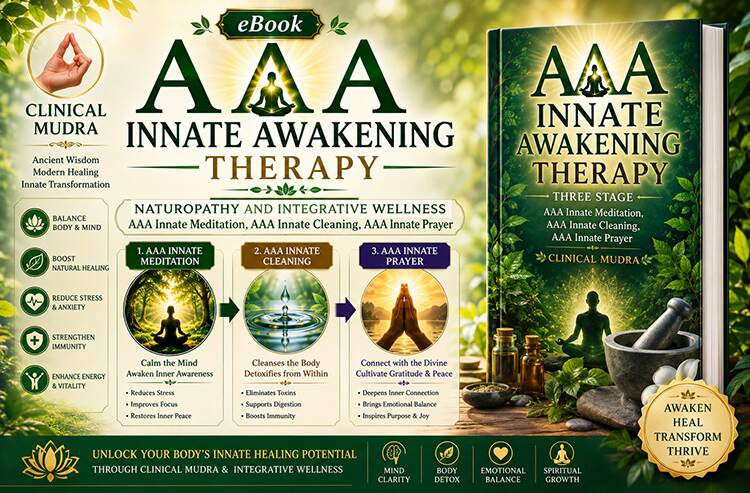
AAA INNATE AWAKENING THERAPY eBOOK
A Comprehensive Guide to Inner Awareness, Clinical Mudra Naturopathy & Integrative Wellness
PART I — THE FOUNDATION
- The Need for Inner Awakening
- What Is AAA Innate Awakening Therapy?
- The Philosophy of Innate Awakening
- Whole-Person Wellness
- The Seven Pillars of Integrative Wellness
- Understanding Clinical Mudra Naturopathy
The source appropriately distinguishes traditional concepts of Prana and energy pathways from established biomedical physiology. That distinction should remain throughout the book.
PART II — THE AAA DAILY JOURNEY
Chapter 7 — The 42-Minute Framework
14 + 14 + 14 = 42 Minutes
Stage One — AAA Innate Meditation
Stage Two — AAA Innate Cleaning
Stage Three — AAA Innate Prayer
The 42 minutes should be presented as a practical organizational framework, not as a scientifically prescribed therapeutic dose. The source explicitly makes this distinction and emphasizes sustainable consistency over strict timing.
Preparation for Practice
- Physical environment
- Personal preparation
- Mental preparation
- Posture
- Natural breathing
- Safety
- Individual adaptation
The source recommends a quiet, clean, ventilated environment, comfortable clothing, relaxed posture, minimal interruption, and practice according to individual physical ability.
PART III — THE THREE-STAGE AAA PROTOCOL
Chapter 8 — AAA Innate Meditation
Calm • Observe • Become Present
Expanded sections:
- Purpose of meditation
- Preparation
- Relaxation
- Conscious breathing
- Guided meditation
- Clinical Mudra Naturopathy
- Visualization
- Therapeutic music
- Mindful observation
- Closing transition
- Complete 14-minute practice
- Reflection questions
The existing source already establishes this integrated sequence.
Chapter 9 — AAA Innate Cleaning
Reflect • Understand • Renew
Expanded sections:
- What “Cleaning” means
- Emotional awareness
- Recognising stress
- Reflective self-observation
- Guided reflection
- Journaling
- Conscious breathing
- Mudras
- Visualization
- Emotional resilience
- Complete 14-minute practice
- Reflection questions
A critical editorial principle: “Cleaning” must never be presented as literal detoxification, removal of toxins, negative energy, or disease. The source explicitly defines it as psychological reflection and emotional renewal.
Chapter 10 — AAA Innate Prayer
Gratitude • Compassion • Stillness • Meaning
Expanded sections:
- The meaning of prayer
- Gratitude
- Reflection
- Positive affirmations
- Universal spirituality
- Silent contemplation
- Loving-kindness
- Mudras
- Inner peace
- Personal meaning
- Closing practice
- Complete 14-minute sequence
The source frames prayer inclusively—as an opportunity for gratitude, compassion, self-awareness, and alignment with personal values rather than as a narrowly religious requirement.
PART IV — THE 13 MUDRAS
This should become one of the most substantial sections of the book.
Each mudra gets its own chapter:
- Jnana / Gyan Mudra
- Chin Mudra
- Anjali Mudra
- Prana Mudra
- Apana Mudra
- Prithvi Mudra
- Varuna Mudra
- Vayu Mudra
- Surya Mudra
- Shunya Mudra
- Hridaya Mudra
- Vishnu Mudra
- Shakti Mudra
And each chapter follows the same professional template:
Meaning
↓
Traditional Context
↓
Hand Position
↓
How to Practise
↓
Breath Integration
↓
Attention / Awareness
↓
AAA Stage
↓
Duration
↓
Reflection
↓
Safety & Individual Adaptation
↓
Responsible Wellness Note
This consistency will make the manual feel much more like a professionally designed methodology.
PART V — THE SUPPORTING PRACTICES
Chapter 24 — Conscious Breathing
Chapter 25 — Relaxation
Chapter 26 — Visualization
Chapter 27 — Therapeutic Music
Chapter 28 — Gratitude
Chapter 29 — Positive Affirmations
Chapter 30 — Reflective Awareness
Chapter 31 — Journaling
Chapter 32 — Loving-Kindness
These should not appear as disconnected techniques. They should continually be shown as supporting components of the three-stage AAA journey.
The source identifies conscious breathing, meditation, relaxation, visualization, reflective awareness, gratitude, and positive intention as the core complementary practices integrated into the 42-minute framework.
PART VI — AAA & INTEGRATIVE WELLNESS
Chapter 33 — Stress Management
Chapter 34 — Emotional Wellness
Chapter 35 — Healthy Lifestyle Habits
Chapter 36 — Nutrition & Nourishment
Chapter 37 — Sleep & Rest
Chapter 38 — Physical Activity & Movement
Chapter 39 — Preventive Healthcare
Chapter 40 — Nature & Environment
Chapter 41 — Positive Psychology & Resilience
This section can connect AAA with broader wellness without claiming that AAA itself treats diseases. The source already describes integrative wellness as combining healthy behaviors and complementary practices with evidence-based healthcare.
PART VII — EVERYDAY AAA
This is where the book becomes more transformational rather than merely instructional.
Awareness While Eating
Awareness While Walking
Awareness While Working
Awareness While Speaking
Awareness While Listening
Awareness in Relationships
Awareness During Difficult Emotions
Awareness in Decision-Making
Awareness Before Sleep
The central message:
Awareness is not limited to 42 minutes.
The 42 minutes are where we practise it.
Life is where we live it.
PART VIII — PRACTICAL TRAINING MANUAL
This should be retained because the existing source already contains a dedicated training component.
Chapter 42 — Learning AAA
Chapter 43 — Developing Personal Practice
Chapter 44 — Learning the Mudras
Chapter 45 — Teaching the Three Stages
Chapter 46 — Communication Skills
Chapter 47 — Individual Sessions
Chapter 48 — Group Sessions
Chapter 49 — Wellness-Education Settings
Chapter 50 — Documentation & Progress Monitoring
Chapter 51 — Professional Boundaries
The source explicitly describes this training section as being for students, wellness practitioners, educators, and healthcare professionals, while emphasizing competency, safety, ethics, and working within professional qualifications.
PART IX — CLINICAL & COMMUNITY INTEGRATION
Chapter 52 — Participant Assessment
Chapter 53 — Wellness Goal Setting
Chapter 54 — Individualized Practice
Chapter 55 — Stress-Management Programs
Chapter 56 — Workplace Wellness
Chapter 57 — Community Wellness
Chapter 58 — Healthy Ageing
Chapter 59 — Interdisciplinary Collaboration
Chapter 60 — Referral & Professional Care
This is an important differentiator. AAA can be presented as a structured complementary wellness framework that can sit alongside appropriate professional care—not as an alternative healthcare system. The source strongly emphasizes patient-centered care, individualized assessment, ethics, referral, and interdisciplinary collaboration.
PART X — THE INNER AWAKENING JOURNEY
This becomes the philosophical heart of the book.
Observe
Become aware of what is happening.
Accept
Meet your experience without unnecessary resistance.
Cleanse
Reflect, process, and create emotional space.
Become Still
Allow moments of quiet awareness.
Awaken
Develop deeper understanding of yourself.
Live Well
Carry that awareness into everyday life.
PART XI — 7, 21 & 42-DAY JOURNEYS
7-Day Introduction
Learning to Observe
21-Day Practice
Building Consistency
42-Day Journey
Deepening Awareness
Each day can include:
Morning Practice
Evening Reflection
Night Gratitude
One Awareness Question
One Affirmation
This would make the book not only something to read, but something the reader can actually practise.
PART XII — RESPONSIBLE WELLNESS
This section should be substantial rather than a short disclaimer.
What AAA Is
What AAA Is Not
Complementary vs. Medical Care
Safety
Contraindications & Adaptation
When to Stop
When to Seek Professional Help
Mental-Health Boundaries
Practitioner Ethics
Informed Participation
Evidence and Traditional Knowledge
The source repeatedly emphasizes that AAA complements rather than replaces evidence-based healthcare and that practitioners must recognize when referral is appropriate.
PART XIII — REFERENCE MATERIAL
Comprehensive FAQ
Daily Practice Checklist
Mudra Quick Reference
42-Minute Quick Reference
Morning Practice Script
Evening Practice Script
Night Practice Script
Reflection Worksheets
Gratitude Journal
Weekly Review
Practitioner Checklist
Closing Message
The final book architecture
The overall journey becomes:
UNDERSTAND
AAA philosophy
↓
PREPARE
Create the right environment
↓
PRACTISE
42-minute daily framework
↓
DEEPEN
Mudras + breath + meditation + reflection
↓
INTEGRATE
Lifestyle + nature + emotional wellness
↓
TRAIN
Learn to practise and facilitate responsibly
↓
AWAKEN
Develop deeper self-awareness
↓
LIVE
Carry awareness into everyday life
OBSERVE • ACCEPT • CLEANSE • BECOME STILL • AWAKEN • LIVE WELL
AAA Innate Awakening Therapy
Unlocking the Body’s Innate Healing Potential Through Clinical Mudra Naturopathy and Integrative Wellness
A Comprehensive Professional Manual for Clinical Mudra Naturopathy, Mind–Body Wellness, and Integrative Self-Care
By
Mani Gandhi
Founder, AAA Center
Copyright
© 2026 Mani Gandhi. All Rights Reserved.
No part of this publication may be reproduced, stored in a retrieval system, or transmitted in any form or by any means—including electronic, mechanical, photocopying, recording, or otherwise—without prior written permission from the copyright holder, except for brief quotations used in reviews or scholarly works as permitted by applicable copyright law.
This publication is intended for educational and informational purposes only.
The views, concepts, and wellness practices presented in this book reflect the author’s professional approach to complementary wellness and Clinical Mudra Naturopathy.
Dedication
This book is lovingly dedicated to all seekers of health, wisdom, and inner peace.
May every individual discover the remarkable capacity of the human body and mind to cultivate balance, resilience, and well-being through conscious living, compassionate service, and lifelong learning.
May this work inspire healthcare professionals, wellness practitioners, educators, researchers, and individuals around the world to embrace a holistic vision of health that honors both scientific inquiry and the timeless wisdom of traditional healing practices.
Acknowledgements
The development of AAA Innate Awakening Therapy has been inspired by years of study, observation, reflection, and practical experience in holistic wellness.
I express my sincere gratitude to my family, mentors, colleagues, students, and well-wishers whose encouragement and support made this work possible.
I also acknowledge the contributions of researchers, healthcare professionals, and scholars in the fields of naturopathy, lifestyle medicine, psychology, neuroscience, mindfulness, yoga, and integrative health, whose work continues to expand our understanding of the remarkable relationship between the body, mind, and human well-being.
Finally, I extend my heartfelt appreciation to every learner and practitioner who continues to explore healthier ways of living and contributes to building a more compassionate and wellness-oriented society.
Foreword
Healthcare is evolving beyond the treatment of disease toward a broader understanding of prevention, resilience, and whole-person well-being. Around the world, increasing attention is being given to integrative approaches that combine evidence-informed lifestyle practices with conventional healthcare to support long-term health.
AAA Innate Awakening Therapy presents a structured framework that integrates Clinical Mudra Naturopathy, meditation, breathing practices, visualization, relaxation, and gratitude-based reflection into a practical daily routine. Rather than presenting isolated techniques, it organizes complementary wellness practices into a coherent model that encourages consistency, self-awareness, and healthy habits.
This manual is intended to serve as an educational resource for healthcare professionals, wellness practitioners, students, researchers, and individuals interested in holistic well-being. Readers are encouraged to evaluate the concepts presented with an open and critical mindset, integrating them responsibly within appropriate professional and personal contexts.
By emphasizing self-care, preventive wellness, and lifelong learning, this work contributes to the ongoing dialogue between traditional healing knowledge and contemporary health sciences.
Preface
Health is more than the absence of illness. It is a dynamic state of physical vitality, emotional balance, mental clarity, social connection, and personal meaning.
The inspiration for AAA Innate Awakening Therapy arose from a simple question:
How can individuals cultivate sustainable daily practices that support their natural capacity for well-being?
This manual is an attempt to answer that question through a structured, practical, and integrative approach.
The therapy is centered on a daily 42-minute routine consisting of three interconnected stages:
- AAA Innate Meditation — cultivating calm awareness and mental focus.
- AAA Innate Cleaning — encouraging emotional balance and reflective renewal.
- AAA Innate Prayer — fostering gratitude, peaceful reflection, and inner integration.
Together, these practices combine elements of Clinical Mudra Naturopathy with breathing exercises, guided relaxation, visualization, and mindful reflection to encourage healthy lifestyle habits.
This book does not claim to offer a universal solution to disease or replace established medical care. Instead, it invites readers to explore complementary wellness practices that may contribute to overall well-being while working alongside appropriate medical guidance.
It is my hope that this manual will encourage thoughtful practice, continued learning, and meaningful collaboration among healthcare professionals, educators, researchers, and wellness practitioners.
How to Use This Book
This manual has been designed as both a learning resource and a practical reference.
Readers may approach the material according to their interests and professional needs.
General Readers
- Begin with Parts I and III to understand the philosophy and daily practice.
- Follow the recommended 42-minute wellness routine.
- Maintain a personal practice journal.
Students
- Study the theoretical foundations before practicing the techniques.
- Review the chapter summaries and reflection questions.
- Use the appendices for revision.
Healthcare and Wellness Practitioners
- Explore the clinical foundations and integrative wellness framework.
- Consider how complementary practices may support patient education and lifestyle improvement within your professional scope.
- Adapt wellness recommendations responsibly and ethically.
Educators and Trainers
- Use the structured chapters as the basis for workshops, seminars, and training programs.
- Encourage evidence-informed discussion and practical application.
Throughout the book, icons, tables, practice guides, and summaries help readers navigate key concepts efficiently.
List of Figures and Tables
Figures
- The AAA Innate Awakening Therapy Framework
- The Three-Stage Daily Wellness Model
- The Mind–Body–Lifestyle Integration Model
- The 42-Minute Daily Practice Cycle
- Clinical Mudra Practice Flow
- Stress and Relaxation Response Overview
- Integrative Wellness Framework
- Daily Practice Timeline
- Self-Care Continuum
- Holistic Wellness Dimensions
Tables
- Daily Practice Schedule
- Stage-by-Stage Objectives
- Meditation Components
- Therapeutic Breathing Practices
- Clinical Mudra Reference Guide
- Visualization Techniques
- Wellness Practice Checklist
- Self-Assessment Guide
- Lifestyle Habit Tracker
- Glossary of Key Terms
Clinical Disclaimer
AAA Innate Awakening Therapy is a complementary wellness and educational program intended to promote healthy lifestyle practices, relaxation, self-awareness, and overall well-being.
The information presented in this manual is not intended to diagnose, treat, cure, or prevent any disease and should not be interpreted as medical advice. Readers should consult qualified healthcare professionals regarding any medical condition, diagnosis, or treatment.
The practices described—including Clinical Mudra Naturopathy, meditation, breathing exercises, visualization, relaxation techniques, and reflective practices—are intended to complement, not replace, conventional healthcare. Individual experiences may vary, and no specific health outcomes are guaranteed.
Healthcare professionals who incorporate elements of this framework into their work should do so within the scope of their professional training, applicable regulations, and ethical standards.
Readers are encouraged to practice the techniques responsibly, adapt them to their individual circumstances, and seek appropriate medical guidance whenever necessary.
PART I
Foundations of Innate Awakening Therapy
Building the Scientific, Philosophical, and Practical Framework for Holistic Wellness
Introduction
Every meaningful system of healthcare begins with a clear understanding of the principles upon which it is built. Before exploring specific therapeutic techniques or clinical applications, it is essential to understand the philosophy, scientific foundations, and wellness principles that guide the practice of AAA Innate Awakening Therapy.
Part I establishes this foundation. It introduces the evolving landscape of modern healthcare, examines the growing impact of lifestyle-related health challenges, and explores why preventive, person-centered, and integrative approaches have become increasingly important in promoting long-term well-being.
The central philosophy of AAA Innate Awakening Therapy is that every individual possesses an inherent capacity to maintain balance, adapt to change, and support healthy functioning through appropriate lifestyle practices. This concept of innate healing potential does not suggest that the body can overcome all illness independently; rather, it recognizes the remarkable biological processes that continually work to regulate, repair, and sustain health. When supported by healthy behaviors, appropriate medical care, and a balanced lifestyle, these natural processes contribute significantly to overall well-being.
Modern health challenges are rarely caused by a single factor. Physical inactivity, poor nutrition, inadequate sleep, chronic stress, environmental influences, emotional strain, and social circumstances often interact to affect health over time. Addressing these complex influences requires a broader perspective—one that considers the whole person rather than isolated symptoms.
AAA Innate Awakening Therapy embraces this holistic perspective by integrating complementary wellness practices, including:
- Clinical Mudra Naturopathy
- Conscious breathing techniques
- Guided meditation
- Relaxation practices
- Positive visualization
- Reflective self-awareness
- Gratitude-based reflection
- Healthy lifestyle education
These complementary practices are organized into a structured daily routine that encourages consistency, self-awareness, and personal responsibility for health. The program is intended to complement—not replace—evidence-based medical care and should be practiced alongside appropriate guidance from qualified healthcare professionals.
Throughout this part, readers will explore how traditional wellness concepts can be thoughtfully integrated with contemporary knowledge from lifestyle medicine, psychology, neuroscience, stress physiology, and preventive healthcare. The goal is to build a balanced understanding that respects both established scientific evidence and the potential value of complementary wellness practices.
Objectives of Part I
By the end of this section, readers will be able to:
- Understand the need for a modern, preventive approach to health and wellness.
- Explain the philosophy and guiding principles of AAA Innate Awakening Therapy.
- Describe the concept of innate healing potential within the context of contemporary health science.
- Recognize the influence of lifestyle, stress, and behavior on long-term health.
- Understand the role of Clinical Mudra Naturopathy within an integrative wellness framework.
- Appreciate the importance of self-care, mindfulness, and healthy daily habits as complementary components of overall well-being.
- Establish a strong conceptual foundation for the practical techniques and clinical applications presented in later chapters.
Chapter 1
The Need for a New Wellness Paradigm
1.1 Modern lifestyle diseases
1.2 Stress and chronic health challenges
1.3 Preventive healthcare
1.4 Integrative wellness
1.5 Why self-care matters
Chapter 1
The Need for a New Wellness Paradigm
“Health is not simply the absence of disease—it is the dynamic harmony of body, mind, emotions, lifestyle, and purpose.”
Chapter Introduction
The world has entered a new era of healthcare. Scientific discoveries, medical technology, improved sanitation, vaccination, and advances in clinical medicine have dramatically increased life expectancy and transformed the management of many diseases. Despite these achievements, humanity faces an equally significant challenge: the rapid increase in chronic, lifestyle-related illnesses and mental health concerns.
Modern life has brought unprecedented convenience and connectivity, but it has also introduced sedentary lifestyles, unhealthy dietary habits, chronic stress, sleep deprivation, environmental pressures, and social isolation. These factors collectively influence physical, mental, and emotional well-being, contributing to the growing burden of non-communicable diseases.
The emerging healthcare paradigm recognizes that long-term health cannot depend solely on diagnosing and treating illness after it develops. Instead, sustainable wellness requires a proactive approach that emphasizes prevention, healthy daily habits, emotional resilience, and personal responsibility for health.
AAA Innate Awakening Therapy has been developed within this broader vision of integrative wellness. It combines Clinical Mudra Naturopathy, mindful breathing, meditation, relaxation, visualization, reflective awareness, and gratitude practices into a structured daily routine designed to support overall well-being. The program is intended as a complementary wellness approach that works alongside—not in place of—professional medical care.
This chapter introduces the need for a new wellness paradigm and explores five essential themes that provide the foundation for the entire AAA Innate Awakening Therapy framework.
1.1 Modern Lifestyle Diseases
The pattern of global disease has changed considerably over the past century. While infectious diseases remain important, chronic non-communicable diseases have become the leading causes of illness, disability, and premature death in many parts of the world.
Lifestyle diseases develop gradually through the interaction of genetics, behavior, environment, and social influences. Common examples include cardiovascular disease, hypertension, type 2 diabetes, obesity, metabolic syndrome, chronic musculoskeletal disorders, sleep disturbances, anxiety, depression, and certain forms of cancer associated with lifestyle and environmental risk factors.
Several characteristics of modern living contribute to these conditions:
- Reduced physical activity and prolonged sitting
- Highly processed and energy-dense diets
- Chronic psychological stress
- Inadequate sleep
- Tobacco and harmful substance use
- Environmental pollution
- Digital overexposure and reduced time in nature
- Social isolation and work-life imbalance
Many lifestyle diseases progress silently for years before symptoms become apparent. Consequently, prevention, early detection, and healthy lifestyle modification have become central priorities in contemporary healthcare.
AAA Innate Awakening Therapy recognizes that daily habits play an important role in supporting long-term wellness. Through consistent self-care practices, individuals can cultivate healthier routines that complement appropriate medical guidance and contribute to improved quality of life.
1.2 Stress and Chronic Health Challenges
Stress is an essential biological mechanism that enables the body to respond to challenges. In the short term, it enhances alertness and helps individuals adapt to changing circumstances. However, when stress becomes persistent, it can influence physical health, emotional well-being, cognitive performance, sleep quality, and health-related behaviors.
Long-term stress may contribute to:
- Fatigue and reduced energy
- Difficulty concentrating
- Emotional exhaustion
- Poor sleep quality
- Irritability and mood disturbances
- Reduced resilience
- Unhealthy lifestyle choices
- Lower overall quality of life
Stress also influences how individuals care for themselves. During periods of prolonged stress, people may exercise less, consume less nutritious foods, neglect sleep, or postpone preventive healthcare.
AAA Innate Awakening Therapy incorporates complementary stress-management practices such as conscious breathing, Clinical Mudra Naturopathy, meditation, visualization, relaxation exercises, reflective awareness, and gratitude practices. These techniques are intended to encourage relaxation, improve self-awareness, and help individuals develop healthier responses to everyday stress.
Managing stress effectively requires a combination of healthy lifestyle habits, supportive relationships, professional healthcare when needed, and regular opportunities for rest and reflection.
1.3 Preventive Healthcare
Preventive healthcare represents a shift from reacting to illness toward actively promoting health before disease develops or progresses. Rather than focusing exclusively on treatment, preventive healthcare encourages individuals and communities to adopt habits that support lifelong well-being.
Preventive healthcare includes:
- Balanced nutrition
- Regular physical activity
- Healthy body weight
- Adequate sleep
- Stress management
- Routine medical check-ups
- Appropriate health screening
- Vaccination where recommended
- Avoidance of tobacco and harmful substances
- Health education and informed decision-making
Healthcare professionals provide clinical expertise, diagnosis, and treatment, while individuals contribute by making informed daily choices that support health. This partnership is fundamental to modern wellness.
AAA Innate Awakening Therapy aligns with preventive healthcare by promoting a structured daily routine that encourages mindfulness, relaxation, emotional balance, and healthy lifestyle habits. The emphasis is on consistency, recognizing that small daily actions often have a greater long-term impact than occasional intensive efforts.
1.4 Integrative Wellness
Health is influenced by much more than physical symptoms alone. Biological, psychological, emotional, social, environmental, and lifestyle factors continually interact to shape overall well-being.
Integrative wellness embraces this broader understanding by combining evidence-based conventional healthcare with appropriate complementary practices that are used responsibly and ethically. It values collaboration among healthcare professionals while encouraging individuals to participate actively in maintaining their health.
The principles of integrative wellness include:
- Whole-person care
- Prevention and health promotion
- Respect for individual needs and values
- Healthy lifestyle behaviors
- Mind-body awareness
- Patient education
- Professional collaboration
- Evidence-informed complementary practices
Within AAA Innate Awakening Therapy, these principles are reflected through the integration of:
- Clinical Mudra Naturopathy
- Conscious breathing
- Guided meditation
- Relaxation techniques
- Visualization
- Reflective awareness
- Positive affirmations
- Gratitude practices
These complementary practices are organized into a practical 42-minute daily routine that supports relaxation, emotional balance, mindfulness, and personal well-being. They are intended to complement—not replace—professional medical care.
1.5 Why Self-Care Matters
Self-care is the intentional practice of supporting one’s physical, emotional, mental, and social well-being through healthy daily habits and informed personal choices. It is not a luxury but a fundamental component of lifelong health.
Effective self-care includes:
- Eating a balanced diet
- Engaging in regular physical activity
- Maintaining healthy sleep habits
- Managing stress constructively
- Practicing relaxation and mindfulness
- Building supportive relationships
- Taking time for reflection and gratitude
- Seeking professional healthcare when appropriate
- Continuing health education throughout life
Consistent self-care helps individuals become active participants in their own wellness journey. Small, sustainable habits practiced every day often produce greater long-term benefits than short periods of intensive effort.
AAA Innate Awakening Therapy is built upon this principle. Its three-stage daily practice—AAA Innate Meditation, AAA Innate Cleaning, and AAA Innate Prayer—encourages individuals to dedicate time each day to relaxation, emotional renewal, and mindful reflection. By combining Clinical Mudra Naturopathy with breathing exercises, meditation, visualization, and gratitude practices, the program seeks to cultivate healthier routines that support overall well-being.
The ultimate goal is not simply to reduce stress or improve daily habits but to encourage a balanced lifestyle in which physical vitality, emotional resilience, mental clarity, and personal purpose develop together.
Chapter Summary
The increasing prevalence of lifestyle-related diseases demonstrates that health is shaped not only by genetics and medical care but also by everyday choices, environmental influences, and emotional well-being. Modern healthcare therefore requires a broader perspective that integrates disease prevention, healthy lifestyle practices, and personal responsibility alongside high-quality clinical care.
This chapter introduced five essential pillars of the new wellness paradigm: understanding modern lifestyle diseases, recognizing the effects of chronic stress, embracing preventive healthcare, adopting an integrative approach to wellness, and practicing consistent self-care. Together, these principles provide the conceptual foundation for AAA Innate Awakening Therapy.
As a complementary wellness framework, AAA Innate Awakening Therapy encourages individuals to integrate Clinical Mudra Naturopathy, conscious breathing, meditation, relaxation, visualization, reflective awareness, and gratitude into a structured daily routine. By promoting consistency, mindfulness, and healthy living, the program supports individuals in taking an active role in maintaining their well-being while continuing to benefit from evidence-based medical care and professional healthcare guidance.
The next chapter explores the philosophy of innate healing, examining how the body’s natural processes of adaptation, regulation, and resilience form the conceptual foundation of AAA Innate Awakening Therapy.
Chapter 2
The Philosophy of Innate Healing
2.1 Understanding innate intelligence
2.2 Homeostasis and self-regulation
2.3 The body’s healing capacity
2.4 Ancient healing traditions
2.5 Modern scientific perspectives
Chapter 2
The Philosophy of Innate Healing
Understanding the Body’s Natural Capacity for Balance, Adaptation, and Well-being
“The human body is constantly working to maintain balance, adapt to change, and support health. Innate healing is the recognition and support of these natural biological processes through healthy living, appropriate medical care, and complementary wellness practices.”
Chapter Introduction
Throughout history, cultures around the world have recognized that the human body possesses remarkable mechanisms for maintaining health and recovering from illness. Whether described as the body’s healing intelligence, self-regulating capacity, or natural resilience, this concept reflects the observation that the body is continually adapting to internal and external changes.
Modern biomedical science explains these processes through physiology, homeostasis, tissue repair, immune function, neuroplasticity, and other mechanisms that sustain life. Traditional healing systems have expressed similar ideas using different philosophical frameworks, emphasizing harmony between the individual, nature, and the environment.
Within AAA Innate Awakening Therapy, the philosophy of innate healing does not imply that the body can overcome every disease independently or that medical care is unnecessary. Rather, it recognizes that the body’s natural regulatory systems function continuously and that healthy lifestyle practices may support these processes. The therapy is therefore presented as a complementary wellness approach that works alongside evidence-based healthcare to encourage relaxation, self-awareness, healthy behaviors, and overall well-being.
This chapter explores the philosophy of innate healing by examining biological self-regulation, traditional concepts of healing, and contemporary scientific understanding.
Learning Objectives
After completing this chapter, readers will be able to:
- Explain the concept of innate intelligence within a wellness framework.
- Describe the role of homeostasis and self-regulation in maintaining health.
- Understand the body’s natural healing processes.
- Appreciate the contributions of ancient healing traditions to holistic health.
- Examine how modern scientific perspectives complement traditional wellness concepts.
2.1 Understanding Innate Intelligence
The term innate intelligence refers to the body’s inherent capacity to organize, regulate, and coordinate countless physiological processes necessary for life. Every second, millions of biological activities occur automatically without conscious effort. The heart beats rhythmically, the lungs exchange oxygen and carbon dioxide, hormones regulate metabolism, immune cells respond to infection, and damaged tissues begin repair.
These coordinated processes are directed by complex interactions among the nervous, endocrine, immune, cardiovascular, respiratory, and musculoskeletal systems. Together they help the body maintain stability while adapting to changing conditions.
Within AAA Innate Awakening Therapy, innate intelligence is understood as the body’s natural ability to strive toward balance when supported by healthy nutrition, restorative sleep, physical activity, stress management, emotional well-being, and appropriate healthcare. Complementary practices such as mindful breathing, meditation, Clinical Mudra Naturopathy, and relaxation are intended to encourage self-awareness and healthy lifestyle behaviors rather than replace medical treatment.
Recognizing innate intelligence encourages individuals to view health as an active process that can be supported through informed daily choices.
2.2 Homeostasis and Self-Regulation
One of the most important concepts in modern physiology is homeostasis—the body’s ability to maintain a stable internal environment despite continual changes in the external world.
Examples include maintaining:
- Body temperature
- Blood glucose levels
- Blood pressure
- Fluid and electrolyte balance
- Oxygen and carbon dioxide levels
- Acid-base balance
- Hormonal regulation
Homeostasis depends upon highly coordinated communication between the nervous system, endocrine system, immune system, kidneys, cardiovascular system, and other organs. When changes occur, feedback mechanisms work continuously to restore balance.
Self-regulation extends beyond physical physiology. Humans also develop emotional, behavioral, and psychological self-regulation through learning, reflection, healthy habits, and supportive relationships.
AAA Innate Awakening Therapy seeks to encourage this broader concept of self-regulation by incorporating structured practices that promote relaxation, mindful awareness, gratitude, and emotional reflection. These practices may help individuals develop healthier responses to everyday stress while complementing established medical care.
2.3 The Body’s Healing Capacity
The human body possesses remarkable mechanisms for repair, adaptation, and recovery. Following injury or illness, numerous biological systems become active to support healing. Blood clotting prevents excessive bleeding, immune cells respond to infection, damaged tissues begin repair, and bones remodel after fractures. Even the brain demonstrates a degree of adaptability through neuroplasticity, enabling learning and functional changes throughout life.
Healing, however, is influenced by many factors, including:
- Age
- Genetics
- Nutrition
- Sleep quality
- Physical activity
- Emotional well-being
- Environmental conditions
- Access to healthcare
- Appropriate medical treatment
No complementary practice can replace these biological realities or eliminate the need for professional healthcare. Instead, healthy lifestyle behaviors may create conditions that support the body’s normal physiological functions.
Within AAA Innate Awakening Therapy, the daily practices of meditation, breathing, relaxation, Clinical Mudra Naturopathy, visualization, and gratitude are intended to encourage emotional balance, stress reduction, and consistent self-care. These practices may contribute to overall well-being when integrated responsibly into a healthy lifestyle.
2.4 Ancient Healing Traditions
Across civilizations, healing traditions have emphasized harmony between the individual, nature, and the wider environment. Although their languages and conceptual models differ, many traditional systems share common themes:
- Health is viewed as a state of balance.
- Lifestyle influences long-term well-being.
- Prevention is preferable to treatment.
- The mind and body are interconnected.
- Daily habits shape physical and emotional health.
Traditional systems such as Ayurveda, Siddha, Traditional Chinese Medicine, and various contemplative traditions have historically incorporated breathing practices, meditation, movement, dietary guidance, and hand gestures or mudras as part of broader approaches to health.
AAA Innate Awakening Therapy draws inspiration from these traditions while presenting its practices within a modern complementary wellness framework. It does not claim to reproduce any single historical system in its entirety but instead integrates selected principles that encourage mindfulness, relaxation, and healthy living.
Readers are encouraged to appreciate these traditions for their historical and cultural significance while also recognizing the importance of scientific evaluation and responsible clinical practice.
2.5 Modern Scientific Perspectives
Contemporary health science increasingly recognizes that health is influenced by complex interactions among biological, psychological, social, behavioral, and environmental factors. Research in fields such as lifestyle medicine, psychology, neuroscience, psychoneuroimmunology, sleep science, and public health has strengthened our understanding of how daily behaviors affect long-term well-being.
Current evidence supports the importance of:
- Regular physical activity
- Balanced nutrition
- Adequate sleep
- Stress management
- Social connection
- Mindfulness-based practices
- Healthy emotional regulation
- Preventive healthcare
Some complementary practices—including meditation and certain mindfulness-based interventions—have been studied for their potential to support stress reduction, emotional well-being, and quality of life in specific populations. However, the strength of evidence varies depending on the practice and the health outcome being considered.
AAA Innate Awakening Therapy encourages an evidence-informed approach. Its methods are intended to complement conventional healthcare by promoting healthy routines, relaxation, and personal engagement in wellness. Ongoing research is essential to further evaluate the effects of specific complementary interventions, including Clinical Mudra Naturopathy, within appropriate scientific and clinical settings.
Integrating Philosophy and Practice
The philosophy of innate healing serves as the foundation for the practical techniques presented throughout this manual. It encourages individuals to respect both the remarkable biological capabilities of the human body and the essential role of evidence-based healthcare.
The goal is neither to reject modern medicine nor to rely solely on traditional practices. Instead, AAA Innate Awakening Therapy advocates a balanced perspective in which healthy lifestyle choices, complementary wellness practices, and professional medical care work together to support lifelong well-being.
Chapter Highlights
- Innate intelligence describes the body’s natural capacity to regulate and coordinate essential physiological processes.
- Homeostasis maintains internal stability through continuous biological self-regulation.
- Healing depends on complex biological mechanisms influenced by lifestyle, environment, genetics, and appropriate medical care.
- Ancient healing traditions emphasized balance, prevention, and the interconnectedness of body and mind.
- Modern science supports the importance of healthy lifestyle behaviors and continues to investigate complementary wellness practices.
- AAA Innate Awakening Therapy integrates complementary practices within an evidence-informed framework intended to support, not replace, conventional healthcare.
Reflection Questions
- How does understanding the body’s natural regulatory systems influence your view of health?
- Which daily habits best support your body’s capacity for adaptation and recovery?
- How can traditional wellness principles be integrated responsibly with modern healthcare?
- What role does self-awareness play in maintaining physical and emotional well-being?
- How can complementary wellness practices contribute to a comprehensive approach to health while respecting scientific evidence?
Chapter Summary
The philosophy of innate healing recognizes the body’s remarkable ability to regulate, adapt, and maintain internal balance through complex biological processes. Modern physiology explains these functions through homeostasis, immune regulation, tissue repair, and neuroplasticity, while many traditional healing systems have long emphasized harmony, prevention, and balanced living. AAA Innate Awakening Therapy brings these perspectives together by encouraging evidence-informed lifestyle practices—including Clinical Mudra Naturopathy, meditation, breathing exercises, relaxation, visualization, and gratitude—as complementary tools for promoting overall well-being. Grounded in both traditional wisdom and contemporary health science, this philosophy forms the conceptual foundation for the practical methods explored in the chapters that follow.
Chapter 3
Origins of AAA Innate Awakening Therapy
3.1 Development of the AAA model
3.2 Vision and objectives
3.3 Clinical Mudra Naturopathy
3.4 Integrative wellness philosophy
3.5 Scope of the therapy
Chapter 3
Origins of AAA Innate Awakening Therapy
Integrating Clinical Mudra Naturopathy, Preventive Healthcare, and Holistic Wellness into a Contemporary Complementary Wellness Framework
“Every lasting wellness system begins with a clear purpose: to empower individuals to participate actively in their own health through knowledge, awareness, and consistent daily practice.”
Chapter Introduction
Healthcare is evolving from a predominantly disease-centered model toward one that emphasizes prevention, lifestyle modification, patient education, and whole-person care. While conventional medicine remains indispensable for diagnosing and treating disease, there is growing recognition that healthy daily behaviors, stress management, emotional resilience, and mindful living also contribute significantly to long-term well-being.
Within this evolving landscape, AAA Innate Awakening Therapy was developed as a structured complementary wellness framework. It brings together principles of Clinical Mudra Naturopathy, meditation, conscious breathing, relaxation, visualization, reflective awareness, and gratitude practices into a practical daily routine designed to encourage healthy living and personal responsibility for wellness.
The therapy does not seek to replace established medical care. Instead, it provides an organized approach to self-care that complements evidence-based healthcare and supports individuals in cultivating healthier habits and greater self-awareness.
This chapter explores the origins of the AAA model, its guiding vision, the principles of Clinical Mudra Naturopathy, its integrative wellness philosophy, and the scope of its application.
Learning Objectives
After completing this chapter, readers will be able to:
- Understand the development of the AAA Innate Awakening Therapy model.
- Describe the vision and objectives of the therapy.
- Explain the principles of Clinical Mudra Naturopathy.
- Understand the integrative wellness philosophy underlying the program.
- Recognize the intended scope and limitations of the therapy as a complementary wellness approach.
3.1 Development of the AAA Model
AAA Innate Awakening Therapy emerged from the recognition that many individuals seek practical, sustainable methods to improve their overall well-being while complementing conventional healthcare. The model was developed to organize a range of complementary wellness practices into a simple, structured, and repeatable daily routine.
The letters AAA represent three core values:
- Anbu (Love) – cultivating compassion, kindness, and respect for oneself and others.
- Amaithi (Peace) – developing inner calm, emotional balance, and harmonious living.
- Anandham (Joy) – fostering positive well-being, gratitude, and purposeful living.
These principles provide the ethical and philosophical foundation of the therapy. Rather than viewing health solely as the absence of disease, the AAA model defines wellness as the harmonious integration of physical vitality, emotional resilience, mental clarity, social connection, and meaningful living.
The therapy organizes complementary practices into a 42-minute daily wellness routine, consisting of:
- AAA Innate Meditation – encouraging calm awareness and mental focus.
- AAA Innate Cleaning – promoting emotional reflection and stress management.
- AAA Innate Prayer – cultivating gratitude, inner peace, and personal meaning.
By emphasizing consistency over complexity, the model seeks to make holistic self-care accessible to individuals from diverse backgrounds and levels of experience.
3.2 Vision and Objectives
Vision
The vision of AAA Innate Awakening Therapy is to promote a culture of preventive health, mindful living, and lifelong wellness by encouraging individuals to participate actively in maintaining their physical, emotional, mental, and social well-being.
The therapy aspires to contribute to healthier communities through education, self-awareness, and responsible complementary wellness practices.
Objectives
The principal objectives of the program include:
- Encouraging healthy daily routines.
- Supporting stress management and relaxation.
- Promoting emotional resilience and self-awareness.
- Integrating Clinical Mudra Naturopathy within a structured wellness framework.
- Complementing preventive healthcare and healthy lifestyle practices.
- Encouraging lifelong learning in holistic wellness.
- Supporting collaboration between conventional healthcare and complementary approaches.
- Promoting ethical, evidence-informed wellness education.
The therapy encourages individuals to take an active role in their own well-being while recognizing the essential role of qualified healthcare professionals in diagnosis and treatment.
3.3 Clinical Mudra Naturopathy
Clinical Mudra Naturopathy is one of the distinguishing features of AAA Innate Awakening Therapy.
Mudras are specific hand positions that have been used in various traditional wellness practices to support focused attention, relaxation, and mindful awareness. Within this program, mudras are integrated with breathing exercises, meditation, relaxation, and visualization to create a comprehensive complementary wellness practice.
The clinical approach emphasizes:
- Simplicity
- Accessibility
- Consistency
- Safety
- Mind-body awareness
- Lifestyle integration
Because mudras require no special equipment and can generally be practiced in many settings, they offer an accessible method for encouraging regular wellness routines.
Within AAA Innate Awakening Therapy, Clinical Mudra Naturopathy is presented as a complementary practice intended to support relaxation, mindfulness, and healthy living. It is not presented as a substitute for evidence-based medical diagnosis or treatment.
3.4 Integrative Wellness Philosophy
AAA Innate Awakening Therapy is based on an integrative understanding of health that recognizes the close relationship between body, mind, emotions, behavior, lifestyle, and environment.
Rather than focusing exclusively on symptoms, the therapy encourages individuals to cultivate overall well-being through consistent daily practices that support healthy living.
The integrative philosophy is founded on several guiding principles:
Whole-Person Wellness
Health includes physical, emotional, mental, social, and personal dimensions that influence one another.
Prevention Before Intervention
Healthy habits established early can contribute to long-term well-being and may reduce the impact of lifestyle-related health risks.
Personal Responsibility
Individuals play an active role in maintaining their health through informed daily choices and regular self-care.
Complementary Care
Complementary wellness practices should be used responsibly alongside professional medical care, not in place of it.
Lifelong Learning
Health is a dynamic process that benefits from continuous education, self-reflection, and adaptation throughout life.
By integrating these principles, AAA Innate Awakening Therapy encourages a balanced approach that values both traditional wellness concepts and contemporary scientific understanding.
3.5 Scope of the Therapy
AAA Innate Awakening Therapy is designed as a complementary wellness and educational program suitable for individuals interested in cultivating healthier lifestyles and improving overall well-being.
The therapy may be incorporated into wellness education, personal self-care routines, community health promotion activities, and complementary wellness programs.
Potential areas of application include:
- Stress management
- Relaxation training
- Mindfulness practice
- Healthy lifestyle education
- Wellness coaching
- Workplace wellness initiatives
- Community wellness programs
- Preventive health promotion
- Personal development
- Healthy ageing support
The therapy is intended to complement—not replace—professional medical care. It does not diagnose, treat, cure, or prevent disease, and individuals with medical or psychological conditions should seek advice from appropriately qualified healthcare professionals.
Healthcare practitioners who choose to incorporate elements of AAA Innate Awakening Therapy into their work should do so within their professional scope of practice, applicable regulations, and ethical responsibilities.
Bringing the Framework Together
The origins of AAA Innate Awakening Therapy reflect a commitment to integrating complementary wellness practices into a coherent and practical framework for daily living. By combining Clinical Mudra Naturopathy with meditation, conscious breathing, relaxation, visualization, reflective awareness, and gratitude, the program offers a structured approach to cultivating healthy habits and mindful self-care.
Its emphasis on prevention, consistency, education, and personal responsibility aligns with contemporary trends in lifestyle medicine and integrative wellness while respecting the essential role of evidence-based healthcare.
Chapter Highlights
- AAA Innate Awakening Therapy was developed as a structured complementary wellness framework that integrates multiple mind-body practices into a practical daily routine.
- The AAA values—Anbu (Love), Amaithi (Peace), and Anandham (Joy)—provide the ethical and philosophical foundation of the model.
- Clinical Mudra Naturopathy combines therapeutic hand mudras with meditation, breathing, relaxation, and visualization to support mindful self-care.
- The therapy embraces an integrative wellness philosophy that emphasizes prevention, whole-person health, personal responsibility, and lifelong learning.
- The program is intended for wellness education, preventive health promotion, stress management, and complementary self-care, while recognizing that conventional medical care remains essential for diagnosis and treatment.
Reflection Questions
- What inspired the development of AAA Innate Awakening Therapy, and how does it respond to contemporary health challenges?
- How do the values of Anbu, Amaithi, and Anandham influence the philosophy of the therapy?
- In what ways does Clinical Mudra Naturopathy contribute to a structured daily wellness routine?
- How can integrative wellness complement conventional healthcare while maintaining scientific and ethical standards?
- How might you incorporate the principles of AAA Innate Awakening Therapy into your personal or professional approach to health promotion?
Chapter Summary
AAA Innate Awakening Therapy was developed to provide a practical, structured, and complementary wellness framework that encourages preventive health, mindful living, and personal responsibility for well-being. Built upon the guiding values of Love, Peace, and Joy, the model integrates Clinical Mudra Naturopathy with meditation, conscious breathing, relaxation, visualization, reflective awareness, and gratitude practices into a sustainable 42-minute daily routine. Its philosophy emphasizes whole-person wellness, prevention, lifelong learning, and collaboration with evidence-based healthcare. By clearly defining its objectives, ethical foundations, and scope of application, AAA Innate Awakening Therapy offers an accessible approach to supporting healthier lifestyles while reinforcing that it is intended to complement—not replace—professional medical care.
PART II
Scientific and Clinical Foundations
Understanding the Biological, Psychological, and Clinical Principles Supporting AAA Innate Awakening Therapy
“A comprehensive wellness system is strengthened when traditional wisdom is explored alongside contemporary scientific understanding. Integrating both perspectives encourages informed practice, critical thinking, and responsible application.”
Introduction
The first part of this manual established the philosophical foundations of AAA Innate Awakening Therapy, introducing the concepts of innate healing, preventive healthcare, integrative wellness, and personal responsibility for health. These principles provide the conceptual framework for understanding the therapy. However, effective wellness practice also requires an appreciation of the biological and clinical processes that influence human health.
Part II examines the scientific and clinical foundations that support the AAA Innate Awakening Therapy framework. Rather than presenting complementary wellness practices in isolation, this section places them within the broader context of modern health sciences, emphasizing how the body’s physiological systems continually interact to maintain balance, adapt to change, and respond to everyday challenges.
Health is a dynamic process involving continuous communication among the nervous, endocrine, immune, cardiovascular, respiratory, digestive, and musculoskeletal systems. These systems work together through complex regulatory mechanisms that maintain homeostasis, allowing the body to respond to internal and external changes while preserving normal function. Lifestyle behaviors—including nutrition, physical activity, sleep, stress management, and emotional well-being—can influence these processes and contribute to overall health.
Modern research increasingly recognizes the close relationship between the mind and body. Fields such as lifestyle medicine, psychoneuroimmunology, behavioral medicine, health psychology, and neuroscience have demonstrated that psychological well-being, stress, behavior, and social relationships can affect physical health. Although complementary practices vary in the amount and quality of scientific evidence supporting them, many mind-body approaches have been investigated for their potential to promote relaxation, reduce perceived stress, improve emotional well-being, and enhance quality of life in appropriate settings.
Within AAA Innate Awakening Therapy, complementary practices—including Clinical Mudra Naturopathy, conscious breathing, guided meditation, relaxation, visualization, reflective awareness, and gratitude practices—are integrated into a structured daily routine intended to encourage healthy habits and mindful self-care. These practices are presented as supportive wellness tools rather than medical treatments and should always be viewed as complementary to evidence-based healthcare.
Part II also introduces the concept of Clinical Mudra Naturopathy from a professional perspective. Mudras have been used historically in various contemplative and traditional wellness practices as hand positions associated with focused attention and mindful awareness. In this manual, they are incorporated into a broader integrative wellness model that combines breathing exercises, meditation, relaxation techniques, and reflective practices. While traditional explanations of mudras often describe energetic concepts, readers are encouraged to distinguish these traditional frameworks from established physiological mechanisms and to interpret them thoughtfully within the context of current scientific knowledge.
Throughout this section, emphasis is placed on responsible practice, professional ethics, and evidence-informed decision-making. Scientific inquiry continues to evolve, and ongoing research is essential for evaluating the effectiveness, safety, and appropriate application of complementary wellness interventions. Readers are encouraged to approach all practices with curiosity, critical thinking, and respect for both scientific evidence and cultural traditions.
The purpose of Part II is not to present definitive scientific proof for every complementary practice discussed, but to build a balanced understanding of how biological regulation, psychological well-being, healthy lifestyle behaviors, and complementary wellness strategies can work together in supporting overall health. This approach reflects the growing movement toward person-centered, preventive, and integrative healthcare.
Objectives of Part II
By the end of this section, readers will be able to:
- Understand the major physiological systems involved in maintaining health and homeostasis.
- Explain how the nervous, endocrine, and immune systems interact in supporting overall well-being.
- Describe the relationship between stress, behavior, emotions, and physical health.
- Understand the scientific principles underlying relaxation, mindfulness, and healthy lifestyle practices.
- Examine Clinical Mudra Naturopathy within an evidence-informed complementary wellness framework.
- Appreciate the role of integrative medicine and lifestyle medicine in preventive healthcare.
- Apply scientific reasoning and ethical judgment when incorporating complementary wellness practices into personal or professional settings.
Chapter 4
The Human Body as an Integrated Healing System
4.1 Nervous system
4.2 Endocrine system
4.3 Immune system
4.4 Psychoneuroimmunology
4.5 Homeostasis
Chapter 4
The Human Body as an Integrated Healing System
Understanding the Biological Foundations of Health, Adaptation, and Well-being
“The human body is not a collection of isolated organs but an integrated network of systems that communicate continuously to maintain health, respond to challenges, and adapt to changing environments.”
Chapter Introduction
The human body is one of the most sophisticated biological systems known. Every moment, billions of cells communicate through intricate networks of nerves, hormones, immune signals, and biochemical messengers. These interactions enable the body to breathe, move, think, repair damaged tissues, fight infection, regulate temperature, digest food, and maintain internal stability despite constant changes in the external environment.
Rather than functioning independently, the body’s organ systems work together as an integrated whole. The nervous system coordinates rapid communication, the endocrine system regulates long-term physiological processes through hormones, and the immune system protects the body from harmful microorganisms while supporting tissue repair. These systems continually interact through complex feedback mechanisms that maintain homeostasis, the dynamic state of internal balance essential for life.
Modern health science increasingly recognizes that psychological well-being, lifestyle behaviors, sleep, nutrition, physical activity, and social relationships influence these biological systems. Consequently, health is now understood as a multidimensional process involving continuous interaction between body, mind, behavior, and environment.
Within AAA Innate Awakening Therapy, this integrated view of human biology forms the scientific foundation for complementary wellness practices such as Clinical Mudra Naturopathy, conscious breathing, meditation, relaxation, visualization, reflective awareness, and gratitude. These practices are intended to encourage healthy lifestyle habits, support relaxation, and promote overall well-being while complementing—not replacing—professional medical care.
Learning Objectives
After completing this chapter, readers will be able to:
- Describe the major physiological systems involved in maintaining health.
- Explain the functions of the nervous, endocrine, and immune systems.
- Understand the principles of psychoneuroimmunology.
- Describe the concept of homeostasis and biological self-regulation.
- Appreciate how complementary wellness practices may support healthy lifestyle behaviors within an evidence-informed framework.
4.1 Nervous System
The nervous system serves as the body’s primary communication network, enabling rapid coordination between the brain, spinal cord, peripheral nerves, and every organ system. It continuously receives information from the environment, processes sensory input, and generates appropriate responses that support movement, perception, memory, learning, and survival.
The nervous system is commonly divided into:
Central Nervous System (CNS)
The brain and spinal cord process information, coordinate voluntary and involuntary activities, and regulate cognition, memory, emotions, and behavior.
Peripheral Nervous System (PNS)
Peripheral nerves connect the central nervous system with muscles, organs, and sensory receptors throughout the body.
Autonomic Nervous System (ANS)
The autonomic nervous system regulates involuntary physiological processes and consists of:
- Sympathetic nervous system, which prepares the body for action during stress (“fight or flight”).
- Parasympathetic nervous system, which supports relaxation, digestion, recovery, and restorative processes (“rest and digest”).
Healthy functioning requires a dynamic balance between these divisions rather than continuous dominance of either state.
Within AAA Innate Awakening Therapy, practices such as slow breathing, meditation, relaxation, and mindful awareness are incorporated as complementary approaches that may help individuals cultivate relaxation and reduce perceived stress. While these practices may influence subjective well-being, they should be understood as supportive lifestyle interventions rather than medical treatments.
4.2 Endocrine System
The endocrine system regulates numerous physiological processes through hormones produced by specialized glands. Unlike the rapid electrical signaling of the nervous system, hormones travel through the bloodstream to influence target tissues over minutes, hours, or longer periods.
Major endocrine glands include:
- Pituitary gland
- Thyroid gland
- Parathyroid glands
- Adrenal glands
- Pancreas
- Pineal gland
- Ovaries
- Testes
Hormones regulate:
- Growth and development
- Metabolism
- Blood glucose balance
- Reproduction
- Sleep–wake cycles
- Stress responses
- Fluid balance
The nervous and endocrine systems work together to coordinate adaptation to changing internal and external conditions.
Lifestyle factors such as nutrition, physical activity, sleep quality, and stress can influence endocrine function. Consequently, maintaining healthy daily habits forms an important part of overall wellness.
AAA Innate Awakening Therapy encourages consistent routines that support healthy living while recognizing that hormonal disorders require appropriate medical evaluation and treatment.
4.3 Immune System
The immune system protects the body against infectious agents while also participating in tissue repair, surveillance, and maintenance of internal health.
Its major functions include:
- Identifying potentially harmful microorganisms
- Eliminating pathogens
- Supporting wound healing
- Removing damaged cells
- Contributing to inflammatory responses
- Developing immunological memory following certain infections or vaccinations
The immune system consists of many specialized cells, tissues, and organs, including:
- White blood cells
- Bone marrow
- Lymph nodes
- Spleen
- Thymus
- Mucosal immune tissues
Immune function is influenced by multiple factors, including:
- Nutrition
- Sleep
- Physical activity
- Age
- Vaccination
- Chronic disease
- Psychological stress
- Environmental exposures
Healthy lifestyle behaviors contribute to optimal immune function, although no complementary practice should be regarded as a substitute for vaccination, infection control, or appropriate medical treatment.
Within AAA Innate Awakening Therapy, relaxation, mindfulness, and stress-management practices are intended to support overall well-being rather than directly treat immune disorders.
4.4 Psychoneuroimmunology
Psychoneuroimmunology is an interdisciplinary field that examines the interactions among the nervous system, endocrine system, immune system, and psychological processes.
Research has shown that emotional experiences, stress, sleep, and behavior can influence physiological responses through interconnected biological pathways.
This field explores relationships between:
- Brain function
- Hormonal regulation
- Immune activity
- Emotional well-being
- Behavior
- Environmental influences
For example, chronic psychological stress may alter sleep patterns, influence hormonal responses, and affect health-related behaviors such as physical activity or nutrition. Conversely, healthy lifestyle practices, supportive relationships, and effective coping strategies may contribute positively to overall well-being.
Although research continues to evolve, psychoneuroimmunology highlights the importance of viewing health as an interaction among biological, psychological, and social factors.
AAA Innate Awakening Therapy reflects this holistic perspective by encouraging complementary practices that promote relaxation, mindful awareness, gratitude, and emotional resilience alongside evidence-based healthcare.
4.5 Homeostasis
Perhaps the most fundamental principle of human physiology is homeostasis, the body’s continuous effort to maintain a stable internal environment despite ongoing changes in the external world.
Homeostasis regulates numerous physiological variables, including:
- Body temperature
- Blood pressure
- Blood glucose
- Fluid balance
- Blood oxygen levels
- Acid–base balance
- Hormone concentrations
- Electrolyte balance
These processes depend upon continuous communication among the nervous, endocrine, cardiovascular, respiratory, renal, digestive, and immune systems.
Homeostasis is dynamic rather than static. The body constantly adjusts to physical activity, emotional experiences, environmental temperature, nutrition, hydration, and countless other influences.
Healthy lifestyle behaviors support these natural regulatory mechanisms by reducing unnecessary physiological strain and promoting resilience.
Within AAA Innate Awakening Therapy, the concept of homeostasis serves as an organizing principle rather than a therapeutic claim. The structured daily routine encourages individuals to adopt behaviors that may support relaxation, emotional balance, and healthy living, thereby complementing the body’s normal adaptive processes.
Clinical Relevance to AAA Innate Awakening Therapy
Understanding the body’s integrated biological systems provides the scientific context for the practices introduced throughout this manual.
AAA Innate Awakening Therapy incorporates:
- Clinical Mudra Naturopathy
- Conscious breathing
- Guided meditation
- Relaxation techniques
- Visualization
- Reflective awareness
- Gratitude practices
These complementary wellness practices are intended to encourage healthy behaviors, improve self-awareness, and support emotional well-being. They should always be practiced alongside appropriate medical care and not as substitutes for diagnosis or treatment.
The therapy emphasizes that long-term wellness depends upon the combined influence of healthy lifestyle choices, preventive healthcare, emotional resilience, social support, and evidence-based medical practice.
Chapter Highlights
- The human body functions as an integrated network of interconnected physiological systems.
- The nervous system coordinates rapid communication and regulates voluntary and involuntary functions.
- The endocrine system maintains long-term physiological regulation through hormones.
- The immune system protects the body and supports tissue maintenance and repair.
- Psychoneuroimmunology demonstrates the interaction between psychological processes and biological function.
- Homeostasis represents the body’s continuous effort to maintain internal stability.
- AAA Innate Awakening Therapy promotes complementary wellness practices that support healthy lifestyle behaviors while respecting the essential role of evidence-based healthcare.
Reflection Questions
- How do the nervous, endocrine, and immune systems work together to maintain health?
- In what ways can lifestyle behaviors influence the body’s capacity for adaptation and resilience?
- How does understanding homeostasis change your perspective on health and disease?
- What insights does psychoneuroimmunology provide about the relationship between mind and body?
- How can complementary wellness practices be integrated responsibly within a comprehensive healthcare approach?
Chapter Summary
The human body is an integrated biological system in which the nervous, endocrine, immune, cardiovascular, respiratory, and other physiological systems continually communicate to maintain health and adapt to changing conditions. Through the process of homeostasis, the body regulates essential functions such as temperature, blood pressure, metabolism, and immune responses. Modern fields such as psychoneuroimmunology further demonstrate that psychological well-being, stress, sleep, and behavior interact with biological processes to influence overall health. AAA Innate Awakening Therapy is grounded in this integrated understanding of human physiology, encouraging complementary practices—including Clinical Mudra Naturopathy, conscious breathing, meditation, relaxation, visualization, and gratitude—as supportive lifestyle interventions that promote self-awareness, healthy habits, and overall well-being while complementing evidence-based medical care.
Chapter 5
Mind-Body Medicine
5.1 Stress physiology
5.2 Relaxation response
5.3 Breath regulation
5.4 Neuroplasticity
5.5 Emotional resilience
Chapter 5
Mind-Body Medicine
Understanding the Scientific Connection Between Thoughts, Emotions, Behavior, and Physical Health
“The mind and body are not separate systems—they communicate continuously through neural, hormonal, immune, and behavioral pathways. Caring for one influences the well-being of the other.”
Chapter Introduction
Modern medicine increasingly recognizes that health is influenced not only by biological processes but also by psychological, emotional, social, and behavioral factors. The field of mind-body medicine explores these interactions and examines how thoughts, emotions, beliefs, behaviors, and lifestyle habits can affect physical health and overall well-being.
Scientific disciplines including neuroscience, health psychology, behavioral medicine, psychoneuroimmunology, and lifestyle medicine have demonstrated that chronic stress, emotional health, sleep, nutrition, exercise, and social relationships all contribute to human health. Likewise, practices such as mindfulness, meditation, controlled breathing, relaxation training, and cognitive coping strategies have been investigated for their potential to support stress management, emotional regulation, and quality of life.
Within AAA Innate Awakening Therapy, mind-body medicine provides an evidence-informed framework for integrating Clinical Mudra Naturopathy, conscious breathing, meditation, relaxation, visualization, reflective awareness, and gratitude practices. These methods are presented as complementary wellness interventions designed to encourage healthy lifestyle habits and emotional well-being while complementing professional medical care.
This chapter explores the physiological mechanisms of stress, the relaxation response, breath regulation, neuroplasticity, and emotional resilience—five essential components of mind-body medicine.
Learning Objectives
After completing this chapter, readers will be able to:
- Explain the physiological response to stress.
- Describe the relaxation response and its role in health.
- Understand how breathing patterns influence physical and emotional well-being.
- Explain the concept of neuroplasticity.
- Appreciate the importance of emotional resilience in lifelong wellness.
5.1 Stress Physiology
Stress is a natural biological response that enables the body to adapt to challenges, threats, and changing environments. Short-term stress can improve alertness, concentration, and performance. However, when stress becomes chronic, it may affect physical health, emotional well-being, sleep, cognition, and health-related behaviors.
The body’s stress response primarily involves:
- The autonomic nervous system
- The hypothalamic-pituitary-adrenal (HPA) axis
- The endocrine system
- The cardiovascular system
- The immune system
When a stressful event occurs, the sympathetic nervous system becomes activated, increasing heart rate, blood pressure, and energy availability. Stress hormones such as cortisol and adrenaline help prepare the body for immediate action.
While these responses are adaptive during acute situations, prolonged activation may contribute to:
- Fatigue
- Sleep disturbances
- Reduced concentration
- Mood changes
- Elevated blood pressure
- Poor lifestyle habits
- Lower overall well-being
Individual responses to stress vary depending on genetics, personality, previous experiences, coping skills, and social support.
AAA Innate Awakening Therapy encourages complementary stress-management practices—including meditation, breathing exercises, Clinical Mudra Naturopathy, visualization, and gratitude—to help individuals develop healthier responses to everyday stress while maintaining appropriate medical care when needed.
5.2 Relaxation Response
The relaxation response is a physiological state characterized by reduced sympathetic nervous system activity and increased parasympathetic activity. It represents the body’s natural counterbalance to the stress response and supports recovery, restoration, and emotional calm.
Common characteristics of the relaxation response include:
- Slower breathing
- Reduced heart rate
- Lower muscle tension
- Increased sense of calm
- Improved mental focus
- Enhanced subjective well-being
The relaxation response can be encouraged through practices such as:
- Mindfulness meditation
- Guided relaxation
- Progressive muscle relaxation
- Gentle movement
- Slow, controlled breathing
- Reflective prayer
- Quiet contemplation
Research suggests that regular relaxation practices may improve perceived stress, emotional well-being, and quality of life for many individuals. However, they are complementary strategies and should not replace treatment for medical or mental health conditions.
Within AAA Innate Awakening Therapy, relaxation forms an essential component of the 42-minute daily routine, helping participants establish consistent habits that support overall wellness.
5.3 Breath Regulation
Breathing is unique among physiological functions because it operates both automatically and under conscious control. This allows breathing techniques to serve as practical tools for promoting relaxation and increasing awareness of the connection between body and mind.
Healthy breathing involves coordinated activity of:
- The respiratory muscles
- The diaphragm
- The lungs
- The nervous system
- The cardiovascular system
Slow, comfortable, diaphragmatic breathing may help:
- Promote relaxation
- Increase body awareness
- Improve breathing efficiency
- Reduce the perception of stress
- Support mindfulness practices
Within AAA Innate Awakening Therapy, conscious breathing is integrated with Clinical Mudra Naturopathy, meditation, and visualization. Participants are encouraged to breathe naturally and comfortably without excessive breath holding or forceful techniques unless supervised by appropriately trained professionals.
Breath regulation should always be adapted to individual needs. People with respiratory or cardiovascular conditions should consult qualified healthcare professionals before beginning new breathing practices.
5.4 Neuroplasticity
For many years, scientists believed that the adult brain remained largely unchanged after early development. Contemporary neuroscience has demonstrated that the brain retains the capacity to reorganize and adapt throughout life—a property known as neuroplasticity.
Neuroplasticity refers to the brain’s ability to:
- Form new neural connections
- Strengthen existing pathways
- Adapt following learning
- Modify behavior through experience
- Support recovery after certain injuries
- Enhance skill development
Lifestyle factors that influence brain health include:
- Physical activity
- Sleep
- Nutrition
- Continuous learning
- Social interaction
- Stress management
- Cognitive engagement
Repeated healthy behaviors strengthen neural pathways associated with those behaviors. Likewise, consistent practice of relaxation, mindfulness, and emotional regulation can reinforce beneficial habits over time.
AAA Innate Awakening Therapy emphasizes regular practice rather than occasional intensive effort. Through repeated engagement with meditation, breathing, visualization, gratitude, and reflective awareness, participants cultivate routines that support long-term psychological and behavioral well-being.
5.5 Emotional Resilience
Emotional resilience is the capacity to adapt positively to stress, adversity, change, and life’s everyday challenges. It does not imply avoiding difficult emotions but rather developing effective ways to understand, manage, and recover from them.
Characteristics of emotionally resilient individuals include:
- Flexible thinking
- Healthy coping strategies
- Self-awareness
- Emotional regulation
- Optimism balanced with realism
- Strong social relationships
- Willingness to seek help when needed
Resilience develops through experience and can be strengthened over time.
Strategies that promote resilience include:
- Maintaining supportive relationships
- Regular physical activity
- Healthy sleep
- Balanced nutrition
- Mindfulness practice
- Gratitude
- Reflective journaling
- Professional counseling when appropriate
Within AAA Innate Awakening Therapy, emotional resilience is encouraged through structured daily practices that promote calm awareness, gratitude, reflection, and compassionate self-care. These practices are intended to complement—not replace—professional psychological or psychiatric care when clinically indicated.
Integrating Mind-Body Medicine into AAA Innate Awakening Therapy
Mind-body medicine provides the scientific context for many of the wellness practices included in AAA Innate Awakening Therapy.
The structured daily program integrates:
- Clinical Mudra Naturopathy
- Conscious breathing
- Guided meditation
- Relaxation exercises
- Visualization
- Reflective awareness
- Gratitude practices
Together, these complementary approaches encourage participants to cultivate healthier behavioral patterns, improve emotional self-awareness, and develop sustainable habits that support overall well-being. The emphasis is on prevention, consistency, and lifelong wellness rather than symptom-focused intervention.
Importantly, AAA Innate Awakening Therapy is designed to work alongside evidence-based healthcare. Individuals experiencing significant physical or mental health concerns should seek assessment and treatment from appropriately qualified healthcare professionals.
Chapter Highlights
- Mind-body medicine examines the interaction between psychological processes and physical health.
- The stress response is an adaptive biological mechanism that can become harmful when chronically activated.
- The relaxation response supports recovery by promoting parasympathetic nervous system activity.
- Conscious breath regulation provides a practical method for encouraging relaxation and mindful awareness.
- Neuroplasticity demonstrates the brain’s lifelong capacity to learn, adapt, and reorganize.
- Emotional resilience can be strengthened through healthy habits, supportive relationships, and effective coping strategies.
- AAA Innate Awakening Therapy integrates complementary mind-body practices within an evidence-informed wellness framework that supports—but does not replace—professional healthcare.
Reflection Questions
- How does chronic stress influence both physical and emotional health?
- Which relaxation techniques are most practical for your daily routine?
- How can conscious breathing support greater self-awareness and emotional balance?
- What does neuroplasticity suggest about the importance of consistent healthy habits?
- How can emotional resilience be developed through regular self-care and supportive relationships?
Chapter Summary
Mind-body medicine recognizes that health emerges from continuous interaction among the brain, nervous system, endocrine system, immune system, emotions, behaviors, and environment. The physiological stress response enables adaptation to challenges, while the relaxation response supports restoration and recovery. Conscious breath regulation provides a practical pathway for promoting calm and enhancing mind-body awareness. Neuroplasticity demonstrates the brain’s remarkable ability to adapt throughout life, reinforcing the value of consistent healthy habits, while emotional resilience equips individuals to cope effectively with adversity and change. Within AAA Innate Awakening Therapy, these scientific principles provide the foundation for integrating Clinical Mudra Naturopathy, meditation, breathing exercises, relaxation, visualization, reflective awareness, and gratitude into a structured complementary wellness program that promotes overall well-being while working alongside evidence-based medical care.
Chapter 6
Clinical Mudra Naturopathy
6.1 Historical background
6.2 Therapeutic principles
6.3 Energy pathways
6.4 Hand mudras
6.5 Clinical applications
6.6 Safety considerations
Chapter 6
Clinical Mudra Naturopathy
A Complementary Wellness Approach Integrating Traditional Mudra Practice with Contemporary Holistic Health Principles
“The hands have long served as instruments of communication, expression, healing traditions, and contemplative practice. Clinical Mudra Naturopathy builds upon this heritage by integrating intentional hand gestures with breathing, meditation, relaxation, and healthy lifestyle practices within a structured complementary wellness framework.”
Chapter Introduction
Hand mudras have been practiced for thousands of years across the contemplative traditions of India and other parts of Asia. They appear in classical yoga, meditation, Siddha traditions, Ayurveda, Buddhism, and spiritual art, where specific hand positions symbolize intention, awareness, balance, and states of consciousness.
In contemporary wellness settings, mudras are increasingly incorporated into meditation, relaxation, yoga, and mindfulness programs. While traditional explanations often describe the movement and balance of subtle life energy, modern scientific understanding primarily interprets the benefits of mudra practice through mechanisms such as focused attention, relaxation, body awareness, motor control, and behavioral conditioning. Research into mudras specifically remains limited, and further high-quality clinical studies are needed to establish their effectiveness for particular health outcomes.
Clinical Mudra Naturopathy, as presented in AAA Innate Awakening Therapy, combines carefully selected hand mudras with conscious breathing, guided meditation, visualization, relaxation, gratitude, and reflective awareness. The objective is not to treat disease directly but to encourage healthy habits, support relaxation, enhance mindful awareness, and promote overall well-being.
This chapter explores the historical roots of mudras, their guiding therapeutic principles, traditional concepts of energy pathways, practical hand mudras, clinical applications, and essential safety considerations.
Learning Objectives
After completing this chapter, readers will be able to:
- Understand the historical origins of mudra practice.
- Explain the principles of Clinical Mudra Naturopathy.
- Appreciate traditional concepts of energy pathways while distinguishing them from established scientific physiology.
- Learn the role of selected hand mudras within AAA Innate Awakening Therapy.
- Identify appropriate wellness applications and safety considerations.
6.1 Historical Background
The Sanskrit word Mudra is commonly translated as gesture, seal, or symbolic hand position. Throughout history, mudras have been used in spiritual practice, ritual, meditation, yoga, dance, and traditional healing systems.
Historical references to mudras appear in:
- Classical Yoga traditions
- Siddha medicine
- Ayurveda
- Buddhist meditation
- Hindu spiritual practices
- Classical Indian dance
- Traditional contemplative disciplines
Traditionally, mudras were believed to influence the flow of Prana (life force), promote inner balance, deepen meditation, and cultivate mental clarity. While these concepts remain important within their cultural and philosophical contexts, contemporary biomedical science has not established measurable evidence for subtle energy pathways as described in traditional texts.
Modern wellness programs therefore often emphasize the practical aspects of mudras—such as posture, mindful attention, breathing, and relaxation—rather than making specific physiological claims.
AAA Innate Awakening Therapy respects the historical and cultural significance of mudras while presenting them within an evidence-informed complementary wellness framework.
6.2 Therapeutic Principles
Clinical Mudra Naturopathy is based upon the integration of hand mudras with complementary mind-body practices that encourage healthy lifestyle habits and personal well-being.
Its guiding principles include:
Whole-Person Wellness
Health encompasses physical, emotional, mental, social, and personal dimensions.
Mindful Awareness
Each mudra is practiced with conscious attention, encouraging present-moment awareness and mental focus.
Breath Integration
Natural, comfortable breathing accompanies mudra practice to promote relaxation and mindful engagement.
Consistency
Regular daily practice is emphasized over occasional intensive sessions, reflecting the importance of sustainable wellness habits.
Complementary Care
Clinical Mudra Naturopathy is intended to complement—not replace—professional medical diagnosis, treatment, or rehabilitation.
Within AAA Innate Awakening Therapy, these principles are integrated into the structured 42-minute daily routine, combining mudras with meditation, relaxation, visualization, gratitude, and reflective awareness.
6.3 Energy Pathways
Traditional healing systems frequently describe networks of subtle energy pathways through which Prana, Qi (Chi), or other forms of life energy are believed to circulate. Examples include:
- Nadis in Yoga and Siddha traditions
- Meridians in Traditional Chinese Medicine
- Various energy-center models, such as chakras, in certain contemplative traditions
These concepts have played an important role in the philosophical development of traditional healing practices and continue to hold cultural and spiritual significance for many practitioners.
From the perspective of contemporary biomedical science, however, these subtle energy pathways have not been demonstrated as anatomical structures or physiological systems in the same way as nerves, blood vessels, or lymphatic channels. Consequently, references to energy pathways within AAA Innate Awakening Therapy are presented as traditional conceptual models rather than established scientific facts.
The practical emphasis of the therapy is therefore placed on observable wellness behaviors, including:
- Focused attention
- Relaxation
- Conscious breathing
- Body awareness
- Healthy posture
- Emotional regulation
- Consistent self-care
This balanced approach allows traditional concepts to be appreciated while maintaining scientific integrity.
6.4 Hand Mudras
Hand mudras involve placing the fingers and thumbs in specific positions while maintaining a comfortable posture and relaxed breathing. Within AAA Innate Awakening Therapy, mudras are selected for their simplicity, accessibility, and compatibility with meditation and relaxation practices.
Common examples include:
Jnana (Gyan) Mudra
- Thumb and index finger gently touch.
- Remaining fingers remain relaxed.
- Frequently used during meditation to encourage focused awareness.
Chin Mudra
- Similar to Jnana Mudra, with palms resting downward.
- Commonly incorporated into breathing and mindfulness practices.
Prana Mudra
- Thumb gently touches the ring and little fingers.
- Traditionally associated with vitality and balanced energy.
Apana Mudra
- Thumb joins the middle and ring fingers.
- Traditionally associated with grounding and natural elimination processes.
Anjali Mudra
- Both palms are gently joined together at the chest.
- Frequently used during gratitude, prayer, and reflective practice.
Within AAA Innate Awakening Therapy, these mudras are practiced together with comfortable breathing, relaxed posture, and mindful attention. Their purpose is to facilitate concentration, encourage emotional calm, and establish a consistent daily wellness routine.
6.5 Clinical Applications
Clinical Mudra Naturopathy is intended for use as a complementary wellness practice rather than a medical intervention.
Potential applications include:
- Meditation programs
- Stress-management education
- Relaxation training
- Mindfulness practice
- Wellness coaching
- Lifestyle modification programs
- Community health promotion
- Workplace wellness initiatives
- Healthy ageing programs
- Personal self-care routines
Healthcare professionals may also incorporate selected mudra practices into broader wellness or rehabilitation programs where appropriate, provided they remain within their professional scope of practice and do not substitute evidence-based treatment.
Current scientific evidence supporting specific clinical outcomes of mudras is still developing. Therefore, any therapeutic claims should be interpreted cautiously and supported by ongoing research.
6.6 Safety Considerations
Clinical Mudra Naturopathy is generally considered a gentle, low-risk wellness practice when performed comfortably and appropriately. Nevertheless, responsible practice requires several important precautions.
Participants should:
- Practice comfortably without forcing finger positions.
- Avoid pain or prolonged discomfort.
- Maintain natural breathing throughout practice.
- Use comfortable sitting or standing postures.
- Stop practice if dizziness, pain, or unusual symptoms occur.
- Consult healthcare professionals when managing chronic medical conditions.
Additional considerations include:
- Mudras should never replace prescribed medical treatment.
- Individuals with acute illness should seek appropriate medical evaluation.
- Mental health conditions require assessment and treatment by qualified professionals.
- Complementary practices should be adapted to each individual’s physical abilities and health status.
- Wellness instructors should avoid making unsupported therapeutic claims.
Ethical practice emphasizes honesty, informed consent, professional competence, and respect for scientific evidence.
Clinical Integration within AAA Innate Awakening Therapy
Clinical Mudra Naturopathy represents one component of the broader AAA Innate Awakening Therapy model.
Its integration with:
- Conscious breathing
- Guided meditation
- Relaxation techniques
- Visualization
- Reflective awareness
- Gratitude practices
creates a structured complementary wellness routine that encourages healthy habits, emotional balance, mindfulness, and personal responsibility for health.
Rather than focusing on disease treatment, the therapy seeks to cultivate sustainable behaviors that contribute to long-term well-being while reinforcing the importance of preventive healthcare and collaboration with qualified medical professionals.
Chapter Highlights
- Mudras have been practiced for centuries in yoga, Siddha, Ayurveda, Buddhist traditions, and contemplative practices.
- Clinical Mudra Naturopathy integrates hand mudras with breathing, meditation, relaxation, and healthy lifestyle practices.
- Traditional concepts of Prana, Nadis, and energy pathways are presented as cultural and philosophical models rather than established anatomical structures.
- Selected mudras support meditation, mindfulness, relaxation, and reflective practice within AAA Innate Awakening Therapy.
- Clinical applications focus on complementary wellness, preventive health education, stress management, and self-care.
- Safe practice requires comfort, appropriate instruction, professional ethics, and continued collaboration with evidence-based healthcare.
Reflection Questions
- How have historical healing traditions influenced the development of Clinical Mudra Naturopathy?
- Why is it important to distinguish traditional energy concepts from established scientific physiology?
- How can hand mudras be integrated into a daily wellness routine in a safe and practical manner?
- What are the appropriate clinical and educational applications of Clinical Mudra Naturopathy?
- How can practitioners maintain scientific integrity while respecting traditional healing knowledge?
Chapter Summary
Clinical Mudra Naturopathy integrates the ancient practice of hand mudras with contemporary principles of complementary wellness, mindful breathing, meditation, relaxation, and healthy lifestyle education. Drawing inspiration from traditional systems such as Siddha medicine, Yoga, and Ayurveda, it acknowledges historical concepts of subtle energy while clearly distinguishing them from established biomedical science. Within AAA Innate Awakening Therapy, mudras are used as practical tools to support relaxation, focused attention, emotional balance, and consistent self-care. Their application is educational and complementary, intended to enhance overall well-being rather than diagnose, treat, or cure disease. Grounded in ethical practice, scientific openness, and respect for cultural traditions, Clinical Mudra Naturopathy forms an important component of the holistic framework presented throughout this manual.
Chapter 7
Integrative Wellness
7.1 Meditation
7.2 Breathwork
7.3 Lifestyle medicine
7.4 Nutrition
7.5 Sleep
7.6 Positive psychology
7.7 Preventive healthcare
Chapter 7
Integrative Wellness
Combining Evidence-Based Lifestyle Practices with Complementary Wellness for Lifelong Health
“Wellness is created through the choices we make every day. Small, consistent habits—supported by scientific knowledge and mindful living—have the potential to shape lifelong health and well-being.”
Chapter Introduction
Healthcare has undergone a significant transformation during the past few decades. While conventional medicine continues to provide remarkable advances in diagnosis, emergency care, surgery, and disease management, increasing attention is now being given to prevention, healthy lifestyles, and whole-person care.
The concept of Integrative Wellness recognizes that health is influenced by biological, psychological, behavioral, environmental, and social factors. It encourages individuals to become active participants in maintaining their health through informed lifestyle choices while benefiting from evidence-based medical care.
Integrative wellness does not reject conventional medicine. Instead, it combines established medical practice with appropriate complementary approaches that support physical health, emotional resilience, stress management, and healthy behaviors. This approach reflects the growing fields of lifestyle medicine, behavioral medicine, public health, and preventive healthcare.
Within AAA Innate Awakening Therapy, integrative wellness forms the practical framework through which Clinical Mudra Naturopathy, meditation, breathwork, relaxation, visualization, gratitude, and reflective awareness are combined with healthy nutrition, adequate sleep, regular physical activity, and preventive healthcare. The emphasis is on creating sustainable habits that contribute to long-term well-being while complementing professional medical care.
This chapter examines seven essential pillars of integrative wellness: meditation, breathwork, lifestyle medicine, nutrition, sleep, positive psychology, and preventive healthcare.
Learning Objectives
After completing this chapter, readers will be able to:
- Explain the principles of integrative wellness.
- Understand the role of meditation and breathwork in complementary wellness.
- Describe the importance of lifestyle medicine in disease prevention.
- Recognize the contribution of nutrition and sleep to overall health.
- Explain how positive psychology supports emotional well-being.
- Appreciate the value of preventive healthcare in promoting lifelong wellness.
7.1 Meditation
Meditation is a broad group of practices that train attention, awareness, and emotional regulation. Across cultures and traditions, meditation has been used to cultivate mental clarity, self-awareness, compassion, and inner calm.
Contemporary research suggests that regular meditation may support:
- Stress management
- Emotional well-being
- Attention and concentration
- Self-awareness
- Quality of life
- Healthy coping strategies
Meditation encompasses many approaches, including mindfulness meditation, focused-attention meditation, loving-kindness meditation, contemplative prayer, and guided meditation.
Within AAA Innate Awakening Therapy, meditation serves as the foundation of the AAA Innate Meditation stage. Combined with Clinical Mudra Naturopathy, conscious breathing, and visualization, it encourages participants to establish a regular period of calm reflection and mindful awareness.
Meditation is presented as a complementary wellness practice and is not intended to replace treatment for mental or physical health conditions.
7.2 Breathwork
Breathing is one of the few physiological functions that can operate automatically while also being consciously regulated. This unique characteristic makes breathwork an effective component of many wellness programs.
Gentle, comfortable breathing exercises may help:
- Promote relaxation
- Improve body awareness
- Support mindfulness practice
- Encourage emotional regulation
- Reduce the perception of stress
Examples include:
- Diaphragmatic breathing
- Slow rhythmic breathing
- Mindful breathing
- Alternate nostril breathing (when appropriately instructed)
- Relaxation breathing exercises
Within AAA Innate Awakening Therapy, breathwork is integrated with Clinical Mudra Naturopathy, meditation, and visualization to encourage relaxation and mindful self-awareness. Participants are advised to practice comfortably and seek medical guidance if they have significant respiratory or cardiovascular conditions.
7.3 Lifestyle Medicine
Lifestyle medicine is an evidence-based medical discipline that focuses on preventing, managing, and, in some cases, improving chronic diseases through healthy lifestyle interventions. It complements conventional medical treatment by addressing the behavioral and environmental factors that influence health.
The six core pillars of lifestyle medicine include:
- Healthy nutrition
- Regular physical activity
- Restorative sleep
- Stress management
- Avoidance of harmful substances
- Positive social connections
Scientific evidence consistently demonstrates that healthy lifestyle behaviors can reduce the risk of many chronic non-communicable diseases, including cardiovascular disease, type 2 diabetes, obesity, and hypertension.
AAA Innate Awakening Therapy aligns with these principles by encouraging daily self-care, mindful living, emotional well-being, and preventive health practices alongside professional medical care.
7.4 Nutrition
Nutrition provides the body with the energy and nutrients required for growth, repair, immune function, metabolism, and overall health. A balanced dietary pattern supports physical vitality and contributes to long-term disease prevention.
General principles of healthy nutrition include:
- Eating a variety of fruits and vegetables
- Choosing whole grains
- Including adequate protein sources
- Selecting healthy fats
- Staying well hydrated
- Limiting highly processed foods, added sugars, and excessive salt
Nutritional needs vary according to age, health status, culture, physical activity, and individual preferences. Therefore, dietary recommendations should be personalized whenever possible.
Within AAA Innate Awakening Therapy, nutrition is regarded as one of the fundamental pillars of wellness. The program encourages mindful eating, moderation, and sustainable dietary habits while recognizing the importance of individualized guidance from qualified nutrition and healthcare professionals when required.
7.5 Sleep
Sleep is a biological necessity that supports physical recovery, cognitive performance, emotional regulation, immune function, and metabolic health.
Adults generally require adequate, high-quality sleep each night, although individual needs may vary.
Healthy sleep habits include:
- Maintaining a consistent sleep schedule
- Limiting caffeine late in the day
- Reducing screen exposure before bedtime
- Creating a comfortable sleep environment
- Practicing relaxation before sleep
- Engaging in regular physical activity
Poor sleep has been associated with reduced concentration, impaired mood, decreased productivity, increased stress, and elevated risk of several chronic health conditions.
AAA Innate Awakening Therapy incorporates evening relaxation, reflective awareness, gratitude, and gentle meditation practices that may support healthy bedtime routines and promote restful sleep.
7.6 Positive Psychology
Positive psychology is the scientific study of human strengths, resilience, optimism, gratitude, meaning, and well-being. Rather than focusing exclusively on illness or dysfunction, it examines the factors that enable individuals and communities to flourish.
Research in positive psychology suggests that cultivating positive emotions and psychological strengths may contribute to improved well-being and resilience.
Important themes include:
- Gratitude
- Optimism
- Compassion
- Purpose in life
- Mindfulness
- Emotional resilience
- Healthy relationships
- Personal strengths
Within AAA Innate Awakening Therapy, gratitude practices, reflective journaling, compassionate self-awareness, and positive affirmations are incorporated to encourage emotional well-being and balanced living.
Positive psychology complements—but does not replace—professional treatment for mental health disorders.
7.7 Preventive Healthcare
Preventive healthcare seeks to maintain health and reduce disease risk before illness develops. It combines healthy lifestyle choices with appropriate medical screening, vaccination, health education, and early intervention.
Preventive healthcare includes:
- Routine medical examinations
- Recommended health screenings
- Vaccination according to public health guidance
- Healthy nutrition
- Physical activity
- Stress management
- Adequate sleep
- Tobacco avoidance
- Responsible alcohol use where applicable
- Health education
The partnership between healthcare professionals and informed individuals forms the foundation of effective preventive healthcare.
AAA Innate Awakening Therapy supports preventive healthcare by encouraging consistent self-care practices that complement medical advice, promote healthy behaviors, and strengthen personal responsibility for lifelong wellness.
Integrating Wellness within AAA Innate Awakening Therapy
The strength of AAA Innate Awakening Therapy lies in its integration of multiple evidence-informed wellness practices into one structured daily routine.
The program combines:
- Clinical Mudra Naturopathy
- Meditation
- Breathwork
- Relaxation
- Visualization
- Reflective awareness
- Gratitude
- Healthy lifestyle habits
Together, these practices encourage participants to cultivate greater self-awareness, emotional balance, healthy routines, and long-term wellness. They are designed to complement evidence-based healthcare while promoting prevention, resilience, and personal growth.
Chapter Highlights
- Integrative wellness combines evidence-based medicine with responsible complementary wellness practices.
- Meditation supports attention, self-awareness, emotional regulation, and stress management.
- Breathwork encourages relaxation and mindful awareness through conscious breathing.
- Lifestyle medicine emphasizes healthy behaviors as the foundation of disease prevention and chronic disease management.
- Nutrition and restorative sleep are essential pillars of physical and mental well-being.
- Positive psychology focuses on strengths, gratitude, resilience, meaning, and flourishing.
- Preventive healthcare combines healthy lifestyles with medical screening, vaccination, and early intervention.
- AAA Innate Awakening Therapy integrates these principles into a practical complementary wellness framework that supports—but does not replace—professional healthcare.
Reflection Questions
- Which pillars of integrative wellness are already part of your daily life, and which require greater attention?
- How can meditation and breathwork be incorporated into a sustainable wellness routine?
- In what ways do nutrition and sleep influence both physical and emotional health?
- How can gratitude, optimism, and resilience contribute to lifelong well-being?
- What role does preventive healthcare play alongside complementary wellness practices in maintaining long-term health?
Chapter Summary
Integrative wellness recognizes that lifelong health depends on the interaction of biological, psychological, behavioral, social, and environmental factors. By combining evidence-based medicine with responsible complementary practices, it promotes a proactive approach to health that emphasizes prevention, resilience, and whole-person care. Meditation and breathwork foster mindful awareness and relaxation, lifestyle medicine addresses the root causes of many chronic diseases, balanced nutrition and restorative sleep support normal physiological function, positive psychology strengthens emotional well-being, and preventive healthcare encourages early intervention and healthy living. Within AAA Innate Awakening Therapy, these seven pillars are integrated into a structured daily routine that combines Clinical Mudra Naturopathy, meditation, breathwork, relaxation, visualization, gratitude, and reflective awareness. Together, they provide a comprehensive complementary wellness framework designed to encourage sustainable self-care, personal responsibility, and lifelong well-being while working in partnership with evidence-based medical care.
PART III
The AAA Innate Awakening Therapy Protocol
A Structured Clinical Framework for Daily Practice, Holistic Wellness, and Complementary Patient Care
“Transformation is rarely the result of a single event. It is the cumulative outcome of small, intentional, and consistent daily practices that nurture the body, calm the mind, strengthen emotional resilience, and cultivate inner awareness.”
Introduction
The first two parts of this manual established the philosophical, scientific, and clinical foundations of AAA Innate Awakening Therapy. Readers explored the concepts of innate healing, preventive healthcare, mind-body medicine, Clinical Mudra Naturopathy, and integrative wellness. These chapters provided the theoretical basis for understanding why healthy lifestyle practices, emotional well-being, and mindful self-care play important roles in supporting overall health.
Part III moves from theory to practice.
This section presents the AAA Innate Awakening Therapy Protocol—a structured complementary wellness program that integrates Clinical Mudra Naturopathy, meditation, conscious breathing, relaxation, visualization, reflective awareness, gratitude, and lifestyle education into a practical daily routine.
The protocol has been designed around three sequential therapeutic stages:
- AAA Innate Meditation
- AAA Innate Cleaning
- AAA Innate Prayer
Each stage serves a distinct purpose while contributing to a unified wellness experience. Together they form a 42-minute structured protocol, with approximately 14 minutes devoted to each phase. The sequence encourages participants to move gradually from mental settling and focused awareness, through emotional reflection and renewal, to gratitude, purpose, and personal integration.
Unlike symptom-focused interventions, the protocol emphasizes the development of sustainable wellness habits that can be incorporated into everyday life. It encourages participants to establish a regular routine that supports healthy behaviors, emotional balance, and mindful living.
The protocol is intentionally simple and adaptable. It can be practiced individually, in groups, within wellness centers, educational programs, community health initiatives, and complementary clinical settings. Healthcare professionals may incorporate selected elements into broader wellness programs when appropriate and within their professional scope of practice.
Throughout this manual, AAA Innate Awakening Therapy is presented as a complementary wellness approach. It is not intended to diagnose, treat, cure, or prevent disease and should never replace evidence-based medical care. Individuals with physical or mental health conditions should continue to seek assessment and treatment from appropriately qualified healthcare professionals.
Objectives of Part III
After studying this section, readers will be able to:
- Understand the structure of the AAA Innate Awakening Therapy Protocol.
- Learn the purpose and sequence of each therapeutic stage.
- Apply Clinical Mudra Naturopathy within a structured daily wellness routine.
- Integrate conscious breathing, meditation, relaxation, visualization, gratitude, and reflective awareness into regular practice.
- Adapt the protocol for individual, educational, community, and complementary clinical settings.
- Recognize appropriate safety considerations, ethical responsibilities, and professional boundaries.
Chapter 8
Overview of the 42-Minute Daily Practice
8.1 Why 42 minutes?
8.2 Consistency over complexity
8.3 Daily routine
8.4 Preparing for practice
Chapter 8
Overview of the 42-Minute Daily Practice
Building Lifelong Wellness Through a Structured Daily Routine
“Health is shaped less by occasional extraordinary efforts than by consistent daily habits. The 42-minute practice is designed to provide a practical, sustainable framework for cultivating physical relaxation, emotional balance, mindful awareness, and personal well-being.”
Chapter Introduction
One of the distinguishing features of AAA Innate Awakening Therapy is its emphasis on a structured daily practice rather than isolated therapeutic techniques. The program recognizes that meaningful and lasting improvements in health and well-being are more likely to arise from regular, sustainable habits than from occasional intensive efforts.
The 42-minute daily practice serves as the practical core of the AAA protocol. It combines Clinical Mudra Naturopathy, meditation, conscious breathing, relaxation, visualization, gratitude, and reflective awareness into a single complementary wellness routine. Organized into three sequential stages of approximately 14 minutes each, the practice is intended to be simple, flexible, and suitable for long-term adoption.
The duration is not presented as a medically validated therapeutic requirement or as the only effective practice length. Rather, it provides a balanced framework that allows sufficient time for participants to settle into the practice, engage meaningfully with each stage, and conclude with reflection and gratitude. Individuals may adapt the duration according to their age, health status, experience, and daily circumstances while maintaining the essential sequence and principles of the program.
Learning Objectives
After completing this chapter, readers will be able to:
- Understand the rationale behind the 42-minute daily practice.
- Appreciate the importance of consistency in developing healthy habits.
- Learn how the daily routine is structured.
- Prepare a safe, comfortable, and supportive environment for practice.
8.1 Why 42 Minutes?
The 42-minute format is a practical organizational framework developed for AAA Innate Awakening Therapy. It divides the daily routine into three complementary stages of approximately 14 minutes each:
- AAA Innate Meditation
- AAA Innate Cleaning
- AAA Innate Prayer
This structure offers several practical advantages:
- Provides adequate time for mental settling and focused attention.
- Encourages gradual progression from relaxation to reflection and gratitude.
- Is manageable for most individuals within a daily schedule.
- Promotes routine formation through a clear and repeatable sequence.
- Supports integration of multiple complementary wellness practices without becoming overly complex.
The emphasis is not on achieving an exact duration but on establishing a regular practice that can be maintained over months and years. Some participants may initially begin with shorter sessions and gradually extend their practice as comfort and familiarity increase.
The success of the program depends more on regular participation than on strict adherence to the 42-minute duration.
8.2 Consistency Over Complexity
A central principle of AAA Innate Awakening Therapy is that simple practices performed consistently often produce greater long-term benefits than complicated routines practiced only occasionally.
Behavioral science demonstrates that healthy habits become more sustainable when they are:
- Easy to remember
- Realistic to perform
- Enjoyable or meaningful
- Integrated into daily routines
- Repeated regularly
Rather than requiring advanced techniques or specialized equipment, the AAA protocol emphasizes:
- Comfortable posture
- Natural breathing
- Clinical Mudra Naturopathy
- Guided meditation
- Relaxation
- Visualization
- Gratitude
- Reflective awareness
This simplicity makes the practice accessible to people of different ages, backgrounds, and levels of experience.
Within AAA Innate Awakening Therapy, progress is viewed as the result of steady practice, patient learning, and gradual personal development rather than rapid or dramatic change.
8.3 Daily Routine
The daily routine is designed to provide a balanced progression from preparation to completion while supporting both physical relaxation and emotional well-being.
Stage One – AAA Innate Meditation (Approximately 14 Minutes)
Purpose
To calm the mind, develop present-moment awareness, and prepare for deeper reflection.
Activities
- Comfortable sitting posture
- Clinical Mudra Naturopathy
- Conscious breathing
- Guided meditation
- Gentle visualization
- Mindful observation
Stage Two – AAA Innate Cleaning (Approximately 14 Minutes)
Purpose
To encourage emotional reflection, stress management, and constructive self-awareness.
Activities
- Relaxation exercises
- Reflective awareness
- Visualization
- Positive emotional processing
- Clinical Mudra Naturopathy
- Mindful breathing
Stage Three – AAA Innate Prayer (Approximately 14 Minutes)
Purpose
To cultivate gratitude, compassion, purpose, and positive intention.
Activities
- Gratitude reflection
- Silent contemplation or prayer according to individual beliefs
- Positive affirmations
- Loving-kindness practice
- Clinical Mudra Naturopathy
- Closing meditation
Suggested Daily Schedule
Although the routine may be practiced at any convenient time, many individuals find it beneficial to establish a consistent daily schedule.
Examples include:
- Early morning before beginning daily activities.
- Evening as part of a relaxation routine.
- Community or wellness group sessions.
- Clinical wellness education programs.
The most important consideration is choosing a time that supports regular, uninterrupted practice.
8.4 Preparing for Practice
A well-prepared environment helps participants settle into the practice more comfortably and minimizes unnecessary distractions.
Physical Environment
Choose a location that is:
- Quiet
- Clean
- Well ventilated
- Comfortable
- Free from unnecessary interruptions
Soft natural lighting or gentle indoor lighting may help create a calm atmosphere.
Personal Preparation
Participants are encouraged to:
- Wear comfortable clothing.
- Silence electronic devices.
- Sit with an upright but relaxed posture.
- Avoid practicing immediately after a heavy meal.
- Have water available if needed.
There is no requirement for special furniture or equipment. A chair, meditation cushion, or mat may be used according to personal comfort and physical ability.
Mental Preparation
Before beginning the session, take a few moments to:
- Notice your current physical and emotional state.
- Set aside immediate concerns as much as possible.
- Establish a gentle intention for the practice.
- Approach the session without judgment or unrealistic expectations.
The objective is not to achieve perfection but to cultivate awareness through regular participation.
Safety Considerations
Practice should always remain comfortable and individualized.
Participants should:
- Breathe naturally without strain.
- Avoid forcing any hand mudra or posture.
- Stop if pain, dizziness, or unusual symptoms occur.
- Modify practices according to physical limitations.
- Seek guidance from healthcare professionals when managing significant medical or mental health conditions.
AAA Innate Awakening Therapy is intended to complement—not replace—appropriate medical diagnosis and treatment.
Clinical Integration
The 42-minute daily practice provides the operational framework for the entire AAA Innate Awakening Therapy program.
Its structured sequence combines:
- Clinical Mudra Naturopathy
- Conscious breathing
- Meditation
- Relaxation
- Visualization
- Reflective awareness
- Gratitude
- Positive intention
Together, these complementary wellness practices encourage participants to develop healthy daily habits that support emotional balance, self-awareness, and long-term well-being.
The flexibility of the protocol also allows healthcare professionals, wellness educators, and community practitioners to adapt the practice to individual needs while maintaining its core principles.
Chapter Highlights
- The 42-minute daily practice is a structured complementary wellness routine organized into three approximately 14-minute stages.
- The duration serves as a practical framework rather than a scientifically prescribed therapeutic requirement.
- Consistency and sustainable habit formation are emphasized over complex or lengthy routines.
- The daily protocol integrates Clinical Mudra Naturopathy, meditation, breathwork, relaxation, visualization, gratitude, and reflective awareness.
- Proper preparation of the environment and mindset enhances comfort, focus, and engagement.
- Safe practice requires flexibility, respect for individual abilities, and collaboration with evidence-based healthcare when appropriate.
Reflection Questions
- Why is consistency more important than complexity in developing healthy habits?
- How does the three-stage structure support gradual mental and emotional engagement?
- What changes could you make to create a more supportive daily practice environment?
- Which time of day best suits your lifestyle for maintaining a regular wellness routine?
- How can the 42-minute protocol be adapted while preserving its core principles?
Chapter Summary
The 42-minute daily practice provides the practical foundation of AAA Innate Awakening Therapy, translating the program’s philosophical and scientific principles into a structured complementary wellness routine. Organized into three sequential stages—AAA Innate Meditation, AAA Innate Cleaning, and AAA Innate Prayer—it integrates Clinical Mudra Naturopathy, conscious breathing, meditation, relaxation, visualization, gratitude, and reflective awareness within a balanced daily schedule. The emphasis is on consistency rather than perfection, encouraging sustainable habits that support physical relaxation, emotional balance, and mindful living. By preparing an appropriate environment, maintaining a comfortable posture, and practicing regularly, participants can incorporate the protocol into everyday life as a complementary approach to lifelong wellness while continuing to benefit from evidence-based medical care.
Chapter 9
Stage One
AAA Innate Meditation
9.1 Objectives
9.2 Relaxation principles
9.3 Conscious breathing
9.4 Guided meditation
9.5 Therapeutic mudras
9.6 Visualization
9.7 Music therapy
9.8 Practice sequence
9.9 Clinical observations
9.10 Wellness benefits
Chapter 9
Stage One – AAA Innate Meditation
Cultivating Inner Awareness Through Relaxation, Conscious Breathing, and Mindful Presence
“Meditation is not an escape from life but an opportunity to cultivate awareness, clarity, and inner balance. Through regular practice, the mind becomes calmer, attention becomes steadier, and everyday living becomes more intentional.”
Chapter Introduction
The first stage of the AAA Innate Awakening Therapy Protocol is AAA Innate Meditation, a structured 14-minute complementary wellness practice designed to prepare the body and mind for the remaining stages of the daily protocol. Rather than focusing on symptom relief or disease treatment, this stage emphasizes relaxation, mindful awareness, conscious breathing, and emotional calm as foundations for holistic well-being.
Meditation has been practiced for thousands of years across diverse cultures and traditions. Contemporary research has shown that regular meditation may support stress management, emotional regulation, attention, and overall quality of life. While individual experiences vary, meditation is widely recognized as a valuable complementary practice for promoting mental and emotional wellness.
Within AAA Innate Awakening Therapy, meditation is integrated with Clinical Mudra Naturopathy, conscious breathing, guided relaxation, visualization, therapeutic music, and reflective awareness. These practices are intended to complement evidence-based healthcare and encourage the development of sustainable daily wellness habits.
Learning Objectives
After completing this chapter, readers will be able to:
- Understand the purpose of AAA Innate Meditation.
- Apply relaxation principles that prepare the mind and body for meditation.
- Practice conscious breathing safely and comfortably.
- Follow a structured guided meditation sequence.
- Use therapeutic hand mudras appropriately.
- Integrate visualization and therapeutic music into meditation practice.
- Conduct a complete 14-minute meditation session.
- Recognize expected wellness outcomes while maintaining realistic expectations.
9.1 Objectives
The primary purpose of AAA Innate Meditation is to establish a calm, attentive, and receptive state that supports physical relaxation and mindful awareness.
Its objectives include:
- Reducing mental distraction
- Encouraging present-moment awareness
- Promoting relaxation
- Developing focused attention
- Supporting emotional balance
- Preparing participants for subsequent stages of the AAA protocol
- Establishing a consistent daily wellness habit
The emphasis is not on achieving a particular mental state but on gently cultivating awareness through regular practice.
9.2 Relaxation Principles
Relaxation is the foundation of effective meditation. Before attention can become steady, unnecessary physical tension and mental agitation should be reduced.
Key relaxation principles include:
Comfortable Posture
Sit upright in a chair or on a meditation cushion with the spine naturally aligned. Hands rest comfortably on the thighs or lap.
Gentle Muscle Relaxation
Allow the muscles of the face, shoulders, jaw, neck, and abdomen to soften naturally without forcing relaxation.
Natural Awareness
Observe thoughts and sensations without attempting to suppress or control them. Simply acknowledge them and gently return attention to the chosen focus.
Non-Judgment
There is no “perfect” meditation session. Every experience provides an opportunity for learning and self-awareness.
Relaxation is viewed as a gradual process rather than an immediate outcome.
9.3 Conscious Breathing
Breathing serves as the central anchor of AAA Innate Meditation. Because breathing occurs automatically yet can also be consciously observed, it provides an accessible point of focus for beginners and experienced practitioners alike.
Participants are encouraged to:
- Breathe naturally through the nose whenever comfortable.
- Allow the abdomen to expand gently during inhalation.
- Exhale slowly without strain.
- Avoid breath holding or forceful breathing.
- Observe the natural rhythm of each breath.
Attention may be directed toward:
- The sensation of air entering and leaving the nostrils.
- Gentle movement of the chest and abdomen.
- The rhythm and continuity of breathing.
Conscious breathing promotes mindful awareness while encouraging relaxation and emotional stability.
9.4 Guided Meditation
The guided meditation component gently directs attention inward using simple verbal instructions or silent self-guidance.
A typical sequence includes:
Settling
Become aware of your posture and breathing.
Body Awareness
Observe sensations throughout the body without judgment.
Breath Awareness
Maintain relaxed attention on natural breathing.
Present-Moment Awareness
Notice thoughts as they arise and allow them to pass without engagement.
Quiet Observation
Rest in open awareness while maintaining a relaxed posture.
Gentle Transition
Gradually prepare to move into the next stage of the protocol.
Participants should avoid striving for complete mental silence. Instead, meditation encourages acceptance of thoughts while repeatedly returning attention to the breath.
9.5 Therapeutic Mudras
Clinical Mudra Naturopathy is incorporated into meditation to encourage mindful posture and intentional practice.
Common mudras include:
Jnana (Gyan) Mudra
- Thumb gently touches the index finger.
- Remaining fingers remain relaxed.
- Commonly used during meditation and mindful awareness practices.
Chin Mudra
- Similar hand position with palms resting downward.
- Often associated with grounding and inward attention.
Anjali Mudra
- Palms gently joined together before or after meditation.
- Encourages gratitude and respectful intention.
Mudras should always be comfortable and never forced. Their purpose within AAA Innate Awakening Therapy is to support concentration, posture, and mindful engagement rather than to produce specific medical effects.
9.6 Visualization
Visualization involves intentionally directing attention toward calming mental images or positive experiences.
Examples include imagining:
- A peaceful natural landscape
- Gentle morning sunlight
- Flowing water
- A quiet forest
- Open sky
- Feelings of gratitude, compassion, or inner peace
Visualization should remain simple, pleasant, and personally meaningful. Participants who find visualization difficult may instead focus solely on breathing or body awareness.
Within AAA Innate Awakening Therapy, visualization is used as a complementary relaxation technique that supports emotional calm and mindful attention.
9.7 Music Therapy
Soft instrumental music may be used to create a calming atmosphere during meditation. Music is intended to support relaxation rather than become the primary object of attention.
Suitable music generally includes:
- Instrumental melodies
- Gentle nature sounds
- Soft ambient music
- Calm acoustic compositions
- Low-volume meditative soundscapes
Music should:
- Remain free from sudden loud changes.
- Be played at a comfortable volume.
- Avoid distracting lyrics.
- Support rather than dominate the meditation experience.
Participants who prefer silence may meditate without music.
Within AAA Innate Awakening Therapy, approximately 14 minutes of gentle instrumental background music may accompany the meditation session to provide a consistent structure and encourage relaxation.
9.8 Practice Sequence
The recommended meditation session follows a simple and repeatable structure.
Step 1 – Preparation (1 minute)
- Sit comfortably.
- Establish posture.
- Select an appropriate mudra.
- Set a gentle intention.
Step 2 – Relaxation (2 minutes)
- Release unnecessary muscular tension.
- Observe natural breathing.
Step 3 – Conscious Breathing (3 minutes)
- Maintain awareness of inhalation and exhalation.
- Return attention gently whenever the mind wanders.
Step 4 – Guided Meditation (5 minutes)
- Observe thoughts without judgment.
- Practice mindful presence.
- Maintain comfortable breathing.
Step 5 – Visualization and Gratitude (2 minutes)
- Visualize calm and positive imagery.
- Cultivate appreciation and inner peace.
Step 6 – Closing Transition (1 minute)
- Deepen awareness of the surroundings.
- Open the eyes gradually.
- Prepare for Stage Two: AAA Innate Cleaning.
The sequence is intended as a flexible guide and may be adapted to individual needs while preserving its overall structure.
9.9 Clinical Observations
Healthcare professionals and wellness educators may observe a variety of responses during meditation practice.
Common observations include:
- Slower breathing
- Relaxed facial expression
- Reduced muscle tension
- Improved posture awareness
- Greater attentiveness
- Increased emotional calm
- Enhanced engagement with the practice
Participants may also experience wandering thoughts, restlessness, or emotional responses, particularly during the early stages of learning. These experiences are common and should be approached with patience rather than self-criticism.
Meditation instructors should encourage a supportive, non-judgmental environment and adapt guidance to individual needs.
9.10 Wellness Benefits
Regular participation in AAA Innate Meditation may contribute to several aspects of overall well-being.
Potential wellness benefits include:
- Increased mindful awareness
- Improved relaxation
- Better perceived stress management
- Enhanced emotional self-awareness
- Greater attention and concentration
- Development of consistent self-care habits
- Improved readiness for subsequent stages of the AAA protocol
These benefits vary among individuals and should not be interpreted as guaranteed clinical outcomes or as substitutes for evidence-based medical treatment.
Clinical Integration
AAA Innate Meditation provides the foundation upon which the remaining stages of the protocol are built.
Its integration of:
- Clinical Mudra Naturopathy
- Conscious breathing
- Guided meditation
- Relaxation
- Visualization
- Therapeutic music
- Reflective awareness
creates a structured complementary wellness experience that encourages calm attention, emotional balance, and lifelong healthy habits.
This stage prepares participants to enter AAA Innate Cleaning, where reflective awareness and emotional renewal become the primary focus.
Chapter Highlights
- AAA Innate Meditation is the first 14-minute stage of the 42-minute AAA Innate Awakening Therapy Protocol.
- The practice emphasizes relaxation, conscious breathing, mindfulness, and emotional balance.
- Clinical Mudra Naturopathy supports comfortable posture and focused attention during meditation.
- Visualization and therapeutic music may enhance the meditation environment while remaining optional.
- A structured practice sequence encourages consistency and sustainable habit formation.
- Clinical observations focus on participant comfort, relaxation, and engagement rather than diagnostic outcomes.
- The practice serves as a complementary wellness intervention and should always be integrated responsibly alongside evidence-based healthcare.
Reflection Questions
- How does relaxation prepare the mind for effective meditation?
- Why is conscious breathing considered the foundation of mindful awareness?
- Which therapeutic mudra feels most comfortable and natural during your practice?
- How can visualization and gentle music support your meditation experience?
- What changes have you noticed in your attention, emotional balance, or daily well-being through regular meditation practice?
Chapter Summary
AAA Innate Meditation is the opening stage of the AAA Innate Awakening Therapy Protocol, providing a structured 14-minute practice that integrates Clinical Mudra Naturopathy, conscious breathing, guided meditation, visualization, therapeutic music, and mindful awareness. By cultivating relaxation and present-moment attention, it prepares participants for the subsequent stages of emotional reflection and gratitude while encouraging sustainable daily wellness habits. The practice emphasizes comfort, consistency, and self-awareness rather than perfection or performance. Used responsibly as a complementary wellness approach, AAA Innate Meditation supports relaxation, emotional balance, and holistic well-being while working in partnership with evidence-based medical care.
Chapter 10
Stage Two
AAA Innate Cleaning
10.1 Emotional awareness
10.2 Stress release
10.3 Guided reflection
10.4 Journaling
10.5 Breath practices
10.6 Therapeutic mudras
10.7 Visualization
10.8 Emotional resilience
10.9 Wellness applications
Chapter 10
Stage Two – AAA Innate Cleaning
Cultivating Emotional Clarity, Self-Reflection, and Inner Renewal
“Emotional well-being is strengthened not by avoiding life’s challenges but by developing the awareness, resilience, and healthy habits needed to respond to them with wisdom and balance.”
Chapter Introduction
The second stage of the AAA Innate Awakening Therapy Protocol is AAA Innate Cleaning, a structured 14-minute complementary wellness practice that follows AAA Innate Meditation. While the first stage prepares the mind through relaxation and mindful awareness, this second stage emphasizes emotional awareness, reflective self-observation, constructive stress management, and the cultivation of healthy emotional habits.
The term “Cleaning” in AAA Innate Awakening Therapy refers to a process of psychological reflection and emotional renewal, not to the literal removal of toxins, negative energies, or disease. It encourages participants to observe thoughts, emotions, and behavioral patterns with openness and compassion, allowing greater self-understanding and emotional balance.
Drawing upon principles from mindfulness, positive psychology, stress management, and reflective practice, AAA Innate Cleaning integrates Clinical Mudra Naturopathy, conscious breathing, guided reflection, visualization, journaling, and gratitude. Together, these complementary practices support emotional resilience and encourage participants to respond to daily challenges with greater clarity and composure.
This stage is intended to complement—not replace—professional psychological or psychiatric care when such care is clinically indicated.
Learning Objectives
After completing this chapter, readers will be able to:
- Develop greater emotional awareness through mindful observation.
- Apply healthy stress-management strategies.
- Practice guided reflective exercises.
- Use journaling as a tool for personal growth.
- Integrate conscious breathing and therapeutic mudras into reflective practice.
- Strengthen emotional resilience through regular self-care.
- Apply AAA Innate Cleaning in complementary wellness settings.
10.1 Emotional Awareness
Emotional awareness is the ability to recognize, understand, and appropriately respond to one’s own emotional experiences. Rather than suppressing emotions or reacting impulsively, emotionally aware individuals learn to observe their internal experiences with curiosity and acceptance.
During AAA Innate Cleaning, participants are encouraged to ask themselves reflective questions such as:
- What emotions am I experiencing right now?
- What events or thoughts may be contributing to these emotions?
- How is my body responding?
- What response would best support my well-being?
The objective is not to judge emotions as “good” or “bad,” but to acknowledge them as natural aspects of human experience. Greater emotional awareness forms the foundation for healthier coping strategies and improved emotional regulation.
10.2 Stress Release
Everyday life presents a variety of personal, professional, and social challenges. While stress itself is a normal biological response, prolonged or unmanaged stress can influence emotional well-being, sleep, concentration, and overall quality of life.
AAA Innate Cleaning incorporates gentle complementary practices that may help participants experience a sense of relaxation and emotional release, including:
- Conscious breathing
- Progressive relaxation
- Guided reflection
- Clinical Mudra Naturopathy
- Mindful observation
- Visualization
- Gratitude
Participants are encouraged to acknowledge stressful experiences without becoming overwhelmed by them. The emphasis is on developing healthier responses to stress rather than eliminating all stress from life.
10.3 Guided Reflection
Guided reflection encourages participants to examine their thoughts, behaviors, relationships, and daily experiences with honesty, compassion, and openness.
Reflection may include consideration of:
- Daily accomplishments
- Challenges encountered
- Emotional responses
- Personal strengths
- Opportunities for growth
- Acts of kindness or gratitude
Reflection is most beneficial when approached without self-criticism. Instead of dwelling on mistakes, participants are encouraged to identify constructive lessons and positive actions for the future.
Within AAA Innate Awakening Therapy, guided reflection supports personal responsibility, lifelong learning, and emotional maturity.
10.4 Journaling
Journaling provides a structured opportunity to record observations, emotions, goals, and personal insights. Writing encourages thoughtful reflection and may help individuals organize their experiences more clearly.
Participants may choose to record:
- Significant events of the day
- Emotional experiences
- Gratitude reflections
- Lessons learned
- Personal goals
- Healthy habits practiced
- Positive affirmations
There is no required format. Some individuals prefer brief daily notes, while others benefit from more detailed reflective writing.
Journaling should remain a personal and confidential practice unless participants voluntarily choose to share their reflections in an appropriate therapeutic or educational setting.
10.5 Breath Practices
Conscious breathing remains an essential component of the AAA protocol during the cleaning stage. Gentle breathing practices help maintain calm attention while supporting reflective awareness.
Participants are encouraged to:
- Breathe comfortably through the nose whenever possible.
- Maintain slow, natural breathing.
- Avoid breath holding or excessive effort.
- Synchronize breathing with reflective observation.
Simple breathing awareness provides an anchor that helps participants remain present even when emotionally challenging thoughts arise.
10.6 Therapeutic Mudras
Clinical Mudra Naturopathy supports mindful attention and emotional balance throughout this stage.
Common therapeutic mudras include:
Chin Mudra
Promotes calm attention and grounded awareness.
Jnana (Gyan) Mudra
Supports mindful observation and focused concentration.
Anjali Mudra
Encourages gratitude, humility, and compassionate reflection.
Prana Mudra
Traditionally associated with vitality and balanced life energy within yogic and contemplative traditions.
Mudras are practiced gently and comfortably. Within AAA Innate Awakening Therapy, they are used to support posture, attention, and meditation rather than to produce specific medical effects.
10.7 Visualization
Visualization during AAA Innate Cleaning focuses on emotional renewal and constructive personal growth.
Participants may visualize:
- Releasing unnecessary tension
- Walking through a peaceful natural environment
- Warm sunlight symbolizing clarity and renewal
- Calm flowing water representing emotional balance
- Positive future goals
- Acts of kindness and compassion
Visualization should remain personally meaningful and emotionally comfortable. Participants who do not find visualization helpful may instead focus on breathing or mindful observation.
10.8 Emotional Resilience
Emotional resilience refers to the ability to adapt effectively to challenges, setbacks, and changing circumstances while maintaining psychological well-being.
AAA Innate Cleaning encourages resilience by promoting:
- Self-awareness
- Healthy emotional expression
- Reflective learning
- Gratitude
- Compassion
- Positive coping strategies
- Consistent self-care
Over time, regular practice may help participants develop greater confidence in managing everyday stress and maintaining emotional balance.
Resilience develops gradually through repeated healthy behaviors rather than through isolated experiences.
10.9 Wellness Applications
AAA Innate Cleaning may be incorporated into a variety of complementary wellness settings, including:
- Individual daily practice
- Community wellness programs
- Lifestyle education
- Stress-management workshops
- Workplace wellness initiatives
- Healthy ageing programs
- Wellness coaching
- Complementary integrative health services
Healthcare professionals and wellness educators may adapt the practices according to participants’ needs while maintaining appropriate professional boundaries and respecting evidence-based healthcare.
The program is intended to support emotional well-being and healthy lifestyle habits rather than provide treatment for psychiatric disorders or psychological crises.
Clinical Integration
AAA Innate Cleaning serves as the bridge between the calm awareness established during meditation and the gratitude-centered practices introduced in the final stage of the AAA protocol.
The integration of:
- Emotional awareness
- Guided reflection
- Journaling
- Conscious breathing
- Clinical Mudra Naturopathy
- Visualization
- Gratitude
encourages participants to develop greater emotional intelligence, healthier coping strategies, and sustainable daily self-care habits.
This structured reflective practice reinforces the philosophy that emotional well-being is strengthened through consistent awareness, compassionate self-observation, and responsible lifestyle choices.
Chapter Highlights
- AAA Innate Cleaning is the second 14-minute stage of the AAA Innate Awakening Therapy Protocol.
- The term “Cleaning” refers to emotional reflection and psychological renewal rather than detoxification or disease treatment.
- Emotional awareness and guided reflection support healthy emotional regulation and personal growth.
- Journaling provides a practical method for organizing thoughts, identifying strengths, and cultivating gratitude.
- Conscious breathing, Clinical Mudra Naturopathy, and visualization enhance mindful reflection and relaxation.
- Emotional resilience develops through consistent self-awareness, healthy coping strategies, and supportive daily habits.
- AAA Innate Cleaning is a complementary wellness practice that should be integrated responsibly alongside evidence-based healthcare.
Reflection Questions
- What emotions arise most frequently during your daily life, and how do you typically respond to them?
- How can guided reflection help transform stressful experiences into opportunities for personal growth?
- Which journaling practices best support your emotional well-being?
- How do conscious breathing and therapeutic mudras contribute to reflective awareness?
- What daily habits can strengthen emotional resilience over time?
Chapter Summary
AAA Innate Cleaning is the second stage of the AAA Innate Awakening Therapy Protocol, focusing on emotional awareness, guided reflection, and the development of healthy coping strategies. Through the integration of Clinical Mudra Naturopathy, conscious breathing, visualization, journaling, and reflective practice, participants are encouraged to cultivate emotional balance, resilience, and lifelong self-awareness. The program views emotional growth as a gradual process supported by consistent daily habits rather than rapid transformation. As a complementary wellness approach, AAA Innate Cleaning promotes psychological well-being, stress management, and personal development while working in partnership with evidence-based medical and mental healthcare.
Chapter 11
Stage Three
AAA Innate Prayer
11.1 Gratitude
11.2 Reflection
11.3 Positive affirmations
11.4 Universal spirituality
11.5 Guided stillness
11.6 Therapeutic mudras
11.7 Inner peace
11.8 Integration
11.9 Closing practice
Chapter 11
Stage Three – AAA Innate Prayer
Cultivating Gratitude, Inner Peace, and Meaningful Living
“Prayer is not merely asking for change—it is an opportunity to cultivate gratitude, deepen self-awareness, strengthen compassion, and align daily living with one’s highest values.”
Chapter Introduction
The final stage of the AAA Innate Awakening Therapy Protocol is AAA Innate Prayer, a structured 14-minute complementary wellness practice that concludes the daily 42-minute program. Following the calming effects of AAA Innate Meditation and the reflective process of AAA Innate Cleaning, this stage emphasizes gratitude, compassion, positive intention, inner peace, and personal meaning.
Within AAA Innate Awakening Therapy, the word “Prayer” is used in its broadest and most inclusive sense. It may involve silent prayer according to one’s own faith tradition, quiet contemplation, gratitude, loving-kindness, or reflective stillness. The practice is non-denominational and respects the diverse spiritual, philosophical, and cultural beliefs of every participant.
Research in positive psychology, contemplative science, and behavioral medicine suggests that gratitude, optimism, compassion, and purposeful reflection may contribute to emotional well-being, resilience, and life satisfaction. Accordingly, AAA Innate Prayer integrates Clinical Mudra Naturopathy, gratitude practices, positive affirmations, guided stillness, and reflective awareness into a structured closing practice that supports holistic wellness.
This stage is intended to complement evidence-based healthcare and personal spiritual traditions. It is not presented as a substitute for professional medical, psychological, or religious guidance.
Learning Objectives
After completing this chapter, readers will be able to:
- Understand the purpose of AAA Innate Prayer.
- Practice gratitude as a daily wellness habit.
- Apply reflective contemplation and positive affirmations.
- Appreciate universal spirituality within an inclusive wellness framework.
- Experience guided stillness and mindful presence.
- Integrate therapeutic mudras into closing meditation.
- Cultivate inner peace and emotional balance.
- Conclude the AAA protocol with purposeful daily intention.
11.1 Gratitude
Gratitude is the conscious recognition and appreciation of the positive aspects of life. It is one of the most extensively studied topics in positive psychology and has been associated with improved emotional well-being, stronger relationships, greater resilience, and increased life satisfaction.
Participants are encouraged to reflect upon:
- Personal health and abilities
- Family and relationships
- Opportunities for learning
- Acts of kindness
- Nature and the environment
- Daily experiences
- Personal growth
Gratitude is not the denial of life’s difficulties. Rather, it encourages balanced awareness by recognizing both challenges and sources of appreciation.
Within AAA Innate Prayer, gratitude serves as the emotional foundation of the closing practice.
11.2 Reflection
Reflection provides an opportunity to thoughtfully review the day’s experiences with honesty, compassion, and acceptance.
Participants may consider:
- What have I learned today?
- What actions reflected my values?
- How did I respond to challenges?
- What can I improve tomorrow?
- What am I thankful for today?
The objective is continuous learning rather than self-criticism. Reflection promotes self-awareness, personal responsibility, and purposeful living.
11.3 Positive Affirmations
Positive affirmations are brief, meaningful statements that reinforce constructive attitudes and healthy intentions. When practiced consistently, affirmations may encourage confidence, optimism, and commitment to positive habits.
Examples include:
- I choose kindness and compassion.
- I care for my body and mind with respect.
- I remain calm during life’s challenges.
- I continue to learn and grow each day.
- I approach others with understanding and gratitude.
Affirmations should be realistic, personally meaningful, and aligned with one’s values. They are intended to support healthy thinking patterns rather than replace practical action or professional care.
11.4 Universal Spirituality
AAA Innate Prayer embraces a concept of universal spirituality that respects diverse beliefs while emphasizing shared human values.
Participants may express their practice through:
- Silent prayer
- Meditation
- Contemplation
- Gratitude
- Loving-kindness
- Reflection on personal values
- Quiet appreciation of nature
The protocol does not promote any specific religion, doctrine, or theological viewpoint. Instead, it encourages compassion, integrity, humility, respect, and service as universal qualities that contribute to individual and community well-being.
This inclusive approach allows individuals of all faiths—or none—to participate comfortably.
11.5 Guided Stillness
Guided stillness is the practice of resting quietly with gentle awareness after reflection and affirmation.
During this period participants are encouraged to:
- Sit comfortably.
- Maintain relaxed breathing.
- Observe thoughts without attachment.
- Rest in quiet awareness.
- Experience moments of silence without expectation.
Stillness provides an opportunity to integrate the experiences of the entire session before returning to daily activities.
There is no requirement to eliminate thoughts completely. Simply returning attention to the present moment is sufficient.
11.6 Therapeutic Mudras
Clinical Mudra Naturopathy remains integrated throughout the closing stage of the protocol.
Commonly used therapeutic mudras include:
Anjali Mudra
Palms gently joined together to express gratitude, humility, and respect.
Jnana (Gyan) Mudra
Supports mindful awareness and contemplative attention.
Chin Mudra
Encourages calm presence and relaxed observation.
Prana Mudra
Traditionally associated with vitality and balanced life energy within yogic traditions.
Mudras are practiced comfortably and naturally. Within AAA Innate Awakening Therapy, they serve as complementary tools that support meditation, attention, and reflective awareness rather than specific medical treatment.
11.7 Inner Peace
Inner peace refers to a state of emotional steadiness, acceptance, and balanced awareness that allows individuals to respond thoughtfully to life’s changing circumstances.
AAA Innate Prayer encourages inner peace through:
- Gratitude
- Compassion
- Reflection
- Conscious breathing
- Guided stillness
- Positive affirmations
- Acceptance of present experience
Inner peace is viewed as an ongoing practice rather than a permanent emotional state. It develops gradually through consistent healthy habits and mindful living.
11.8 Integration
The final stage integrates the experiences of the entire AAA Innate Awakening Therapy Protocol.
Participants bring together:
- Relaxation developed during AAA Innate Meditation
- Emotional insight gained during AAA Innate Cleaning
- Gratitude and purpose cultivated during AAA Innate Prayer
This integration encourages participants to carry mindful awareness, emotional balance, compassion, and healthy intentions into everyday life.
The emphasis is on translating reflective practice into practical daily actions that support long-term wellness.
11.9 Closing Practice
The concluding minutes of the session provide a gentle transition from structured practice to normal daily activities.
A suggested closing sequence includes:
Step 1 – Gratitude
Reflect on three aspects of life for which you are thankful.
Step 2 – Positive Intention
Select one healthy intention to guide the coming day.
Step 3 – Silent Stillness
Remain quietly aware for one or two minutes.
Step 4 – Closing Mudra
Complete the session using Anjali Mudra or another comfortable therapeutic mudra.
Step 5 – Gentle Transition
Take several natural breaths, become aware of your surroundings, open your eyes slowly, and resume daily activities with calm attention.
Participants are encouraged to carry the qualities cultivated during the practice—gratitude, compassion, patience, and mindful awareness—into their interactions throughout the day.
Clinical Integration
AAA Innate Prayer completes the 42-minute AAA Innate Awakening Therapy Protocol by integrating gratitude, reflection, therapeutic mudras, guided stillness, and positive intention into a cohesive closing practice.
Together with the previous stages of meditation and emotional reflection, this final phase encourages participants to develop sustainable habits that support emotional well-being, resilience, purposeful living, and holistic wellness.
Healthcare professionals and wellness educators may incorporate these complementary practices into broader lifestyle and wellness programs while ensuring that participants continue to receive appropriate evidence-based healthcare.
Chapter Highlights
- AAA Innate Prayer is the third and final 14-minute stage of the AAA Innate Awakening Therapy Protocol.
- Gratitude and reflection promote emotional well-being, resilience, and personal growth.
- Positive affirmations reinforce healthy intentions and constructive thinking.
- Universal spirituality provides an inclusive framework that respects diverse beliefs and traditions.
- Guided stillness encourages mindful presence and peaceful transition.
- Therapeutic mudras support attention, meditation, and reflective awareness.
- The final stage integrates the benefits of the entire protocol into daily living.
- AAA Innate Prayer is a complementary wellness practice that supports—but does not replace—professional healthcare or personal religious guidance.
Reflection Questions
- How does gratitude influence your emotional well-being and daily outlook?
- Which positive affirmation best reflects your current life goals?
- What does universal spirituality mean within your own personal beliefs or philosophy?
- How can guided stillness help you respond more calmly to daily challenges?
- Which qualities cultivated during the AAA protocol would you like to integrate more fully into your everyday life?
Chapter Summary
AAA Innate Prayer is the concluding stage of the AAA Innate Awakening Therapy Protocol, providing a structured practice centered on gratitude, reflection, positive affirmations, universal spirituality, guided stillness, therapeutic mudras, and inner peace. By integrating the relaxation cultivated during meditation with the emotional awareness developed through reflective practice, this final stage encourages participants to conclude each session with clarity, compassion, and purposeful intention. The practice is inclusive of diverse spiritual and philosophical perspectives and emphasizes universal human values rather than specific religious beliefs. As a complementary wellness approach, AAA Innate Prayer supports emotional resilience, mindful living, and holistic well-being while remaining fully compatible with evidence-based healthcare and individual faith traditions.
Chapter 12
Combining the Three Stages
12.1 Morning routine
12.2 Evening routine
12.3 Daily integration
12.4 Weekly review
12.5 Long-term practice
Chapter 12
Combining the Three Stages
Integrating Meditation, Reflection, and Prayer into a Lifelong Daily Wellness Practice
“True transformation is achieved when awareness becomes a daily habit. By integrating meditation, emotional reflection, and gratitude into everyday life, wellness evolves from an activity into a way of living.”
Chapter Introduction
The AAA Innate Awakening Therapy Protocol is designed as a unified complementary wellness program in which each stage builds upon the previous one. AAA Innate Meditation develops calm attention and mindful awareness, AAA Innate Cleaning promotes emotional reflection and resilience, and AAA Innate Prayer cultivates gratitude, compassion, and purposeful living.
Although each stage can be practiced independently, their greatest value emerges when they are integrated into a structured 42-minute daily routine. Together they create a balanced progression from physical relaxation to emotional awareness and finally to reflective gratitude and inner peace.
This chapter explains how the three stages can be incorporated into daily life, adapted to different schedules, and sustained over the long term. The emphasis is on consistency, simplicity, and lifelong practice rather than perfection or rigid adherence to a fixed routine.
Throughout this chapter, AAA Innate Awakening Therapy is presented as a complementary wellness approach that supports healthy lifestyle habits alongside evidence-based healthcare.
Learning Objectives
After completing this chapter, readers will be able to:
- Integrate the three stages into a unified daily practice.
- Develop practical morning and evening wellness routines.
- Apply the principles of mindful living throughout the day.
- Conduct regular self-review to support personal growth.
- Establish a sustainable long-term wellness practice.
12.1 Morning Routine
Morning practice provides an opportunity to begin the day with calmness, clarity, and positive intention before the demands of daily life arise.
A recommended morning routine includes:
Preparation
- Choose a quiet, comfortable location.
- Sit with a relaxed, upright posture.
- Minimize distractions.
- Set a gentle intention for the session.
Stage One – AAA Innate Meditation
- Relaxation
- Conscious breathing
- Therapeutic mudras
- Guided meditation
- Visualization
Stage Two – AAA Innate Cleaning
- Emotional awareness
- Guided reflection
- Breath practices
- Visualization
- Journaling (if time permits)
Stage Three – AAA Innate Prayer
- Gratitude
- Positive affirmations
- Guided stillness
- Closing mudra
- Positive intention for the day
Completing the protocol in the morning may help establish a focused and balanced mindset that supports healthy decision-making throughout the day.
12.2 Evening Routine
Evening practice offers an opportunity to transition from daily activity to restful reflection.
The evening session may emphasize:
- Relaxation after work or study.
- Emotional review of the day’s experiences.
- Gratitude for positive moments.
- Reflection on lessons learned.
- Calm breathing before sleep.
- Gentle meditation and stillness.
Evening practice may also contribute to healthy bedtime routines by encouraging mental relaxation and reducing unnecessary emotional tension.
Participants are encouraged to avoid approaching the practice as another task to complete. Instead, it should become a period of intentional self-care and renewal.
12.3 Daily Integration
The principles of AAA Innate Awakening Therapy extend beyond the formal 42-minute practice.
Throughout the day, participants are encouraged to integrate mindful habits such as:
- Conscious breathing during stressful situations.
- Brief moments of mindful awareness between activities.
- Speaking with kindness and respect.
- Practicing gratitude throughout the day.
- Maintaining healthy posture and body awareness.
- Responding thoughtfully rather than reacting impulsively.
- Making balanced lifestyle choices.
- Caring for physical, emotional, and social well-being.
In this way, the formal practice gradually becomes a foundation for mindful living rather than an isolated daily exercise.
12.4 Weekly Review
Regular reflection supports continuous learning and helps maintain motivation for long-term practice.
Once each week, participants may review:
Practice Consistency
- How many days did I complete my practice?
- What helped maintain consistency?
- What obstacles did I encounter?
Emotional Well-being
- How have my emotions changed during the week?
- How effectively did I respond to stressful situations?
Lifestyle Habits
- Nutrition
- Physical activity
- Sleep quality
- Stress management
- Relationships
Personal Growth
- What have I learned?
- Which healthy habits have strengthened?
- Which areas require greater attention?
Weekly review encourages gradual improvement without encouraging perfectionism or self-criticism.
12.5 Long-Term Practice
Meaningful wellness develops through consistent habits maintained over months and years.
Long-term practice emphasizes:
Consistency
Small daily efforts are generally more sustainable than occasional intensive practice.
Flexibility
The protocol may be adapted according to:
- Age
- Physical ability
- Health status
- Daily schedule
- Individual preferences
Lifelong Learning
Participants are encouraged to continue learning about:
- Lifestyle medicine
- Nutrition
- Mindfulness
- Emotional well-being
- Positive psychology
- Healthy ageing
Personal Responsibility
Wellness is supported through informed daily choices made in partnership with healthcare professionals when appropriate.
The objective is not perfection but steady progress toward healthier living.
Clinical Integration
When practiced together, the three stages create a comprehensive complementary wellness program.
Stage One – AAA Innate Meditation
Supports:
- Relaxation
- Focused attention
- Mindful awareness
Stage Two – AAA Innate Cleaning
Supports:
- Emotional reflection
- Healthy coping strategies
- Emotional resilience
Stage Three – AAA Innate Prayer
Supports:
- Gratitude
- Compassion
- Positive intention
- Inner peace
Together, these stages encourage participants to develop sustainable habits that promote physical relaxation, emotional balance, psychological well-being, and meaningful daily living.
Healthcare professionals may incorporate elements of the protocol into broader lifestyle and wellness programs while maintaining appropriate professional boundaries and ensuring that participants continue to receive evidence-based medical care.
Best Practices for Sustained Success
Participants are encouraged to:
- Practice at approximately the same time each day.
- Begin with realistic expectations.
- Focus on regular participation rather than perfection.
- Adapt the routine when necessary without abandoning it.
- Maintain a comfortable and quiet practice environment.
- Record progress through reflective journaling.
- Seek professional healthcare when physical or mental health concerns arise.
- View wellness as a lifelong journey of learning and self-development.
Chapter Highlights
- The three stages of AAA Innate Awakening Therapy function as an integrated complementary wellness protocol.
- Morning practice promotes clarity, focus, and positive intention for the day.
- Evening practice supports relaxation, reflection, gratitude, and healthy sleep routines.
- Daily integration extends mindful awareness beyond formal meditation sessions.
- Weekly review encourages continuous learning, self-awareness, and sustainable habit formation.
- Long-term practice is built upon consistency, flexibility, and lifelong learning.
- The protocol complements evidence-based healthcare while promoting holistic well-being and personal responsibility.
Reflection Questions
- Which time of day is most suitable for your regular AAA practice, and why?
- How can mindful awareness be incorporated into ordinary daily activities?
- What did your most recent week teach you about your emotional well-being and lifestyle habits?
- Which component of the three-stage protocol has had the greatest impact on your personal growth?
- How can you adapt the AAA protocol to remain sustainable throughout different stages of life?
Chapter Summary
The strength of the AAA Innate Awakening Therapy Protocol lies in the integration of its three complementary stages into a consistent daily wellness practice. AAA Innate Meditation cultivates relaxation and focused awareness, AAA Innate Cleaning develops emotional insight and resilience, and AAA Innate Prayer concludes the session with gratitude, reflection, and purposeful intention. By combining these practices within a structured morning or evening routine and extending their principles into everyday life, participants develop sustainable habits that support physical, emotional, psychological, and spiritual well-being. Regular weekly review and flexible long-term practice reinforce continuous personal growth while ensuring that the program remains practical, adaptable, and complementary to evidence-based healthcare. Together, these three stages provide a holistic framework for lifelong wellness, mindful living, and responsible self-care.
PART IV
Clinical Applications
Applying AAA Innate Awakening Therapy in Complementary Integrative Healthcare
“The value of a wellness intervention is realized not only through its principles but through its safe, ethical, and individualized application in real-world practice.”
Part Introduction
Having explored the philosophical foundations, scientific principles, and structured 42-minute AAA Innate Awakening Therapy Protocol, the reader is now prepared to examine its application within clinical and community wellness settings.
Part IV focuses on the practical implementation of AAA Innate Awakening Therapy as a complementary wellness intervention that may be integrated alongside evidence-based healthcare. Throughout this section, the emphasis remains on patient-centered care, professional ethics, individualized assessment, and safe practice.
Rather than presenting AAA Innate Awakening Therapy as a treatment for specific diseases, this section demonstrates how its three-stage protocol—AAA Innate Meditation, AAA Innate Cleaning, and AAA Innate Prayer—may support individuals in developing healthier lifestyle habits, improving stress management, enhancing emotional well-being, and strengthening self-care behaviors.
Healthcare professionals increasingly recognize that long-term health is influenced by biological, psychological, social, behavioral, and environmental factors. Consequently, modern wellness programs often combine conventional medical care with evidence-informed complementary practices such as mindfulness, breathing exercises, relaxation techniques, lifestyle counseling, and behavioral interventions. AAA Innate Awakening Therapy is designed to contribute within this integrative framework.
This part also emphasizes that every participant presents unique needs, abilities, cultural backgrounds, personal beliefs, and health goals. The protocol should therefore be adapted thoughtfully, respecting individual preferences while remaining within the practitioner’s professional scope of practice.
Special attention is given to appropriate screening, contraindications, informed consent, communication, documentation, outcome monitoring, and interdisciplinary collaboration. Practitioners are encouraged to recognize situations that require referral to qualified medical or mental health professionals rather than attempting to manage conditions beyond their competence.
Ultimately, the purpose of Part IV is to help practitioners translate the structured AAA protocol into responsible, ethical, and person-centered clinical practice that supports lifelong wellness while maintaining full respect for evidence-based medicine.
Learning Objectives
After completing Part IV, readers will be able to:
- Apply AAA Innate Awakening Therapy within complementary healthcare settings.
- Conduct appropriate participant assessment before beginning the protocol.
- Individualize practices according to age, ability, health status, and wellness goals.
- Integrate meditation, emotional reflection, breathing practices, therapeutic mudras, visualization, and gratitude into professional wellness programs.
- Recognize situations requiring modification, postponement, or referral.
- Maintain ethical standards, professional boundaries, and participant safety.
- Monitor participant progress using practical wellness indicators.
- Collaborate effectively with other healthcare professionals within an integrative model of care.
Major Themes of Part IV
The chapters in this section explore the practical application of AAA Innate Awakening Therapy across diverse complementary healthcare environments.
Key themes include:
- Comprehensive participant assessment
- Clinical interviewing and wellness goal setting
- Development of individualized practice plans
- Application across different age groups
- Stress management and emotional wellness
- Lifestyle medicine integration
- Community and workplace wellness programs
- Supportive care for healthy ageing
- Practitioner communication and education
- Documentation and progress monitoring
- Safety considerations and contraindications
- Professional ethics and interdisciplinary collaboration
Each chapter combines current knowledge from lifestyle medicine, behavioral science, mindfulness-based interventions, and complementary wellness practice with the structured framework of AAA Innate Awakening Therapy.
Chapter 13
Stress Management
13.1 Understanding Stress
13.2 The Physiology of Stress
13.3 Recognizing Signs of Stress
13.4 The AAA Approach to Stress Management
13.5 Lifestyle Strategies for Managing Stress
13.6 Clinical Mudra Naturopathy in Stress Management
13.7 Building Emotional Resilience
13.8 Professional Considerations
13.9 Wellness Applications
Chapter 13
Stress Management
Applying AAA Innate Awakening Therapy for Healthy Stress Adaptation and Emotional Well-Being
“Stress is an inevitable part of life, but our response to stress can be shaped through awareness, healthy habits, and supportive self-care practices.”
Chapter Introduction
Stress is a natural physiological and psychological response to change, challenge, or perceived threat. In appropriate amounts, stress helps individuals adapt, solve problems, and respond effectively to everyday demands. However, when stress becomes chronic or overwhelming, it may influence physical health, emotional well-being, cognitive performance, sleep quality, and overall quality of life.
Modern lifestyles expose individuals to numerous stressors, including occupational demands, family responsibilities, financial concerns, chronic illness, social pressures, and rapid technological change. Consequently, stress management has become an essential component of preventive healthcare and lifestyle medicine.
Within AAA Innate Awakening Therapy, stress management is approached as a complementary wellness strategy that combines mindful awareness, relaxation, conscious breathing, Clinical Mudra Naturopathy, guided reflection, gratitude, and healthy lifestyle practices. Rather than attempting to eliminate stress completely, the protocol helps participants develop healthier ways of responding to life’s challenges.
The practices presented in this chapter are designed to complement evidence-based medical and psychological care. Individuals experiencing severe anxiety, depression, trauma-related conditions, or other mental health disorders should receive assessment and treatment from appropriately qualified healthcare professionals.
Learning Objectives
After completing this chapter, readers will be able to:
- Explain the physiology and psychology of stress.
- Differentiate between healthy and chronic stress.
- Identify common sources and symptoms of stress.
- Apply the AAA Innate Awakening Therapy Protocol for stress management.
- Integrate lifestyle strategies that strengthen resilience.
- Recognize situations requiring referral for professional care.
13.1 Understanding Stress
Stress is the body’s adaptive response to internal or external demands that require adjustment.
Common sources include:
- Work-related responsibilities
- Academic pressures
- Family and caregiving responsibilities
- Financial concerns
- Health challenges
- Major life transitions
- Relationship difficulties
- Environmental changes
Short-term stress may improve alertness and performance. Chronic or excessive stress, however, may negatively affect physical, emotional, and social well-being.
The goal of stress management is not to eliminate all stress but to improve an individual’s ability to respond effectively and recover appropriately.
13.2 The Physiology of Stress
When a person perceives a challenge, the nervous and endocrine systems activate the body’s stress response.
This response includes:
- Activation of the sympathetic nervous system.
- Release of adrenaline and noradrenaline.
- Activation of the hypothalamic–pituitary–adrenal (HPA) axis.
- Increased secretion of cortisol.
These physiological changes may temporarily increase:
- Heart rate
- Blood pressure
- Respiratory rate
- Muscle tension
- Alertness
While beneficial during short-term challenges, prolonged activation may contribute to fatigue, sleep disturbances, emotional distress, and reduced overall well-being.
Complementary practices that encourage relaxation may help support the body’s return toward physiological balance.
13.3 Recognizing Signs of Stress
Stress affects individuals differently.
Physical Signs
- Muscle tension
- Headaches
- Fatigue
- Disturbed sleep
- Digestive discomfort
- Rapid breathing
Emotional Signs
- Irritability
- Anxiety
- Frustration
- Low mood
- Feeling overwhelmed
Cognitive Signs
- Poor concentration
- Racing thoughts
- Indecisiveness
- Forgetfulness
Behavioural Signs
- Reduced productivity
- Social withdrawal
- Unhealthy eating habits
- Reduced physical activity
- Difficulty relaxing
Early recognition allows individuals to adopt healthy coping strategies before stress becomes more persistent.
13.4 The AAA Approach to Stress Management
AAA Innate Awakening Therapy addresses stress through a structured, three-stage approach.
Stage One – AAA Innate Meditation
Supports:
- Physical relaxation
- Mindful awareness
- Focused attention
- Conscious breathing
Stage Two – AAA Innate Cleaning
Supports:
- Emotional awareness
- Guided reflection
- Journaling
- Healthy emotional processing
Stage Three – AAA Innate Prayer
Supports:
- Gratitude
- Positive affirmations
- Compassion
- Guided stillness
- Positive intention
Together, these complementary practices encourage healthier emotional regulation and greater resilience when responding to everyday stressors.
13.5 Lifestyle Strategies for Managing Stress
Stress management extends beyond formal meditation sessions.
Healthy lifestyle practices include:
Regular Physical Activity
Moderate exercise supports cardiovascular health, emotional well-being, and stress reduction.
Balanced Nutrition
Nutritious meals help support energy levels and overall health.
Healthy Sleep
Adults should aim for sufficient, high-quality sleep while maintaining consistent sleep routines.
Social Connection
Supportive relationships provide emotional encouragement during stressful periods.
Time Management
Prioritizing tasks and allowing adequate rest may reduce unnecessary pressure.
Leisure and Recreation
Meaningful hobbies, creativity, and time in nature contribute to emotional renewal.
These practices complement the AAA protocol and reinforce long-term wellness.
13.6 Clinical Mudra Naturopathy in Stress Management
Therapeutic mudras are incorporated throughout the AAA protocol to encourage mindful attention and relaxed posture.
Commonly used mudras include:
Jnana (Gyan) Mudra
Supports focused awareness during meditation.
Chin Mudra
Encourages calm observation and relaxed attention.
Anjali Mudra
Promotes gratitude, compassion, and reflective awareness.
Within AAA Innate Awakening Therapy, mudras are viewed as complementary contemplative practices. Current scientific evidence regarding their specific physiological effects remains limited, and further research is needed.
13.7 Building Emotional Resilience
Resilience is the capacity to adapt positively to stress, adversity, and life changes.
AAA Innate Awakening Therapy encourages resilience through:
- Mindfulness
- Emotional awareness
- Reflection
- Gratitude
- Positive affirmations
- Healthy relationships
- Regular self-care
Resilience develops progressively through repeated healthy behaviours rather than isolated experiences.
13.8 Professional Considerations
Healthcare professionals should recognize that stress exists on a continuum.
Participants should be referred for appropriate medical or mental health assessment when they experience:
- Persistent anxiety
- Severe depression
- Thoughts of self-harm
- Substance misuse
- Trauma-related symptoms
- Significant impairment in daily functioning
AAA Innate Awakening Therapy should be integrated within a broader, person-centred healthcare plan and should never delay or replace appropriate diagnosis or treatment.
13.9 Wellness Applications
Stress management principles may be incorporated into a wide range of complementary wellness settings, including:
- Lifestyle medicine clinics
- Integrative healthcare centres
- Corporate wellness programmes
- Educational institutions
- Community health initiatives
- Healthy ageing programmes
- Wellness coaching
- Preventive health education
Programs should be adapted to participants’ age, health status, cultural background, and personal goals while maintaining professional standards of practice.
Clinical Integration
Stress management is one of the most practical applications of AAA Innate Awakening Therapy.
By combining:
- Conscious breathing
- Meditation
- Guided reflection
- Therapeutic mudras
- Visualization
- Gratitude
- Positive affirmations
- Healthy lifestyle practices
the protocol provides a structured complementary approach that may assist individuals in developing healthier responses to everyday stress while promoting emotional balance and long-term self-care.
Chapter Highlights
- Stress is a normal adaptive response that becomes problematic when persistent or excessive.
- The nervous and endocrine systems coordinate the physiological stress response.
- Early recognition of physical, emotional, cognitive, and behavioural signs supports timely intervention.
- AAA Innate Awakening Therapy addresses stress through meditation, emotional reflection, gratitude, and mindful living.
- Healthy nutrition, physical activity, sleep, social connection, and time management reinforce stress resilience.
- Clinical Mudra Naturopathy is used as a complementary contemplative practice within the protocol.
- Individuals with severe or persistent psychological symptoms should receive appropriate professional assessment and treatment.
Reflection Questions
- What are the most common sources of stress in your daily life?
- How does your body typically respond to stressful situations?
- Which component of the AAA protocol helps you manage stress most effectively?
- What healthy lifestyle habits could further improve your resilience?
- When should a participant be referred for professional medical or mental healthcare?
Chapter Summary
Stress is an unavoidable aspect of life, but healthy coping strategies can significantly influence how individuals respond to its challenges. AAA Innate Awakening Therapy provides a structured complementary wellness approach that integrates meditation, conscious breathing, emotional reflection, therapeutic mudras, gratitude, and positive affirmations to support stress management and emotional well-being. Combined with evidence-based lifestyle practices such as regular physical activity, balanced nutrition, restorative sleep, and supportive relationships, the protocol encourages resilience, mindful awareness, and long-term self-care. As with all complementary wellness interventions, AAA Innate Awakening Therapy should be used alongside—not in place of—appropriate medical and psychological care, ensuring safe, ethical, and person-centred support for overall health.
Chapter 14
Emotional Well-being
14.1 Understanding Emotional Well-being
14.2 Factors Influencing Emotional Health
14.3 The Mind–Body Connection
14.4 The AAA Approach to Emotional Well-being
14.5 Healthy Emotional Regulation
14.6 Clinical Mudra Naturopathy and Emotional Wellness
14.7 Building Emotional Resilience
14.8 Professional Considerations
14.9 Wellness Applications
Chapter 14
Emotional Well-being
Strengthening Emotional Health Through Awareness, Resilience, and Complementary Wellness Practices
“Emotional well-being is not the absence of difficult emotions but the ability to understand, express, and respond to them with wisdom, compassion, and balance.”
Chapter Introduction
Emotional well-being is a fundamental dimension of holistic health. It influences how individuals perceive life experiences, manage stress, build relationships, make decisions, and adapt to change. Healthy emotional functioning contributes to resilience, personal growth, and an improved quality of life, while emotional distress may affect physical health, social relationships, occupational performance, and overall well-being.
Modern healthcare increasingly recognizes the close interaction between emotional health and physical health. Research in psychology, neuroscience, behavioral medicine, and psychoneuroimmunology demonstrates that emotional experiences can influence sleep, immune function, cardiovascular health, pain perception, and lifestyle behaviors. Consequently, promoting emotional well-being has become an important component of preventive healthcare and lifestyle medicine.
Within AAA Innate Awakening Therapy, emotional well-being is supported through a structured combination of AAA Innate Meditation, AAA Innate Cleaning, and AAA Innate Prayer. These complementary practices integrate mindful awareness, conscious breathing, Clinical Mudra Naturopathy, guided reflection, gratitude, visualization, and positive affirmations to encourage emotional balance and healthy coping.
This chapter presents evidence-informed strategies that complement professional healthcare. Individuals experiencing persistent emotional distress or symptoms suggestive of a mental health disorder should seek assessment and treatment from appropriately qualified healthcare professionals.
Learning Objectives
After completing this chapter, readers will be able to:
- Define emotional well-being within a holistic health framework.
- Recognize factors that influence emotional health.
- Understand the relationship between emotions and physical health.
- Apply the AAA Innate Awakening Therapy Protocol to support emotional well-being.
- Develop emotional resilience through healthy lifestyle practices.
- Identify situations requiring professional mental health referral.
14.1 Understanding Emotional Well-being
Emotional well-being refers to the ability to recognize, understand, express, and regulate emotions in ways that support healthy functioning and meaningful relationships.
Emotionally healthy individuals generally demonstrate the ability to:
- Recognize their emotional experiences.
- Respond thoughtfully rather than impulsively.
- Adapt to change and uncertainty.
- Develop supportive relationships.
- Maintain hope and optimism.
- Learn from challenges and setbacks.
- Balance personal needs with those of others.
Emotional well-being does not imply constant happiness. Instead, it reflects the ability to experience the full range of human emotions while maintaining psychological flexibility and resilience.
14.2 Factors Influencing Emotional Health
Emotional well-being is influenced by multiple interacting factors.
Biological Factors
- Genetics
- Physical health
- Hormonal balance
- Sleep quality
- Nutrition
Psychological Factors
- Personality
- Self-esteem
- Coping strategies
- Thought patterns
- Previous life experiences
Social Factors
- Family relationships
- Friendships
- Workplace environment
- Community support
- Social connectedness
Lifestyle Factors
- Physical activity
- Relaxation practices
- Mindfulness
- Time management
- Recreation
Recognizing these influences helps practitioners develop individualized wellness strategies.
14.3 The Mind–Body Connection
Emotions and physical health are closely interconnected.
Positive emotional states may encourage:
- Healthy lifestyle behaviors.
- Better sleep quality.
- Improved social engagement.
- Greater motivation for self-care.
Conversely, persistent emotional distress may influence:
- Appetite
- Sleep
- Concentration
- Pain perception
- Physical activity
- Immune function
Although emotional well-being alone cannot prevent or treat disease, healthy emotional habits may contribute positively to overall wellness when combined with evidence-based healthcare.
14.4 The AAA Approach to Emotional Well-being
AAA Innate Awakening Therapy supports emotional wellness through its integrated three-stage protocol.
Stage One – AAA Innate Meditation
Promotes:
- Relaxation
- Present-moment awareness
- Emotional calm
- Focused attention
Stage Two – AAA Innate Cleaning
Encourages:
- Emotional awareness
- Guided reflection
- Journaling
- Healthy emotional expression
Stage Three – AAA Innate Prayer
Cultivates:
- Gratitude
- Compassion
- Positive affirmations
- Inner peace
- Purposeful intention
Together, these practices encourage healthier emotional regulation and lifelong emotional self-care.
14.5 Healthy Emotional Regulation
Emotional regulation refers to the ability to respond appropriately to emotional experiences rather than becoming overwhelmed by them.
Healthy strategies include:
- Conscious breathing
- Mindful observation
- Reflective journaling
- Problem-solving
- Seeking social support
- Regular physical activity
- Healthy sleep habits
- Professional counseling when appropriate
Avoiding or suppressing emotions is generally less effective than learning to acknowledge and manage them constructively.
14.6 Clinical Mudra Naturopathy and Emotional Wellness
Therapeutic mudras are incorporated into AAA Innate Awakening Therapy to support mindful attention and reflective practice.
Commonly used mudras include:
Jnana (Gyan) Mudra
Supports calm concentration and mindful awareness.
Chin Mudra
Encourages relaxed observation and emotional steadiness.
Anjali Mudra
Promotes gratitude, compassion, and positive interpersonal connection.
Prana Mudra
Traditionally associated with vitality and balanced life energy within yogic traditions.
Within this protocol, therapeutic mudras are used as complementary contemplative practices. Current scientific evidence regarding their specific physiological effects remains limited, and additional research is required.
14.7 Building Emotional Resilience
Emotional resilience is the capacity to recover from adversity while maintaining psychological well-being.
Strategies that strengthen resilience include:
- Developing self-awareness.
- Practicing gratitude.
- Maintaining supportive relationships.
- Engaging in regular meditation.
- Participating in meaningful activities.
- Maintaining healthy lifestyle habits.
- Learning from difficult experiences.
- Seeking professional support when needed.
Resilience develops gradually through repeated healthy behaviors rather than isolated events.
14.8 Professional Considerations
Healthcare professionals should recognize the boundaries of complementary wellness practice.
Referral is appropriate when participants experience:
- Persistent sadness or hopelessness.
- Severe anxiety or panic symptoms.
- Thoughts of self-harm or suicide.
- Trauma-related symptoms.
- Significant impairment in work, relationships, or daily functioning.
- Substance misuse.
- Suspected psychiatric disorders.
AAA Innate Awakening Therapy should complement—not replace—appropriate psychological, psychiatric, or medical treatment.
14.9 Wellness Applications
The principles of emotional well-being may be integrated into various complementary wellness settings, including:
- Lifestyle medicine programs.
- Integrative healthcare clinics.
- Workplace wellness initiatives.
- Educational institutions.
- Community wellness programs.
- Healthy ageing services.
- Wellness coaching.
- Preventive healthcare education.
Programs should be individualized according to participants’ health status, personal goals, cultural background, and level of emotional readiness.
Clinical Integration
Emotional well-being represents one of the central goals of AAA Innate Awakening Therapy.
By integrating:
- Meditation
- Conscious breathing
- Guided reflection
- Therapeutic mudras
- Visualization
- Gratitude
- Positive affirmations
- Healthy lifestyle behaviors
the protocol provides a structured complementary approach that encourages emotional balance, resilience, self-awareness, and meaningful personal growth while supporting evidence-based healthcare.
Chapter Highlights
- Emotional well-being is an essential component of holistic health and quality of life.
- Biological, psychological, social, and lifestyle factors all influence emotional health.
- Emotional experiences and physical health interact through complex mind–body mechanisms.
- AAA Innate Awakening Therapy supports emotional wellness through meditation, reflection, gratitude, and mindful living.
- Healthy emotional regulation involves awareness, acceptance, and constructive coping strategies.
- Clinical Mudra Naturopathy serves as a complementary contemplative practice within the protocol.
- Persistent emotional distress or suspected mental illness requires referral to qualified healthcare professionals.
Reflection Questions
- What factors most strongly influence your emotional well-being?
- How do your emotions affect your physical health and daily behavior?
- Which element of the AAA protocol contributes most to your emotional balance?
- What habits can strengthen your emotional resilience over the coming months?
- When should complementary wellness practices be combined with professional mental health care?
Chapter Summary
Emotional well-being is a dynamic aspect of holistic health that influences relationships, decision-making, physical health, and overall quality of life. AAA Innate Awakening Therapy supports emotional wellness through an integrated program of meditation, conscious breathing, guided reflection, therapeutic mudras, visualization, gratitude, and positive affirmations. These complementary practices encourage self-awareness, emotional regulation, resilience, and healthy lifestyle behaviors while respecting the principles of evidence-based healthcare. When combined with appropriate medical and mental health services, the AAA protocol provides a structured, person-centered framework for promoting lifelong emotional health and psychological well-being.
Chapter 15
Sleep and Relaxation
15.1 Understanding Sleep
15.2 Physiology of Relaxation
15.3 Common Causes of Poor Sleep
15.4 The AAA Approach to Sleep and Relaxation
15.5 Healthy Sleep Hygiene
15.6 Clinical Mudra Naturopathy for Relaxation
15.7 Guided Relaxation and Visualization
15.8 Professional Considerations
15.9 Wellness Applications
Chapter 15
Sleep and Relaxation
Promoting Restorative Sleep and Deep Relaxation Through AAA Innate Awakening Therapy
“Quality sleep and intentional relaxation are essential pillars of health. By calming the body, quieting the mind, and establishing healthy daily routines, individuals create the conditions for recovery, resilience, and lifelong well-being.”
Chapter Introduction
Sleep and relaxation are fundamental biological processes that support physical restoration, emotional regulation, cognitive performance, and overall health. During sleep, the body undergoes numerous restorative processes that contribute to tissue repair, memory consolidation, immune function, metabolic regulation, and hormonal balance. Likewise, intentional relaxation helps counterbalance the physiological effects of stress by encouraging a shift from heightened arousal toward a calmer, more restorative state.
Modern lifestyles often interfere with healthy sleep through irregular schedules, excessive screen exposure, occupational demands, emotional stress, and environmental distractions. Persistent sleep disturbances may contribute to fatigue, reduced concentration, mood changes, impaired work performance, and diminished quality of life. Consequently, sleep hygiene and relaxation practices have become important components of preventive healthcare and lifestyle medicine.
Within AAA Innate Awakening Therapy, sleep and relaxation are supported through an integrated approach combining AAA Innate Meditation, AAA Innate Cleaning, and AAA Innate Prayer. Conscious breathing, Clinical Mudra Naturopathy, guided reflection, visualization, gratitude, and mindful stillness are used to encourage relaxation and establish healthy bedtime routines.
This chapter presents evidence-informed complementary wellness strategies designed to support healthy sleep habits. These practices are not intended to diagnose or treat sleep disorders. Individuals with persistent insomnia, sleep apnea, restless legs syndrome, narcolepsy, or other sleep-related conditions should seek assessment from qualified healthcare professionals.
Learning Objectives
After completing this chapter, readers will be able to:
- Explain the importance of sleep and relaxation for overall health.
- Describe the physiology of healthy sleep.
- Recognize common factors affecting sleep quality.
- Apply the AAA Innate Awakening Therapy Protocol to promote relaxation.
- Develop healthy sleep hygiene practices.
- Identify situations requiring professional medical evaluation.
15.1 Understanding Sleep
Sleep is an essential biological function that supports the restoration of both body and mind.
Healthy sleep contributes to:
- Memory consolidation
- Learning and cognitive performance
- Emotional regulation
- Immune function
- Tissue repair
- Hormonal balance
- Physical recovery
- Overall quality of life
Adults generally require sufficient sleep each night, although individual needs vary according to age, health status, and lifestyle.
Sleep quality is often as important as sleep duration. Regular sleep schedules and consistent bedtime routines help support healthy sleep patterns.
15.2 Physiology of Relaxation
Relaxation represents a physiological state characterized by reduced sympathetic nervous system activity and increased parasympathetic activity.
During relaxation, individuals may experience:
- Slower breathing
- Reduced muscle tension
- Lower heart rate
- Increased feelings of calm
- Improved mental clarity
Relaxation practices do not simply prepare the body for sleep; they also support emotional balance and recovery from daily stress.
The relaxation response complements the body’s natural restorative processes and may contribute to overall well-being.
15.3 Common Causes of Poor Sleep
Many factors may interfere with healthy sleep.
Lifestyle Factors
- Irregular sleep schedules
- Excessive caffeine intake
- Alcohol consumption
- Lack of physical activity
- Late-night meals
Psychological Factors
- Stress
- Anxiety
- Emotional distress
- Excessive worry
Environmental Factors
- Noise
- Light exposure
- Uncomfortable temperature
- Electronic devices
Medical Factors
- Chronic pain
- Respiratory disorders
- Sleep apnea
- Medication effects
Understanding these contributing factors helps practitioners recommend appropriate lifestyle modifications.
15.4 The AAA Approach to Sleep and Relaxation
The three stages of AAA Innate Awakening Therapy may be incorporated into a healthy bedtime routine.
Stage One – AAA Innate Meditation
Supports:
- Relaxation
- Conscious breathing
- Reduced mental activity
- Mindful awareness
Stage Two – AAA Innate Cleaning
Encourages:
- Emotional reflection
- Journaling
- Stress release
- Positive emotional processing
Stage Three – AAA Innate Prayer
Promotes:
- Gratitude
- Positive affirmations
- Guided stillness
- Peaceful transition toward sleep
These complementary practices encourage a calm mental state that may support healthy sleep habits.
15.5 Healthy Sleep Hygiene
Sleep hygiene refers to behaviors and environmental practices that promote consistent, restorative sleep.
Recommended habits include:
- Maintain a regular bedtime and waking schedule.
- Create a quiet, dark, and comfortable sleeping environment.
- Limit screen exposure before bedtime.
- Avoid excessive caffeine late in the day.
- Engage in regular physical activity during the day.
- Practice relaxation before sleep.
- Avoid heavy meals immediately before bedtime.
- Reserve the bedroom primarily for sleep and rest.
Consistency is often more beneficial than occasional intensive efforts.
15.6 Clinical Mudra Naturopathy for Relaxation
Therapeutic mudras may be incorporated into evening relaxation practices.
Examples include:
Jnana (Gyan) Mudra
Supports mindful attention and relaxed breathing.
Chin Mudra
Encourages calm observation and mental quietness.
Anjali Mudra
Promotes gratitude and emotional relaxation before bedtime.
Prana Mudra
Traditionally associated with vitality and balanced life energy within yogic traditions.
Within AAA Innate Awakening Therapy, therapeutic mudras are used as complementary contemplative practices. Their proposed physiological effects require further scientific investigation.
15.7 Guided Relaxation and Visualization
Visualization and guided relaxation help prepare the mind for restful sleep.
Participants may imagine:
- A peaceful natural landscape.
- Gentle ocean waves.
- A quiet forest path.
- Warm sunlight fading into evening.
- Slow rhythmic breathing.
Relaxation exercises should remain simple and comfortable. Individuals who prefer not to visualize may instead focus on their breathing or body awareness.
15.8 Professional Considerations
Persistent sleep problems should not be overlooked.
Referral to an appropriate healthcare professional is recommended when participants experience:
- Chronic insomnia
- Loud snoring with breathing pauses
- Excessive daytime sleepiness
- Persistent fatigue despite adequate sleep opportunity
- Significant mood disturbance related to poor sleep
- Suspected sleep disorders
Complementary wellness practices should always be integrated with appropriate medical assessment when necessary.
15.9 Wellness Applications
Sleep and relaxation practices may be incorporated into:
- Lifestyle medicine programs
- Integrative healthcare clinics
- Corporate wellness initiatives
- Community wellness programs
- Healthy ageing services
- Stress-management programs
- Preventive healthcare education
- Wellness coaching
Programs should be adapted according to age, health status, occupational demands, and individual sleep habits.
Clinical Integration
Sleep and relaxation are closely connected with every stage of AAA Innate Awakening Therapy.
By integrating:
- Conscious breathing
- Meditation
- Guided reflection
- Therapeutic mudras
- Visualization
- Gratitude
- Positive affirmations
- Healthy bedtime routines
the protocol provides a structured complementary approach that supports relaxation, emotional balance, and healthy sleep behaviors while complementing evidence-based healthcare.
Chapter Highlights
- Sleep and relaxation are essential components of physical, emotional, and cognitive health.
- Healthy sleep supports memory, immunity, emotional regulation, and tissue repair.
- Relaxation encourages parasympathetic activity and recovery from daily stress.
- AAA Innate Awakening Therapy promotes healthy bedtime routines through meditation, reflection, gratitude, and guided stillness.
- Good sleep hygiene includes consistent schedules, appropriate sleep environments, and healthy lifestyle habits.
- Clinical Mudra Naturopathy is incorporated as a complementary contemplative practice within the protocol.
- Persistent sleep disturbances require assessment by qualified healthcare professionals.
Reflection Questions
- Which lifestyle habits most influence your sleep quality?
- How does relaxation before bedtime affect your ability to fall asleep?
- Which component of the AAA protocol best prepares you for restful sleep?
- What improvements could you make to your bedtime routine?
- When should persistent sleep problems be referred for medical evaluation?
Chapter Summary
Sleep and relaxation are indispensable for maintaining physical health, emotional well-being, cognitive performance, and overall quality of life. AAA Innate Awakening Therapy supports healthy sleep through an integrated program of meditation, conscious breathing, emotional reflection, therapeutic mudras, visualization, gratitude, and guided stillness. These complementary practices help establish calming bedtime routines and encourage restorative relaxation while promoting lifelong healthy habits. Although many individuals may benefit from improved sleep hygiene and stress reduction, persistent sleep disturbances require appropriate medical assessment and treatment. Used responsibly alongside evidence-based healthcare, the AAA protocol provides a practical framework for supporting restorative sleep, relaxation, and holistic wellness.
Chapter 16
Lifestyle Disorders
16.1 Hypertension (Supportive Wellness)
16.2 Diabetes Wellness Support
16.3 Obesity Management
16.4 Chronic Fatigue
16.5 Workplace Stress
Chapter 16
Lifestyle Disorders
Complementary Wellness Applications of AAA Innate Awakening Therapy for Lifestyle-Related Health Conditions
“Many lifestyle-related health conditions develop gradually through the interaction of genetics, environment, and daily habits. Sustainable improvements often begin with small, consistent changes that support lifelong health.”
Chapter Introduction
Lifestyle disorders, also known as non-communicable diseases (NCDs) or chronic lifestyle-related conditions, are among the leading causes of illness, disability, and premature mortality worldwide. Conditions such as hypertension, type 2 diabetes mellitus, obesity, and chronic fatigue are influenced by multiple factors, including physical inactivity, unhealthy dietary habits, chronic stress, inadequate sleep, tobacco use, excessive alcohol consumption, and environmental influences.
Modern healthcare increasingly emphasizes prevention, early intervention, and lifestyle modification alongside medical treatment. Evidence-based strategies including regular physical activity, balanced nutrition, healthy sleep, stress management, and psychological well-being play important roles in reducing health risks and improving quality of life.
Within AAA Innate Awakening Therapy, lifestyle disorders are approached through a complementary wellness framework. The structured integration of AAA Innate Meditation, AAA Innate Cleaning, and AAA Innate Prayer encourages relaxation, mindful awareness, emotional resilience, gratitude, and healthier daily habits that may support overall well-being.
It is important to emphasize that AAA Innate Awakening Therapy is not a treatment or cure for lifestyle disorders. Participants should continue prescribed medications, follow medical advice, and receive ongoing care from qualified healthcare professionals. The practices described in this chapter are intended to complement—not replace—evidence-based healthcare.
Learning Objectives
After completing this chapter, readers will be able to:
- Describe common lifestyle-related disorders.
- Understand the role of healthy lifestyle behaviors in disease prevention and management.
- Apply the AAA protocol as a complementary wellness practice.
- Promote sustainable health behavior change.
- Recognize the importance of interdisciplinary healthcare collaboration.
16.1 Hypertension (Supportive Wellness)
Hypertension, or persistently elevated blood pressure, is a major risk factor for cardiovascular disease, stroke, and kidney disease. Many individuals experience no symptoms, making regular screening essential.
Evidence-based management typically includes:
- Medical evaluation
- Prescribed antihypertensive medication when indicated
- Reduced dietary sodium intake
- Regular physical activity
- Weight management
- Smoking cessation
- Limiting alcohol consumption
- Stress management
Supportive Role of AAA Innate Awakening Therapy
The protocol may complement conventional hypertension management by encouraging:
- Relaxation through meditation
- Conscious breathing
- Emotional self-awareness
- Gratitude practices
- Improved stress management
- Healthy lifestyle adherence
Participants should never discontinue prescribed medication without consulting their healthcare provider.
16.2 Diabetes Wellness Support
Type 2 diabetes mellitus is a chronic metabolic disorder characterized by impaired glucose regulation. Effective management requires long-term collaboration between individuals and healthcare professionals.
Evidence-based care includes:
- Regular blood glucose monitoring
- Individualized nutrition planning
- Physical activity
- Weight management
- Medication or insulin therapy when prescribed
- Routine medical follow-up
Complementary Wellness Applications
AAA Innate Awakening Therapy may support diabetes self-management by encouraging:
- Consistent daily routines
- Stress reduction
- Mindful eating awareness
- Emotional resilience
- Improved motivation for healthy lifestyle habits
- Better adherence to self-care behaviors
The protocol is not intended to replace medical treatment or glucose-lowering therapy.
16.3 Obesity Management
Obesity is a complex health condition influenced by genetic, behavioral, environmental, metabolic, and psychological factors. Successful management generally requires long-term lifestyle modification rather than short-term restrictive approaches.
Evidence-based strategies include:
- Balanced nutrition
- Regular physical activity
- Behavioral counseling
- Sleep optimization
- Medical evaluation
- Pharmacological or surgical interventions when appropriate
Complementary Wellness Applications
AAA Innate Awakening Therapy may assist participants by promoting:
- Mindful awareness of eating behaviors
- Emotional regulation
- Stress management
- Positive self-care habits
- Improved motivation
- Sustainable daily routines
The emphasis is on supporting overall health rather than pursuing unrealistic weight-loss expectations.
16.4 Chronic Fatigue
Persistent fatigue may arise from numerous physical, psychological, lifestyle, or medical causes. Fatigue should never be assumed to result solely from stress or lifestyle factors.
Healthcare professionals should evaluate possible underlying conditions such as:
- Anemia
- Thyroid disorders
- Sleep disorders
- Depression
- Chronic medical illness
- Nutritional deficiencies
- Medication effects
Complementary Wellness Applications
Following appropriate medical assessment, AAA Innate Awakening Therapy may support overall well-being through:
- Gentle relaxation
- Conscious breathing
- Emotional reflection
- Stress reduction
- Healthy sleep routines
- Gradual development of healthy daily habits
Practice intensity should always be adapted to the participant’s physical capacity and medical condition.
16.5 Workplace Stress
Modern workplaces frequently expose individuals to prolonged psychological and physical demands.
Common contributors include:
- Heavy workloads
- Long working hours
- Job insecurity
- Interpersonal conflict
- Limited work-life balance
- Digital overload
Persistent workplace stress may influence:
- Sleep quality
- Emotional well-being
- Productivity
- Physical health
- Job satisfaction
Complementary Wellness Applications
AAA Innate Awakening Therapy may be incorporated into workplace wellness initiatives by encouraging:
- Short mindful breathing breaks
- Brief meditation sessions
- Emotional reflection
- Positive communication
- Gratitude practices
- Healthy work-life balance
- Regular relaxation after work
Organizations may also support employee well-being through ergonomic work environments, flexible scheduling where feasible, access to wellness education, and supportive leadership practices.
Clinical Integration
Lifestyle disorders require comprehensive, multidisciplinary management.
Within an integrative healthcare model, AAA Innate Awakening Therapy may complement conventional care by supporting:
- Stress management
- Emotional well-being
- Healthy lifestyle behaviors
- Consistent self-care
- Mindfulness
- Relaxation
- Positive behavioral change
- Long-term wellness habits
The protocol should always be individualized according to the participant’s health status, medical advice, and personal goals.
Professional Considerations
Healthcare practitioners should:
- Conduct appropriate participant assessments.
- Encourage adherence to prescribed medical treatment.
- Avoid making unsupported therapeutic claims.
- Refer participants for medical evaluation when necessary.
- Collaborate with physicians, nurses, dietitians, psychologists, physiotherapists, and other qualified healthcare professionals.
- Monitor participant progress using appropriate wellness indicators.
Complementary wellness interventions are most effective when integrated within evidence-based, person-centered healthcare.
Chapter Highlights
- Lifestyle disorders are influenced by complex interactions between biological, behavioral, environmental, and psychological factors.
- Hypertension, diabetes, obesity, chronic fatigue, and workplace stress require comprehensive evidence-based management.
- AAA Innate Awakening Therapy supports relaxation, emotional well-being, mindfulness, and healthy lifestyle behaviors.
- The protocol complements conventional medical care but is not a substitute for diagnosis or treatment.
- Sustainable behavior change, stress reduction, healthy nutrition, physical activity, restorative sleep, and regular medical follow-up remain essential components of long-term health.
- Interdisciplinary collaboration enhances participant safety and overall wellness outcomes.
Reflection Questions
- How can stress management support individuals living with lifestyle-related disorders?
- Which healthy habits are most important for preventing or managing hypertension, diabetes, and obesity?
- How might mindfulness and emotional awareness improve long-term adherence to healthy lifestyle behaviors?
- In what ways can workplaces promote employee health and well-being?
- Why is collaboration between complementary wellness practitioners and conventional healthcare professionals important for participant safety?
Chapter Summary
Lifestyle disorders such as hypertension, type 2 diabetes, obesity, chronic fatigue, and workplace stress are major contributors to global disease burden and require comprehensive, evidence-based management. AAA Innate Awakening Therapy offers a complementary wellness framework that integrates meditation, conscious breathing, emotional reflection, therapeutic mudras, gratitude, and mindful living to support stress reduction, emotional resilience, and healthier daily habits. When practiced alongside medical treatment, appropriate nutrition, regular physical activity, restorative sleep, and professional healthcare guidance, the AAA protocol may help individuals strengthen self-care behaviors and improve overall quality of life. By emphasizing sustainable lifestyle modification rather than quick solutions, the program supports long-term health while maintaining the highest standards of patient safety, professional ethics, and evidence-informed integrative care.
Chapter 17
Healthy Ageing
17.1 Understanding Healthy Ageing
17.2 Physical Changes Associated with Ageing
17.3 Emotional and Cognitive Well-being
17.4 The AAA Approach to Healthy Ageing
17.5 Lifestyle Practices for Healthy Ageing
17.6 Clinical Mudra Naturopathy for Older Adults
17.7 Safety Considerations
17.8 Community and Family Support
17.9 Professional Considerations
Chapter 17
Healthy Ageing
Supporting Healthy Ageing Through AAA Innate Awakening Therapy and Integrative Lifestyle Practices
“Healthy ageing is not simply about adding years to life, but about adding life to those years through purposeful living, healthy habits, meaningful relationships, and lifelong learning.”
Chapter Introduction
Healthy ageing is a lifelong process of maintaining physical health, mental well-being, functional independence, social engagement, and a meaningful quality of life as individuals grow older. Advances in healthcare have increased life expectancy worldwide, making it increasingly important to focus not only on longevity but also on maintaining vitality, resilience, and dignity throughout the ageing process.
Ageing is influenced by a combination of genetic, environmental, behavioral, psychological, and social factors. Although certain biological changes occur naturally with advancing age, many aspects of healthy ageing can be positively influenced through evidence-based lifestyle practices, including regular physical activity, balanced nutrition, restorative sleep, stress management, cognitive engagement, and supportive social relationships.
Within AAA Innate Awakening Therapy, healthy ageing is approached through a complementary wellness framework that integrates AAA Innate Meditation, AAA Innate Cleaning, and AAA Innate Prayer. Together with conscious breathing, Clinical Mudra Naturopathy, guided reflection, visualization, gratitude, and positive affirmations, these practices encourage relaxation, emotional resilience, mindful awareness, and lifelong self-care.
This chapter presents complementary wellness strategies that support healthy ageing while emphasizing that they do not replace appropriate medical care, preventive screening, rehabilitation, or treatment prescribed by qualified healthcare professionals.
Learning Objectives
After completing this chapter, readers will be able to:
- Describe the principles of healthy ageing.
- Recognize physical, psychological, and social changes associated with ageing.
- Apply the AAA Innate Awakening Therapy Protocol to support older adults.
- Promote healthy lifestyle behaviors that encourage functional independence.
- Identify safety considerations when working with older participants.
17.1 Understanding Healthy Ageing
Healthy ageing refers to the process of developing and maintaining the functional abilities that enable individuals to live meaningful, independent, and fulfilling lives.
Healthy ageing includes:
- Maintaining physical function.
- Preserving cognitive health.
- Supporting emotional well-being.
- Encouraging social participation.
- Promoting independence in daily activities.
- Enhancing overall quality of life.
Ageing should be viewed as a natural stage of life rather than a disease. Individual experiences vary considerably depending on genetics, health status, lifestyle, and environmental influences.
17.2 Physical Changes Associated with Ageing
Normal ageing may involve gradual physiological changes, including:
- Reduced muscle strength.
- Decreased bone density.
- Slower metabolism.
- Reduced flexibility.
- Changes in balance and coordination.
- Alterations in vision and hearing.
- Reduced cardiovascular fitness.
These changes do not necessarily prevent individuals from maintaining active and healthy lifestyles. Appropriate exercise, nutrition, medical care, and wellness practices can help support functional capacity.
17.3 Emotional and Cognitive Well-being
Emotional health remains an essential component of healthy ageing.
Older adults may experience:
- Major life transitions.
- Retirement.
- Bereavement.
- Changing family roles.
- Social isolation.
- Chronic health conditions.
Positive emotional well-being may be supported through:
- Mindfulness practices.
- Gratitude.
- Purposeful activities.
- Lifelong learning.
- Social engagement.
- Community participation.
Maintaining cognitive activity through reading, learning, creative pursuits, and meaningful conversations also contributes to healthy ageing.
17.4 The AAA Approach to Healthy Ageing
AAA Innate Awakening Therapy offers a structured complementary wellness approach that may be adapted to the needs of older adults.
Stage One – AAA Innate Meditation
Supports:
- Relaxation
- Mindful awareness
- Conscious breathing
- Mental calmness
Stage Two – AAA Innate Cleaning
Encourages:
- Emotional reflection
- Gratitude journaling
- Positive emotional processing
- Healthy coping strategies
Stage Three – AAA Innate Prayer
Promotes:
- Gratitude
- Compassion
- Purposeful living
- Inner peace
- Reflective stillness
The protocol should be individualized according to the participant’s mobility, health status, and personal preferences.
17.5 Lifestyle Practices for Healthy Ageing
Healthy ageing is strengthened by consistent daily habits.
Recommended practices include:
Regular Physical Activity
Appropriate exercise may include walking, flexibility exercises, balance training, and strength-building activities under professional guidance.
Balanced Nutrition
Nutritious meals support healthy ageing, muscle maintenance, bone health, and overall well-being.
Restorative Sleep
Consistent sleep routines contribute to physical recovery, emotional regulation, and cognitive performance.
Social Engagement
Maintaining supportive relationships and participating in community activities may reduce loneliness and improve emotional health.
Lifelong Learning
Learning new skills, reading, creative activities, and intellectual engagement help maintain cognitive vitality.
17.6 Clinical Mudra Naturopathy for Older Adults
Therapeutic mudras may be incorporated into meditation and relaxation practices when comfortable for the participant.
Commonly used mudras include:
Jnana (Gyan) Mudra
Supports mindful awareness and focused attention.
Chin Mudra
Encourages relaxed breathing and contemplative practice.
Anjali Mudra
Promotes gratitude, compassion, and social connectedness.
Prana Mudra
Traditionally associated with vitality and balanced life energy within yogic traditions.
Within AAA Innate Awakening Therapy, mudras are presented as complementary contemplative practices. Scientific evidence regarding their specific physiological effects remains limited, and further high-quality research is needed.
17.7 Safety Considerations
Older adults may have multiple chronic health conditions requiring individualized care.
Practitioners should:
- Obtain an appropriate health history.
- Consider mobility limitations.
- Encourage comfortable seated or supported positions.
- Modify session duration when necessary.
- Avoid practices that cause discomfort or fatigue.
- Encourage hydration when appropriate.
- Recommend medical consultation before beginning new wellness programs, particularly for individuals with significant health concerns.
Safety should always take priority over completing a standardized protocol.
17.8 Community and Family Support
Healthy ageing extends beyond individual practice.
Families, caregivers, healthcare professionals, and community organizations all contribute by:
- Encouraging regular participation in wellness activities.
- Supporting healthy lifestyle habits.
- Promoting social interaction.
- Reducing isolation.
- Providing opportunities for lifelong learning.
- Respecting personal autonomy and cultural values.
Collaborative support helps older adults maintain independence, confidence, and meaningful participation in society.
17.9 Professional Considerations
Healthcare professionals should recognize that complementary wellness practices are one component of comprehensive geriatric care.
Older participants should continue to receive:
- Preventive health screenings.
- Routine medical follow-up.
- Medication management.
- Rehabilitation services when indicated.
- Nutritional guidance.
- Mental health support when needed.
Referral to appropriate healthcare professionals is recommended whenever new symptoms, functional decline, cognitive impairment, or significant emotional distress is identified.
Clinical Integration
Healthy ageing is enhanced through a holistic approach that integrates medical care with evidence-informed lifestyle practices.
AAA Innate Awakening Therapy may complement conventional healthcare by encouraging:
- Relaxation
- Mindfulness
- Conscious breathing
- Emotional resilience
- Gratitude
- Healthy daily routines
- Social connection
- Lifelong self-care
The protocol should always be adapted to individual abilities and implemented within an interdisciplinary, person-centered model of care.
Chapter Highlights
- Healthy ageing emphasizes functional ability, independence, and quality of life rather than simply increasing lifespan.
- Physical, emotional, cognitive, and social factors all influence the ageing process.
- AAA Innate Awakening Therapy supports healthy ageing through meditation, reflection, gratitude, and mindful living.
- Regular physical activity, balanced nutrition, restorative sleep, and social engagement are key components of successful ageing.
- Clinical Mudra Naturopathy is incorporated as a complementary contemplative practice within the protocol.
- Programs should be individualized according to mobility, health status, and participant preferences.
- Complementary wellness practices should always accompany appropriate medical care and preventive health services.
Reflection Questions
- What habits contribute most to healthy ageing and long-term independence?
- How can meditation and gratitude support emotional well-being in older adults?
- What adaptations may be required when implementing the AAA protocol for participants with reduced mobility?
- How do family and community support influence healthy ageing?
- Why is interdisciplinary collaboration important in promoting the health of older adults?
Chapter Summary
Healthy ageing is a lifelong process that seeks to preserve physical function, emotional well-being, cognitive health, social participation, and independence. AAA Innate Awakening Therapy provides a complementary wellness framework that integrates meditation, conscious breathing, guided reflection, therapeutic mudras, gratitude, visualization, and positive affirmations to support relaxation, resilience, and healthy daily living. Combined with evidence-based practices such as regular physical activity, balanced nutrition, restorative sleep, preventive healthcare, and meaningful social engagement, the protocol may enhance quality of life throughout the ageing process. By emphasizing individualized care, safety, and collaboration with healthcare professionals, AAA Innate Awakening Therapy offers a practical, person-centered approach to supporting healthy ageing and lifelong wellness.
Chapter 18
Preventive Wellness
18.1 Understanding Preventive Wellness
18.2 Levels of Prevention
18.3 The AAA Approach to Preventive Wellness
18.4 Healthy Lifestyle Practices
18.5 Clinical Mudra Naturopathy in Preventive Wellness
18.6 Health Education and Self-Care
18.7 Community-Based Preventive Wellness
18.8 Professional Considerations
18.9 Building a Lifelong Preventive Wellness Plan
Chapter 18
Preventive Wellness
Promoting Lifelong Health Through Prevention, Healthy Living, and AAA Innate Awakening Therapy
“The greatest healthcare intervention is often the one that prevents illness before it begins. Daily habits practiced consistently become the foundation of lifelong health and well-being.”
Chapter Introduction
Preventive wellness is a proactive approach to health that focuses on maintaining well-being, reducing disease risk, and promoting healthy ageing before illness develops. Rather than concentrating solely on the treatment of disease, preventive wellness encourages individuals to adopt healthy behaviors that support physical, psychological, emotional, social, and spiritual well-being throughout life.
Modern healthcare recognizes prevention as one of the most effective strategies for improving population health and reducing the burden of chronic disease. Scientific evidence demonstrates that many lifestyle-related conditions can be influenced through regular physical activity, balanced nutrition, adequate sleep, stress management, tobacco avoidance, moderation of alcohol consumption, preventive health screening, vaccination, and healthy social relationships.
Within AAA Innate Awakening Therapy, preventive wellness is approached through an integrated framework of AAA Innate Meditation, AAA Innate Cleaning, and AAA Innate Prayer. Together with conscious breathing, Clinical Mudra Naturopathy, guided reflection, visualization, gratitude, and positive affirmations, these practices encourage self-awareness, emotional resilience, healthy decision-making, and sustainable lifestyle habits.
This chapter explores how AAA Innate Awakening Therapy can complement evidence-based preventive healthcare while reinforcing the importance of regular medical care, health education, and personal responsibility for lifelong wellness.
Learning Objectives
After completing this chapter, readers will be able to:
- Define preventive wellness and its role in healthcare.
- Explain the levels of disease prevention.
- Apply AAA Innate Awakening Therapy within preventive health programs.
- Promote healthy lifestyle behaviors that reduce disease risk.
- Encourage lifelong wellness through self-care and health education.
18.1 Understanding Preventive Wellness
Preventive wellness focuses on preserving health before disease develops and minimizing the impact of illness through early detection and healthy living.
Its goals include:
- Maintaining physical health.
- Supporting emotional and mental well-being.
- Promoting healthy ageing.
- Preventing avoidable disease.
- Preserving functional independence.
- Enhancing quality of life.
Preventive wellness emphasizes informed daily choices that contribute to long-term health outcomes.
18.2 Levels of Prevention
Preventive healthcare is commonly described in three complementary levels.
Primary Prevention
Primary prevention aims to reduce the risk of disease before it occurs.
Examples include:
- Balanced nutrition
- Regular physical activity
- Vaccination
- Tobacco avoidance
- Healthy sleep habits
- Stress management
- Wellness education
Secondary Prevention
Secondary prevention focuses on early detection and timely intervention.
Examples include:
- Blood pressure screening
- Blood glucose testing
- Cancer screening programs
- Vision and hearing assessments
- Routine health examinations
Tertiary Prevention
Tertiary prevention aims to reduce complications and improve quality of life in individuals living with chronic conditions.
Examples include:
- Rehabilitation
- Lifestyle modification
- Ongoing medical management
- Patient education
- Self-management support
AAA Innate Awakening Therapy may contribute as a complementary wellness practice across all three levels while remaining integrated with conventional healthcare.
18.3 The AAA Approach to Preventive Wellness
The three-stage AAA protocol encourages healthy daily habits that support preventive wellness.
Stage One – AAA Innate Meditation
Supports:
- Relaxation
- Mindful awareness
- Focused attention
- Conscious breathing
Stage Two – AAA Innate Cleaning
Encourages:
- Emotional awareness
- Reflective learning
- Healthy coping strategies
- Positive lifestyle evaluation
Stage Three – AAA Innate Prayer
Promotes:
- Gratitude
- Compassion
- Positive affirmations
- Purposeful living
- Inner peace
Together, these stages strengthen self-awareness and encourage consistent engagement in healthy behaviors.
18.4 Healthy Lifestyle Practices
Preventive wellness depends upon sustainable lifestyle choices practiced consistently over time.
Essential components include:
Balanced Nutrition
A varied, nutrient-rich diet supports healthy growth, metabolism, and disease prevention.
Regular Physical Activity
Routine exercise promotes cardiovascular health, musculoskeletal function, metabolic health, and emotional well-being.
Restorative Sleep
Adequate sleep contributes to cognitive performance, immune function, emotional regulation, and physical recovery.
Stress Management
Mindfulness, relaxation, and healthy coping strategies help reduce the effects of chronic stress.
Avoidance of Harmful Behaviors
Avoiding tobacco, limiting alcohol intake, and following public health recommendations reduce the risk of many chronic diseases.
18.5 Clinical Mudra Naturopathy in Preventive Wellness
Therapeutic mudras are incorporated into AAA Innate Awakening Therapy as complementary contemplative practices.
Commonly practiced mudras include:
Jnana (Gyan) Mudra
Supports mindful attention during meditation.
Chin Mudra
Encourages calm breathing and present-moment awareness.
Anjali Mudra
Promotes gratitude, compassion, and reflective practice.
Prana Mudra
Traditionally associated with vitality and balanced life energy within yogic philosophy.
Current scientific evidence regarding the specific physiological effects of therapeutic mudras remains limited. Their use within this protocol is intended to complement broader wellness practices.
18.6 Health Education and Self-Care
Health education empowers individuals to make informed decisions about their well-being.
Effective preventive wellness programs encourage participants to:
- Understand personal health risks.
- Develop realistic wellness goals.
- Practice regular self-care.
- Participate in preventive health screenings.
- Follow medical advice.
- Build lifelong healthy habits.
- Continue learning about health and wellness.
Self-care becomes most effective when integrated into daily routines rather than practiced only during illness.
18.7 Community-Based Preventive Wellness
Communities play an important role in promoting health.
Preventive wellness initiatives may include:
- Community education programs.
- Workplace wellness campaigns.
- School health promotion.
- Healthy ageing initiatives.
- Physical activity groups.
- Mindfulness workshops.
- Nutrition education.
- Public health awareness events.
AAA Innate Awakening Therapy may be incorporated into these programs as a complementary wellness activity that encourages relaxation, emotional well-being, and healthy lifestyle behaviors.
18.8 Professional Considerations
Healthcare professionals should encourage participants to combine complementary wellness practices with evidence-based preventive healthcare.
Participants should continue to receive:
- Routine medical examinations.
- Vaccinations according to national recommendations.
- Preventive health screenings.
- Medication management when prescribed.
- Appropriate specialist referrals.
- Individualized health education.
Practitioners should avoid overstating the benefits of complementary interventions and maintain clear communication regarding their supportive role.
18.9 Building a Lifelong Preventive Wellness Plan
Preventive wellness is most effective when approached as a lifelong commitment rather than a short-term program.
A sustainable wellness plan may include:
- Daily meditation and relaxation.
- Healthy nutrition.
- Regular physical activity.
- Adequate sleep.
- Emotional self-reflection.
- Gratitude practices.
- Social engagement.
- Periodic health assessments.
- Continuous personal learning.
Small, consistent improvements accumulated over time often produce meaningful long-term health benefits.
Clinical Integration
Preventive wellness represents one of the most valuable applications of AAA Innate Awakening Therapy.
The protocol complements preventive healthcare by encouraging:
- Mindful awareness.
- Relaxation.
- Emotional resilience.
- Healthy daily routines.
- Positive lifestyle choices.
- Long-term self-care.
- Personal responsibility for health.
When combined with evidence-based medicine, preventive screening, public health measures, and healthy living, AAA Innate Awakening Therapy contributes to a comprehensive, person-centered model of wellness.
Chapter Highlights
- Preventive wellness emphasizes maintaining health before disease develops.
- Primary, secondary, and tertiary prevention each contribute to comprehensive healthcare.
- AAA Innate Awakening Therapy promotes preventive wellness through meditation, reflection, gratitude, and mindful living.
- Healthy nutrition, regular physical activity, restorative sleep, stress management, and avoidance of harmful behaviors are essential preventive strategies.
- Clinical Mudra Naturopathy is incorporated as a complementary contemplative practice within the protocol.
- Health education empowers individuals to develop lifelong self-care habits.
- Preventive wellness is most effective when integrated with evidence-based healthcare and regular medical follow-up.
Reflection Questions
- How can preventive wellness improve long-term health and quality of life?
- Which healthy lifestyle habits have the greatest influence on disease prevention?
- How does the AAA protocol encourage lifelong self-care and healthy decision-making?
- What role do health education and community programs play in preventive healthcare?
- Why is it important to combine complementary wellness practices with routine medical care and preventive health screening?
Chapter Summary
Preventive wellness is a proactive approach that emphasizes maintaining health, reducing disease risk, and enhancing quality of life through informed daily choices and healthy lifestyle behaviors. AAA Innate Awakening Therapy complements preventive healthcare by integrating meditation, conscious breathing, guided reflection, therapeutic mudras, gratitude, visualization, and positive affirmations into a structured program that encourages relaxation, emotional resilience, and lifelong self-care. Together with balanced nutrition, regular physical activity, restorative sleep, preventive health screening, vaccination, and ongoing medical care, these complementary practices contribute to a holistic model of health promotion. By fostering personal responsibility, health education, and sustainable behavior change, AAA Innate Awakening Therapy supports individuals and communities in achieving lifelong wellness while remaining firmly aligned with evidence-based healthcare principles.
PART V
Practical Training Manual
A Step-by-Step Guide to Learning, Teaching, and Applying AAA Innate Awakening Therapy
“Knowledge becomes wisdom only through consistent practice. The purpose of training is not merely to understand the principles of healing but to cultivate them through disciplined, compassionate, and ethical practice.”
Part Introduction
The previous sections of this manual introduced the philosophical foundations, scientific perspectives, structured practice protocol, and complementary clinical applications of AAA Innate Awakening Therapy. Readers have explored the integration of Clinical Mudra Naturopathy, mindful breathing, guided meditation, emotional reflection, gratitude, visualization, and healthy lifestyle practices within a comprehensive framework for holistic wellness.
Part V translates this knowledge into practical training. It is designed as a structured manual for students, wellness practitioners, educators, and healthcare professionals who wish to learn, practice, and responsibly facilitate AAA Innate Awakening Therapy within their professional scope.
The emphasis throughout this section is on safe practice, competency development, ethical conduct, and progressive skill acquisition. Training begins with fundamental techniques and gradually advances toward confident implementation in individual and group wellness settings. Rather than focusing solely on theoretical knowledge, the chapters encourage experiential learning through regular practice, observation, reflection, and continuous professional development.
The practical exercises described in this section are intended to strengthen participant confidence, improve communication skills, enhance observational ability, and develop competence in guiding the three-stage AAA protocol. These activities are educational in nature and are not intended to prepare practitioners to diagnose, treat, or cure medical or psychological disorders. Participants should always practice within the limits of their professional qualifications and comply with applicable healthcare regulations.
Successful training depends upon patience, consistency, and self-discipline. Learners are encouraged to develop their own daily practice before facilitating sessions for others, as personal experience strengthens authenticity, empathy, and professional confidence.
Learning Objectives
After completing Part V, readers will be able to:
- Develop a regular personal AAA Innate Awakening Therapy practice.
- Demonstrate the three-stage protocol with confidence and consistency.
- Apply effective communication and participant-guidance skills.
- Conduct structured wellness sessions safely and ethically.
- Adapt practices to different participant needs while maintaining professional boundaries.
- Monitor participant progress through observation and documentation.
- Reflect on personal learning and engage in continuous professional development.
Chapter 19
Learning Clinical Mudras
19.1 Understanding Mudras
19.2 Principles of Clinical Mudra Practice
19.3 Core Clinical Mudras
19.4 Integrating Mudras into the Three-Stage Protocol
19.5 Teaching Clinical Mudras
19.6 Safety Considerations
19.7 Professional Considerations
Chapter 19
Learning Clinical Mudras
Foundations, Practice, and Professional Application of Clinical Mudra Naturopathy
“A mudra is more than a hand position; it is an intentional practice that combines posture, awareness, breathing, and mindful attention to cultivate inner balance and support holistic well-being.”
Chapter Introduction
Mudras have been described for centuries within the traditions of Yoga, Ayurveda, and various contemplative systems as symbolic and functional hand gestures used during meditation, prayer, breathing exercises, and spiritual practice. In AAA Innate Awakening Therapy, these practices are integrated into Clinical Mudra Naturopathy as complementary wellness techniques that encourage mindful awareness, relaxation, focused attention, and emotional balance.
Within this manual, the term Clinical Mudra Naturopathy refers to the structured educational use of selected mudras as part of a comprehensive wellness program. The emphasis is not on treating disease through hand gestures alone, but on combining mudras with conscious breathing, meditation, guided reflection, visualization, gratitude, and healthy lifestyle practices.
Current scientific research suggests that meditation, breathing exercises, and mindful attention may contribute to relaxation and emotional well-being. However, scientific evidence specifically supporting the therapeutic effects of individual mudras remains limited and continues to evolve. Therefore, mudras should be viewed as complementary contemplative practices rather than stand-alone medical treatments.
This chapter introduces the foundational mudras used throughout the AAA protocol and provides practical guidance for safe learning, correct technique, and professional application.
Learning Objectives
After completing this chapter, readers will be able to:
- Explain the concept and historical background of mudras.
- Demonstrate the principal clinical mudras used in AAA Innate Awakening Therapy.
- Apply correct posture, breathing, and mindful attention during mudra practice.
- Integrate mudras into meditation and relaxation sessions.
- Recognize safety considerations and professional limitations.
19.1 Understanding Mudras
The Sanskrit word mudra is commonly translated as gesture, seal, or symbolic hand position. Traditionally, mudras have been practiced to enhance meditation, cultivate concentration, and express devotion or intention.
Within AAA Innate Awakening Therapy, mudras are used to:
- Encourage mindful awareness.
- Promote relaxed posture.
- Support conscious breathing.
- Enhance meditation practice.
- Foster emotional calmness.
- Develop intentional presence.
Mudras are considered one component of a broader complementary wellness program rather than an independent therapeutic intervention.
19.2 Principles of Clinical Mudra Practice
Effective mudra practice combines several essential elements.
Comfortable Posture
Participants should sit or stand comfortably while maintaining natural spinal alignment.
Gentle Hand Position
Finger contact should be light and relaxed without excessive pressure.
Natural Breathing
Breathing should remain slow, comfortable, and unforced throughout practice.
Mindful Attention
Attention should gently return to the breath, bodily sensations, or the intended focus whenever the mind wanders.
Relaxed Awareness
The objective is comfortable, sustained awareness rather than physical effort or mental strain.
19.3 Core Clinical Mudras
The AAA protocol incorporates a small number of foundational mudras that are simple to learn and suitable for most participants.
Jnana (Gyan) Mudra
Technique
- Touch the tip of the index finger to the tip of the thumb.
- Extend the remaining fingers comfortably.
- Rest the hands on the thighs with palms facing upward.
Applications
- Meditation
- Mindfulness
- Concentration
- Relaxation
This mudra is commonly used during AAA Innate Meditation to encourage calm attention.
Chin Mudra
Technique
- Touch the thumb and index finger together.
- Rest the backs of the hands on the thighs with palms facing downward.
Applications
- Relaxed observation
- Grounding
- Conscious breathing
- Emotional steadiness
Chin Mudra is frequently practiced during breathing exercises and reflective meditation.
Anjali Mudra
Technique
- Bring both palms together comfortably in front of the chest.
- Relax the shoulders and elbows.
- Maintain natural breathing.
Applications
- Gratitude
- Compassion
- Respect
- Reflective practice
This mudra is commonly used during AAA Innate Prayer and at the beginning or conclusion of wellness sessions.
Prana Mudra
Technique
- Touch the tips of the thumb, ring finger, and little finger together.
- Extend the index and middle fingers comfortably.
Applications
Within traditional yogic practice, Prana Mudra is associated with vitality and balanced life energy. Within AAA Innate Awakening Therapy, it is incorporated as a complementary contemplative practice during meditation and relaxation.
19.4 Integrating Mudras into the Three-Stage Protocol
Mudras are used throughout the AAA protocol according to the objectives of each stage.
Stage One – AAA Innate Meditation
Recommended mudras:
- Jnana Mudra
- Chin Mudra
Primary focus:
- Relaxation
- Conscious breathing
- Mindful awareness
Stage Two – AAA Innate Cleaning
Recommended mudras:
- Chin Mudra
- Prana Mudra
Primary focus:
- Emotional reflection
- Calm observation
- Journaling preparation
Stage Three – AAA Innate Prayer
Recommended mudras:
- Anjali Mudra
- Jnana Mudra
Primary focus:
- Gratitude
- Compassion
- Positive intention
- Inner peace
Mudra selection may be adapted according to participant comfort and practitioner judgment.
19.5 Teaching Clinical Mudras
When introducing mudras to participants, practitioners should:
- Demonstrate each mudra slowly.
- Explain hand positioning clearly.
- Encourage relaxed practice without force.
- Observe participant comfort.
- Correct technique gently and respectfully.
- Allow sufficient time for familiarization.
- Emphasize breathing and awareness over perfect finger placement.
The educational experience should remain supportive and free from unnecessary complexity.
19.6 Safety Considerations
Mudra practice is generally gentle and well tolerated.
However, practitioners should consider:
- Arthritis or joint discomfort.
- Hand injuries.
- Reduced finger mobility.
- Neurological conditions affecting movement.
- Participant fatigue.
Adaptations may include:
- Relaxed finger positioning.
- Shorter practice periods.
- Comfortable resting supports.
- Alternative hand positions when necessary.
Participants should discontinue any position that causes discomfort or pain.
19.7 Professional Considerations
Clinical Mudra Naturopathy should always be practiced within an evidence-informed, person-centered framework.
Practitioners should:
- Avoid claiming that mudras cure disease.
- Present mudras as complementary wellness practices.
- Encourage participants to continue appropriate medical care.
- Respect individual cultural and spiritual beliefs.
- Maintain professional boundaries.
- Adapt practices according to participant needs.
Ongoing scientific research may further clarify the role of mudras within integrative health and wellness programs.
Clinical Integration
Clinical Mudra Naturopathy provides a practical method for integrating mindful hand gestures into meditation, breathing, reflection, and gratitude practices.
When combined with:
- Conscious breathing
- Guided meditation
- Emotional reflection
- Visualization
- Positive affirmations
- Healthy lifestyle behaviors
mudras contribute to a structured complementary wellness approach that supports relaxation, mindful awareness, and participant engagement.
Their greatest value lies in enhancing the quality of contemplative practice rather than serving as independent therapeutic interventions.
Practice Guidelines
For effective learning, practitioners are encouraged to:
- Practice mudras daily for 10–15 minutes.
- Combine mudras with slow, natural breathing.
- Maintain a comfortable upright posture.
- Practice in a quiet, distraction-free environment.
- Record personal observations in a reflective journal.
- Progress gradually while maintaining consistency.
- Focus on awareness rather than achieving a specific outcome.
Chapter Highlights
- Mudras are traditional hand gestures widely used in meditation and contemplative practices.
- Clinical Mudra Naturopathy integrates selected mudras into the AAA Innate Awakening Therapy Protocol.
- Jnana Mudra, Chin Mudra, Anjali Mudra, and Prana Mudra form the foundational mudras used throughout the program.
- Correct posture, gentle hand positioning, natural breathing, and mindful attention are essential for effective practice.
- Mudras should be presented as complementary contemplative practices rather than treatments for disease.
- Practice should be individualized according to participant comfort, health status, and physical ability.
- Ethical communication and evidence-informed practice remain central to professional application.
Reflection Questions
- What distinguishes Clinical Mudra Naturopathy from traditional mudra practice?
- How does combining mudras with breathing and meditation enhance the overall practice experience?
- Which foundational mudra do you find most comfortable, and why?
- How would you adapt mudra practice for participants with reduced hand mobility?
- Why is it important to avoid making unsupported therapeutic claims about mudras?
Chapter Summary
Clinical Mudra Naturopathy forms an integral component of AAA Innate Awakening Therapy by incorporating selected traditional mudras into a structured program of meditation, conscious breathing, emotional reflection, gratitude, and mindful living. The foundational mudras—Jnana Mudra, Chin Mudra, Anjali Mudra, and Prana Mudra—are simple, accessible practices that support relaxation, focused attention, and contemplative awareness when performed with correct posture, gentle technique, and natural breathing. Although scientific evidence regarding the specific physiological effects of individual mudras remains limited, they may enhance participant engagement and the quality of meditative practice within an evidence-informed complementary wellness framework. Through consistent practice, thoughtful adaptation, and ethical professional conduct, practitioners can integrate Clinical Mudra Naturopathy safely and effectively into holistic wellness programs while complementing conventional healthcare.
Chapter 20
Breathing Techniques
20.1 Understanding Conscious Breathing
20.2 Physiology of Breathing
20.3 Principles of Safe Breathing Practice
20.4 Core Breathing Techniques
20.4 Core Breathing Techniques
20.5 Breathing Within the Three-Stage Protocol
20.6 Integrating Breathing into Daily Life
20.7 Safety Considerations
20.8 Professional Considerations
Chapter 20
Breathing Techniques
Applying Conscious Breathing for Relaxation, Mindfulness, and Holistic Wellness in AAA Innate Awakening Therapy
“Breath is the bridge between the body and the mind. By observing and regulating the breath with awareness, individuals cultivate calmness, clarity, and emotional balance.”
Chapter Introduction
Breathing is one of the body’s most fundamental physiological processes, sustaining life through the continuous exchange of oxygen and carbon dioxide. Although breathing occurs automatically, it can also be consciously observed and gently regulated. This unique characteristic makes breathing an effective tool for promoting relaxation, improving body awareness, and supporting emotional well-being.
Modern research has demonstrated that slow, comfortable breathing practices may influence autonomic nervous system activity, reduce physiological arousal, improve relaxation, and support stress management. Consequently, breathing exercises are widely incorporated into lifestyle medicine, rehabilitation, mindfulness-based interventions, yoga, and complementary healthcare programs.
Within AAA Innate Awakening Therapy, conscious breathing forms the foundation of all three stages of the protocol. AAA Innate Meditation uses breathing to establish present-moment awareness, AAA Innate Cleaning incorporates breathing to facilitate emotional reflection and relaxation, and AAA Innate Prayer employs gentle breathing to cultivate gratitude, inner stillness, and purposeful intention.
This chapter introduces safe, evidence-informed breathing techniques that support holistic wellness. These practices are intended to complement—not replace—medical care. Individuals with respiratory disease, cardiovascular conditions, dizziness, or other health concerns should practice under appropriate professional guidance and discontinue any technique that causes discomfort.
Learning Objectives
After completing this chapter, readers will be able to:
- Explain the physiological importance of breathing.
- Describe the relationship between breathing and the autonomic nervous system.
- Demonstrate safe breathing techniques used in AAA Innate Awakening Therapy.
- Integrate conscious breathing into meditation and relaxation sessions.
- Adapt breathing practices to individual needs and abilities.
20.1 Understanding Conscious Breathing
Breathing occurs automatically through the respiratory centers of the brain. Conscious breathing involves intentionally bringing awareness to the natural rhythm of inhalation and exhalation without creating unnecessary effort.
Benefits commonly associated with conscious breathing include:
- Increased body awareness.
- Improved relaxation.
- Reduced mental distraction.
- Enhanced concentration.
- Greater emotional self-awareness.
- Support for mindfulness practice.
The emphasis is on gentle observation rather than forceful control of the breath.
20.2 Physiology of Breathing
During normal breathing:
- Oxygen enters the lungs through inhalation.
- Oxygen is exchanged into the bloodstream.
- Carbon dioxide is removed during exhalation.
- Respiratory muscles coordinate efficient ventilation.
Slow, comfortable breathing may encourage greater parasympathetic nervous system activity, helping the body transition from heightened physiological arousal toward a calmer state.
Breathing should always remain natural, comfortable, and appropriate for the individual’s health status.
20.3 Principles of Safe Breathing Practice
Effective breathing exercises share several common principles.
Comfortable Posture
Sit upright or lie comfortably while maintaining relaxed body alignment.
Nasal Breathing
Whenever comfortable and medically appropriate, breathe gently through the nose to help warm, humidify, and filter inspired air.
Diaphragmatic Breathing
Allow the abdomen to expand naturally during inhalation while minimizing unnecessary shoulder movement.
Relaxed Rhythm
Maintain smooth, even breathing without strain or excessive breath-holding.
Mindful Awareness
Observe each breath with gentle attention rather than attempting to achieve a perfect breathing pattern.
20.4 Core Breathing Techniques
Natural Breath Awareness
Purpose
Develop present-moment awareness.
Method
- Sit comfortably.
- Observe the natural flow of breathing.
- Do not intentionally change the rhythm.
- Gently return attention to the breath whenever the mind wanders.
This practice forms the foundation of AAA Innate Meditation.
Diaphragmatic Breathing
Purpose
Encourage relaxed breathing.
Method
- Place one hand on the chest and one on the abdomen.
- Inhale comfortably through the nose.
- Allow the abdomen to rise naturally.
- Exhale slowly without forcing the breath.
This technique promotes awareness of efficient breathing patterns.
Slow Rhythmic Breathing
Purpose
Support relaxation and emotional calmness.
Method
- Inhale slowly and comfortably.
- Exhale gently for approximately the same duration.
- Continue without breath-holding.
- Maintain a relaxed rhythm for several minutes.
Participants should never experience breathlessness or discomfort.
Mindful Breathing During Reflection
During AAA Innate Cleaning, breathing accompanies emotional observation and guided reflection.
Participants simply:
- Notice the breath.
- Observe emotions without judgment.
- Return attention to breathing whenever distracted.
This encourages emotional awareness while maintaining relaxation.
Gratitude Breathing
During AAA Innate Prayer:
- Inhale with awareness.
- Exhale while cultivating gratitude and calmness.
- Continue breathing naturally throughout reflective practice.
The emphasis remains on mindfulness rather than respiratory performance.
20.5 Breathing Within the Three-Stage Protocol
Stage One – AAA Innate Meditation
Primary breathing focus:
- Natural breathing
- Diaphragmatic breathing
- Mindful awareness
Stage Two – AAA Innate Cleaning
Primary breathing focus:
- Emotional regulation
- Relaxed observation
- Calm breathing during reflection
Stage Three – AAA Innate Prayer
Primary breathing focus:
- Gentle breathing
- Gratitude
- Reflective stillness
- Positive intention
Each stage uses breathing differently while maintaining the same principles of comfort, awareness, and relaxation.
20.6 Integrating Breathing into Daily Life
Conscious breathing can be practiced throughout the day.
Examples include:
- Before beginning work.
- During stressful situations.
- Prior to important conversations.
- While waiting or commuting.
- Before meals.
- Before sleep.
- During brief mindfulness breaks.
Even short periods of conscious breathing may help individuals reconnect with the present moment and respond more calmly to daily challenges.
20.7 Safety Considerations
Breathing exercises should always remain comfortable.
Practitioners should avoid:
- Forceful inhalation.
- Excessively deep breathing.
- Rapid breathing unless specifically indicated in another qualified practice.
- Prolonged breath-holding.
- Practice that causes dizziness, chest discomfort, or anxiety.
Individuals with chronic respiratory disease, cardiovascular conditions, pregnancy-related concerns, or recent surgery should consult qualified healthcare professionals before beginning new breathing programs.
Practice should be stopped immediately if discomfort occurs.
20.8 Professional Considerations
Healthcare practitioners should:
- Demonstrate techniques clearly.
- Encourage natural breathing rather than rigid performance.
- Observe participant comfort.
- Modify exercises according to individual ability.
- Maintain professional boundaries.
- Avoid unsupported claims regarding therapeutic outcomes.
Breathing techniques should complement comprehensive lifestyle medicine and evidence-based healthcare.
Clinical Integration
Conscious breathing serves as one of the central components of AAA Innate Awakening Therapy.
When combined with:
- Meditation
- Therapeutic mudras
- Emotional reflection
- Visualization
- Gratitude
- Positive affirmations
- Healthy lifestyle practices
breathing techniques provide a structured complementary approach that supports relaxation, mindful awareness, emotional regulation, and participant engagement.
Practice Guidelines
For effective learning, participants are encouraged to:
- Practice breathing exercises daily for 10–15 minutes.
- Choose a quiet, comfortable environment.
- Maintain a relaxed posture.
- Focus on smooth, natural breathing.
- Avoid comparing breathing patterns with others.
- Progress gradually while respecting personal comfort.
- Record observations in a reflective journal.
Regular practice is generally more beneficial than occasional lengthy sessions.
Chapter Highlights
- Conscious breathing is a fundamental component of AAA Innate Awakening Therapy.
- Gentle breathing practices may support relaxation, mindfulness, and emotional well-being.
- Natural breath awareness, diaphragmatic breathing, slow rhythmic breathing, reflective breathing, and gratitude breathing are the primary techniques used in the AAA protocol.
- Breathing should remain comfortable, unforced, and individualized.
- Safe practice requires avoiding excessive breath-holding, hyperventilation, and discomfort.
- Breathing techniques complement meditation, Clinical Mudra Naturopathy, visualization, and healthy lifestyle practices.
- These practices support overall wellness while complementing evidence-based healthcare.
Reflection Questions
- How does conscious breathing influence your awareness of the present moment?
- Which breathing technique feels most comfortable and sustainable for your daily practice?
- How can breathing exercises be integrated into your work and home routines?
- What precautions should practitioners observe when teaching breathing techniques?
- Why should breathing practices be viewed as complementary rather than stand-alone medical interventions?
Chapter Summary
Conscious breathing is a simple yet powerful component of AAA Innate Awakening Therapy that supports relaxation, mindful awareness, emotional balance, and healthy self-care. Through techniques such as natural breath awareness, diaphragmatic breathing, slow rhythmic breathing, reflective breathing, and gratitude breathing, participants develop greater awareness of the connection between breath, body, and mind. Practiced alongside meditation, Clinical Mudra Naturopathy, guided reflection, visualization, and positive lifestyle behaviors, these evidence-informed breathing techniques contribute to a structured complementary wellness program. When performed safely, comfortably, and consistently, conscious breathing becomes a lifelong skill that enhances resilience, supports emotional well-being, and complements comprehensive healthcare.
Chapter 21
Visualization Practices
21.1 Understanding Visualization
21.2 Scientific Perspective
21.3 Principles of Effective Visualization
21.4 Core Visualization Practices
21.5 Visualization Within the Three-Stage Protocol
21.6 Teaching Visualization
21.7 Safety Considerations
21.8 Professional Considerations
Chapter 21
Visualization Practices
Developing Positive Mental Imagery for Relaxation, Emotional Well-being, and Holistic Wellness
“The mind naturally creates images. When guided with awareness and positive intention, visualization becomes a valuable tool for cultivating relaxation, resilience, and purposeful living.”
Chapter Introduction
Visualization, also known as guided imagery or mental imagery, is a complementary mind-body practice that involves intentionally creating or recalling calming and meaningful mental images. For centuries, visualization has been incorporated into meditation, contemplative traditions, psychology, athletic performance, and stress-management programs. Today, guided imagery is widely recognized as a supportive wellness technique that may enhance relaxation, emotional well-being, and mindful awareness.
Scientific research suggests that positive mental imagery may help reduce psychological stress, improve emotional regulation, and support relaxation when used alongside evidence-based healthcare. Visualization is therefore increasingly incorporated into mindfulness-based interventions, lifestyle medicine, rehabilitation, and integrative wellness programs.
Within AAA Innate Awakening Therapy, visualization complements AAA Innate Meditation, AAA Innate Cleaning, and AAA Innate Prayer by encouraging participants to cultivate peaceful awareness, positive emotional states, gratitude, compassion, and constructive life goals.
The purpose of visualization is not to escape reality or replace practical action. Instead, it serves as a structured contemplative practice that helps individuals develop calmness, emotional balance, and purposeful intention while supporting healthy lifestyle behaviors.
This chapter presents safe, evidence-informed visualization techniques intended to complement—not replace—appropriate medical, psychological, or psychiatric care.
Learning Objectives
After completing this chapter, readers will be able to:
- Explain the principles of guided visualization.
- Describe the role of visualization in complementary wellness.
- Apply visualization techniques within the AAA protocol.
- Develop safe and individualized guided imagery sessions.
- Recognize professional boundaries and safety considerations.
21.1 Understanding Visualization
Visualization is the intentional use of imagination to create positive mental experiences while maintaining full awareness of the present moment.
Visualization may involve imagining:
- Peaceful natural environments.
- Positive life experiences.
- Healthy personal habits.
- Meaningful relationships.
- Personal strengths.
- Future goals.
- Compassion toward oneself and others.
The objective is to encourage relaxation, emotional awareness, and constructive thinking rather than fantasy or avoidance of real-life challenges.
21.2 Scientific Perspective
Visualization is studied within psychology, neuroscience, sports science, and behavioral medicine.
Research suggests that guided imagery may contribute to:
- Relaxation.
- Reduced perceived stress.
- Emotional regulation.
- Improved concentration.
- Enhanced motivation.
- Greater self-awareness.
Although visualization may support psychological well-being, it should not be presented as a treatment for medical or psychiatric conditions. Its benefits vary among individuals and are best understood as part of a broader, evidence-informed wellness program.
21.3 Principles of Effective Visualization
Successful visualization depends on several key principles.
Relaxation First
Visualization is generally most effective after the body has become physically relaxed through comfortable posture and conscious breathing.
Positive Imagery
Mental images should encourage feelings of calmness, safety, gratitude, confidence, or hope.
Gentle Attention
Participants should observe images naturally without attempting to force detailed mental pictures.
Individual Experience
People experience visualization differently. Some perceive vivid images, while others experience thoughts, emotions, bodily sensations, or simple impressions. All responses are acceptable.
Present-Moment Awareness
Participants remain aware of their surroundings and should never lose orientation to the present environment.
21.4 Core Visualization Practices
Nature Visualization
Participants imagine a peaceful natural setting such as:
- A quiet forest.
- A calm beach.
- Gentle mountains.
- A flowing river.
- A peaceful garden.
Attention is directed toward the imagined sights, sounds, and sensations while maintaining relaxed breathing.
Light Visualization
Participants imagine a soft, warm light representing calmness, clarity, or inner peace.
The visualization may progress gradually from:
- The heart center.
- Throughout the body.
- Into the surrounding environment.
Within AAA Innate Awakening Therapy, this imagery serves as a symbolic contemplative exercise rather than a description of physical energy transfer.
Gratitude Visualization
Participants reflect upon:
- Family.
- Friends.
- Health.
- Learning experiences.
- Nature.
- Acts of kindness.
This practice strengthens appreciation and positive emotional awareness.
Future Wellness Visualization
Participants imagine themselves practicing healthy daily habits such as:
- Regular exercise.
- Balanced nutrition.
- Meditation.
- Compassionate communication.
- Restful sleep.
- Lifelong learning.
The emphasis is on reinforcing positive behaviors rather than predicting future outcomes.
Compassion Visualization
Participants silently cultivate goodwill toward:
- Themselves.
- Family members.
- Friends.
- Colleagues.
- Communities.
- Humanity.
This practice supports empathy, forgiveness, and positive interpersonal relationships.
21.5 Visualization Within the Three-Stage Protocol
Stage One – AAA Innate Meditation
Visualization focuses on:
- Peaceful environments.
- Relaxation.
- Breath awareness.
- Mental calmness.
Stage Two – AAA Innate Cleaning
Visualization supports:
- Emotional reflection.
- Releasing unnecessary mental tension.
- Learning from daily experiences.
- Positive personal growth.
Stage Three – AAA Innate Prayer
Visualization encourages:
- Gratitude.
- Compassion.
- Purposeful living.
- Inner peace.
- Positive intention for the future.
Each stage uses visualization to reinforce its unique objectives while maintaining continuity throughout the 42-minute protocol.
21.6 Teaching Visualization
Practitioners should guide visualization with calm, simple language.
Effective guidance includes:
- Speaking slowly and clearly.
- Allowing adequate periods of silence.
- Avoiding excessive detail.
- Encouraging participants to experience images naturally.
- Respecting cultural and personal preferences.
- Reassuring participants that vivid imagery is not required.
Participants who do not naturally visualize may instead focus on breathing, emotions, bodily sensations, or meaningful words.
21.7 Safety Considerations
Visualization should always remain comfortable and voluntary.
Practitioners should:
- Respect individual comfort levels.
- Avoid emotionally distressing imagery.
- Modify practices for participants with trauma histories when appropriate.
- Encourage participants to stop if they experience discomfort.
- Refer individuals with persistent psychological distress for appropriate professional care.
Visualization should never be used to recover suppressed memories or replace evidence-based psychological treatment.
21.8 Professional Considerations
Healthcare practitioners should present visualization as a complementary wellness technique.
Professional practice includes:
- Avoiding exaggerated therapeutic claims.
- Maintaining participant autonomy.
- Respecting cultural and spiritual diversity.
- Using inclusive, non-directive language.
- Working within professional scope of practice.
- Collaborating with other healthcare professionals when appropriate.
Visualization is most effective when integrated into comprehensive lifestyle medicine and holistic wellness programs.
Clinical Integration
Visualization complements the three stages of AAA Innate Awakening Therapy by integrating:
- Conscious breathing.
- Meditation.
- Therapeutic mudras.
- Emotional reflection.
- Gratitude.
- Positive affirmations.
- Mindful awareness.
Together, these practices create a structured complementary wellness program that supports relaxation, emotional resilience, self-awareness, and healthy behavior change while remaining aligned with evidence-based healthcare.
Practice Guidelines
Participants are encouraged to:
- Practice visualization for 5–10 minutes daily.
- Begin with relaxed breathing.
- Choose personally meaningful imagery.
- Maintain a comfortable posture.
- Avoid forcing mental images.
- Record reflections in a wellness journal.
- Practice consistently rather than seeking immediate results.
Regular practice often improves comfort and familiarity over time.
Chapter Highlights
- Visualization is a complementary mind-body practice that uses positive mental imagery to support relaxation and emotional well-being.
- Scientific evidence suggests guided imagery may contribute to stress reduction, emotional regulation, and improved focus.
- Nature, light, gratitude, future wellness, and compassion visualizations form the core practices within AAA Innate Awakening Therapy.
- Visualization is integrated into all three stages of the AAA protocol.
- Individual experiences of visualization vary and should be respected.
- Practitioners should avoid unsupported therapeutic claims and maintain professional boundaries.
- Visualization complements evidence-based healthcare and broader lifestyle medicine programs.
Reflection Questions
- How does visualization differ from imagination or daydreaming?
- Which type of visualization do you find most calming or meaningful?
- How can visualization reinforce healthy lifestyle habits and emotional resilience?
- What adaptations should practitioners make for participants who struggle to form mental images?
- Why is it important to present visualization as a complementary wellness practice rather than a medical treatment?
Chapter Summary
Visualization is a practical and evidence-informed complementary wellness technique that uses positive mental imagery to support relaxation, emotional balance, mindful awareness, and purposeful living. Within AAA Innate Awakening Therapy, visualization is integrated into meditation, emotional reflection, and gratitude practices to reinforce the objectives of each stage of the three-part protocol. Nature imagery, symbolic light visualization, gratitude, future wellness, and compassion practices encourage participants to develop healthy habits, resilience, and self-awareness while maintaining present-moment attention. When practiced safely, respectfully, and consistently alongside conscious breathing, Clinical Mudra Naturopathy, and evidence-based healthcare, visualization becomes a valuable lifelong skill that enriches holistic wellness and personal growth.
Chapter 22
Meditation Scripts
22.1 Principles of Guided Meditation
22.2 Preparing Participants
22.3 Script for Stage One – AAA Innate Meditation
22.4 Script for Stage Two – AAA Innate Cleaning
22.5 Script for Stage Three – AAA Innate Prayer
22.6 Voice and Delivery Techniques
22.7 Adapting Scripts
22.8 Professional Considerations
Chapter 22
Meditation Scripts
Guided Meditation Scripts for AAA Innate Awakening Therapy Practice and Facilitation
“A well-guided meditation does not seek to control the mind; it gently invites awareness, acceptance, and inner stillness through calm instruction and compassionate presence.”
Chapter Introduction
Guided meditation is one of the central teaching methods used in AAA Innate Awakening Therapy. A meditation script provides practitioners with a structured sequence of verbal instructions that helps participants relax, cultivate mindful awareness, observe their thoughts without judgment, and develop emotional balance.
Effective meditation guidance is clear, gentle, and supportive. Rather than directing participants toward specific experiences or promising predetermined outcomes, the facilitator creates a safe environment in which each individual can explore present-moment awareness at their own pace.
Within the AAA Innate Awakening Therapy Protocol, meditation scripts are used throughout the three stages of practice:
- AAA Innate Meditation promotes relaxation, breathing awareness, and mindful presence.
- AAA Innate Cleaning supports emotional reflection and psychological renewal.
- AAA Innate Prayer cultivates gratitude, compassion, inner peace, and purposeful living.
The scripts presented in this chapter are educational models. Practitioners are encouraged to adapt the wording according to participant needs, cultural context, session length, and professional setting while maintaining the principles of safety, inclusivity, and evidence-informed practice.
Learning Objectives
After completing this chapter, readers will be able to:
- Understand the structure of guided meditation.
- Deliver meditation scripts with confidence and clarity.
- Guide participants through the three stages of the AAA protocol.
- Adapt meditation language for individual and group sessions.
- Maintain professional and ethical facilitation standards.
22.1 Principles of Guided Meditation
An effective meditation script should:
- Use simple, clear language.
- Be spoken slowly and calmly.
- Include pauses for silent reflection.
- Encourage observation without judgment.
- Avoid suggesting guaranteed experiences.
- Respect participants’ personal beliefs and backgrounds.
- Promote comfort, relaxation, and present-moment awareness.
The facilitator’s role is to guide rather than direct the participant’s internal experience.
22.2 Preparing Participants
Before beginning meditation, practitioners should invite participants to:
- Sit comfortably with the spine naturally upright or lie down if appropriate.
- Relax the shoulders, jaw, and facial muscles.
- Rest the hands comfortably, optionally using a preferred Clinical Mudra.
- Gently close the eyes or soften the gaze.
- Allow breathing to remain slow, natural, and comfortable.
Participants should be reminded that there is no “perfect” meditation experience and that wandering thoughts are a normal part of practice.
22.3 Script for Stage One – AAA Innate Meditation
Guided Relaxation and Mindful Awareness (Approximately 14 Minutes)
“Welcome. Take a comfortable seated position and allow your body to settle naturally.
Gently close your eyes, or soften your gaze if that feels more comfortable.
Notice your breathing without trying to change it.
Feel the gentle movement of each inhalation and each exhalation.
Allow your shoulders to relax.
Relax your face.
Relax your hands.
Relax your entire body.
If thoughts arise, simply notice them with kindness and gently return your attention to your breathing.
Bring your awareness to the present moment.
There is nowhere else you need to be.
Nothing else you need to accomplish.
Simply breathe.
If you wish, imagine yourself sitting in a peaceful natural environment—a quiet garden, a calm forest, or beside a gentle stream.
Observe the sights, sounds, and peaceful atmosphere.
Continue breathing comfortably.
Enjoy this moment of quiet awareness.
As the meditation comes to a close, gradually deepen your breathing.
Gently move your fingers and hands.
When you are ready, slowly open your eyes, bringing this calm awareness into the rest of your day.”
22.4 Script for Stage Two – AAA Innate Cleaning
Guided Emotional Reflection (Approximately 14 Minutes)
“Sit comfortably and begin by observing your natural breathing.
Allow your body to become relaxed.
Bring gentle awareness to today’s experiences.
Observe your thoughts without trying to judge or change them.
Notice any emotions that may be present.
Welcome each emotion with kindness and curiosity.
Ask yourself:
‘What have I learned today?’
‘What am I grateful for?’
‘What can I release that no longer serves me?’
Allow each question to settle naturally.
There is no need to force an answer.
Simply observe.
If difficult thoughts arise, acknowledge them with compassion and gently return your attention to your breathing.
Imagine placing unnecessary tension aside and creating space for clarity and emotional balance.
Continue breathing calmly.
As this reflection concludes, take a few comfortable breaths.
Appreciate your willingness to learn and grow.
When you are ready, slowly return your attention to the present moment.”
22.5 Script for Stage Three – AAA Innate Prayer
Guided Gratitude and Compassion Practice (Approximately 14 Minutes)
“Sit comfortably and allow your breathing to become calm and natural.
Bring your hands together in Anjali Mudra if comfortable.
Bring to mind the people, experiences, and opportunities for which you are grateful.
Silently express appreciation for the gift of life, learning, and personal growth.
Extend thoughts of kindness toward yourself.
Extend the same kindness toward your family.
Toward your friends.
Toward your colleagues.
Toward your community.
And toward all living beings.
May I live with wisdom.
May I live with compassion.
May I contribute positively to the lives of others.
May I continue learning each day.
Rest quietly in gratitude for several peaceful breaths.
As you prepare to conclude, notice the calmness within you.
Carry this gratitude into your words, your actions, and your relationships.
When you are ready, gently open your eyes.”
22.6 Voice and Delivery Techniques
Effective facilitation depends not only on the words used but also on the manner in which they are spoken.
Practitioners should:
- Speak slowly and clearly.
- Maintain a calm, reassuring tone.
- Pause frequently to allow reflection.
- Avoid speaking continuously without silence.
- Keep instructions concise.
- Avoid dramatic or emotionally manipulative language.
- Allow participants to progress at their own pace.
The facilitator’s presence often influences the quality of the meditation more than the complexity of the script.
22.7 Adapting Scripts
Meditation scripts may be modified according to:
- Participant age.
- Cultural background.
- Language preference.
- Session duration.
- Physical abilities.
- Group or individual settings.
- Healthcare environment.
- Educational objectives.
Adaptations should preserve the principles of mindfulness, respect, inclusivity, and participant autonomy.
22.8 Professional Considerations
Practitioners should:
- Obtain informed consent before guided meditation sessions.
- Respect participants’ beliefs and personal boundaries.
- Avoid making promises of healing or guaranteed outcomes.
- Encourage participants to discontinue if they feel uncomfortable.
- Refer individuals experiencing significant psychological distress to appropriate healthcare professionals.
- Practice within their professional qualifications.
Meditation scripts are intended to support wellness and personal development as complementary practices.
Clinical Integration
Guided meditation scripts provide a structured framework for delivering AAA Innate Awakening Therapy consistently and compassionately.
When combined with:
- Conscious breathing
- Clinical Mudra Naturopathy
- Visualization
- Emotional reflection
- Gratitude practices
- Healthy lifestyle behaviors
they create a comprehensive complementary wellness experience that supports relaxation, self-awareness, emotional resilience, and mindful living.
Practice Guidelines
To develop confidence in guided meditation, practitioners are encouraged to:
- Practice each script daily before teaching others.
- Read aloud to improve pacing and voice modulation.
- Allow natural pauses throughout the session.
- Avoid memorizing every word; focus instead on the flow and intention.
- Observe participant comfort and adapt the script when appropriate.
- Reflect on each session to identify opportunities for improvement.
Authenticity, empathy, and consistency are more valuable than perfect recitation.
Chapter Highlights
- Guided meditation scripts provide a structured method for facilitating AAA Innate Awakening Therapy.
- The three scripts correspond to AAA Innate Meditation, AAA Innate Cleaning, and AAA Innate Prayer.
- Effective scripts use simple language, calm pacing, and periods of silence.
- Meditation guidance should encourage awareness without imposing expectations or guaranteeing specific outcomes.
- Scripts may be adapted for different participants and settings while maintaining core principles.
- Ethical facilitation requires respect for participant autonomy, cultural diversity, and professional scope of practice.
- Guided meditation complements breathing techniques, Clinical Mudra Naturopathy, visualization, and healthy lifestyle practices.
Reflection Questions
- What qualities make a guided meditation script effective and participant-centered?
- How does the facilitator’s voice and pacing influence the meditation experience?
- In what ways can meditation scripts be adapted for different populations while preserving their purpose?
- Why should meditation guidance avoid suggesting guaranteed experiences or outcomes?
- How do the three meditation scripts support the objectives of the AAA Innate Awakening Therapy protocol?
Chapter Summary
Guided meditation scripts provide a practical foundation for teaching and facilitating AAA Innate Awakening Therapy. Through calm, inclusive, and structured verbal guidance, practitioners help participants cultivate mindful awareness, emotional reflection, gratitude, and inner peace. The three core scripts—AAA Innate Meditation, AAA Innate Cleaning, and AAA Innate Prayer—align with the objectives of the 42-minute protocol and integrate seamlessly with conscious breathing, Clinical Mudra Naturopathy, visualization, and positive lifestyle practices. When delivered with professionalism, empathy, and respect for individual differences, guided meditation becomes a valuable complementary wellness practice that supports lifelong self-awareness, resilience, and holistic well-being while remaining consistent with evidence-based healthcare principles.
Chapter 23
Therapeutic Daily Schedules
23.1 Why Daily Routines Matter
23.2 Principles of Therapeutic Scheduling
23.3 Morning Therapeutic Schedule
23.4 Midday Wellness Schedule
23.5 Evening Therapeutic Schedule
23.6 Integrating the AAA Protocol
23.7 Weekly Wellness Planning
23.8 Adapting Schedules Across the Lifespan
Chapter 23
Therapeutic Daily Schedules
Designing Structured Daily Wellness Routines for Lifelong Health Through AAA Innate Awakening Therapy
“Healing is not created by occasional effort but by the consistent practice of healthy daily habits. Every day offers a new opportunity to cultivate balance, resilience, and well-being.”
Chapter Introduction
A structured daily routine is one of the most effective ways to support long-term health and well-being. Scientific evidence consistently demonstrates that regular habits—including adequate sleep, physical activity, balanced nutrition, stress management, mindfulness, and social connection—contribute significantly to physical, psychological, and emotional health.
Within AAA Innate Awakening Therapy, therapeutic daily schedules provide a practical framework for integrating the 42-minute AAA protocol into everyday life. Rather than viewing wellness as an occasional activity, the program encourages individuals to cultivate healthy routines that become sustainable lifelong habits.
The daily schedules presented in this chapter are educational examples. They may be adapted according to age, occupation, cultural practices, health status, family responsibilities, and personal goals. They are intended to complement evidence-based healthcare and should never replace individualized medical advice or treatment.
Learning Objectives
After completing this chapter, readers will be able to:
- Explain the value of structured daily wellness routines.
- Develop individualized therapeutic daily schedules.
- Integrate the three-stage AAA protocol into daily life.
- Balance work, family, rest, and self-care.
- Promote long-term adherence to healthy lifestyle practices.
23.1 Why Daily Routines Matter
Human physiology follows natural biological rhythms that influence:
- Sleep and wakefulness.
- Hormonal regulation.
- Digestion.
- Energy levels.
- Cognitive performance.
- Emotional regulation.
Consistent daily routines help support these rhythms and encourage healthier lifestyle behaviors.
Benefits of structured routines may include:
- Improved organization.
- Better stress management.
- Increased consistency in self-care.
- Enhanced emotional stability.
- Greater adherence to healthy habits.
- Improved overall quality of life.
23.2 Principles of Therapeutic Scheduling
An effective wellness schedule should be:
Realistic
The routine should fit comfortably within the individual’s lifestyle.
Flexible
Schedules should accommodate changing work, family, and health needs.
Balanced
Time should be allocated for work, rest, movement, nutrition, relationships, and self-care.
Sustainable
Small daily practices maintained consistently are generally more beneficial than intensive routines that cannot be sustained.
Individualized
Schedules should reflect personal goals, physical abilities, cultural preferences, and professional responsibilities.
23.3 Morning Therapeutic Schedule
Morning routines establish a positive foundation for the day.
Suggested Morning Routine
| Time | Activity |
| 5:45–6:00 a.m. | Wake gently and hydrate |
| 6:00–6:42 a.m. | AAA Innate Awakening Therapy (42-minute protocol) |
| 6:42–7:00 a.m. | Gentle stretching or light physical activity |
| 7:00–7:20 a.m. | Personal hygiene |
| 7:20–7:45 a.m. | Balanced breakfast |
| 7:45 onward | Begin daily work or responsibilities with mindful awareness |
Morning practice encourages calmness, mental clarity, and intentional planning before engaging in daily activities.
23.4 Midday Wellness Schedule
Throughout the day, brief wellness practices help maintain balance.
Suggested activities include:
- Conscious breathing for 2–5 minutes.
- Gentle stretching.
- Healthy hydration.
- Mindful eating.
- Short walking breaks.
- Positive communication.
- Brief gratitude reflection.
These practices support sustained attention and reduce prolonged sedentary behavior.
23.5 Evening Therapeutic Schedule
Evening routines facilitate relaxation and transition toward restful sleep.
Suggested Evening Routine
| Time | Activity |
| 6:30–6:45 p.m. | Light walk or gentle movement |
| 6:45–7:00 p.m. | Relaxation and conscious breathing |
| 7:00–7:20 p.m. | Healthy evening meal |
| 8:30–8:45 p.m. | Reflection or gratitude journaling |
| 9:00–9:20 p.m. | Light reading or calming activities |
| 9:30–10:00 p.m. | Prepare for sleep |
Evening routines should gradually reduce stimulation and encourage emotional calmness.
23.6 Integrating the AAA Protocol
The complete 42-minute AAA Innate Awakening Therapy Protocol may be practiced once daily or adapted according to individual circumstances.
Stage One – AAA Innate Meditation
Approximately 14 minutes
Focus:
- Relaxation.
- Conscious breathing.
- Clinical Mudra Naturopathy.
- Mindfulness.
Stage Two – AAA Innate Cleaning
Approximately 14 minutes
Focus:
- Emotional reflection.
- Guided journaling.
- Visualization.
- Positive learning.
Stage Three – AAA Innate Prayer
Approximately 14 minutes
Focus:
- Gratitude.
- Compassion.
- Positive affirmations.
- Purposeful intention.
When time is limited, shorter practices may be performed while maintaining consistency and quality.
23.7 Weekly Wellness Planning
Daily routines become more effective when supported by weekly planning.
Suggested weekly activities include:
- Meal planning.
- Exercise scheduling.
- Family wellness activities.
- Nature walks.
- Community service.
- Learning sessions.
- Personal reflection.
- Preventive healthcare appointments.
Weekly review encourages continuous improvement and long-term commitment.
23.8 Adapting Schedules Across the Lifespan
Children and Adolescents
Focus on:
- Short meditation sessions.
- Play and movement.
- Healthy sleep.
- Family participation.
Working Adults
Prioritize:
- Stress management.
- Time-efficient routines.
- Workplace wellness.
- Work-life balance.
Older Adults
Emphasize:
- Gentle physical activity.
- Comfortable meditation.
- Social engagement.
- Healthy ageing.
- Regular health monitoring.
Individual adaptation is essential for safety and sustainability.
23.9 Professional Considerations
Healthcare practitioners should encourage participants to:
- Establish realistic wellness goals.
- Progress gradually.
- Respect personal limitations.
- Continue prescribed medical care.
- Participate in preventive health screening.
- Seek professional advice when needed.
Daily schedules should complement comprehensive healthcare rather than replace individualized treatment plans.
Clinical Integration
Therapeutic daily schedules translate the principles of AAA Innate Awakening Therapy into practical daily living.
By combining:
- Meditation.
- Conscious breathing.
- Clinical Mudra Naturopathy.
- Visualization.
- Emotional reflection.
- Gratitude.
- Healthy nutrition.
- Physical activity.
- Adequate sleep.
participants develop sustainable routines that promote physical, emotional, and psychological well-being.
The greatest benefits arise through consistent practice over months and years rather than occasional intensive effort.
Practice Guidelines
Practitioners are encouraged to:
- Begin with a manageable routine.
- Practice the AAA protocol at approximately the same time each day.
- Maintain regular sleep and meal schedules.
- Include movement throughout the day.
- Record daily observations in a wellness journal.
- Review progress weekly.
- Adjust routines according to changing life circumstances.
Consistency is generally more important than perfection.
Sample Therapeutic Daily Schedule
| Time | Therapeutic Activity |
| 5:45 a.m. | Wake, hydrate, and prepare for the day |
| 6:00–6:42 a.m. | AAA Innate Awakening Therapy (Meditation, Cleaning, Prayer) |
| 6:45–7:00 a.m. | Stretching or light exercise |
| 7:20 a.m. | Healthy breakfast |
| During Work | Mindful breathing, hydration, movement breaks |
| 1:00 p.m. | Balanced lunch with mindful eating |
| 6:30 p.m. | Light physical activity or walking |
| 8:30 p.m. | Gratitude journaling or reflection |
| 9:30–10:00 p.m. | Sleep preparation and relaxation |
This schedule may be modified to accommodate individual lifestyles and professional responsibilities.
Chapter Highlights
- Structured daily routines support long-term health, emotional well-being, and healthy lifestyle behaviors.
- The 42-minute AAA Innate Awakening Therapy protocol can be integrated into morning or other suitable daily routines.
- Consistent routines promote relaxation, mindfulness, healthy sleep, balanced nutrition, and regular physical activity.
- Therapeutic schedules should be realistic, flexible, sustainable, and individualized.
- Weekly planning strengthens long-term adherence to wellness goals.
- Daily schedules should be adapted for children, working adults, and older adults according to their needs.
- Therapeutic scheduling complements evidence-based healthcare and preventive medicine.
Reflection Questions
- Why are consistent daily routines important for long-term health and well-being?
- How can the AAA 42-minute protocol be integrated into your current daily schedule?
- Which lifestyle habits are easiest for you to maintain consistently, and which require improvement?
- How should therapeutic schedules be adapted for individuals at different stages of life?
- What role do flexibility and sustainability play in successful long-term wellness planning?
Chapter Summary
Therapeutic daily schedules provide a practical framework for transforming the principles of AAA Innate Awakening Therapy into sustainable daily habits. By integrating the 42-minute three-stage protocol with balanced nutrition, regular physical activity, conscious breathing, adequate sleep, emotional reflection, gratitude, and healthy lifestyle practices, individuals can develop routines that support lifelong physical, emotional, and psychological well-being. Successful wellness schedules are realistic, flexible, individualized, and maintained consistently over time. When combined with preventive healthcare, regular medical follow-up, and evidence-based lifestyle medicine, structured daily routines become a powerful foundation for holistic health, resilience, and quality of life.
Chapter 24
Teaching AAA Innate Awakening Therapy
24.1 The Role of the AAA Educator
24.2 Core Teaching Competencies
24.3 Preparing a Teaching Session
24.4 Structure of an AAA Learning Session
24.5 Teaching Different Learner Groups
24.6 Communication Techniques
24.7 Managing Group Learning
24.8 Ethical and Professional Responsibilities
24.9 Evaluating Learning Outcomes
24.10 Continuing Professional Development
Chapter 24
Teaching AAA Innate Awakening Therapy
Principles, Methods, and Professional Standards for Facilitating AAA Innate Awakening Therapy
“An effective teacher does more than share knowledge—they inspire confidence, cultivate understanding, and empower others to develop lifelong habits of health, awareness, and compassionate living.”
Chapter Introduction
Teaching is one of the most meaningful ways to extend the benefits of AAA Innate Awakening Therapy to individuals, families, healthcare professionals, and communities. Effective instruction requires more than a thorough understanding of the therapy itself. It also demands clear communication, ethical practice, empathy, cultural sensitivity, and a commitment to lifelong learning.
Within AAA Innate Awakening Therapy, teaching emphasizes participant-centered learning rather than passive instruction. Learners are encouraged to develop their own experience of the 42-minute three-stage protocol through regular practice before facilitating sessions for others. Personal experience enhances authenticity, confidence, and the ability to respond compassionately to participants’ needs.
This chapter presents practical guidance for teaching AAA Innate Awakening Therapy in educational institutions, wellness centers, community organizations, healthcare settings, and online learning environments. The methods described are intended for complementary wellness education and should always remain within the educator’s professional qualifications and applicable regulations.
Learning Objectives
After completing this chapter, readers will be able to:
- Explain the responsibilities of an AAA Innate Awakening Therapy educator.
- Plan and deliver structured learning sessions.
- Demonstrate effective communication and facilitation skills.
- Adapt teaching methods for diverse learners.
- Apply ethical and professional standards in wellness education.
24.1 The Role of the AAA Educator
An educator serves as a facilitator of learning rather than an authority who dictates experiences or outcomes.
The responsibilities of an AAA educator include:
- Providing accurate and evidence-informed information.
- Demonstrating techniques clearly and safely.
- Encouraging regular personal practice.
- Creating a respectful and inclusive learning environment.
- Supporting participant confidence and independence.
- Recognizing personal and professional limitations.
The educator’s role is to guide participants toward developing sustainable wellness habits rather than fostering dependence on the instructor.
24.2 Core Teaching Competencies
Effective educators cultivate a range of professional competencies.
Subject Knowledge
A thorough understanding of:
- AAA Innate Meditation.
- AAA Innate Cleaning.
- AAA Innate Prayer.
- Clinical Mudra Naturopathy.
- Conscious breathing.
- Visualization.
- Healthy lifestyle practices.
Communication Skills
Educators should communicate with:
- Clarity.
- Simplicity.
- Patience.
- Respect.
- Active listening.
Facilitation Skills
Effective facilitators:
- Encourage participation.
- Manage group discussions.
- Respect diverse viewpoints.
- Foster a supportive learning atmosphere.
Professionalism
Educators demonstrate:
- Ethical conduct.
- Reliability.
- Confidentiality.
- Respect for participant autonomy.
- Commitment to continuing education.
24.3 Preparing a Teaching Session
Successful sessions begin with thoughtful preparation.
Before each session, educators should:
- Define clear learning objectives.
- Review lesson content.
- Prepare teaching materials.
- Ensure a quiet and comfortable environment.
- Arrange seating appropriate for the activity.
- Test audiovisual equipment if used.
- Allocate time for discussion and questions.
Preparation contributes to participant confidence and effective learning.
24.4 Structure of an AAA Learning Session
A typical teaching session may follow this sequence:
Introduction (10–15 Minutes)
- Welcome participants.
- Introduce the session objectives.
- Review safety considerations.
- Encourage questions.
Educational Presentation (20–30 Minutes)
Present the theoretical concepts using:
- Clear explanations.
- Demonstrations.
- Visual aids.
- Practical examples.
Practical Experience (30–45 Minutes)
Guide participants through:
- Conscious breathing.
- Clinical Mudra Naturopathy.
- Meditation.
- Visualization.
- Emotional reflection.
- Gratitude practice.
Reflection and Discussion (15–20 Minutes)
Encourage participants to:
- Share observations voluntarily.
- Ask questions.
- Discuss practical application.
- Reflect on personal learning.
Closing (5–10 Minutes)
Summarize key learning points.
Encourage continued daily practice.
24.5 Teaching Different Learner Groups
Teaching strategies should be adapted according to participant characteristics.
Community Groups
Focus on:
- Simple language.
- Practical demonstrations.
- Everyday wellness applications.
Healthcare Professionals
Emphasize:
- Evidence-informed practice.
- Clinical integration.
- Ethical considerations.
- Interdisciplinary collaboration.
Students
Encourage:
- Active participation.
- Reflective learning.
- Regular practice.
- Critical thinking.
Older Adults
Provide:
- Gentle pacing.
- Comfortable seating.
- Clear demonstrations.
- Adapted physical activities.
Online Learners
Ensure:
- Clear audio and video.
- Interactive participation.
- Appropriate pacing.
- Opportunities for questions.
- Accessible learning materials.
24.6 Communication Techniques
Effective communication enhances learning.
Educators should:
- Speak clearly.
- Maintain appropriate eye contact.
- Use positive and inclusive language.
- Ask open-ended questions.
- Encourage discussion.
- Listen actively.
- Respect differing opinions.
- Provide constructive feedback.
Communication should inspire confidence rather than create dependence.
24.7 Managing Group Learning
Successful group facilitation includes:
- Establishing respectful ground rules.
- Encouraging voluntary participation.
- Maintaining confidentiality.
- Managing time effectively.
- Responding calmly to questions.
- Supporting quieter participants.
- Handling disagreements respectfully.
Every participant should feel valued and respected.
24.8 Ethical and Professional Responsibilities
Educators must uphold high professional standards.
They should:
- Obtain informed consent where appropriate.
- Respect participant privacy.
- Avoid exaggerated therapeutic claims.
- Work within professional scope of practice.
- Encourage participants to continue appropriate medical care.
- Refer participants to qualified healthcare professionals when necessary.
- Maintain accurate educational records where applicable.
Professional integrity strengthens participant trust and promotes responsible wellness education.
24.9 Evaluating Learning Outcomes
Assessment helps educators understand participant progress.
Evaluation methods may include:
- Observation during practical sessions.
- Participant self-reflection.
- Learning journals.
- Knowledge quizzes.
- Practical demonstrations.
- Group discussions.
- Constructive feedback.
Assessment should encourage learning and personal development rather than competition.
24.10 Continuing Professional Development
Effective educators remain lifelong learners.
Professional development may include:
- Reading current scientific literature.
- Attending workshops and conferences.
- Participating in peer supervision.
- Reflecting on teaching experiences.
- Updating educational materials.
- Collaborating with healthcare professionals.
Continuous learning strengthens both teaching quality and participant outcomes.
Clinical Integration
Teaching AAA Innate Awakening Therapy bridges theoretical knowledge and practical application.
By integrating:
- Clinical Mudra Naturopathy.
- Conscious breathing.
- Meditation.
- Visualization.
- Emotional reflection.
- Gratitude practices.
- Healthy lifestyle education.
educators help participants develop sustainable wellness habits that complement evidence-based healthcare and support long-term physical, emotional, and psychological well-being.
Best Practices for AAA Educators
Educators are encouraged to:
- Maintain a consistent personal practice.
- Model professional behavior.
- Prepare thoroughly for every session.
- Encourage participant autonomy.
- Adapt teaching to individual needs.
- Foster a safe, inclusive, and respectful environment.
- Seek feedback for continuous improvement.
- Stay informed about current developments in integrative health and wellness.
Leading by example is one of the most effective teaching methods.
Chapter Highlights
- Effective teaching combines subject expertise, communication skills, and ethical professionalism.
- AAA educators guide participants through the 42-minute protocol using participant-centered learning.
- Teaching sessions should include theoretical instruction, practical experience, reflection, and discussion.
- Educational methods should be adapted for different learner groups and settings.
- Ethical practice requires informed consent, professional boundaries, respect for diversity, and evidence-informed communication.
- Assessment supports learning through observation, reflection, feedback, and practical demonstration.
- Lifelong professional development enhances teaching quality and participant outcomes.
Reflection Questions
- What qualities distinguish an effective AAA Innate Awakening Therapy educator?
- How can teaching methods be adapted for different learner groups while maintaining consistency in the curriculum?
- Why is personal practice important before teaching others?
- How do communication skills influence participant engagement and learning?
- Why are ethical practice and professional boundaries essential in wellness education?
Chapter Summary
Teaching AAA Innate Awakening Therapy is both an educational responsibility and an opportunity to promote lifelong wellness through compassionate, evidence-informed guidance. Effective educators combine subject knowledge with strong communication, ethical practice, and participant-centered facilitation to create meaningful learning experiences. By preparing structured sessions, adapting instruction for diverse audiences, encouraging reflective practice, and maintaining professional standards, educators help learners confidently integrate the three-stage AAA protocol into daily life. Continuous professional development, personal practice, and collaboration with the wider healthcare community ensure that AAA Innate Awakening Therapy remains a safe, complementary, and person-centered approach to holistic wellness that supports, rather than replaces, evidence-based healthcare.
PART VI
Research, Future Directions, and Professional Practice
Advancing Clinical Mudra Naturopathy Through Research, Ethics, Evidence-Based Practice, and Lifelong Professional Development
“The future of holistic healthcare depends not only on honoring traditional wisdom but also on evaluating it through scientific inquiry, ethical practice, and continuous professional learning.”
Part Introduction
The field of integrative wellness continues to evolve as healthcare professionals, researchers, educators, and policymakers seek effective approaches that promote health, prevent disease, and improve quality of life. Traditional healing systems have contributed valuable perspectives on lifestyle, mindfulness, movement, nutrition, and contemplative practices for centuries. At the same time, contemporary healthcare increasingly emphasizes evidence-based practice, clinical safety, patient-centered care, and interdisciplinary collaboration.
AAA Innate Awakening Therapy has been presented throughout this manual as a structured complementary wellness program integrating Clinical Mudra Naturopathy, conscious breathing, meditation, guided visualization, emotional reflection, gratitude practices, and healthy lifestyle education. These components align with widely recognized principles of lifestyle medicine and mind-body wellness while remaining complementary to conventional medical care.
The continued growth and acceptance of complementary wellness approaches depend upon a commitment to scientific inquiry, ethical responsibility, professional accountability, and ongoing quality improvement. Wellness practitioners must be prepared not only to teach and facilitate these practices but also to evaluate outcomes critically, communicate honestly, respect professional boundaries, and contribute responsibly to the advancement of knowledge.
Part VI explores these essential professional dimensions. It examines the importance of clinical research, evidence-based practice, ethical decision-making, frequently encountered questions in professional practice, emerging directions in integrative wellness, and the lifelong application of AAA Innate Awakening Therapy as a sustainable way of living.
Rather than presenting complementary practices as alternatives to established healthcare, this section encourages thoughtful integration with evidence-based medicine, preventive healthcare, public health initiatives, and multidisciplinary collaboration. Such an approach strengthens public confidence, improves participant safety, and supports responsible innovation within holistic wellness.
Ultimately, the long-term success of AAA Innate Awakening Therapy will depend not only upon the effectiveness of its daily practices but also upon the integrity, professionalism, and scientific curiosity of those who study, teach, and apply its principles.
Learning Objectives
After completing Part VI, readers will be able to:
- Understand the role of scientific research in advancing complementary wellness practices.
- Apply evidence-based principles to the teaching and practice of AAA Innate Awakening Therapy.
- Demonstrate ethical and professional conduct in clinical and educational settings.
- Respond confidently to common questions regarding the safety, purpose, and application of the therapy.
- Appreciate emerging trends in integrative wellness and preventive healthcare.
- Develop a lifelong commitment to healthy living, reflective practice, and continuous professional development.
Chapter 25
Research Perspectives
25.1 Why Research Matters
25.2 Research and Complementary Wellness
25.3 Types of Health Research
25.4 Research Opportunities in AAA Innate Awakening Therapy
25.5 Measuring Outcomes
25.6 Research Design Considerations
25.7 Ethical Principles in Research
25.8 Challenges in Complementary Wellness Research
25.9 Building a Research Culture
25.10 Future Research Directions
Chapter 25
Research Perspectives
Advancing AAA Innate Awakening Therapy Through Scientific Inquiry, Clinical Evaluation, and Evidence-Informed Practice
“Research transforms observation into knowledge, knowledge into evidence, and evidence into better care. Scientific inquiry is the bridge between traditional wisdom and contemporary healthcare.”
Chapter Introduction
Healthcare continues to evolve through scientific discovery, critical evaluation, and continuous improvement. Every intervention—whether pharmaceutical, surgical, psychological, or lifestyle-based—benefits from rigorous research that evaluates its safety, effectiveness, feasibility, and applicability across diverse populations.
Complementary wellness approaches, including meditation, breathing exercises, mindfulness, and lifestyle interventions, have received increasing scientific attention over recent decades. Research has contributed to a better understanding of how these practices may support stress management, emotional well-being, quality of life, and healthy lifestyle behaviors when used alongside evidence-based medical care.
Within AAA Innate Awakening Therapy, the integration of Clinical Mudra Naturopathy, conscious breathing, guided meditation, visualization, emotional reflection, gratitude practices, and healthy lifestyle education presents numerous opportunities for scientific investigation. While individual components such as mindfulness and breathing exercises have been studied extensively, additional high-quality research is needed to evaluate the complete AAA protocol and its implementation in diverse healthcare and community settings.
The purpose of research is not to confirm preconceived beliefs but to ask meaningful questions, collect reliable evidence, analyze results objectively, and improve professional practice. An evidence-informed approach strengthens participant safety, supports clinical decision-making, encourages interdisciplinary collaboration, and builds public confidence in complementary wellness programs.
This chapter introduces the principles of health research and explores how practitioners, educators, and researchers can contribute to the growing body of knowledge surrounding AAA Innate Awakening Therapy.
Learning Objectives
After completing this chapter, readers will be able to:
- Explain the importance of research in complementary wellness.
- Describe common health research methodologies.
- Identify potential areas for research involving AAA Innate Awakening Therapy.
- Understand ethical principles governing health research.
- Appreciate the role of evidence in professional practice.
25.1 Why Research Matters
Research is the systematic process of generating knowledge through observation, measurement, analysis, and interpretation.
In healthcare, research serves several important purposes:
- Evaluating safety.
- Measuring effectiveness.
- Improving quality of care.
- Guiding clinical decision-making.
- Supporting public health policy.
- Identifying best practices.
- Advancing professional education.
For complementary wellness approaches, research helps distinguish practices supported by evidence from those requiring further investigation.
Rather than relying solely on tradition or anecdotal experience, evidence-informed practice encourages continuous learning and objective evaluation.
25.2 Research and Complementary Wellness
Interest in complementary and integrative health has increased worldwide. Universities, healthcare organizations, and research institutions have examined interventions such as:
- Mindfulness-based programs.
- Meditation.
- Breathing exercises.
- Yoga.
- Lifestyle medicine.
- Stress-management interventions.
- Health coaching.
- Behavioral change strategies.
Many studies suggest that these approaches may support psychological well-being, stress reduction, healthy behavior change, and quality of life when integrated with conventional healthcare.
Because AAA Innate Awakening Therapy combines several complementary practices into a structured 42-minute protocol, systematic research is essential to evaluate its feasibility, participant experiences, and potential wellness outcomes.
25.3 Types of Health Research
Different research methods answer different questions.
Basic Research
Explores biological, psychological, or physiological mechanisms that contribute to health and disease.
Clinical Research
Evaluates interventions in healthcare settings to determine safety, feasibility, and outcomes.
Observational Research
Examines participants without assigning interventions.
Examples include:
- Cross-sectional studies.
- Cohort studies.
- Case series.
Experimental Research
Compares interventions using controlled study designs.
Randomized controlled trials are commonly regarded as the strongest design for evaluating the effectiveness of healthcare interventions.
Qualitative Research
Explores participant experiences through:
- Interviews.
- Focus groups.
- Reflective journals.
- Observations.
Qualitative methods provide valuable insights into participant perceptions, motivation, and lived experience.
Mixed-Methods Research
Combines quantitative measurements with qualitative exploration to provide a more comprehensive understanding.
25.4 Research Opportunities in AAA Innate Awakening Therapy
Numerous areas warrant scientific investigation.
Possible research topics include:
Feasibility Studies
- Can participants complete the 42-minute protocol consistently?
- What factors influence adherence?
Stress and Well-Being
- Changes in perceived stress.
- Emotional resilience.
- Life satisfaction.
Lifestyle Behaviors
- Physical activity.
- Sleep quality.
- Nutrition habits.
- Self-care practices.
Educational Outcomes
- Learner confidence.
- Knowledge acquisition.
- Teaching effectiveness.
Community Health Programs
- Participation rates.
- Program satisfaction.
- Community engagement.
Older Adult Wellness
- Acceptability.
- Functional independence.
- Social participation.
Healthcare Professional Training
- Confidence in delivering complementary wellness education.
- Interdisciplinary collaboration.
- Professional competence.
These studies should employ appropriate methodology and validated outcome measures.
25.5 Measuring Outcomes
Reliable research requires objective measurement.
Common outcome measures may include:
Physical Health
- Blood pressure.
- Resting heart rate.
- Body mass index.
- Physical activity levels.
- Sleep duration.
Psychological Well-Being
- Perceived stress scales.
- Anxiety questionnaires.
- Depression screening tools.
- Quality-of-life measures.
Behavioral Outcomes
- Attendance.
- Daily practice adherence.
- Lifestyle modifications.
- Wellness goal achievement.
Participant Experience
Qualitative interviews may explore:
- Motivation.
- Satisfaction.
- Perceived benefits.
- Practical challenges.
Using validated assessment instruments improves research quality and comparability.
25.6 Research Design Considerations
High-quality research requires careful planning.
Researchers should define:
- Research question.
- Objectives.
- Study population.
- Inclusion and exclusion criteria.
- Intervention procedures.
- Outcome measures.
- Follow-up schedule.
- Statistical analysis plan.
Clear protocols improve study reliability and reproducibility.
Whenever possible, intervention descriptions should be sufficiently detailed to allow replication by other researchers.
25.7 Ethical Principles in Research
Health research must prioritize participant welfare.
Researchers should adhere to internationally accepted ethical principles.
Respect for Persons
Participants should provide voluntary, informed consent.
Beneficence
Research should maximize potential benefits while minimizing risk.
Non-Maleficence
Researchers should avoid causing unnecessary physical, psychological, or social harm.
Justice
Participant selection should be fair and equitable.
Confidentiality
Personal information must be protected through secure data management and privacy safeguards.
Institutional ethics committee approval should be obtained before conducting studies involving human participants, in accordance with applicable regulations.
25.8 Challenges in Complementary Wellness Research
Complementary wellness research presents unique challenges.
These may include:
- Difficulty blinding participants.
- Variability in participant adherence.
- Individual differences in lifestyle.
- Placebo and expectation effects.
- Measuring subjective experiences.
- Long-term follow-up requirements.
Recognizing these challenges enables researchers to design stronger and more transparent studies.
25.9 Building a Research Culture
Every practitioner can contribute to research, even outside formal academic settings.
Ways to support research include:
- Maintaining accurate documentation.
- Recording participant feedback.
- Using validated assessment tools.
- Collaborating with universities.
- Participating in professional conferences.
- Publishing case reports and observational studies where appropriate.
- Encouraging ethical data collection.
A culture of inquiry promotes continual improvement and accountability.
25.10 Future Research Directions
Future investigations may explore:
- Digital delivery of AAA Innate Awakening Therapy.
- Telehealth-based wellness education.
- Workplace wellness applications.
- Healthy ageing programs.
- School and university wellness initiatives.
- Community-based preventive health.
- Long-term adherence.
- Comparative effectiveness with other wellness interventions.
- Cost-effectiveness analyses.
- Multicenter collaborative studies.
As research expands, evidence will continue to refine best practices and guide responsible implementation.
Clinical Integration
Scientific research strengthens the safe and responsible integration of AAA Innate Awakening Therapy into contemporary wellness practice.
By evaluating:
- Safety.
- Feasibility.
- Participant experiences.
- Lifestyle outcomes.
- Educational effectiveness.
researchers and practitioners can continuously improve the quality, credibility, and accessibility of complementary wellness programs.
Evidence-informed practice encourages collaboration rather than competition between complementary approaches and conventional healthcare.
Best Practices for Practitioner-Researchers
Practitioners interested in research should:
- Ask clear and meaningful research questions.
- Use validated measurement tools whenever possible.
- Maintain accurate documentation.
- Protect participant confidentiality.
- Collaborate with experienced researchers and statisticians.
- Report findings honestly, including negative or inconclusive results.
- Avoid overstating conclusions beyond the available evidence.
- Commit to continuous learning and quality improvement.
Scientific integrity is essential for advancing both professional practice and public trust.
Chapter Highlights
- Research is fundamental to advancing complementary wellness and improving participant care.
- AAA Innate Awakening Therapy offers multiple opportunities for scientific investigation across clinical, educational, and community settings.
- Quantitative, qualitative, and mixed-methods research each contribute valuable insights.
- Reliable outcome measures and validated assessment tools strengthen research quality.
- Ethical principles—including informed consent, beneficence, confidentiality, and justice—are essential in all health research.
- Complementary wellness research should acknowledge methodological challenges while striving for transparency and rigor.
- Evidence-informed research supports the responsible integration of AAA Innate Awakening Therapy with contemporary healthcare.
Reflection Questions
- Why is scientific research essential for the long-term development of complementary wellness practices?
- Which research designs would be most appropriate for evaluating the AAA Innate Awakening Therapy protocol?
- What outcome measures could best assess participant experiences and wellness changes?
- How do ethical principles protect participants and improve research quality?
- In what ways can practitioners contribute to a culture of evidence-informed practice?
Chapter Summary
Research provides the scientific foundation for evaluating and improving complementary wellness practices such as AAA Innate Awakening Therapy. Through systematic investigation, researchers can examine the safety, feasibility, participant experiences, educational outcomes, and potential wellness benefits of the therapy while recognizing the limitations and challenges inherent in mind-body research. High-quality studies employing appropriate methodologies, validated outcome measures, and rigorous ethical standards strengthen the credibility of Clinical Mudra Naturopathy and its integration with contemporary healthcare. By embracing scientific inquiry, transparent reporting, and interdisciplinary collaboration, practitioners and researchers contribute to the continual refinement of AAA Innate Awakening Therapy and help ensure that its future development remains evidence-informed, person-centered, and professionally responsible.
Chapter 26
Building Evidence-Based Practice
26.1 Understanding Evidence-Based Practice
26.2 Why Evidence-Based Practice Matters
26.3 Sources of Evidence
26.4 Applying Evidence-Based Practice in AAA Innate Awakening Therapy
26.5 Critical Appraisal of Research
26.6 Clinical Documentation
26.7 Reflective Practice
26.8 Continuous Quality Improvement
26.9 Collaboration in Integrative Healthcare
26.10 Developing an Evidence-Based Culture
Chapter 26
Building Evidence-Based Practice
Integrating Scientific Evidence, Clinical Expertise, and Person-Centered Care in AAA Innate Awakening Therapy
“Evidence-based practice does not replace professional wisdom or human compassion; it strengthens both by guiding decisions with the best available scientific knowledge.”
Chapter Introduction
Modern healthcare increasingly emphasizes evidence-based practice (EBP) as the foundation for safe, effective, and person-centered care. Evidence-based practice combines the best available scientific research, professional expertise, and the individual’s values, preferences, and circumstances to guide clinical and wellness decisions.
This approach recognizes that no single source of knowledge is sufficient. Scientific research provides objective evidence regarding safety and effectiveness, professional experience contributes practical judgment developed through training and observation, and participant preferences ensure that care remains individualized, respectful, and meaningful.
Within AAA Innate Awakening Therapy, evidence-based practice encourages practitioners to integrate Clinical Mudra Naturopathy, conscious breathing, meditation, visualization, emotional reflection, gratitude practices, and healthy lifestyle education with current scientific knowledge and accepted standards of healthcare. Complementary wellness practices should be presented honestly, without exaggerating benefits or minimizing limitations, and should always support—not replace—appropriate medical diagnosis and treatment.
Developing an evidence-based culture promotes professional credibility, improves participant safety, supports interdisciplinary collaboration, and encourages continuous learning. It enables practitioners to refine their methods as new scientific evidence emerges while preserving the valuable insights of traditional wellness practices.
This chapter explores the principles, processes, and practical application of evidence-based practice within AAA Innate Awakening Therapy.
Learning Objectives
After completing this chapter, readers will be able to:
- Define evidence-based practice and its core components.
- Explain the relationship between research evidence, clinical expertise, and participant preferences.
- Apply evidence-based principles when planning wellness interventions.
- Critically evaluate scientific literature.
- Promote continuous quality improvement in professional practice.
26.1 Understanding Evidence-Based Practice
Evidence-based practice is a systematic approach to professional decision-making.
It integrates three essential components:
Best Available Research Evidence
Current, high-quality scientific studies provide information regarding safety, effectiveness, and appropriate application.
Professional Expertise
Practitioners contribute clinical judgment developed through education, supervised training, practical experience, and reflective learning.
Participant Values and Preferences
Every participant has unique goals, beliefs, cultural traditions, health priorities, and personal circumstances that should guide shared decision-making.
Evidence-based practice balances all three elements rather than relying exclusively on any one source.
26.2 Why Evidence-Based Practice Matters
Applying evidence-based principles helps practitioners to:
- Improve participant safety.
- Deliver more consistent care.
- Reduce unsupported practices.
- Increase professional accountability.
- Strengthen public confidence.
- Promote lifelong learning.
- Encourage interdisciplinary collaboration.
Evidence-based practice also supports responsible innovation by encouraging practitioners to evaluate new ideas critically before adopting them.
26.3 Sources of Evidence
Professional decisions may be informed by multiple sources.
Systematic Reviews
These summarize findings from multiple high-quality studies and often provide the strongest level of evidence.
Randomized Controlled Trials
These studies compare interventions under controlled conditions and are commonly used to evaluate effectiveness.
Cohort and Observational Studies
These provide valuable information regarding real-world outcomes, safety, and long-term observations.
Clinical Practice Guidelines
Professional organizations develop guidelines by reviewing available scientific evidence and expert consensus.
Qualitative Research
Participant interviews and observations help practitioners understand lived experiences, expectations, and barriers to participation.
Professional Experience
Clinical expertise assists practitioners in applying evidence appropriately to individual participants.
No single study should determine professional practice in isolation. Decisions should consider the overall body of available evidence.
26.4 Applying Evidence-Based Practice in AAA Innate Awakening Therapy
The principles of evidence-based practice can guide every stage of wellness education and facilitation.
Practitioners should:
- Explain the complementary nature of the therapy.
- Use interventions supported by current evidence whenever possible.
- Adapt practices according to participant needs.
- Encourage informed decision-making.
- Monitor participant progress.
- Refer participants when medical evaluation is indicated.
For example, while meditation and slow breathing have substantial evidence supporting their role in stress management and relaxation, the evidence for specific therapeutic effects of individual mudras remains limited. Practitioners should communicate this distinction clearly and accurately.
26.5 Critical Appraisal of Research
Not all published studies provide the same level of reliability.
Practitioners should ask:
- Was the research question clearly defined?
- Was the study design appropriate?
- Were enough participants included?
- Were validated outcome measures used?
- Were statistical analyses appropriate?
- Were limitations acknowledged?
- Are the conclusions supported by the data?
Critical appraisal helps distinguish high-quality evidence from weaker or preliminary findings.
26.6 Clinical Documentation
Accurate documentation supports evidence-based practice.
Documentation may include:
- Participant attendance.
- Wellness goals.
- Session content.
- Participant observations.
- Self-reported outcomes.
- Follow-up recommendations.
- Referral information where appropriate.
Records should remain factual, objective, confidential, and securely maintained according to applicable legal and professional standards.
26.7 Reflective Practice
Professional growth depends upon continuous reflection.
After each session, practitioners may consider:
- What worked well?
- What challenges occurred?
- How did participants respond?
- Were learning objectives achieved?
- What improvements can be made?
Reflective journals, peer discussions, and supervision encourage ongoing professional development.
26.8 Continuous Quality Improvement
Evidence-based practice involves continual evaluation and refinement.
Quality improvement activities may include:
- Participant satisfaction surveys.
- Regular program reviews.
- Outcome monitoring.
- Peer observation.
- Curriculum updates.
- Continuing education.
- Review of emerging scientific literature.
Quality improvement is an ongoing process rather than a single event.
26.9 Collaboration in Integrative Healthcare
AAA Innate Awakening Therapy is intended to complement existing healthcare services.
Effective collaboration may involve:
- Physicians.
- Nurses.
- Physiotherapists.
- Psychologists.
- Occupational therapists.
- Dietitians.
- Public health professionals.
- Lifestyle medicine practitioners.
Interdisciplinary communication enhances participant safety and supports coordinated, person-centered care.
26.10 Developing an Evidence-Based Culture
An evidence-based culture encourages curiosity, transparency, and professional accountability.
Organizations can promote this culture by:
- Supporting continuing education.
- Encouraging research participation.
- Reviewing current literature regularly.
- Maintaining professional standards.
- Sharing best practices.
- Welcoming constructive feedback.
- Updating protocols as new evidence emerges.
Such a culture fosters continual improvement while preserving the values of compassion and holistic care.
Clinical Integration
Evidence-based practice strengthens the responsible application of AAA Innate Awakening Therapy.
By integrating:
- Scientific research.
- Professional expertise.
- Participant preferences.
- Ethical decision-making.
- Continuous quality improvement.
practitioners provide complementary wellness services that are safe, transparent, and aligned with contemporary healthcare standards.
This balanced approach supports collaboration between complementary wellness practitioners and conventional healthcare professionals while promoting participant trust and informed choice.
Best Practices for Evidence-Based Practitioners
Practitioners are encouraged to:
- Stay informed about current scientific literature.
- Apply interventions within their professional competence.
- Explain both benefits and limitations honestly.
- Document sessions accurately.
- Encourage shared decision-making.
- Seek peer consultation when appropriate.
- Participate in continuing professional education.
- Revise practice as new evidence becomes available.
Evidence-based practice is a dynamic process of learning, evaluating, and improving.
Chapter Highlights
- Evidence-based practice integrates scientific evidence, professional expertise, and participant values.
- Research evidence should be interpreted critically and applied thoughtfully within individual practice settings.
- AAA Innate Awakening Therapy should be presented as a complementary wellness program that supports evidence-based healthcare.
- Clinical documentation, reflective practice, and quality improvement strengthen professional standards.
- Interdisciplinary collaboration enhances participant safety and continuity of care.
- Continuous learning and adaptation are essential components of professional excellence.
- An evidence-based culture promotes accountability, credibility, and sustainable advancement of integrative wellness.
Reflection Questions
- What are the three core components of evidence-based practice, and why are they equally important?
- How can practitioners critically evaluate the quality of scientific research before applying it?
- Why should complementary wellness practices be integrated with, rather than presented as alternatives to, conventional healthcare?
- How do documentation and reflective practice contribute to continuous quality improvement?
- In what ways can practitioners and organizations foster an evidence-based culture within integrative wellness?
Chapter Summary
Evidence-based practice provides the professional framework for delivering AAA Innate Awakening Therapy safely, ethically, and effectively. By integrating the best available scientific evidence with clinical expertise and the individual values and preferences of participants, practitioners can make informed decisions that support person-centered care. Critical appraisal of research, accurate documentation, reflective practice, continuous quality improvement, and interdisciplinary collaboration strengthen both professional credibility and participant outcomes. As scientific knowledge continues to evolve, evidence-based practice encourages practitioners to remain adaptable, transparent, and committed to lifelong learning, ensuring that AAA Innate Awakening Therapy continues to develop as a responsible complementary wellness approach within modern integrative healthcare.
Chapter 27
Professional Ethics
27.1 Understanding Professional Ethics
27.2 Core Ethical Principles
27.3 Scope of Practice
27.4 Informed Consent
27.5 Confidentiality and Privacy
27.6 Professional Boundaries
27.7 Honest Communication
27.8 Cultural Respect and Inclusion
27.9 Ethical Decision-Making
27.10 Professional Accountability
Chapter 27
Professional Ethics
Upholding Integrity, Responsibility, and Person-Centered Care in AAA Innate Awakening Therapy
“Professional ethics are the foundation of trust. Knowledge may inspire confidence, but integrity sustains it through every interaction with those we serve.”
Chapter Introduction
Professional ethics form the foundation of safe, respectful, and trustworthy healthcare and wellness practice. Regardless of discipline, practitioners have a responsibility to act with integrity, competence, honesty, and compassion while placing the well-being of participants at the center of every professional decision.
Within AAA Innate Awakening Therapy, ethical practice extends beyond technical competence. It requires practitioners to communicate truthfully, respect individual autonomy, maintain confidentiality, practice within their professional qualifications, and recognize the complementary role of the therapy within contemporary healthcare.
As complementary and integrative wellness services become increasingly accessible through community programs, educational institutions, healthcare organizations, and digital platforms, maintaining high ethical standards is essential for protecting participants, strengthening public confidence, and supporting interdisciplinary collaboration.
Professional ethics are not limited to compliance with regulations. They reflect an ongoing commitment to fairness, accountability, cultural humility, lifelong learning, and responsible service. Ethical practitioners recognize that every participant has unique values, beliefs, health goals, and life circumstances that deserve respect.
This chapter presents the ethical principles and professional responsibilities that guide the safe and responsible practice of AAA Innate Awakening Therapy.
Learning Objectives
After completing this chapter, readers will be able to:
- Explain the importance of professional ethics in complementary wellness.
- Apply ethical principles in teaching and facilitating AAA Innate Awakening Therapy.
- Recognize professional boundaries and scope of practice.
- Protect participant rights, privacy, and confidentiality.
- Demonstrate integrity, accountability, and ethical decision-making.
27.1 Understanding Professional Ethics
Professional ethics are the moral principles and standards that guide professional behavior.
They help practitioners:
- Protect participant welfare.
- Build trust.
- Promote fairness.
- Support informed decision-making.
- Maintain professional accountability.
- Enhance the credibility of the profession.
Ethics provide guidance not only in routine situations but also when practitioners face complex decisions involving participant safety, confidentiality, or competing responsibilities.
27.2 Core Ethical Principles
Several universally recognized ethical principles guide professional practice.
Respect for Autonomy
Participants have the right to make informed decisions regarding their own health and wellness.
Practitioners should:
- Respect individual choices.
- Encourage questions.
- Provide balanced information.
- Avoid coercion or manipulation.
Beneficence
Practitioners should act in ways that promote participant well-being.
This includes:
- Providing safe instruction.
- Supporting healthy lifestyle behaviors.
- Encouraging evidence-informed decisions.
- Working toward positive participant outcomes.
Non-Maleficence
The principle of “do no harm” requires practitioners to minimize physical, emotional, psychological, and social risks.
Practitioners should:
- Avoid unsafe practices.
- Modify activities when necessary.
- Refer participants appropriately.
- Recognize personal limitations.
Justice
All participants should be treated fairly regardless of:
- Age.
- Gender.
- Race or ethnicity.
- Religion.
- Disability.
- Socioeconomic status.
- Cultural background.
Equal respect and equitable access are fundamental professional responsibilities.
Fidelity
Fidelity refers to honesty, reliability, and maintaining professional commitments.
Practitioners should:
- Keep promises.
- Maintain professional standards.
- Communicate honestly.
- Act consistently with ethical values.
27.3 Scope of Practice
Every practitioner should clearly understand the limits of their professional role.
AAA Innate Awakening Therapy practitioners should:
- Facilitate complementary wellness practices.
- Promote healthy lifestyle education.
- Teach meditation, breathing, visualization, gratitude, and Clinical Mudra Naturopathy.
- Encourage self-care and preventive wellness.
Practitioners should not:
- Diagnose medical conditions unless appropriately licensed.
- Prescribe medications without legal authority.
- Advise participants to discontinue prescribed treatments.
- Promise cures or guaranteed health outcomes.
Working within professional scope protects both practitioners and participants.
27.4 Informed Consent
Participants should receive sufficient information before beginning wellness sessions.
Information should include:
- Purpose of the program.
- Nature of the activities.
- Expected commitment.
- Potential benefits.
- Possible limitations.
- Situations in which medical consultation may be appropriate.
Participation should always be voluntary.
Participants may withdraw at any time without penalty.
27.5 Confidentiality and Privacy
Respecting confidentiality strengthens trust.
Practitioners should:
- Protect personal information.
- Store records securely.
- Share information only with appropriate authorization or when legally required.
- Maintain privacy during discussions and wellness sessions.
Special care should be taken when conducting online sessions to ensure secure communication and appropriate handling of participant information.
27.6 Professional Boundaries
Healthy professional boundaries support safe and respectful relationships.
Practitioners should:
- Maintain respectful communication.
- Avoid exploiting participant trust.
- Refrain from creating unhealthy dependency.
- Keep personal and professional relationships appropriately separate.
- Refer participants when needs exceed professional competence.
Boundaries protect both participants and practitioners while fostering a supportive learning environment.
27.7 Honest Communication
Ethical communication requires transparency.
Practitioners should:
- Present information accurately.
- Distinguish between established evidence and traditional knowledge.
- Explain both potential benefits and limitations.
- Avoid misleading advertising or promotional claims.
- Correct misunderstandings respectfully.
Statements regarding health outcomes should always be supported by appropriate evidence.
27.8 Cultural Respect and Inclusion
Participants come from diverse cultural, linguistic, and spiritual backgrounds.
Practitioners should:
- Respect individual beliefs.
- Use inclusive language.
- Avoid imposing personal philosophies.
- Adapt teaching appropriately.
- Welcome diversity.
- Encourage mutual respect.
AAA Innate Awakening Therapy should remain accessible to individuals of all backgrounds while respecting their personal values.
27.9 Ethical Decision-Making
When faced with uncertainty, practitioners may follow a structured approach.
Step 1
Clearly identify the ethical issue.
Step 2
Review professional responsibilities and relevant regulations.
Step 3
Consider participant safety and well-being.
Step 4
Seek guidance from experienced colleagues or supervisors when appropriate.
Step 5
Choose the course of action that best protects participant interests while maintaining professional integrity.
Ethical reflection should continue after important decisions to support ongoing learning.
27.10 Professional Accountability
Ethical practitioners accept responsibility for their actions.
Professional accountability includes:
- Maintaining competence through continuing education.
- Participating in quality improvement.
- Accepting constructive feedback.
- Correcting errors promptly.
- Documenting practice accurately.
- Cooperating with professional oversight where applicable.
Accountability strengthens public trust and contributes to professional excellence.
Clinical Integration
Professional ethics guide every aspect of AAA Innate Awakening Therapy.
Whether teaching Clinical Mudra Naturopathy, facilitating meditation, leading breathing exercises, or providing wellness education, practitioners should consistently demonstrate:
- Integrity.
- Compassion.
- Respect.
- Transparency.
- Professional competence.
- Evidence-informed communication.
Ethical practice ensures that complementary wellness remains safe, person-centered, and aligned with contemporary healthcare standards.
Code of Professional Conduct for AAA Practitioners
Practitioners are encouraged to:
- Place participant welfare above personal interests.
- Practice within their education, training, and legal scope.
- Respect confidentiality and privacy.
- Communicate honestly and avoid exaggerated claims.
- Promote informed choice and shared decision-making.
- Collaborate respectfully with other healthcare professionals.
- Maintain accurate records.
- Pursue lifelong learning and professional development.
- Demonstrate compassion, humility, and cultural sensitivity.
- Reflect regularly on personal and professional growth.
This code provides a practical framework for ethical conduct in both educational and wellness settings.
Chapter Highlights
- Professional ethics establish the foundation for safe, respectful, and trustworthy wellness practice.
- Core ethical principles include autonomy, beneficence, non-maleficence, justice, and fidelity.
- Practitioners should always work within their professional scope of practice.
- Informed consent, confidentiality, and privacy are essential participant rights.
- Professional boundaries protect both participants and practitioners.
- Honest, evidence-informed communication strengthens public trust.
- Lifelong learning, accountability, and ethical reflection support continuous professional excellence.
Reflection Questions
- Why are professional ethics essential in complementary wellness practice?
- How do the principles of autonomy, beneficence, and non-maleficence guide decision-making?
- What actions help practitioners maintain appropriate professional boundaries?
- How can honest communication improve participant trust and informed decision-making?
- In what ways does lifelong professional development contribute to ethical practice?
Chapter Summary
Professional ethics provide the moral and professional framework for delivering AAA Innate Awakening Therapy with integrity, responsibility, and respect. By adhering to the principles of autonomy, beneficence, non-maleficence, justice, and fidelity, practitioners create safe, inclusive, and person-centered learning environments that promote participant well-being and informed choice. Ethical practice also requires working within one’s professional scope, protecting confidentiality, maintaining appropriate boundaries, communicating honestly, and collaborating effectively with the wider healthcare community. Through continuous education, reflective practice, and accountability, practitioners uphold the highest standards of professionalism, ensuring that AAA Innate Awakening Therapy remains a credible, evidence-informed, and compassionate complementary wellness approach within modern integrative healthcare.
Chapter 28
Frequently Asked Questions
28.1 What is AAA Innate Awakening Therapy?
28.2 Who can participate?
28.3 Can healthcare professionals use this program?
28.4 Does AAA Innate Awakening Therapy replace medical treatment?
28.5 What is Clinical Mudra Naturopathy?
28.6 Is there scientific evidence supporting the program?
28.7 How often should the program be practiced?
28.8 Can beginners learn the program?
28.9 Are there any risks?
28.10 Can the program help reduce stress?
28.11 Can children participate?
28.12 Is AAA Innate Awakening Therapy associated with a particular religion?
28.13 Can the program be practiced online?
28.14 How long does it take to notice benefits?
28.15 What qualifications should an instructor have?
28.16 Can the program be combined with other wellness approaches?
28.17 What should participants do if they miss a day of practice?
28.18 How can practitioners maintain professional standards?
Chapter 28
Frequently Asked Questions
Practical Answers for Participants, Students, Educators, and Healthcare Professionals
“Clear answers build understanding, informed choices, and confidence. Every question is an opportunity to learn, grow, and practice responsibly.”
Chapter Introduction
As interest in complementary and integrative wellness continues to grow, practitioners, educators, participants, and healthcare professionals often have important questions about the purpose, safety, and practical application of AAA Innate Awakening Therapy. Providing accurate, balanced, and evidence-informed responses helps individuals make informed decisions and promotes responsible practice.
Throughout this manual, AAA Innate Awakening Therapy has been presented as a complementary wellness approach that integrates Clinical Mudra Naturopathy, conscious breathing, guided meditation, visualization, emotional reflection, gratitude practices, and healthy lifestyle education. It is intended to support overall well-being and healthy living while complementing—not replacing—appropriate medical care.
This chapter addresses many of the questions commonly raised during educational programs, professional training, community workshops, and clinical wellness settings. The responses are based on current professional standards and emphasize participant safety, ethical practice, and evidence-informed communication.
Learning Objectives
After completing this chapter, readers will be able to:
- Respond accurately to common questions about AAA Innate Awakening Therapy.
- Explain the complementary role of the therapy within modern healthcare.
- Clarify the purpose, benefits, and limitations of the program.
- Promote informed participation and realistic expectations.
- Encourage safe and responsible wellness practice.
Frequently Asked Questions
28.1 What is AAA Innate Awakening Therapy?
AAA Innate Awakening Therapy is a structured complementary wellness program that integrates:
- Clinical Mudra Naturopathy
- Conscious breathing
- Guided meditation
- Visualization
- Emotional reflection
- Gratitude practices
- Healthy lifestyle education
The program is organized around a 42-minute daily practice consisting of three approximately 14-minute stages:
- AAA Innate Meditation
- AAA Innate Cleaning
- AAA Innate Prayer
Its purpose is to promote relaxation, self-awareness, emotional well-being, and healthy lifestyle habits. It complements evidence-based healthcare and is not intended to replace medical diagnosis or treatment.
28.2 Who can participate?
Most healthy adults can participate in the program.
The practices may also be adapted for:
- Older adults
- Adolescents
- Community groups
- Workplace wellness programs
- Educational settings
Individuals with significant medical or mental health conditions should consult an appropriately qualified healthcare professional before beginning any new wellness program.
28.3 Can healthcare professionals use this program?
Yes.
Healthcare professionals may incorporate appropriate components of AAA Innate Awakening Therapy into health promotion, patient education, and wellness programs, provided they:
- Work within their professional scope of practice.
- Follow applicable legal and professional standards.
- Present the program as a complementary wellness approach.
- Continue to support evidence-based medical care.
28.4 Does AAA Innate Awakening Therapy replace medical treatment?
No.
AAA Innate Awakening Therapy is designed to complement conventional healthcare.
Participants should:
- Continue prescribed medications.
- Attend scheduled medical appointments.
- Follow professional medical advice.
- Seek prompt medical evaluation for new or worsening symptoms.
The program should never be promoted as a substitute for appropriate medical diagnosis, treatment, or emergency care.
28.5 What is Clinical Mudra Naturopathy?
Clinical Mudra Naturopathy is the structured use of selected hand gestures (mudras) within the AAA program to support relaxation, mindfulness, and focused awareness.
While traditional systems attribute broader energetic effects to mudras, scientific evidence for specific therapeutic effects remains limited. Within AAA Innate Awakening Therapy, mudras are used as complementary practices that may enhance concentration, relaxation, and participant engagement.
28.6 Is there scientific evidence supporting the program?
Research supports several individual components incorporated into the program, including:
- Mindfulness practices
- Meditation
- Slow, controlled breathing
- Stress-management strategies
- Healthy lifestyle interventions
Research specifically evaluating the complete AAA Innate Awakening Therapy protocol is still developing. Further well-designed studies are needed to assess its safety, feasibility, and long-term outcomes.
28.7 How often should the program be practiced?
Regular practice is generally more beneficial than occasional practice.
Many participants choose to follow the 42-minute daily routine, although shorter sessions may be appropriate depending on individual circumstances, experience, and available time.
Consistency is usually more important than intensity.
28.8 Can beginners learn the program?
Yes.
The practices are designed to be introduced gradually.
Beginners are encouraged to:
- Learn from qualified instructors.
- Progress at a comfortable pace.
- Ask questions when uncertain.
- Practice consistently.
- Focus on developing healthy habits rather than achieving perfect performance.
28.9 Are there any risks?
For most healthy individuals, the practices are generally low risk when performed appropriately.
However:
- Exercises should never cause pain or significant discomfort.
- Participants should avoid overexertion.
- Individuals with medical conditions should follow professional medical advice.
- Sessions should be modified according to individual abilities.
If participants experience concerning physical or psychological symptoms, they should discontinue the activity and seek appropriate professional evaluation.
28.10 Can the program help reduce stress?
Many participants report feeling calmer and more relaxed following meditation, slow breathing, and mindfulness practices.
Scientific research supports these practices as helpful strategies for stress management and emotional well-being in many individuals.
Individual responses, however, vary, and the program should not be viewed as a guaranteed treatment for stress-related disorders.
28.11 Can children participate?
Yes, when the activities are adapted appropriately.
Children benefit most from:
- Shorter sessions.
- Age-appropriate explanations.
- Gentle breathing exercises.
- Simple mindfulness activities.
- Supportive adult supervision.
Programs should be developmentally appropriate and enjoyable.
28.12 Is AAA Innate Awakening Therapy associated with a particular religion?
No.
The program is designed to be inclusive and respectful of people from all cultural and spiritual backgrounds.
The gratitude and reflection practices can be adapted according to individual beliefs and personal values.
Participation does not require adherence to any specific religious tradition.
28.13 Can the program be practiced online?
Yes.
Many educational and wellness sessions can be delivered effectively through secure online platforms.
Online teaching should include:
- Clear instructions.
- Opportunities for questions.
- Appropriate pacing.
- Safe practice recommendations.
- Respect for participant privacy.
28.14 How long does it take to notice benefits?
Experiences vary among individuals.
Some participants report feeling more relaxed after a single session, while others notice gradual improvements in routine, mindfulness, emotional awareness, or stress management after several weeks of consistent practice.
The program emphasizes sustainable lifestyle habits rather than immediate results.
28.15 What qualifications should an instructor have?
Qualified instructors should have:
- Formal education or recognized training in AAA Innate Awakening Therapy.
- Competence in teaching meditation, breathing, and Clinical Mudra Naturopathy.
- Knowledge of professional ethics.
- Understanding of participant safety.
- Commitment to continuing professional development.
Healthcare professionals should also practice within their licensed scope of practice.
28.16 Can the program be combined with other wellness approaches?
In many cases, yes.
Participants often combine the program with:
- Regular physical activity.
- Balanced nutrition.
- Adequate sleep.
- Stress-management strategies.
- Preventive healthcare.
- Other evidence-informed wellness practices.
Any combination should remain appropriate for the individual’s health status and should not conflict with medical advice.
28.17 What should participants do if they miss a day of practice?
Missing an occasional session is a normal part of developing new habits.
Participants are encouraged to:
- Resume practice without self-criticism.
- Maintain realistic expectations.
- Focus on long-term consistency.
- Adjust schedules when necessary.
Building sustainable habits is more important than striving for perfection.
28.18 How can practitioners maintain professional standards?
Practitioners should:
- Continue professional education.
- Review current scientific literature.
- Follow ethical guidelines.
- Document practice appropriately.
- Respect participant autonomy.
- Collaborate with healthcare professionals when needed.
- Seek supervision or mentorship for complex situations.
Professional excellence develops through continuous learning and reflective practice.
Clinical Integration
Frequently asked questions provide valuable opportunities for education and informed decision-making.
Practitioners should answer questions by:
- Listening carefully.
- Responding honestly.
- Explaining both benefits and limitations.
- Distinguishing scientific evidence from traditional knowledge.
- Encouraging participants to consult qualified healthcare professionals when appropriate.
Clear communication strengthens participant trust and supports safe integration of AAA Innate Awakening Therapy within contemporary healthcare.
Communication Guidelines for Practitioners
When responding to participant questions:
- Use clear, respectful, and non-technical language whenever appropriate.
- Encourage informed choice rather than persuasion.
- Avoid guaranteeing specific health outcomes.
- Acknowledge uncertainties where evidence is still emerging.
- Respect cultural, personal, and spiritual diversity.
- Refer participants for medical evaluation when concerns fall outside the practitioner’s professional scope.
- Welcome questions as part of an ongoing learning process.
Thoughtful communication enhances both participant confidence and professional credibility.
Chapter Highlights
- AAA Innate Awakening Therapy is a complementary wellness program designed to support overall health and well-being.
- The therapy should complement, not replace, evidence-based medical care.
- Most healthy adults can participate, with appropriate adaptations for different age groups and abilities.
- Research supports several individual components of the program, while additional studies are needed to evaluate the complete protocol.
- Qualified instruction, ethical practice, and participant safety remain central to successful implementation.
- Honest, evidence-informed communication promotes realistic expectations and informed participation.
- Frequently asked questions provide opportunities to strengthen understanding, trust, and collaborative healthcare.
Reflection Questions
- Why is it important to distinguish complementary wellness practices from medical treatment?
- How can practitioners communicate scientific evidence honestly while respecting traditional knowledge?
- What strategies help participants develop realistic expectations about wellness outcomes?
- Why should instructors welcome questions during wellness education?
- How do clear and transparent answers strengthen participant trust and professional credibility?
Chapter Summary
Frequently asked questions offer an opportunity to educate participants, clarify misconceptions, and promote informed engagement with AAA Innate Awakening Therapy. By providing balanced, evidence-informed answers, practitioners help individuals understand the complementary nature of the program, its purpose, potential benefits, and current limitations. Ethical communication, participant-centered guidance, and respect for individual preferences foster trust and encourage safe, responsible practice. Through honest dialogue and ongoing education, practitioners strengthen both professional credibility and the effective integration of AAA Innate Awakening Therapy within modern holistic and integrative healthcare.
Chapter 29
Future of Integrative Wellness
29.1 The Changing Landscape of Healthcare
29.2 The Rise of Lifestyle Medicine
29.3 Person-Centered Integrative Care
29.4 Digital Health and Wellness Technologies
29.5 Artificial Intelligence and Personalized Wellness
29.6 Interdisciplinary Collaboration
29.7 Community Health and Preventive Wellness
29.8 Research and Innovation
29.9 Professional Development for the Future
29.10 The Future of AAA Innate Awakening Therapy
Chapter 29
Future of Integrative Wellness
Advancing Person-Centered Healthcare Through Prevention, Innovation, Collaboration, and Lifelong Well-Being
“The future of healthcare lies not in choosing between modern science and traditional wisdom, but in responsibly integrating the strengths of both to promote healthier lives and stronger communities.”
Chapter Introduction
Healthcare is undergoing a profound transformation. Around the world, increasing life expectancy, the growing prevalence of chronic diseases, rising healthcare costs, and greater public interest in preventive health have prompted healthcare systems to reconsider how health and wellness are promoted. Rather than focusing exclusively on the treatment of illness, contemporary healthcare increasingly recognizes the importance of prevention, healthy lifestyles, early intervention, mental well-being, and person-centered care.
Within this evolving landscape, integrative wellness has emerged as a collaborative approach that combines evidence-based conventional healthcare with appropriate complementary practices. The emphasis is not on replacing modern medicine but on expanding opportunities for individuals to actively participate in maintaining their health through education, healthy behaviors, stress management, and self-care.
Throughout this manual, AAA Innate Awakening Therapy has been presented as a complementary wellness framework that integrates Clinical Mudra Naturopathy, conscious breathing, guided meditation, visualization, emotional reflection, gratitude practices, and healthy lifestyle education. As scientific knowledge grows, digital technologies expand access to care, and interdisciplinary collaboration becomes increasingly common, complementary wellness programs have the opportunity to contribute meaningfully to preventive health and health promotion.
The future of integrative wellness will depend upon continued research, ethical practice, technological innovation, professional education, and a commitment to evidence-informed care. Practitioners must remain adaptable, scientifically curious, culturally respectful, and responsive to the changing needs of individuals and communities.
This chapter explores emerging trends, opportunities, and challenges that may shape the future of integrative wellness and the continued development of AAA Innate Awakening Therapy.
Learning Objectives
After completing this chapter, readers will be able to:
- Describe emerging trends in integrative healthcare.
- Explain the growing importance of preventive and lifestyle medicine.
- Identify the role of digital technologies in wellness education.
- Recognize opportunities for interdisciplinary collaboration.
- Appreciate the future directions of AAA Innate Awakening Therapy within person-centered healthcare.
29.1 The Changing Landscape of Healthcare
Healthcare has shifted from a disease-centered model toward a broader understanding of health that includes physical, psychological, social, and environmental well-being.
Several global trends are influencing this transition:
- Increasing rates of chronic diseases.
- Aging populations.
- Greater awareness of mental health.
- Expansion of preventive healthcare.
- Increased interest in healthy aging.
- Growing public engagement in self-care.
- Greater emphasis on quality of life.
These changes encourage healthcare systems to integrate prevention, education, and lifestyle interventions alongside medical treatment.
29.2 The Rise of Lifestyle Medicine
Many chronic health conditions are influenced by lifestyle factors such as nutrition, physical activity, sleep, stress, and social connection.
Lifestyle medicine emphasizes:
- Healthy eating patterns.
- Regular physical activity.
- Restorative sleep.
- Stress management.
- Avoidance of harmful substances.
- Positive social relationships.
AAA Innate Awakening Therapy complements these principles by encouraging mindfulness, emotional awareness, healthy routines, gratitude, and self-reflection as part of a comprehensive approach to wellness.
29.3 Person-Centered Integrative Care
Future healthcare is expected to become increasingly personalized.
Person-centered care recognizes that each individual has unique:
- Health goals.
- Cultural values.
- Personal beliefs.
- Lifestyle preferences.
- Medical history.
- Learning needs.
Practitioners collaborate with participants to develop individualized wellness plans that complement evidence-based medical care and support informed decision-making.
29.4 Digital Health and Wellness Technologies
Digital technologies are expanding access to health education and wellness services.
Examples include:
- Telehealth consultations.
- Online wellness education.
- Mobile health applications.
- Wearable health-monitoring devices.
- Digital wellness journals.
- Guided meditation platforms.
- Remote group learning.
These technologies enable greater accessibility for individuals living in rural communities, older adults with mobility limitations, and people seeking flexible learning opportunities.
Practitioners should ensure that digital services maintain privacy, security, accessibility, and ethical standards.
29.5 Artificial Intelligence and Personalized Wellness
Artificial intelligence (AI) is increasingly supporting healthcare professionals and educators by analyzing health information, identifying patterns, and enhancing personalized learning experiences.
Potential applications include:
- Personalized wellness education.
- Adaptive learning programs.
- Habit-tracking support.
- Educational chat assistants.
- Wellness reminders.
- Data analysis for research.
- Administrative efficiency.
AI should assist—not replace—professional judgment, compassionate communication, or individualized care. Human oversight remains essential to ensure safety, ethical practice, and respect for participant preferences.
29.6 Interdisciplinary Collaboration
Future healthcare will increasingly depend on collaboration among professionals from multiple disciplines.
Potential collaborators include:
- Physicians.
- Nurses.
- Physiotherapists.
- Psychologists.
- Occupational therapists.
- Dietitians.
- Public health professionals.
- Lifestyle medicine practitioners.
- Wellness educators.
AAA Innate Awakening Therapy may contribute to interdisciplinary wellness initiatives by providing structured education in relaxation, mindfulness, healthy habits, and self-care while respecting the expertise of other healthcare professionals.
29.7 Community Health and Preventive Wellness
Communities play an important role in promoting lifelong health.
Future wellness initiatives may include:
- Community education programs.
- Workplace wellness initiatives.
- School-based health education.
- Healthy aging programs.
- Family wellness workshops.
- Public health campaigns.
- Volunteer wellness networks.
By empowering individuals with practical self-care skills, integrative wellness programs can complement broader public health strategies focused on prevention and health promotion.
29.8 Research and Innovation
Continued scientific research is essential for responsible innovation.
Future priorities include:
- High-quality clinical trials.
- Long-term follow-up studies.
- Comparative effectiveness research.
- Health economics and cost-effectiveness.
- Digital wellness interventions.
- Cross-cultural studies.
- Implementation science.
- Quality improvement initiatives.
Research findings should continually inform educational materials, professional standards, and clinical practice.
29.9 Professional Development for the Future
Healthcare professionals must remain lifelong learners.
Future professional development may include:
- Continuing education.
- Interdisciplinary training.
- Evidence appraisal skills.
- Digital health competencies.
- Leadership development.
- Cultural competence.
- Research participation.
- Ethical decision-making.
Organizations should foster environments that encourage collaboration, innovation, and reflective practice.
29.10 The Future of AAA Innate Awakening Therapy
As scientific understanding and healthcare systems continue to evolve, AAA Innate Awakening Therapy has opportunities to contribute responsibly to integrative wellness.
Potential areas of growth include:
- Preventive health education.
- Workplace wellness programs.
- Healthy aging initiatives.
- Educational institutions.
- Community health promotion.
- Online learning platforms.
- Professional training programs.
- Collaborative research partnerships.
Future development should remain guided by:
- Scientific evidence.
- Ethical responsibility.
- Participant safety.
- Professional competence.
- Interdisciplinary collaboration.
- Continuous quality improvement.
Maintaining these principles will help ensure that the therapy continues to evolve as a credible, person-centered complementary wellness approach.
Clinical Integration
The future of integrative wellness lies in the thoughtful integration of scientific evidence, professional expertise, and participant-centered care.
AAA Innate Awakening Therapy can contribute to this future by promoting:
- Clinical Mudra Naturopathy.
- Mindfulness practices.
- Conscious breathing.
- Emotional resilience.
- Healthy lifestyle habits.
- Preventive wellness education.
- Lifelong self-care.
When practiced ethically and supported by ongoing research, these complementary approaches can work alongside conventional healthcare to promote holistic well-being.
Preparing for the Next Generation of Wellness
Future practitioners are encouraged to:
- Embrace lifelong learning.
- Remain open to new scientific evidence.
- Collaborate across healthcare disciplines.
- Use technology responsibly.
- Respect cultural diversity.
- Promote health equity and accessibility.
- Encourage informed participant choice.
- Maintain the highest ethical standards.
- Contribute to research and quality improvement.
- Inspire healthy communities through compassionate leadership.
The future of wellness depends not only on innovation but also on integrity, humility, and a commitment to continuous improvement.
Chapter Highlights
- Healthcare is increasingly emphasizing prevention, lifestyle medicine, and person-centered care.
- Integrative wellness complements conventional healthcare through evidence-informed self-care and health promotion.
- Digital technologies and artificial intelligence are expanding access to education and personalized wellness support.
- Interdisciplinary collaboration strengthens participant safety and improves continuity of care.
- Community-based wellness initiatives play an important role in disease prevention and healthy aging.
- Continued research, ethical practice, and professional development are essential for responsible innovation.
- The future of AAA Innate Awakening Therapy depends on scientific inquiry, quality improvement, and person-centered implementation.
Reflection Questions
- What global healthcare trends are driving the growth of integrative wellness?
- How can digital technologies improve access to complementary wellness education while maintaining ethical standards?
- What role should artificial intelligence play in supporting—but not replacing—professional healthcare practice?
- Why is interdisciplinary collaboration essential for the future of person-centered healthcare?
- How can practitioners help ensure that AAA Innate Awakening Therapy continues to develop as an evidence-informed complementary wellness approach?
Chapter Summary
The future of integrative wellness is being shaped by a growing commitment to prevention, lifestyle medicine, scientific research, digital innovation, and person-centered healthcare. As healthcare systems respond to the challenges of chronic disease, aging populations, and rising demand for accessible wellness services, complementary approaches such as AAA Innate Awakening Therapy have opportunities to contribute through education, self-care, stress management, and healthy lifestyle promotion. Continued progress will depend on rigorous research, ethical practice, interdisciplinary collaboration, technological responsibility, and lifelong professional learning. By embracing these principles, practitioners can help ensure that AAA Innate Awakening Therapy evolves as a credible, evidence-informed, and compassionate component of modern integrative healthcare, supporting individuals and communities in achieving sustainable health and well-being.
Chapter 30
Living the Innate Awakening Lifestyle
30.1 Understanding the Innate Awakening Lifestyle
30.2 Building Healthy Daily Habits
30.3 Practicing the AAA Daily Wellness Routine
30.4 Emotional Resilience
30.5 Lifelong Learning
30.6 Healthy Relationships
30.7 Service and Community Engagement
30.8 Gratitude and Purpose
30.9 Sustaining Long-Term Wellness
30.10 Inspiring Future Generations
Chapter 30
Living the Innate Awakening Lifestyle
A Lifelong Journey of Health, Awareness, Purpose, and Compassionate Living
“True awakening is not a single moment of insight but a lifelong commitment to living each day with awareness, balance, gratitude, and purposeful action.”
Chapter Introduction
Health is more than the absence of disease. It is an ongoing process of nurturing the body, cultivating emotional resilience, developing mental clarity, strengthening meaningful relationships, and living with purpose and integrity. Sustainable well-being arises not from occasional wellness activities but from consistent daily choices that support lifelong physical, psychological, social, and spiritual flourishing.
Throughout this manual, AAA Innate Awakening Therapy has been presented as a structured complementary wellness approach integrating Clinical Mudra Naturopathy, conscious breathing, guided meditation, visualization, emotional reflection, gratitude practices, and healthy lifestyle education. While these practices may be learned individually, their greatest value emerges when they become part of a balanced and sustainable way of life.
The Innate Awakening Lifestyle is not a rigid program or a destination to be achieved. It is a flexible, person-centered approach that encourages individuals to develop healthy habits, strengthen self-awareness, cultivate compassion, and take an active role in maintaining their own well-being. It recognizes that personal growth is continuous and that each day offers new opportunities to learn, adapt, and serve others.
This concluding chapter brings together the principles presented throughout the book and explores how AAA Innate Awakening Therapy can support lifelong wellness, ethical living, and meaningful contribution to families, workplaces, and communities.
Learning Objectives
After completing this chapter, readers will be able to:
- Describe the principles of the Innate Awakening Lifestyle.
- Develop sustainable daily wellness habits.
- Foster emotional resilience and self-awareness.
- Integrate healthy relationships, service, and gratitude into daily life.
- Commit to lifelong learning and personal growth.
30.1 Understanding the Innate Awakening Lifestyle
The Innate Awakening Lifestyle is founded on the belief that health is strengthened through consistent, intentional daily practices.
Its core principles include:
- Personal responsibility.
- Self-awareness.
- Balanced living.
- Healthy lifestyle choices.
- Compassion toward self and others.
- Lifelong learning.
- Preventive wellness.
- Respect for evidence-based healthcare.
Rather than seeking perfection, the lifestyle encourages continuous improvement through small, sustainable actions.
30.2 Building Healthy Daily Habits
Healthy habits are developed through repetition, patience, and consistency.
Examples include:
- Practicing the AAA 42-minute wellness routine.
- Maintaining regular sleep patterns.
- Eating a balanced and nutritious diet.
- Remaining physically active.
- Taking regular breaks from prolonged sitting.
- Staying adequately hydrated.
- Limiting harmful habits.
- Scheduling time for reflection and relaxation.
Small daily improvements often lead to meaningful long-term benefits.
30.3 Practicing the AAA Daily Wellness Routine
The three-stage AAA practice serves as the foundation of the Innate Awakening Lifestyle.
Stage One – AAA Innate Meditation
Supports:
- Mindful awareness.
- Mental clarity.
- Relaxation.
- Focused attention.
Stage Two – AAA Innate Cleaning
Encourages:
- Emotional reflection.
- Letting go of unhelpful thoughts.
- Self-awareness.
- Personal growth.
Stage Three – AAA Innate Prayer
Cultivates:
- Gratitude.
- Compassion.
- Hope.
- Purpose.
- Positive intention.
Practicing these stages consistently helps reinforce healthy routines and reflective living.
30.4 Emotional Resilience
Life inevitably includes challenges, uncertainty, and change.
Emotional resilience involves the ability to:
- Adapt to adversity.
- Manage stress constructively.
- Learn from experience.
- Maintain perspective.
- Seek support when needed.
Helpful practices include:
- Mindfulness.
- Conscious breathing.
- Reflective journaling.
- Gratitude exercises.
- Healthy social relationships.
- Professional support when appropriate.
Resilience develops gradually through regular practice and supportive environments.
30.5 Lifelong Learning
Personal development continues throughout every stage of life.
Practitioners and participants are encouraged to:
- Read current health literature.
- Develop new skills.
- Reflect on experiences.
- Participate in educational programs.
- Remain open to scientific evidence.
- Learn from diverse perspectives.
Curiosity and humility are essential qualities for lifelong growth.
30.6 Healthy Relationships
Meaningful relationships contribute significantly to overall well-being.
Healthy relationships are strengthened through:
- Respect.
- Honest communication.
- Empathy.
- Active listening.
- Forgiveness.
- Cooperation.
- Shared responsibility.
The Innate Awakening Lifestyle encourages compassionate interactions within families, workplaces, and communities.
30.7 Service and Community Engagement
Well-being extends beyond individual health.
Serving others may include:
- Volunteering.
- Mentoring.
- Health education.
- Community wellness initiatives.
- Environmental responsibility.
- Acts of kindness.
- Professional service.
Community engagement strengthens both personal fulfillment and social well-being.
30.8 Gratitude and Purpose
Gratitude encourages appreciation for life’s experiences and relationships.
Simple daily practices include:
- Reflecting on positive experiences.
- Expressing appreciation to others.
- Keeping a gratitude journal.
- Celebrating personal progress.
- Recognizing opportunities for growth.
A clear sense of purpose can motivate healthy choices, strengthen resilience, and encourage meaningful contribution to society.
30.9 Sustaining Long-Term Wellness
Long-term wellness depends upon consistency rather than intensity.
Helpful strategies include:
- Setting realistic goals.
- Establishing regular routines.
- Monitoring personal progress.
- Adjusting practices as life circumstances change.
- Celebrating small achievements.
- Seeking support when challenges arise.
Flexibility allows wellness practices to remain sustainable throughout different stages of life.
30.10 Inspiring Future Generations
Healthy lifestyles become more meaningful when shared with others.
Practitioners and participants can inspire future generations by:
- Demonstrating healthy habits.
- Teaching with integrity.
- Encouraging evidence-informed wellness.
- Supporting lifelong learning.
- Respecting diversity.
- Promoting compassion and inclusion.
- Contributing to healthier communities.
Positive example is often the most effective form of education.
Integrating the Lessons of This Manual
The journey presented throughout this manual reflects the integration of complementary wellness practices with contemporary professional standards.
Key themes include:
- Clinical Mudra Naturopathy.
- Conscious breathing.
- Meditation.
- Guided visualization.
- Emotional reflection.
- Gratitude.
- Healthy lifestyle education.
- Evidence-based practice.
- Professional ethics.
- Lifelong learning.
Together, these principles provide a practical framework for supporting holistic well-being while respecting the role of conventional healthcare.
Clinical Integration
Living the Innate Awakening Lifestyle means applying wellness principles consistently in everyday life.
By integrating:
- Mindfulness.
- Healthy movement.
- Balanced nutrition.
- Restorative sleep.
- Stress management.
- Gratitude.
- Compassion.
- Reflective practice.
individuals develop habits that support physical, emotional, psychological, and social well-being.
AAA Innate Awakening Therapy complements these lifestyle practices by providing a structured daily routine that encourages self-awareness, preventive wellness, and responsible self-care alongside evidence-based healthcare.
Personal Commitment to Lifelong Wellness
Readers are encouraged to make a personal commitment to:
- Practice consistently rather than perfectly.
- Continue learning throughout life.
- Care for physical, emotional, and social well-being.
- Respect scientific evidence and professional healthcare.
- Support family and community wellness.
- Live with integrity, compassion, and gratitude.
- Inspire others through positive example.
- Contribute to a healthier and more caring society.
The Innate Awakening Lifestyle is best understood not as a temporary program, but as a lifelong commitment to continuous growth and balanced living.
Chapter Highlights
- The Innate Awakening Lifestyle promotes lifelong health through consistent, balanced daily habits.
- The AAA 42-minute wellness routine integrates meditation, emotional reflection, and gratitude into everyday life.
- Emotional resilience develops through mindfulness, healthy relationships, reflective practice, and appropriate support.
- Lifelong learning encourages continual personal and professional growth.
- Healthy relationships, community service, and gratitude contribute to overall well-being.
- Sustainable wellness is achieved through realistic goals, consistency, and flexibility.
- Living with integrity, compassion, and purpose supports both individual flourishing and healthier communities.
Reflection Questions
- What daily habits best support your long-term physical, emotional, and mental well-being?
- How can the three stages of AAA Innate Awakening Therapy be incorporated into your everyday routine?
- In what ways do gratitude and meaningful relationships contribute to a balanced life?
- How can lifelong learning strengthen both personal wellness and professional practice?
- What practical steps can you take to inspire healthier living within your family, workplace, or community?
Final Chapter Summary
Living the Innate Awakening Lifestyle is a lifelong journey of cultivating health, awareness, resilience, compassion, and purposeful living. Through the consistent practice of the AAA 42-minute wellness routine, supported by healthy lifestyle habits, reflective learning, gratitude, and meaningful relationships, individuals can develop sustainable patterns that promote overall well-being. This lifestyle does not replace evidence-based healthcare but complements it by encouraging active participation in preventive health and responsible self-care. As scientific knowledge continues to evolve, the enduring principles of integrity, curiosity, kindness, and service remain central to personal growth and professional excellence. By embracing these values and sharing them through everyday actions, practitioners, educators, and participants can contribute to healthier individuals, stronger communities, and a more compassionate future.
Concluding Message
The completion of this manual marks not the end of the journey but the beginning of a lifelong commitment to learning, practice, and service. The knowledge presented in these chapters is most valuable when translated into thoughtful daily action, ethical professional conduct, and compassionate engagement with others.
May AAA Innate Awakening Therapy inspire continued curiosity, responsible scientific inquiry, respectful collaboration, and person-centered care. By integrating traditional wellness practices with contemporary evidence-based healthcare, readers have the opportunity to promote healthier lives, strengthen communities, and contribute meaningfully to the evolving future of integrative wellness.
May your journey be guided by awareness, wisdom, compassion, integrity, and lifelong well-being.
Appendices
The appendices provide practical resources that support the learning, teaching, and implementation of AAA Innate Awakening Therapy. They are designed for students, wellness practitioners, educators, healthcare professionals, and researchers who wish to apply the principles presented throughout this manual in a structured, ethical, and evidence-informed manner.
These materials complement the instructional chapters by offering standardized templates, reference guides, assessment tools, and practice resources that promote consistency, participant safety, reflective learning, and continuous quality improvement.
The appendices should be adapted to individual participants, organizational policies, professional scope of practice, and applicable legal and regulatory requirements. They are intended to support complementary wellness education and should not replace appropriate medical assessment, diagnosis, or treatment.
Appendix A
Daily Practice Charts
This appendix provides structured daily practice schedules to help participants establish consistent wellness routines.
Contents
- Daily 42-Minute AAA Practice Schedule
- Morning Wellness Routine
- Evening Reflection Routine
- Weekly Practice Planner
- Monthly Habit Calendar
- Personal Wellness Goals Worksheet
- Daily Gratitude Journal
- Daily Reflection Notes
- Lifestyle Habit Checklist
- Self-Care Planning Template
The charts encourage consistency while allowing flexibility according to individual needs and circumstances.
Appendix B
Clinical Assessment Forms
These forms support participant assessment and program planning in educational and wellness settings.
Sample Forms
- Participant Registration Form
- Wellness History Questionnaire
- Lifestyle Assessment
- Stress and Well-Being Checklist
- Sleep Quality Assessment
- Daily Habit Evaluation
- Wellness Goal Planning Form
- Session Attendance Record
- Progress Review Form
- Referral Documentation Template
These tools are intended for complementary wellness programs and do not replace comprehensive medical assessment.
Appendix C
Clinical Mudra Reference Guide
This reference guide summarizes the Clinical Mudra Naturopathy practices introduced throughout the manual.
For each mudra, the guide includes:
- Sanskrit and English name
- Hand position
- Purpose within AAA practice
- Recommended duration
- Stage of application
- Teaching notes
- Safety considerations
- Professional guidance
Illustrations or photographs may be included in future editions to support accurate learning.
Appendix D
Breathing Practice Guide
This appendix provides practical reference material for breathing exercises.
Included are:
- Breath Awareness
- Diaphragmatic Breathing
- Slow Rhythmic Breathing
- Reflective Breathing
- Gratitude Breathing
Each technique includes:
- Step-by-step instructions
- Recommended duration
- Teaching points
- Safety precautions
- Common mistakes
- Modifications for different populations
Appendix E
Meditation Scripts
Complete facilitator scripts for:
- AAA Innate Meditation
- AAA Innate Cleaning
- AAA Innate Prayer
Additional resources include:
- Short introductory practices
- Five-minute guided sessions
- Group facilitation notes
- Voice modulation guidance
- Timing suggestions
- Adaptations for beginners
- Online teaching recommendations
The scripts are intended as flexible guides and may be adapted while preserving their educational objectives.
Appendix F
Progress Tracking Sheets
Monitoring progress encourages participant engagement and reflective learning.
Tracking tools include:
- Daily Practice Log
- Weekly Reflection Sheet
- Monthly Progress Review
- Wellness Goal Tracker
- Emotional Awareness Journal
- Lifestyle Improvement Checklist
- Attendance Record
- Self-Evaluation Form
- Facilitator Observation Notes
These resources support continuous quality improvement rather than performance comparison.
Appendix G
Recommended Reading
Readers are encouraged to continue their professional development through reputable publications in complementary wellness, lifestyle medicine, and health sciences.
Suggested subject areas include:
Naturopathy
Texts introducing naturopathic philosophy, preventive care, and healthy lifestyle approaches.
Lifestyle Medicine
Publications addressing nutrition, physical activity, sleep, stress management, and behavior change.
Integrative Medicine
Evidence-based resources describing collaborative approaches that combine conventional healthcare with appropriate complementary practices.
Mindfulness and Meditation
Books and research exploring mindfulness, meditation, emotional regulation, and stress reduction.
Positive Psychology
Resources examining resilience, optimism, gratitude, purpose, and psychological well-being.
Health Education
Publications supporting adult learning, health promotion, and wellness coaching.
Research Methodology
Texts covering research design, statistics, critical appraisal, and evidence-based practice.
Readers are encouraged to prioritize peer-reviewed literature and current clinical guidelines.
Appendix H
Glossary
The glossary provides concise definitions of important terms used throughout the manual.
Examples include:
- Adaptation
- Awareness
- Clinical Mudra Naturopathy
- Complementary Wellness
- Compassion
- Conscious Breathing
- Emotional Reflection
- Evidence-Based Practice
- Gratitude Practice
- Guided Visualization
- Healthy Lifestyle
- Holistic Wellness
- Innate Awakening
- Lifestyle Medicine
- Meditation
- Mindfulness
- Person-Centered Care
- Preventive Health
- Professional Ethics
- Quality Improvement
- Reflective Practice
- Self-Care
- Stress Management
- Visualization
- Wellness Education
Definitions should remain consistent with internationally accepted healthcare terminology wherever possible.
References
The scientific and professional foundation of this manual should be supported by a comprehensive bibliography drawn from authoritative books, peer-reviewed journals, professional guidelines, and consensus statements.
The reference list should primarily include current publications while also acknowledging influential foundational works where appropriate.
Recommended Reference Categories
Naturopathy
Foundational textbooks and professional resources addressing naturopathic philosophy, preventive healthcare, nutrition, hydrotherapy, lifestyle interventions, and natural therapeutics.
Lifestyle Medicine
Publications from recognized professional organizations and academic publishers covering nutrition, exercise, sleep, stress management, behavior change, and chronic disease prevention.
Integrative Medicine
Evidence-based texts and consensus statements describing the responsible integration of complementary approaches with conventional healthcare.
Mindfulness Research
Peer-reviewed studies and systematic reviews examining mindfulness-based interventions, stress reduction, attention, emotional regulation, and well-being.
Positive Psychology
Scientific literature exploring resilience, gratitude, optimism, flourishing, character strengths, meaning, and psychological health.
Psychoneuroimmunology
Research examining interactions among psychological processes, the nervous system, endocrine function, immune responses, and health outcomes.
Stress Physiology
Scientific publications covering stress responses, autonomic regulation, relaxation physiology, and health implications.
Yoga and Meditation Research
Peer-reviewed investigations evaluating meditation, breathing practices, yoga-based interventions, and related mind-body approaches.
Traditional Wellness Systems
Scholarly resources discussing historical and cultural perspectives on traditional wellness systems while clearly distinguishing traditional concepts from established scientific evidence.
Referencing Standards
For academic publication, references should follow a recognized citation style such as:
- APA (7th Edition)
- Vancouver
- AMA
- Harvard
The selected style should be applied consistently throughout the manuscript.
Whenever discussing complementary practices, statements should accurately distinguish:
- Well-established scientific evidence
- Emerging evidence
- Traditional knowledge
- Experiential observations
This distinction strengthens scientific integrity and supports informed decision-making.
Index
A detailed subject index enhances the manual’s value as a professional educational resource.
Suggested index entries include:
A
- Assessment
- Awareness
- Autonomy
B
- Beneficence
- Breathing Techniques
C
- Clinical Assessment
- Clinical Mudra Naturopathy
- Compassion
- Complementary Wellness
- Confidentiality
D
- Daily Practice
- Documentation
E
- Emotional Reflection
- Ethics
- Evidence-Based Practice
F
- Facilitator
- Future Directions
G
- Gratitude
- Guided Meditation
H
- Healthy Lifestyle
- Holistic Wellness
I
- Integrative Medicine
- Interdisciplinary Collaboration
L
- Lifestyle Medicine
- Lifelong Learning
M
- Meditation
- Mindfulness
- Motivation
P
- Participant Safety
- Person-Centered Care
- Positive Psychology
- Preventive Health
- Professional Development
- Professional Ethics
Q
- Quality Improvement
R
- Reflection
- Relaxation
- Research
S
- Self-Care
- Stress Management
V
- Visualization
W
- Wellness Education
- Well-Being
The final index should be prepared after page layout and pagination are complete to ensure accurate page references.
Final Editorial Notes
This manual has been developed as a comprehensive educational resource for the study and application of AAA Innate Awakening Therapy within the context of complementary wellness and integrative health. It combines foundational philosophy, structured daily practice, Clinical Mudra Naturopathy, breathing techniques, guided meditation, visualization, ethical practice, research perspectives, and professional education into a coherent framework suitable for students, educators, practitioners, and researchers.
Throughout the manuscript, every effort has been made to maintain an evidence-informed perspective by:
- Clearly distinguishing established scientific evidence from traditional concepts and experiential practices.
- Presenting AAA Innate Awakening Therapy as a complementary wellness approach, not a substitute for medical diagnosis, treatment, or emergency care.
- Encouraging collaboration with qualified healthcare professionals whenever appropriate.
- Promoting ethical practice, participant safety, informed choice, and professional accountability.
- Supporting lifelong learning, continuous quality improvement, and scientific inquiry.
By integrating traditional wellness principles with contemporary healthcare standards, this manual seeks to contribute responsibly to the evolving field of integrative wellness. Its ultimate aim is to encourage healthy living, reflective practice, compassionate service, and evidence-informed professional excellence while respecting the diversity of individuals, cultures, and healthcare systems.
AAA உள்ளார்ந்த விழிப்புணர்வு சிகிச்சை
இயற்கை மருத்துவம் • உள்ளார்ந்த நடைமுறைகள் • யோக முத்திரைகள் • இசை சிகிச்சை
AAA உள்ளார்ந்த தியானம் + AAA உள்ளார்ந்த சுத்தம் + AAA உள்ளார்ந்த பிரார்த்தனை
**இயற்கையுடன் இணைந்து,
உங்களுடன் உங்களை மீண்டும் இணைக்கும்
ஒரு முழுமையான ஆரோக்கியப் பயணம்**
AAA உள்ளார்ந்த விழிப்புணர்வு சிகிச்சை
இயற்கை மருத்துவம் • உள்ளார்ந்த நடைமுறைகள் • யோக முத்திரைகள் • இசை சிகிச்சை
உடல் • மனம் • உணர்வு • உள்ளுணர்வு
**இயற்கையுடன் இணைந்து,
உங்களுடன் உங்களை மீண்டும் இணைக்கும்
ஒரு முழுமையான ஆரோக்கியப் பயணம்**
ஒரு புதிய நலவாழ்வு அணுகுமுறைக்கான அழைப்பு
மனித வாழ்க்கை வெளிப்புற உலகத்துடன் தொடர்ந்து தொடர்பு கொள்ளும் ஒரு பயணம். நாம் வேலை செய்கிறோம், கற்கிறோம், உறவுகளை உருவாக்குகிறோம், பொறுப்புகளை ஏற்கிறோம், திட்டமிடுகிறோம், சாதிக்கிறோம். வாழ்க்கையின் ஒவ்வொரு நாளும் பல்வேறு அனுபவங்கள், உணர்வுகள், சவால்கள் மற்றும் வாய்ப்புகளை நமக்கு வழங்குகிறது.
ஆனால் இந்த வேகமான வாழ்க்கைப் பயணத்தின் நடுவில் ஒரு முக்கியமான தொடர்பு மெதுவாகப் பின்தங்குகிறது.
நம்முடன் நமக்குள்ள தொடர்பு.
நம்முடைய உடல் என்ன சொல்கிறது?
நம்முடைய சுவாசம் எப்படி இருக்கிறது?
நம்முடைய மனம் எந்த நிலையில் உள்ளது?
எந்த உணர்வுகள் நம்முள் இயங்குகின்றன?
நாம் உண்மையில் என்ன விரும்புகிறோம்?
நம்முடைய வாழ்க்கைக்கு எந்த திசை அர்த்தமுள்ளதாக இருக்கிறது?
இந்தக் கேள்விகளுக்கான பதில்களை வெளியில் மட்டும் தேட முடியாது. சில பதில்கள் அமைதியான உள்ளார்ந்த கவனத்திலிருந்து பிறக்கின்றன.
அந்த உள்ளார்ந்த கவனத்தை வளர்ப்பதற்கான ஒரு ஒழுங்கான தினசரி நடைமுறையாகவே AAA உள்ளார்ந்த விழிப்புணர்வு சிகிச்சை வடிவமைக்கப்படுகிறது.
இது ஒரு குறிப்பிட்ட நோய்க்கான உடனடி “தீர்வு” என்ற கருத்தில் அமைந்தது அல்ல. மாறாக, சுயகவனம், மன அமைதி, உடல் விழிப்புணர்வு, உணர்வு சமநிலை, உள்ளார்ந்த ஒழுங்கு மற்றும் நலவாழ்வு பழக்கங்களை நாளாந்த வாழ்க்கையில் வளர்க்கும் ஒரு ஒருங்கிணைந்த அணுகுமுறையாகும்.
AAA உள்ளார்ந்த விழிப்புணர்வு என்றால் என்ன?
AAA உள்ளார்ந்த விழிப்புணர்வு சிகிச்சையின் மையத்தில் ஒரு எளிய எண்ணம் உள்ளது:
**முதலில் உங்களை கவனியுங்கள்.
பின்னர் உங்களை புரிந்துகொள்ளுங்கள்.
பின்னர் உங்களுடன் இணைந்து வாழுங்கள்.**
உடல், மனம், உணர்வு, உள்ளுணர்வு ஆகியவை தனித்தனி உலகங்கள் அல்ல. அவை மனித அனுபவத்தின் ஒருங்கிணைந்த பரிமாணங்கள்.
உடலின் சோர்வு மனநிலையைப் பாதிக்கலாம்.
மன அழுத்தம் உடல் உணர்வுகளை மாற்றலாம்.
உணர்ச்சி அனுபவங்கள் சுவாசத்திலும் நடத்தையிலும் பிரதிபலிக்கலாம்.
அமைதியான கவனம் நம்முடைய உள்ளார்ந்த அனுபவத்தை தெளிவாகப் பார்க்க உதவலாம்.
அதனால், AAA அணுகுமுறை ஒரு ஒருங்கிணைந்த பார்வையை முன்வைக்கிறது:
**உடலை கவனியுங்கள்.
மனதை கவனியுங்கள்.
உணர்வுகளை கவனியுங்கள்.
உள்ளார்ந்த குரலைக் கேளுங்கள்.**
இதன் மூலம் வெளிப்புற வாழ்க்கையையும் உள்ளார்ந்த வாழ்க்கையையும் ஒரே தொடர்ச்சியாக பார்க்கும் பழக்கம் உருவாகிறது.
42 நிமிட தினசரி உள்ளார்ந்த பயணம்
AAA முறையின் முக்கிய அமைப்பு:
14 + 14 + 14 = 42 நிமிடங்கள்
ஒரே நேரத்தில் 42 நிமிடங்கள் ஒதுக்க முடியாதவர்களுக்கும் தினசரி நடைமுறையை எளிதாகக் கடைப்பிடிக்கக்கூடிய வகையில் இது மூன்று பகுதிகளாகப் பிரிக்கப்படுகிறது.
காலை — 14 நிமிடங்கள்
AAA உள்ளார்ந்த தியானம் + சிகிச்சை முத்திரை + இசை
மாலை — 14 நிமிடங்கள்
AAA உள்ளார்ந்த சுத்தம் + சிகிச்சை முத்திரை + இசை
இரவு — 14 நிமிடங்கள்
AAA உள்ளார்ந்த பிரார்த்தனை + சிகிச்சை முத்திரை + இசை
இந்த மூன்று நேரங்களும் நாளின் மூன்று வேறுபட்ட உள் நிலைகளைக் குறிக்கின்றன:
தொடக்கம் • மாற்றம் • நிறைவு
காலை — நம்முள் நுழையும் நேரம்.
மாலை — நாளின் அனுபவங்களை விடுவிக்கும் நேரம்.
இரவு — நன்றியுணர்வுடன் அமைதிக்கு திரும்பும் நேரம்.
பகுதி ஒன்று
காலை 14 நிமிடங்கள்
AAA உள்ளார்ந்த தியானம்
நாளை உங்களுடன் தொடங்குங்கள்
காலை நேரம் மனமும் உடலும் புதிய நாளை நோக்கி நகரத் தயாராகும் நேரம்.
அந்த நாளின் முதல் சில நிமிடங்களை உடனடியாக தொலைபேசி, செய்தி, பணிகள் அல்லது வெளிப்புற செயல்பாடுகளுக்குக் கொடுப்பதற்குப் பதிலாக, சில நிமிடங்களை நமக்காக ஒதுக்கலாம்.
AAA உள்ளார்ந்த தியானம் என்பது சிக்கலான ஒன்றாக இருக்க வேண்டியதில்லை.
ஒரு வசதியான அமர்வு.
மென்மையான சுவாசம்.
உடலின் உணர்வுகளைக் கவனித்தல்.
எண்ணங்களைப் பார்த்தல்.
உள்ளார்ந்த நிலையை உணர்தல்.
தேர்ந்தெடுக்கப்பட்ட முத்திரையை அமைத்தல்.
அதனுடன் இசையின் மென்மையான ஓட்டத்தை அனுபவித்தல்.
இந்தச் சிறிய செயல்முறைகள் சேர்ந்து ஒரு அமைதியான காலை இடத்தை உருவாக்குகின்றன.
இந்தப் பயிற்சியின் நோக்கங்கள்
மன அமைதி
சுயகவனம்
உள்ளார்ந்த விழிப்புணர்வு
ஒருமுக கவனம்
நாளை சமநிலையுடன் தொடங்குதல்
தியானத்தின் நோக்கம் எண்ணங்களை வலுக்கட்டாயமாக நிறுத்துவது அல்ல.
எண்ணங்கள் வரலாம்.
செல்லலாம்.
அவற்றைக் கவனிக்கலாம்.
மீண்டும் சுவாசத்திற்கும் தற்போதைய அனுபவத்திற்கும் திரும்பலாம்.
இதன் மூலம் “எண்ணம்” மற்றும் “எண்ணத்தை கவனிக்கும் நான்” என்ற இரண்டிற்கும் இடையில் ஒரு சிறிய இடைவெளி உருவாகிறது.
அந்த இடைவெளியே உள்ளார்ந்த விழிப்புணர்வின் தொடக்கமாக இருக்கலாம்.
AAA உள்ளார்ந்த தியான முத்திரை
தியானப் பகுதிக்கு பொருத்தமான முத்திரையை ஒருவர் தேர்ந்தெடுக்கலாம்.
அதற்குள் ஞான முத்திரை போன்ற அமைதியான, கவனத்தை ஆதரிக்கும் முத்திரைகள் பயன்படுத்தப்படலாம்.
இங்கே முக்கியம் முத்திரையைச் சரியான “சிகிச்சை” என்ற நம்பிக்கையுடன் மட்டும் செய்வது அல்ல.
மாறாக:
உடல் நிலை + சுவாசம் + கவனம் + நோக்கம்
இவற்றை ஒரே புள்ளியில் ஒன்றிணைப்பதே முக்கியம்.
AAA உள்ளார்ந்த தியானம் இசை சிகிச்சை
மென்மையான, அமைதியான, ஒழுங்கமைக்கப்பட்ட இசை, பயிற்சிக்கான சூழலை உருவாக்கும் ஒரு துணை ஊடகமாகப் பயன்படுத்தப்படலாம்.
இசையைக் கேட்பது மட்டுமே இலக்கு அல்ல.
இசையின் ஒலியுடன் சுவாசத்தை உணரலாம்.
உடல் எப்படி பதிலளிக்கிறது என்று கவனிக்கலாம்.
எந்த உணர்வு எழுகிறது என்பதைப் பார்க்கலாம்.
அமைதியை அனுபவிக்கலாம்.
இதன் மூலம் இசை ஒரு “பின்னணி ஒலி”யிலிருந்து உள்ளார்ந்த கவனத்திற்கான சூழலாக மாறுகிறது.
பகுதி இரண்டு
🌿 மாலை 14 நிமிடங்கள்
AAA உள்ளார்ந்த சுத்தம்
நாளின் சுமைகளிலிருந்து உள்ளே திரும்புங்கள்
ஒரு நாள் முழுவதும் நாம் எண்ணற்ற அனுபவங்களைச் சந்திக்கிறோம்.
சில நிமிடங்களில் பல நூறு எண்ணங்கள் மனதுக்குள் வரலாம்.
சில உரையாடல்கள் தொடர்ந்து நினைவில் நிற்கலாம்.
சில வேலைகள் முடிவடையாமல் இருக்கலாம்.
சில உணர்வுகள் வெளிப்படாமல் உள்ளே தங்கியிருக்கலாம்.
மாலை நேரம் அவற்றை ஒதுக்கிவிட்டு அடுத்த செயல்பாட்டிற்குச் செல்லும் நேரமாக மட்டும் இருக்க வேண்டியதில்லை.
அது ஒரு உள்ளார்ந்த மாற்ற நேரமாகவும் இருக்கலாம்.
AAA உள்ளார்ந்த சுத்தம் என்பது உடலை மட்டும் சுத்தம் செய்வதை குறிக்கவில்லை.
இதில் மன அனுபவங்களையும் கவனிப்பது அடங்கும்.
என்ன நடந்தது?
நான் என்ன உணர்ந்தேன்?
உடலில் எங்கு பதற்றம் இருக்கிறது?
எந்த எண்ணங்கள் மீண்டும் மீண்டும் வருகிறது?
இவற்றில் எதை நான் இப்போது விடுவிக்கத் தயாராக இருக்கிறேன்?
இந்தக் கேள்விகளுக்குப் பதில் சொல்ல வேண்டிய அவசியமில்லை.
அவற்றைக் கவனிப்பதே போதுமானதாக இருக்கலாம்.
“விடுவித்தல்” என்றால் என்ன?
விடுவிப்பது என்பது அனுபவத்தை மறுப்பது அல்ல.
மாறாக:
“இது நடந்தது.”
“நான் இதை உணர்ந்தேன்.”
“இப்போது இதை மெதுவாக விடுவதற்கான இடத்தை உருவாக்குகிறேன்.”
என்று நமக்குள் சொல்லிக் கொள்வது.
AAA மாலைப் பயிற்சியின் உள்ளார்ந்த நோக்கம் இதுவாக இருக்கலாம்.
உடல் ஓய்வைப் பெறட்டும்.
சுவாசம் மென்மையடையட்டும்.
மனம் மெதுவாக இறங்கட்டும்.
நாள் முடிவை உடனடியாக மறுநாளின் சுமைகளாக எடுத்துச் செல்லாமல், அதிலிருந்து ஒரு இடைவெளி உருவாகட்டும்.
AAA உள்ளார்ந்த சுத்தம் முத்திரைகள்
மாலைப் பயிற்சியில் அபான முத்திரை, பிருத்வி முத்திரை, வருண முத்திரை போன்ற முத்திரைகள் பாரம்பரிய யோகப் பயன்பாடுகளின் அடிப்படையில் தேர்ந்தெடுக்கப்படலாம்.
இங்கு முத்திரைகள்:
- உடல் உணர்வை கவனிக்க
- உள்ளார்ந்த கவனத்தை நிலைநிறுத்த
- சுவாசத்துடன் இணைந்திருக்க
- மாலை ஓய்வின் சூழலை உருவாக்க
துணையாகப் பயன்படுத்தப்படுகின்றன.
AAA உள்ளார்ந்த சுத்தம் இசை சிகிச்சை
மாலை நேர இசை, காலை தியானத்தின் இசையிலிருந்து வேறுபட்ட மனநிலையை உருவாக்கலாம்.
அது அதிக அமைதி, மென்மை மற்றும் மெதுவான உள்ளார்ந்த மாற்றத்தை ஆதரிக்கும் வகையில் இருக்கலாம்.
இசை முடிந்தபின் சில நொடிகள் அமைதியில் இருப்பதும் இந்தப் பயிற்சியின் ஒரு பகுதியாகக் கருதப்படலாம்.
இசை → அமைதி → கவனம் → விடுவித்தல்
என்ற இயல்பான ஓட்டம் உருவாகிறது.
பகுதி மூன்று
🙏 இரவு 14 நிமிடங்கள்
AAA உள்ளார்ந்த பிரார்த்தனை
நன்றியுணர்வுடன் நாளை நிறைவு செய்யுங்கள்
இரவு ஒரு முடிவு மட்டுமல்ல.
அது மறுநாளுக்கான உள் இடத்தை உருவாக்கும் ஒரு தொடக்கமும் ஆகும்.
நாளில் நடந்த தவறுகளைப் பற்றிக் கடுமையாக சிந்தித்துக் கொண்டிருப்பதை விட,
அவற்றை ஏற்றுக்கொண்டு,
நல்லவற்றை நினைவுகூர்ந்து,
கிடைத்த உதவிக்கு நன்றி கூறி,
அன்புடன் நாளை நிறைவு செய்வது
மனதிற்கு ஒரு மென்மையான மாற்றத்தை உருவாக்கலாம்.
AAA உள்ளார்ந்த பிரார்த்தனை மதத்தைக் கடந்து பயன்படுத்தக்கூடிய ஒரு நன்றியுணர்வு நடைமுறையாகவும் அமைக்கப்படலாம்.
ஒருவர் தன்னுடைய இறைநம்பிக்கையின் அடிப்படையில் பிரார்த்தனை செய்யலாம்.
அல்லது இயற்கைக்கு நன்றி கூறலாம்.
அல்லது வாழ்க்கைக்கு நன்றி கூறலாம்.
அல்லது தன்னுடைய உள்ளார்ந்த அமைதியுடன் சில நிமிடங்கள் இருக்கலாம்.
முக்கியம்:
நன்றியுணர்வுடன் நாளை நிறைவு செய்தல்.
AAA உள்ளார்ந்த பிரார்த்தனை முத்திரைகள்
ஹிருதய முத்திரை, அஞ்சலி முத்திரை, சக்தி முத்திரை போன்ற அமைப்புகள் இரவு நேர உள்ளார்ந்த பயிற்சிக்கான துணை நடைமுறைகளாக தேர்ந்தெடுக்கப்படலாம்.
இவை:
அன்பு
நன்றியுணர்வு
ஏற்றுக்கொள்ளுதல்
உள்ளார்ந்த அமைதி
போன்ற உணர்வுகளை கவனிக்கும் சூழலை உருவாக்க உதவும்.
AAA உள்ளார்ந்த பிரார்த்தனை இசை சிகிச்சை
இரவு நேர இசை, காலை தியானத்தின் இசையிலிருந்து வேறுபட்ட மனநிலையை உருவாக்கலாம்.
அது அதிக அமைதி, மென்மை மற்றும் மெதுவான உள்ளார்ந்த மாற்றத்தை ஆதரிக்கும் வகையில் இருக்கலாம்.
இசை முடிந்தபின் சில நொடிகள் அமைதியில் இருப்பதும் இந்தப் பயிற்சியின் ஒரு பகுதியாகக் கருதப்படலாம்.
இசை → நன்றியுணர்வு → ஏற்றுக்கொள்ளுதல் → உள்ளார்ந்த அமைதி
என்ற இயல்பான ஓட்டம் உருவாகிறது.
யோக முத்திரைகள் — AAA அணுகுமுறையில்
முத்திரைகள் இந்திய யோக மரபில் நீண்டகாலமாகப் பயன்படுத்தப்பட்டு வரும் கைகள் மற்றும் விரல்களின் குறிப்பிட்ட நிலைகள்.
AAA அணுகுமுறையில் முத்திரைகளைப் பார்க்கும் விதம்:
முத்திரை = கவனத்தை ஒருங்கிணைக்கும் உடல் மொழி
அதாவது முத்திரையின் உடல் அமைப்பு நம்முடைய கவனத்திற்கு ஒரு குறிப்பிட்ட “நங்கூரம்” அளிக்கிறது.
நாம் கைகளில் கவனம் செலுத்துகிறோம்.
சுவாசத்தை உணர்கிறோம்.
உடலில் ஏற்படும் நுண்ணுணர்வுகளைக் கவனிக்கிறோம்.
அதனுடன் மனத்தின் நிலையைப் பார்க்கிறோம்.
இந்தச் செயல்முறை ஒரு முத்திரையை வெறும் விரல் அமைப்பிலிருந்து உள்ளார்ந்த விழிப்புணர்வு நடைமுறையாக மாற்றுகிறது.
AAA-வில் இடம்பெறக்கூடிய முக்கிய முத்திரைகள்
ஞான முத்திரை
கவனம் • அறிவு • தியானம்
பெருவிரல் மற்றும் ஆள்காட்டி விரலின் நுனிகளை இணைத்து, மற்ற விரல்களை இயல்பாக வைத்துக்கொள்ளலாம்.
தியானம் மற்றும் சுயகவனப் பயிற்சிகளில் பாரம்பரியமாகப் பயன்படுத்தப்படும் முத்திரையாகக் கருதப்படுகிறது.
வாயு முத்திரை
கவனம் • மென்மை • உடல் உணர்வு
ஆள்காட்டி விரலை மடித்து, பெருவிரலால் மெதுவாக ஆதரிக்கப்படுகிறது.
உடல் உணர்வுகளை கவனிக்கும் பயிற்சிகளுடன் இணைக்கப்படலாம்.
சூரிய முத்திரை
அக்னி • மாற்றம் • விழிப்புணர்வு
மோதிர விரலை மடித்து பெருவிரலால் ஆதரிக்கும் அமைப்பு.
பாரம்பரிய யோக விளக்கங்களில் சூரிய அல்லது அக்னி தத்துவத்துடன் தொடர்புபடுத்தப்படுகிறது.
லிங்க முத்திரை
உஷ்ணம் • ஆற்றல் • ஒருமுகக் கவனம்
இரு கைகளின் விரல்களை ஒன்றோடொன்று கோர்த்து, ஒரு பெருவிரலை மேல்நோக்கி வைத்திருக்கும் அமைப்பு.
உடல் வசதியை கருத்தில் கொண்டு மட்டுமே பயிற்சி செய்ய வேண்டும்.
பிருத்வி முத்திரை
நிலைத்தன்மை • தரை உணர்வு • சமநிலை
மோதிர விரல் மற்றும் பெருவிரலின் நுனிகள் இணைக்கப்படுகின்றன.
தியானத்தில் நிலைத்தன்மை மற்றும் “இங்கே–இப்போது” என்ற உணர்வை வளர்க்கும் துணை அமைப்பாகப் பயன்படுத்தலாம்.
பிராண முத்திரை
உயிர்சக்தி • விழிப்புணர்வு • உற்சாகம்
சுண்டுவிரல் மற்றும் மோதிர விரல் நுனிகளை பெருவிரல் நுனியுடன் இணைக்கிறது.
சுவாசம் மற்றும் உடல் விழிப்புணர்வு பயிற்சிகளுடன் இணைக்கலாம்.
அபான முத்திரை
விடுவித்தல் • நிலைத்தன்மை • உள்ளார்ந்த சுத்தம்
நடுவிரல் மற்றும் மோதிர விரல் நுனிகளை பெருவிரல் நுனியுடன் இணைக்கிறது.
மாலை “விடுவித்தல்” பயிற்சிகளுடன் பாரம்பரிய அடிப்படையில் இணைக்கப்படலாம்.
சூன்ய முத்திரை
இடம் • கேட்கும் திறன் • அமைதி
நடுவிரலை மடித்து பெருவிரலால் ஆதரிக்கும் அமைப்பு.
அமைதியாக அமர்ந்து ஒலிகளை கவனிக்கும் பயிற்சிகளுடன் இணைக்கலாம்.
ஹிருதய முத்திரை
அன்பு • கருணை • இதய உணர்வு
ஆள்காட்டி விரல் மடக்கப்பட்டு, நடுவிரல் மற்றும் மோதிர விரல் பெருவிரலின் நுனியுடன் இணைகின்றன.
இரவு நன்றியுணர்வு மற்றும் உள்ளார்ந்த பிரார்த்தனைப் பயிற்சிகளில் பயன்படுத்தலாம்.
வருண முத்திரை
நீர் • மென்மை • சமநிலை
சுண்டுவிரல் மற்றும் பெருவிரல் நுனிகளை இணைக்கிறது.
மென்மையான உடல்–மன கவனப் பயிற்சிகளுக்கான ஒரு துணை முத்திரையாகப் பயன்படுத்தலாம்.
அஞ்சலி முத்திரை
நன்றியுணர்வு • மரியாதை • ஒன்றிணைவு
இரு உள்ளங்கைகளையும் இணைக்கும் அமைப்பு.
பிரார்த்தனை, நன்றியுணர்வு மற்றும் நாள் நிறைவு பயிற்சிகளில் இயல்பாகப் பொருந்துகிறது.
விஷ்ணு முத்திரை
சுவாச ஒழுங்கு • சமநிலை • கவனம்
சில பாரம்பரிய பிராணாயாமப் பயிற்சிகளில் கையின் நிலையை அமைக்கப் பயன்படுத்தப்படுகிறது.
AAA முறையில் சுவாசப் பயிற்சியுடன் இணைக்கும்போது பயிற்சியின் கவனத்தை ஆதரிக்கலாம்.
சக்தி முத்திரை
ஓய்வு • உள்ளார்ந்த ஆற்றல் • அமைதி
மென்மையான இரவு நேரப் பயிற்சிகளில் பயன்படுத்தப்படும் பாரம்பரிய முத்திரைகளில் ஒன்றாக எடுத்துக்கொள்ளலாம்.
முத்திரையை விட முக்கியமானது — உங்கள் விழிப்புணர்வு
ஒரு முத்திரையைச் செய்வதால் உடனடியாக ஒரு குறிப்பிட்ட நோய் மறைந்து விடும் என்ற எதிர்பார்ப்பு AAA அணுகுமுறையின் நோக்கமல்ல.
முத்திரை ஒரு கவனத்தின் கதவு.
அந்தக் கதவு வழியாக நாம்:
உடலுக்குள் திரும்புகிறோம்.
சுவாசத்தை உணர்கிறோம்.
மனத்தை கவனிக்கிறோம்.
உணர்வுகளை ஏற்றுக்கொள்கிறோம்.
அமைதிக்கு இடம் உருவாக்குகிறோம்.
இதுவே AAA உள்ளார்ந்த விழிப்புணர்வின் மையப் பார்வை.
இசை சிகிச்சை
ஒலி → அதிர்வு → கவனம் → அனுபவம்
இசை மனித வாழ்க்கையின் அனைத்து பரிமாணங்களிலும் இடம்பிடித்துள்ளது.
ஒரு மென்மையான இசை நினைவுகளைத் தூண்டலாம்.
ஒரு தாளம் உடலை இயக்கலாம்.
ஒரு அமைதியான ஒலி மனதை தளரச் செய்யலாம்.
AAA அணுகுமுறையில் இசை, உள்ளார்ந்த பயிற்சியின் சூழல் மற்றும் கவனத் துணை என அணுகப்படுகிறது.
காலை இசை — விழிப்புணர்வை ஆதரிக்கும்.
மாலை இசை — மாற்றம் மற்றும் விடுவிப்பை ஆதரிக்கும்.
இரவு இசை — நன்றியுணர்வு மற்றும் அமைதியை ஆதரிக்கும்.
இதன் மூலம் மூன்று நேரங்களுக்கும் தனித்த உள் குணம் உருவாகிறது.
இயற்கையுடன் இணைந்த வாழ்க்கை
AAA உள்ளார்ந்த விழிப்புணர்வு சிகிச்சை, முத்திரை மற்றும் தியான நேரத்திலேயே முடிவடையாது.
அது அன்றாட வாழ்க்கை முறையிலும் தொடர வேண்டும்.
இயற்கையான வெளிச்சத்தை அனுபவியுங்கள்.
சுத்தமான காற்றை உணருங்கள்.
போதுமான நீரை அருந்தும் பழக்கத்தை வளர்த்துக் கொள்ளுங்கள்.
இயற்கையான உணவுப் பழக்கங்களைப் பேணுங்கள்.
உடலுக்குத் தேவையான இயக்கத்தை வழங்குங்கள்.
போதுமான ஓய்வுக்கு இடமளியுங்கள்.
தூக்கத்திற்கான ஒழுங்கான சூழலை உருவாக்குங்கள்.
இயற்கையோடு நேரம் செலவிடுங்கள்.
இவை அனைத்தும் ஒரு “சிகிச்சை” என்று பார்க்கப்பட வேண்டியதில்லை.
மாறாக, நலவாழ்வை ஆதரிக்கும் வாழ்க்கை முறையின் அங்கங்களாக அணுகப்படலாம்.
AAA-வின் ஐந்து உள்ளார்ந்த நிலைகள்
01 — கவனியுங்கள்
முதலில் உங்களைப் பாருங்கள்.
உடலை.
சுவாசத்தை.
எண்ணங்களை.
உணர்வுகளை.
02 — ஏற்றுக்கொள்ளுங்கள்
உள்ளே நடப்பதை உடனடியாக மாற்ற வேண்டிய அவசியமில்லை.
முதலில் அதை உணருங்கள்.
அதை எதிர்க்காமல் பார்க்க கற்றுக்கொள்ளுங்கள்.
03 — சுத்தப்படுத்துங்கள்
உங்களுக்கு தேவையில்லாத மனச் சுமைகளிலிருந்து மெதுவாக இடைவெளி பெறுங்கள்.
04 — அமைதியடையுங்கள்
சில நிமிடங்களாவது அமைதியில் இருப்பதைப் பழகுங்கள்.
05 — விழிப்புணர்வுடன் வாழுங்கள்
தியானத்தில் கிடைக்கும் விழிப்புணர்வு வாழ்க்கையின் பிற பகுதிகளிலும் பிரதிபலிக்க வேண்டும்.
உங்கள் பேச்சில்.
உங்கள் உறவுகளில்.
உங்கள் உணவில்.
உங்கள் பணியில்.
உங்கள் ஓய்வில்.
உங்கள் முடிவுகளில்.
உங்கள் வாழ்க்கை முறையில்.
ஒரு நாள் — ஒரு உள்ளார்ந்த சுழற்சி
காலை
நான் என்னுடன் தொடங்குகிறேன்.
தியானம்.
சுவாசம்.
முத்திரை.
இசை.
கவனம்.
மாலை
நான் நாளிலிருந்து என்னை மீண்டும் சேகரிக்கிறேன்.
கவனிப்பு.
சுத்தம்.
விடுவித்தல்.
முத்திரை.
இசை.
இரவு
நான் நன்றியுடன் நாளை நிறைவு செய்கிறேன்.
பிரார்த்தனை.
அன்பு.
நன்றியுணர்வு.
முத்திரை.
இசை.
அமைதி.
42 நிமிடங்கள் — உங்களுக்கான பரிசு
ஒரு நாளில் 1,440 நிமிடங்கள் உள்ளன.
அதில் 42 நிமிடங்களை உங்களுக்காக ஒதுக்குவது ஒரு பெரிய முதலீடு அல்ல.
ஆனால் அது ஒரு முக்கியமான நினைவூட்டல்:
“நானும் எனது வாழ்க்கையின் ஒரு முக்கியமான பகுதி.”
14 நிமிடங்கள் என்பது மிக நீண்ட நேரமல்ல.
ஆனால் 14 நிமிடங்கள் தினமும் தொடர்ந்து செய்யப்படும் போது அது ஒரு பழக்கமாக மாறலாம்.
பழக்கம் ஒரு ஒழுங்கை உருவாக்கலாம்.
ஒழுங்கு சுயகவனத்தை வளர்க்கலாம்.
சுயகவனம் வாழ்க்கை முறையைக் மாற்றத் தொடங்கலாம்.
அதனால் AAA-வில் முக்கியமானது ஒரு நாளில் ஒருமுறை மிகப்பெரிய முயற்சி செய்வது அல்ல.
தினமும் சிறிதளவு தொடர்ந்து செய்வது.
யாருக்காக AAA உள்ளார்ந்த விழிப்புணர்வு?
AAA உள்ளார்ந்த விழிப்புணர்வு சிகிச்சை, தங்களுக்காக தினசரி நேரம் ஒதுக்கி, உள்ளார்ந்த கவனம் மற்றும் நலவாழ்வு நடைமுறையை வளர்க்க விரும்பும் பெரியவர்களுக்கான ஒரு சுயபராமரிப்பு அணுகுமுறையாக வடிவமைக்கப்படலாம்.
இது:
- தியானத்தைத் தொடங்க விரும்புபவர்கள்
- தினசரி அமைதியான நேரத்தை உருவாக்க விரும்புபவர்கள்
- உடல் உணர்வுகளை கவனிக்க விரும்புபவர்கள்
- மனஅழுத்தத்திலிருந்து இடைவெளி தேடுபவர்கள்
- நன்றியுணர்வு மற்றும் பிரார்த்தனைப் பழக்கத்தை வளர்க்க விரும்புபவர்கள்
- யோக முத்திரைகளை ஒரு உள்ளார்ந்த பயிற்சியுடன் இணைக்க விரும்புபவர்கள்
- இயற்கை சார்ந்த நலவாழ்வு வாழ்க்கை முறையை நாடுபவர்கள்
போன்றோருக்குப் பொருத்தமான ஒரு துணை நடைமுறையாக இருக்கலாம்.
AAA — ஒரு பயிற்சியல்ல, ஒரு வாழ்க்கை அணுகுமுறை
AAA-வை 42 நிமிடங்களுக்குள் மட்டும் அடைத்து வைக்க வேண்டியதில்லை.
இந்தப் பயிற்சியின் உண்மையான நோக்கம் விழிப்புணர்வை மற்ற நேரங்களிலும் எடுத்துச் செல்லுதல்.
சாப்பிடும்போது — கவனியுங்கள்.
நடக்கும்போது — கவனியுங்கள்.
பேசும்போது — கவனியுங்கள்.
கேட்கும்போது — கவனியுங்கள்.
வேலை செய்யும்போது — கவனியுங்கள்.
கோபப்படும்போது — கவனியுங்கள்.
மகிழும்போது — கவனியுங்கள்.
அமைதியாக இருக்கும்போது — கவனியுங்கள்.
விழிப்புணர்வு ஒரு நேர அட்டவணை அல்ல. அது ஒரு வாழ்க்கைத் தரம்.
AAA தினசரி உறுதி
காலை
“இன்று நான் என்னை கவனிப்பேன்.”
மாலை
“இன்று நடந்தவற்றிலிருந்து தேவையற்ற சுமைகளை விடுவிப்பேன்.”
இரவு
“இன்றைய நாளுக்கு நான் நன்றி கூறுகிறேன்.”
ஒவ்வொரு நாளும்
“நான் என்னுடன் என்னை மீண்டும் இணைத்துக் கொள்கிறேன்.”
FAQ
AAA என்றால் என்ன?
AAA உள்ளார்ந்த விழிப்புணர்வு சிகிச்சை என்பது சுயகவனம், உள்ளார்ந்த நடைமுறைகள், யோக முத்திரைகள், இசை மற்றும் இயற்கை சார்ந்த நலவாழ்வு பழக்கங்களை ஒருங்கிணைக்கும் ஒரு wellness approach.
42 நிமிடங்கள் ஏன்?
தினசரி பயிற்சியை மூன்று எளிய 14 நிமிடப் பகுதிகளாகப் பிரிப்பதற்காக.
14 + 14 + 14 = 42 நிமிடங்கள்.
மூன்று பயிற்சிகளையும் தினமும் செய்ய வேண்டுமா?
AAA முழுமையான தினசரி சுழற்சியாக மூன்று நேரங்களைக் கொண்டுள்ளது. ஆனால் ஒருவர் தன்னுடைய சூழல் மற்றும் வசதிக்கேற்ப நடைமுறையைப் புரிந்துகொண்டு அமைத்துக்கொள்ளலாம்.
ஒவ்வொரு practice எப்போது செய்ய வேண்டும்?
காலை: உள்ளார்ந்த தியானம்
மாலை: உள்ளார்ந்த சுத்தம்
இரவு: உள்ளார்ந்த பிரார்த்தனை
முத்திரைகள் கட்டாயமா?
முத்திரைகள் AAA பயிற்சியின் ஒரு துணை நடைமுறை. அவை கவனத்தை ஒருங்கிணைக்க உதவும் நங்கூரமாக அணுகப்படுகின்றன; அவற்றை கட்டாயமான மருத்துவ முறையாக பார்க்க வேண்டியதில்லை.
எந்த முத்திரையைத் தேர்வு செய்வது?
பயிற்சியின் நோக்கத்திற்கும் உங்கள் வசதிக்கும் ஏற்ப தேர்வு செய்யலாம். AAA-வில் 13 முத்திரைகள் தனித்தனி practice contexts-ல் அறிமுகப்படுத்தப்படுகின்றன.
இசை அவசியமா?
இசை AAA-வில் சூழல் மற்றும் கவனத் துணையாகப் பயன்படுத்தப்படுகிறது. இசை இல்லாமல் அமைதியிலும் பயிற்சி செய்ய முடியும்.
AAA யாருக்காக?
தங்களுக்காக தினசரி நேரம் ஒதுக்கி, உள்ளார்ந்த கவனம் மற்றும் நலவாழ்வு நடைமுறையை வளர்க்க விரும்பும் பெரியவர்களுக்கான துணை self-care approach.
AAA மருத்துவ சிகிச்சைக்கு மாற்றா?
இல்லை.
AAA மருத்துவ diagnosis அல்லது treatment replacement அல்ல.
பயிற்சியின்போது அசௌகரியம் ஏற்பட்டால்?
பயிற்சியை நிறுத்துங்கள். உங்கள் உடலைக் கேளுங்கள். தேவையானபோது தகுதியான சுகாதார நிபுணரின் ஆலோசனையைப் பெறுங்கள்.
இந்த page visitor-ன் கடைசி சந்தேகங்களைத் தீர்க்க வேண்டும்.
எங்கள் பொறுப்பான அணுகுமுறை
AAA என்பது:
Self-care + Inner Awareness + Wellness
மருத்துவ diagnosis அல்லது treatment replacement அல்ல.
உங்கள் source-ல் குறிப்பிட்ட மருத்துவ நிலைகள், நீடித்த அறிகுறிகள், காயங்கள் அல்லது மருந்து சிகிச்சை உள்ளவர்கள் தகுதியான சுகாதார நிபுணரின் ஆலோசனையைத் தொடர வேண்டும் என்று தெளிவாகக் குறிப்பிடப்பட்டுள்ளது.
இது AAA brand-க்கு trust + credibility + ethical positioning உருவாக்கும்.
AAA உள்ளார்ந்த விழிப்புணர்வு சிகிச்சை
கவனியுங்கள்
உங்களை நீங்கள் உணரத் தொடங்குங்கள்.
ஏற்றுக்கொள்ளுங்கள்
உள்ளே நடப்பதை மென்மையாக அணுகுங்கள்.
சுத்தப்படுத்துங்கள்
தேவையற்ற சுமைகளிலிருந்து இடைவெளி பெறுங்கள்.
அமைதியடையுங்கள்
உள்ளார்ந்த அமைதிக்கான இடத்தை உருவாக்குங்கள்.
விழித்தெழுங்கள்
உங்களைப் பற்றிய புரிதலை ஆழப்படுத்துங்கள்.
நலமாக வாழுங்கள்
விழிப்புணர்வை வாழ்க்கையாக மாற்றுங்கள்.
இயற்கையுடன் இணைந்து.
உங்களுடன் உங்களை மீண்டும் இணைத்து.
உள்ளார்ந்த விழிப்புணர்வுடன் வாழ்ந்து.
முழுமையான நலவாழ்வை நோக்கி.
AAA உள்ளார்ந்த விழிப்புணர்வு சிகிச்சை
இயற்கை மருத்துவம்
உள்ளார்ந்த நடைமுறைகள்
யோக முத்திரைகள்
இசை சிகிச்சை
உடல் • மனம் • உணர்வு • உள்ளுணர்வு
14 நிமிடங்கள் — காலை
14 நிமிடங்கள் — மாலை
14 நிமிடங்கள் — இரவு
42 நிமிடங்கள் தினமும்
உங்களை மாற்றுவதற்கான அவசரம் வேண்டாம்.
முதலில் உங்களை கவனியுங்கள்.
கவனத்திலிருந்து புரிதல் பிறக்கட்டும்.
புரிதலிலிருந்து அமைதி மலரட்டும்.
அமைதியிலிருந்து விழிப்புணர்வு மலரட்டும்.
விழிப்புணர்விலிருந்து நலமான வாழ்க்கை உருவாகட்டும்.
கவனியுங்கள் • சுத்தப்படுத்துங்கள் • அமைதியடையுங்கள் • விழித்தெழுங்கள் • நலமாக வாழுங்கள்
இறுதி அழைப்பு
உலகத்தை மாற்றுவதற்கு முன், சில நிமிடங்கள் உங்களை கவனியுங்கள்.
வாழ்க்கையை வேகமாக நடத்துவதற்கு முன், சுவாசத்தின் மென்மையை உணருங்கள்.
எல்லோரையும் புரிந்துகொள்ள முயல்வதற்கு முன், உங்களை நீங்கள் கேளுங்கள்.
வெளியில் ஆரோக்கியத்தைத் தேடுவதற்கு முன், உங்கள் தினசரி வாழ்க்கையில் நலவாழ்வை உருவாக்கும் பழக்கங்களுக்கு இடம் கொடுங்கள்.
இயற்கையுடன் மீண்டும் இணைந்திருங்கள்.
உடலுடன் நட்பாக இருங்கள்.
மனதை கவனியுங்கள்.
உணர்வுகளை ஏற்றுக்கொள்ளுங்கள்.
உள்ளார்ந்த அமைதிக்கு இடம் கொடுங்கள்.
அதன் வழியே:
உங்களுடன் உங்களை மீண்டும் இணைத்துக்கொள்ளுங்கள்.
AAA உள்ளார்ந்த விழிப்புணர்வு சிகிச்சை
இயற்கை மருத்துவம் • உள்ளார்ந்த நடைமுறைகள் • யோக முத்திரைகள் • இசை சிகிச்சை
உடல் • மனம் • உணர்வு • உள்ளுணர்வு
கவனியுங்கள்
சுத்தப்படுத்துங்கள்
அமைதியடையுங்கள்
விழித்தெழுங்கள்
நலமாக வாழுங்கள்
தினமும் 42 நிமிடங்கள் —
உங்களை உங்களுடன் மீண்டும் இணைக்கும்
ஒரு உள்ளார்ந்த நலவாழ்வு பயணம்.
பொறுப்பான நலவாழ்வு வழிகாட்டுதல்
AAA உள்ளார்ந்த விழிப்புணர்வு சிகிச்சை ஒரு சுயபராமரிப்பு, உள்ளார்ந்த கவனிப்பு மற்றும் நலவாழ்வு அணுகுமுறை எனப் புரிந்துகொள்ளப்பட வேண்டும். யோக முத்திரைகள், தியானம், இசை மற்றும் பிரார்த்தனை போன்ற நடைமுறைகள் தனிநபரின் அனுபவத்திற்கும் பயிற்சி நோக்கத்திற்கும் ஏற்ப துணை முறைகளாகப் பயன்படுத்தப்படுகின்றன.
இவை குறிப்பிட்ட நோய்களை கண்டறிதல், குணப்படுத்துதல் அல்லது தடுப்பதற்கான மருத்துவ சிகிச்சைக்கு மாற்றாக அல்ல. குறிப்பிட்ட மருத்துவ நிலை, நீடித்த அறிகுறி, காயம் அல்லது மருந்து சிகிச்சை உள்ளவர்கள் தகுதியான சுகாதார நிபுணரின் ஆலோசனையை தொடர்ந்து பெற வேண்டும்.
முத்திரை அல்லது வேறு எந்தப் பயிற்சியின்போதும் வலி, தலைச்சுற்றல், மூச்சுத்திணறல் அல்லது குறிப்பிடத்தக்க அசௌகரியம் ஏற்பட்டால் பயிற்சியை நிறுத்தி தேவையான தொழில்முறை ஆலோசனையைப் பெறுவது நல்லது.
AAA-வின் மையச் செய்தி:
**சிகிச்சையை மட்டும் தேடாதீர்கள்.
உங்களை கவனிக்கவும்.**
**உடலை கேளுங்கள்.
மனதை கவனியுங்கள்.
உணர்வுகளை ஏற்றுக்கொள்ளுங்கள்.
உள்ளுணர்வை மதியுங்கள்.**
இயற்கையுடன் இணைந்து வாழுங்கள்.
உங்களுடன் உங்களை மீண்டும் இணைத்துக் கொள்ளுங்கள்.

ABOUT US


OUR WORK

TRAININGS