MASTERING SIDDHA CONSCIOUSNESS AND SIGHT: AAA Nokku Varmam Healing – A Comprehensive Professional eBook
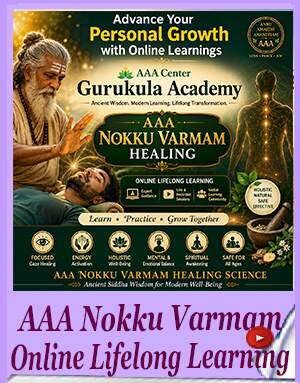
Online Lifelong Learning
Learn • Practice • Grow Together
AAA Nokku Varmam Healing Science
Ancient Siddha Wisdom for Modern Well-Being

MASTERING SIDDHA CONSCIOUSNESS AND SIGHT
AAA Nokku Varmam Healing
Awaken Your Inner Awareness • Cultivate Focused Presence • Explore the Timeless Wisdom of the Tamil Siddhas
A Comprehensive Professional eBook
Mastering Siddha Consciousness and Sight presents a structured introduction to the philosophy, principles, and practical disciplines associated with the Tamil Siddha tradition and AAA Nokku Varmam Healing. Designed for contemporary readers, this comprehensive guide integrates traditional perspectives with practical exercises that encourage self-awareness, focused attention, ethical living, emotional balance, and lifelong personal development.
Rather than presenting Siddha wisdom as abstract philosophy alone, the book emphasizes its thoughtful application to everyday life—supporting readers in cultivating clarity, resilience, compassion, responsible leadership, and meaningful service. Each chapter builds progressively, combining historical context, reflective practices, meditation, and practical guidance within a balanced educational framework.
Whether you are beginning your journey of self-discovery or seeking to deepen an established contemplative practice, this eBook offers an accessible roadmap inspired by the enduring heritage of the Tamil Siddhas.
Explore the 12-Chapter Learning Journey
Chapter 1 – The Legacy of the Tamil Siddhas
Discover the historical foundations, philosophical heritage, and enduring contributions of the Tamil Siddha tradition.
Chapter 2 – Understanding Siddha Consciousness
Explore awareness, perception, self-observation, and the cultivation of conscious living.
Chapter 3 – The Science and Philosophy of Nokku Varmam
Examine the traditional principles, historical context, and educational perspectives associated with Nokku Varmam.
Chapter 4 – Developing Focused Sight
Learn practical methods for strengthening concentration, observation, mindful attention, and disciplined awareness.
Chapter 5 – Varmam Points and Traditional Energy Concepts
Gain an introduction to traditional Siddha concepts related to varmam (vital points) and historical understandings of vital energy.
Chapter 6 – Breath, Awareness, and Mental Discipline
Develop mindful breathing practices that support calmness, emotional balance, sustained attention, and mental clarity.
Chapter 7 – Meditation and Inner Stillness
Build a consistent meditation practice that encourages self-reflection, inner stability, and balanced living.
Chapter 8 – The Art of Focused Awareness and Conscious Observation
Refine the ability to observe with clarity, presence, discernment, and thoughtful intention in everyday life.
Chapter 9 – Conscious Presence and Compassionate Living
Learn how awareness naturally supports empathy, ethical relationships, emotional intelligence, and compassionate action.
Chapter 10 – The Path of Lifelong Practice and Inner Transformation
Establish sustainable daily practices that encourage resilience, continuous learning, gratitude, and long-term personal growth.
Chapter 11 – The Siddha Path of Leadership, Service, and Collective Well-Being
Discover how self-mastery, integrity, ethical leadership, and community service contribute to collective flourishing.
Chapter 12 – The Continuing Journey: Integrating Siddha Consciousness into Everyday Life
Bring together the teachings of the entire book through practical guidance for lifelong practice, reflection, resilience, purposeful living, and compassionate service.
What You’ll Discover
- The philosophical foundations of the Tamil Siddha tradition
- Practical methods for cultivating awareness and focused attention
- Guided approaches to meditation and mindful breathing
- Ethical principles for conscious decision-making
- Strategies for emotional resilience and balanced living
- Reflection exercises and lifelong learning practices
- Personal journals, planners, and integration challenges
- Leadership through integrity, compassion, and service
- A structured framework for sustainable personal development
- Practical tools for integrating Siddha-inspired awareness into everyday life
Ideal For
- Students of Tamil Siddha philosophy
- Meditation and mindfulness practitioners
- Personal growth enthusiasts
- Holistic wellness learners
- Educators and facilitators
- Leadership development professionals
- Readers interested in contemplative traditions
- Anyone seeking a thoughtful and balanced approach to conscious living
Begin Your Journey Toward Greater Awareness
Through disciplined practice, thoughtful reflection, and compassionate action, the timeless wisdom of the Tamil Siddhas continues to inspire individuals to live with clarity, purpose, integrity, and inner balance.
Mastering Siddha Consciousness and Sight offers a practical companion for that lifelong journey—encouraging readers to cultivate awareness not only in moments of study or meditation, but in every aspect of daily life.
By Mani Gandhi
MASTERING SIDDHA CONSCIOUSNESS AND SIGHT
AAA Nokku Varmam Healing
Awaken Your Inner Awareness • Cultivate Focused Presence • Explore the Timeless Wisdom of the Tamil Siddhas
A Comprehensive Illustrated Guide to the Timeless Wisdom of the Tamil Siddhas
By Mani Gandhi
AAA Center Gurukula Academy
Copyright
Copyright © 2026 Mani Gandhi. All Rights Reserved.
No part of this publication may be reproduced, stored in a retrieval system, transmitted, or distributed in any form or by any means—electronic, mechanical, photocopying, recording, or otherwise—without the prior written permission of the copyright holder, except for brief quotations used in reviews, scholarly works, or other uses permitted under applicable copyright law.
This book is intended solely for educational, cultural, and personal development purposes.
First Edition – 2026
Author: Mani Gandhi
Publisher: AAA Center Gurukula Academy
Disclaimer
This book presents traditional concepts, historical information, philosophical perspectives, and contemplative practices inspired by the Tamil Siddha tradition. It is intended for educational, cultural, and personal reflection purposes only.
The content should not be interpreted as medical, psychological, or professional healthcare advice, nor is it intended to diagnose, treat, cure, or prevent any disease or medical condition. Readers should consult qualified healthcare professionals regarding any medical concerns.
Descriptions of traditional practices, including Nokku Varmam and related concepts, are presented to promote understanding of the Siddha heritage and should be approached respectfully and responsibly. Individual experiences may vary, and readers are encouraged to practice discernment and seek qualified instruction where appropriate.
Neither the author nor the publisher accepts responsibility for any consequences arising from the application or interpretation of the material contained in this book.
Dedication
This book is lovingly dedicated to the timeless wisdom of the Tamil Siddhas, whose enduring teachings continue to inspire seekers of truth, awareness, compassion, and inner transformation.
It is also dedicated to every sincere student who chooses the path of self-discovery, mindful living, and lifelong learning, with the aspiration to cultivate greater peace, clarity, and service to humanity.
May this work encourage thoughtful exploration, disciplined practice, and a deeper appreciation of the profound spiritual heritage of the Siddha tradition.
Foreword
The Tamil Siddha tradition represents one of humanity’s most remarkable streams of contemplative knowledge, emphasizing self-understanding, disciplined awareness, ethical living, and harmony between body, mind, and consciousness.
Mastering Siddha Consciousness and Sight offers readers an accessible introduction to many of these enduring ideas. Rather than presenting quick techniques or shortcuts, this book encourages gradual learning through reflection, observation, meditation, and consistent personal practice.
The chapters are designed to guide readers from historical and philosophical foundations toward practical methods for cultivating mindfulness, focused attention, emotional balance, and conscious living. Throughout, respect for tradition, personal responsibility, and ethical practice remain central themes.
Whether you are approaching the Siddha tradition for the first time or seeking to deepen your understanding, may these pages serve as a thoughtful companion on your journey of lifelong learning.
Preface
For centuries, the Tamil Siddhas explored profound questions about consciousness, perception, self-awareness, and human potential. Their teachings have inspired generations to pursue inner clarity through disciplined observation, meditation, compassion, and ethical conduct.
This book has been created to present selected aspects of that rich tradition in a structured, reader-friendly format suitable for contemporary audiences. It combines historical background, philosophical reflection, guided exercises, and practical suggestions while encouraging readers to approach the material with curiosity, respect, and discernment.
Although rooted in traditional wisdom, the emphasis throughout this book is on personal reflection and responsible practice. Readers are invited to learn gradually, reflect deeply, and integrate insights into everyday life in ways that support personal growth and well-being.
It is my hope that this work will contribute to a greater appreciation of the Tamil Siddha heritage and inspire readers to continue their own journey of conscious living.
— Mani Gandhi
Introduction
Every human being possesses the capacity for greater awareness, deeper presence, and more intentional living. Across cultures and generations, contemplative traditions have offered pathways for cultivating these qualities, and among them, the Tamil Siddha tradition holds a distinctive place.
This book explores principles associated with Siddha consciousness and the traditional concepts surrounding Nokku Varmam from an educational and reflective perspective. It examines the importance of observation, attention, disciplined practice, meditation, ethical living, and lifelong learning as means of fostering inner development.
Rather than promising extraordinary abilities, the focus is on practical self-awareness, mindful observation, and the cultivation of clarity in daily life. Each chapter builds progressively, helping readers develop a thoughtful understanding of the subject while encouraging personal reflection and consistent practice.
Whether your interest is philosophical, cultural, spiritual, or educational, this book invites you to engage with one of South India’s enduring wisdom traditions with openness, humility, and respect.
How to Use This Book
This book is organized as a step-by-step learning journey.
For the best experience:
- Read each chapter in sequence, as later chapters build upon earlier concepts.
- Reflect on the questions and journal prompts before moving to the next chapter.
- Practice the guided exercises regularly rather than rushing through them.
- Approach the material with patience, curiosity, and an open mind.
- Respect the cultural and historical significance of the Tamil Siddha tradition.
- View the practices as opportunities for cultivating awareness, focus, and personal growth rather than seeking immediate results.
- Revisit important chapters periodically to deepen your understanding as your experience develops.
Each chapter includes:
- Learning Objectives
- Historical and Philosophical Insights
- Guided Reflection
- Practical Exercises
- Journal Prompts
- Illustrations and Diagrams
- Chapter Summary
- Key Takeaways
Your journey through these pages is not simply about acquiring information—it is an invitation to cultivate greater awareness, thoughtful reflection, and a lifelong commitment to conscious living.
Chapter 1: The Legacy of the Tamil Siddhas
This chapter explores the following themes:
Section 1.1: Origins of the Siddha Tradition
Section 1.2: Historical Background
Section 1.3: The Eighteen Siddhas
Section 1.4: Siddha Philosophy
Section 1.5: Consciousness in Siddha Literature
Section 1.6: Body, Mind, and Awareness
Section 1.7: Why Siddha Wisdom Matters Today
Section 1.8: Chapter Summary, Reflection Questions, Journal Prompt, and Key Takeaways
Chapter 1: The Legacy of the Tamil Siddhas
“The journey toward wisdom begins not by seeking what is outside, but by awakening to what already exists within.”
Chapter Introduction
For thousands of years, the Tamil Siddhas have been revered as philosophers, mystics, poets, scholars, and seekers who dedicated their lives to exploring the nature of existence, consciousness, and human potential. Their writings, composed in the Tamil language, form a rich body of literature that reflects deep contemplation on ethical living, self-discipline, meditation, and the relationship between the individual and the wider universe.
The Siddha tradition is not merely a collection of ancient teachings; it is a living cultural and spiritual heritage that continues to inspire people seeking greater self-awareness, inner balance, and purposeful living. Through poetry, philosophical verses, and practical guidance, the Siddhas encouraged individuals to cultivate wisdom through direct experience, disciplined practice, and compassionate action rather than through belief alone.
This book approaches the Siddha tradition with respect for its historical and cultural significance. Rather than presenting extraordinary claims or shortcuts to transformation, it invites readers to explore timeless principles that encourage mindful observation, ethical conduct, reflective inquiry, and lifelong learning. These values remain meaningful in a rapidly changing world where many people seek clarity, resilience, and a deeper understanding of themselves.
The title Mastering Siddha Consciousness and Sight refers to the cultivation of conscious awareness and attentive observation. In this context, “sight” extends beyond physical vision to include the ability to perceive one’s thoughts, emotions, intentions, and actions with greater clarity. Such awareness is developed gradually through consistent reflection, meditation, disciplined attention, and responsible practice.
This opening chapter lays the foundation for the journey ahead. It introduces the origins of the Siddha tradition, explores its historical development, presents the legacy of the renowned Siddhas, and examines the philosophical principles that continue to influence contemporary discussions of consciousness and mindful living. By understanding the roots of this tradition, readers will be better prepared to appreciate the practices and reflections explored in later chapters.
Whether you are approaching these teachings from a cultural, philosophical, contemplative, or educational perspective, this chapter offers an invitation to engage with the Siddha heritage thoughtfully, respectfully, and with an open mind.
Learning Objectives
By the end of this chapter, you will be able to:
- Describe the historical origins and cultural development of the Tamil Siddha tradition.
- Recognize the contributions traditionally attributed to the Eighteen Siddhas and their place within Tamil spiritual literature.
- Understand the foundational philosophical ideas associated with the Siddha tradition, including self-inquiry, ethical living, and disciplined awareness.
- Explain how concepts of consciousness, observation, and inner awareness are expressed in Siddha writings.
- Appreciate the interconnected relationship between the body, mind, and awareness as presented in Siddha philosophy.
- Reflect on the continuing relevance of Siddha wisdom for personal growth, mindfulness, and responsible living in the modern world.
- Develop a respectful understanding of the Siddha tradition as an important part of Tamil cultural and intellectual heritage.
Section 1.1: Origins of the Siddha Tradition
The Tamil Siddha tradition is one of the oldest and most distinctive streams of spiritual and philosophical thought in South India. Rooted in the cultural heritage of Tamil civilization, it reflects centuries of inquiry into consciousness, ethical living, self-discipline, and the pursuit of wisdom. The word Siddha is derived from the Sanskrit term Siddhi, meaning “accomplishment,” “attainment,” or “perfection.” In the Tamil tradition, a Siddhar is generally understood to be a realized sage who has devoted a lifetime to self-knowledge, disciplined practice, and compassionate service.
Unlike traditions centered primarily on ritual or institutional authority, the Siddha tradition places strong emphasis on direct experience and personal transformation. The Siddhas encouraged seekers to question, observe, contemplate, and verify insights through disciplined practice. Their teachings suggest that genuine wisdom arises from lived experience, ethical conduct, and sustained self-reflection rather than from belief alone.
The Cultural Foundations of the Siddha Tradition
The origins of the Siddha tradition are closely connected with the rich intellectual and spiritual history of ancient Tamil society. Tamil literature, including the Sangam corpus and later devotional and philosophical works, reflects a longstanding interest in the relationship between humanity, nature, morality, and the inner life. Within this cultural environment, the Siddhas developed a distinctive body of poetry and philosophical writings that explored questions of consciousness, impermanence, compassion, and self-realization.
Many traditional accounts describe the Siddhas as individuals who chose lives of simplicity, contemplation, and service. They are often portrayed as wandering teachers, scholars, poets, healers, or yogic practitioners who shared their insights through concise verses rich in symbolism and metaphor. These literary works continue to be studied for their philosophical depth, linguistic beauty, and cultural significance.
The Meaning of “Siddha”
In the Siddha tradition, the title Siddhar does not merely indicate knowledge acquired through study. Rather, it signifies an individual who has cultivated wisdom through disciplined practice, ethical living, and profound self-understanding. Siddha literature frequently emphasizes qualities such as humility, compassion, patience, discernment, and inner balance as hallmarks of genuine spiritual maturity.
Traditional writings describe the journey toward wisdom as a gradual process of refining one’s character, observing the mind, developing self-control, and living harmoniously with others. Progress is portrayed not as the accumulation of external achievements but as the cultivation of clarity, equanimity, and insight.
A Tradition of Inquiry and Experience
One of the defining characteristics of the Siddha tradition is its encouragement of inquiry. The Siddhas often challenged superficial understanding and invited students to examine experience directly. Through observation, meditation, contemplation, and ethical conduct, practitioners were encouraged to develop greater awareness of themselves and the world around them.
This emphasis on experiential understanding distinguishes the Siddha tradition as both philosophical and practical. Rather than separating intellectual knowledge from everyday life, the Siddhas encouraged integrating wisdom into daily conduct, relationships, work, and service. Their writings consistently suggest that knowledge becomes meaningful only when it is expressed through compassion, responsibility, and mindful action.
Knowledge Expressed Through Poetry
Much of what is known about the Siddha tradition has been preserved in Tamil poetic literature. Siddhar verses often combine philosophical reflection with vivid imagery, symbolism, and concise expression. Their language invites readers to contemplate multiple layers of meaning rather than offering simple, literal explanations.
These poems explore themes such as the nature of the mind, the cultivation of awareness, the impermanence of worldly attachments, ethical responsibility, and the search for enduring wisdom. Their enduring appeal lies in their ability to inspire reflection across generations while remaining deeply rooted in Tamil language and culture.
Diversity Within the Tradition
The Siddha tradition is not a single, uniform system. Over many centuries it has encompassed diverse teachers, lineages, interpretations, and practices. Historical evidence and traditional accounts indicate that different Siddhas emphasized different aspects of learning, including philosophy, meditation, literature, yoga, ethics, and traditional healing knowledge.
This diversity reflects the adaptability of the tradition and its capacity to engage with changing social and cultural contexts while preserving core values such as disciplined inquiry, compassion, and respect for knowledge.
A Living Heritage
Today, the Siddha tradition continues to be appreciated as an important part of Tamil cultural heritage. Scholars study Siddha literature for its contributions to philosophy, language, and history, while many people draw inspiration from its teachings on mindfulness, ethical living, and self-reflection.
Although interpretations and practices vary, the enduring message of the Siddhas remains relevant: cultivate awareness, live with integrity, seek wisdom through experience, and contribute positively to the well-being of others. These principles transcend historical boundaries and continue to resonate with individuals seeking meaning, balance, and purposeful living in the modern world.
As the chapters that follow will demonstrate, understanding the origins of the Siddha tradition provides a valuable foundation for appreciating its broader philosophical vision. By exploring its historical roots and cultural context, readers can approach Siddha teachings with greater clarity, respect, and appreciation for one of the world’s enduring contemplative traditions.
This section provides a balanced historical and philosophical introduction suitable for a premium eBook. It emphasizes the Siddha tradition’s cultural heritage, literary richness, and contemplative values while distinguishing traditional accounts from historical evidence where appropriate.
Section 1.2: Historical Background
The Tamil Siddha tradition emerged within the rich cultural landscape of South India, where philosophy, poetry, spirituality, and the observation of nature developed side by side over many centuries. Although the precise origins of the Siddha movement cannot be established with certainty, scholars generally agree that Siddha literature evolved over a long period, drawing upon earlier Tamil intellectual traditions while also interacting with broader Indian philosophical and yogic currents.
Rather than representing a single school founded at one moment in history, the Siddha tradition is best understood as a living stream of knowledge that developed through generations of teachers, poets, contemplatives, and practitioners. Their ideas were preserved primarily through Tamil verses, oral transmission, and later manuscript collections, creating a diverse body of literature that continues to be studied today.
Ancient Tamil Civilization
The roots of the Siddha tradition are closely connected to the history of ancient Tamil civilization, one of the world’s oldest continuously living cultural traditions. Long before the rise of many medieval kingdoms, Tamil society had developed sophisticated systems of literature, agriculture, trade, governance, music, and philosophy.
The Sangam period, generally dated between approximately 300 BCE and 300 CE, produced a remarkable collection of Tamil poetry that celebrated human experience, ethics, nature, love, courage, and social responsibility. Although Sangam literature and Siddha literature are distinct traditions, they share a common cultural foundation that values wisdom, disciplined living, and harmony with the natural world.
This fertile intellectual environment encouraged inquiry into both the external world and the inner dimensions of human life. Questions concerning the nature of existence, consciousness, virtue, and personal responsibility became recurring themes in Tamil thought and later found distinctive expression in Siddha writings.
The Development of Siddha Literature
Siddha literature gradually emerged as a unique form of philosophical and contemplative writing. Unlike formal academic treatises, many Siddhar works were composed as concise poems, songs, aphorisms, and symbolic verses. Their language was intentionally layered, inviting thoughtful reflection rather than immediate interpretation.
These works addressed a wide range of subjects, including ethics, meditation, self-discipline, the nature of the mind, impermanence, devotion, and traditional systems of knowledge. Many texts also discuss topics related to yoga, alchemy, astronomy, language, and traditional healing, reflecting the broad intellectual interests traditionally associated with the Siddhas.
Because many writings were transmitted orally before being copied by hand, and because authorship is sometimes uncertain, assigning exact dates to individual texts is often difficult. Consequently, historians approach Siddha literature through linguistic analysis, manuscript evidence, and comparison with other historical sources, while recognizing that traditional accounts may preserve symbolic or lineage-based understandings rather than precise chronology.
The Guru–Disciple Tradition
A defining feature of the Siddha heritage is the importance of the guru–disciple relationship, in which knowledge was traditionally transmitted through personal guidance, disciplined practice, and ethical example. Rather than emphasizing the accumulation of information alone, the tradition encouraged students to cultivate character, humility, patience, and discernment.
Teachers guided disciples through gradual stages of learning, helping them develop observation, concentration, meditation, and self-understanding. This personalized approach reflected the belief that genuine wisdom grows through lived experience supported by careful instruction and consistent practice.
While the methods of learning have evolved over time, the underlying values of respectful learning, disciplined inquiry, and lifelong self-cultivation remain central to the Siddha tradition.
The Siddhas as Poets, Philosophers, and Seekers
Traditional accounts describe the Siddhas as individuals from diverse social backgrounds who dedicated themselves to the pursuit of wisdom. Many are remembered as poets whose verses challenged social conventions, encouraged critical thinking, and emphasized compassion over outward status or ritual.
Their poetry frequently reminds readers that external achievements alone do not guarantee inner fulfillment. Instead, they encouraged self-examination, moderation, ethical conduct, and an awareness of the impermanent nature of worldly life.
This combination of philosophical insight and practical guidance has contributed to the enduring appeal of Siddha literature across generations.
Preservation Through Manuscripts and Oral Tradition
For many centuries, Siddha knowledge was preserved through handwritten palm-leaf manuscripts, oral recitation, and local teaching traditions. Palm leaves were carefully prepared, inscribed with a stylus, and preserved by scholars and custodians who recognized their cultural value.
Because palm-leaf manuscripts are vulnerable to climate, insects, and the passage of time, some texts have been lost, while others survive only in fragmentary form or in later copies. Modern efforts by researchers, libraries, and cultural institutions have helped preserve and digitize many important manuscripts, allowing new generations to study this literary heritage.
At the same time, oral traditions have continued to play an important role in transmitting stories, interpretations, and practical teachings associated with the Siddhas, demonstrating the resilience of this cultural legacy.
Historical Perspectives and Traditional Narratives
It is important to distinguish between historical research and traditional narratives. Historians rely on archaeological evidence, manuscripts, linguistic analysis, and documented sources to reconstruct the past. Traditional accounts, by contrast, often emphasize symbolic meaning, spiritual lineage, and cultural memory.
Both perspectives contribute to understanding the Siddha tradition. Historical scholarship helps place Siddha literature within the broader context of Tamil history, while traditional narratives reflect the reverence and inspiration with which generations have regarded the Siddhas. Appreciating these complementary perspectives enables readers to approach the tradition with both respect and critical understanding.
An Enduring Cultural Legacy
Today, the Tamil Siddha tradition continues to be recognized as an important component of India’s cultural and intellectual heritage. Universities, research institutions, and scholars study Siddha literature for its contributions to philosophy, language, ethics, and history, while many readers continue to find inspiration in its reflections on awareness, disciplined living, and compassion.
The historical journey of the Siddhas demonstrates that enduring wisdom is preserved not only through books but also through thoughtful practice, responsible teaching, and the willingness of each generation to engage with its cultural heritage. By understanding the historical background of the Siddha tradition, readers gain a deeper appreciation of the remarkable legacy that has shaped Tamil philosophical thought for centuries and continues to inspire inquiry into the nature of consciousness and human flourishing.
Section 1.3: The Eighteen Siddhas
Among the many revered figures of the Tamil Siddha tradition, the Pathinen Siddhar—commonly translated as the Eighteen Siddhas—occupy a special place in Tamil spiritual and literary heritage. They are traditionally regarded as enlightened sages whose lives and teachings have inspired generations of seekers to pursue wisdom, self-discipline, compassion, and inner awareness.
The number eighteen holds symbolic significance within the tradition, representing a lineage of accomplished teachers rather than a single historical group that lived at the same time. Different manuscripts and regional traditions sometimes present slightly different lists of the Eighteen Siddhas, reflecting the diversity and evolution of the Siddha heritage over many centuries. While the exact historical details of every Siddhar remain the subject of ongoing scholarly study, their collective contribution to Tamil philosophy and literature is widely recognized.
The Siddhas as Exemplars of Wisdom
The Siddhas are remembered not only for their knowledge but also for the values they embodied. Traditional accounts describe them as individuals who sought truth through contemplation, disciplined practice, ethical conduct, and compassionate service. Their writings often encourage readers to look beyond external appearances and cultivate inner clarity through self-observation and mindful living.
Rather than emphasizing status or ritual, the Siddhas consistently highlighted humility, sincerity, perseverance, and direct experience. Their verses invite readers to question assumptions, examine the workings of the mind, and develop a deeper understanding of themselves and the world around them.
Traditional List of the Eighteen Siddhas
Although variations exist, one commonly recognized traditional list includes:
- Agathiyar (Agastya) – Revered as one of the foremost Siddhas and traditionally regarded as a foundational teacher within the Siddha tradition. Many works on philosophy, grammar, yoga, and traditional healing are attributed to him.
- Thirumoolar – Celebrated author of the Thirumandiram, an important Tamil philosophical text exploring yoga, ethics, devotion, and spiritual realization.
- Bogar – Traditionally associated with alchemical knowledge, meditation, and the integration of philosophical inquiry with practical disciplines. He is also linked by tradition with the sacred site of Palani.
- Konganar – Remembered for writings emphasizing disciplined living, observation, and the pursuit of wisdom through experience.
- Korakkar (Gorakhnath) – Associated in traditional accounts with yogic practice, meditation, and the cultivation of inner awareness.
- Karuvoorar – Revered as a scholar and spiritual teacher whose verses emphasize ethical conduct, devotion, and contemplative practice.
- Sattaimuni – Remembered for writings on self-discipline, philosophical inquiry, and the refinement of consciousness.
- Sundaranandar – Traditionally known for teachings that encourage simplicity, compassion, and inner transformation.
- Ramadevar – Associated with contemplative practice and philosophical reflection on the nature of consciousness.
- Machamuni (Matsyendranath) – Revered in both Tamil Siddha and broader yogic traditions for teachings on meditation and disciplined practice.
- Kudhambai Siddhar – Known for poetic verses that communicate profound truths through simple language accessible to ordinary people.
- Pambatti Siddhar – Famous for symbolic poetry using the image of the snake to illustrate the awakening of awareness and inner transformation.
- Idaikadar – Remembered for wisdom that integrates observation of nature with ethical and philosophical reflection.
- Kamalamuni – Traditionally associated with meditation, disciplined awareness, and contemplative insight.
- Patanjali – Revered in Indian philosophical traditions as a great teacher of yoga. Some Siddha lineages include him among the Siddhas because of his enduring influence on contemplative practice.
- Dhanvantari – Traditionally honored for contributions to healing knowledge and holistic approaches to well-being.
- Nandidevar – Revered as an early teacher in several Siddha traditions and often described as a guide who transmitted profound spiritual knowledge to later Siddhas.
- Valmiki (included in some traditional lists) – Remembered as a sage whose life symbolizes the transformative power of wisdom and self-realization. Some Siddha lineages include him, while others substitute another revered Siddhar.
Diversity of Traditional Lists
Readers should note that no single list of the Eighteen Siddhas is universally accepted across all traditions. Historical manuscripts, regional lineages, and scholarly sources present different names and sequences. This diversity reflects the organic development of the Siddha tradition over many centuries rather than inconsistency.
Instead of focusing exclusively on a definitive list, it is more meaningful to appreciate the shared ideals represented by these revered teachers—the pursuit of wisdom, disciplined inquiry, ethical living, compassion, and the continual refinement of consciousness.
Literary and Philosophical Contributions
The writings attributed to the Siddhas cover a remarkable range of subjects, including philosophy, ethics, meditation, yoga, poetry, language, cosmology, and traditional systems of knowledge. Their verses are often concise yet rich in symbolism, encouraging readers to contemplate multiple layers of meaning rather than accepting superficial interpretations.
Many Siddhar poems remind readers that genuine learning requires both intellectual understanding and personal transformation. Knowledge, they suggest, becomes truly meaningful only when expressed through humility, integrity, kindness, and service to others.
Enduring Influence
The legacy of the Eighteen Siddhas continues to inspire scholars, practitioners, and readers interested in Tamil literature, philosophy, and contemplative traditions. Their teachings encourage a lifelong commitment to learning, reflection, ethical conduct, and mindful awareness.
Whether viewed through the lens of history, literature, philosophy, or spirituality, the Siddhas represent an enduring symbol of humanity’s search for wisdom. Their lives remind us that the highest form of knowledge is not merely the accumulation of information, but the cultivation of insight, compassion, and responsible living.
As we continue through this book, the wisdom associated with the Siddhas will serve as a guiding thread—inviting us to explore consciousness not as an abstract concept, but as a living experience shaped by attention, reflection, and purposeful action.
This section distinguishes between traditional accounts and historical scholarship where appropriate, acknowledges that the list of the Eighteen Siddhas varies across lineages, and presents each Siddhar in a way that is suitable for a modern, educational publication.
Section 1.4: Siddha Philosophy
Siddha philosophy is a profound exploration of life, consciousness, and human potential. Rooted in the wisdom of the Tamil Siddhas, it encourages individuals to seek truth through self-observation, disciplined practice, ethical living, and direct experience. Rather than presenting philosophy as an abstract intellectual pursuit, the Siddha tradition views it as a practical guide for living with clarity, compassion, and inner balance.
At its heart, Siddha philosophy teaches that genuine wisdom arises through the transformation of one’s own awareness. It invites every individual to become both the observer and the student of their own life, cultivating insight through reflection, mindfulness, and continuous learning.
The Quest for Self-Knowledge
One of the central themes of Siddha philosophy is self-knowledge. The Siddhas repeatedly emphasize that understanding oneself is the foundation of understanding the world. Instead of searching exclusively for answers in external circumstances, they encourage turning inward with honesty, humility, and careful observation.
This inward journey is not an escape from everyday life but a way of engaging with it more consciously. By observing thoughts, emotions, habits, and actions without immediate judgment, individuals can gradually develop greater clarity, emotional balance, and wisdom.
Self-knowledge, in this sense, is viewed as an ongoing process rather than a final destination. Each experience becomes an opportunity to learn, grow, and refine one’s understanding.
Direct Experience Over Blind Acceptance
A distinctive feature of Siddha philosophy is its emphasis on direct experience. While honoring teachers and traditional knowledge, the Siddhas encourage learners to examine ideas thoughtfully rather than accepting them without reflection.
This approach promotes inquiry, observation, contemplation, and responsible practice. Wisdom is understood to arise through lived experience supported by disciplined effort, ethical conduct, and continuous reflection.
Such an attitude fosters intellectual humility and encourages lifelong learning. It reminds readers that genuine understanding develops gradually through experience rather than through memorization alone.
Unity of Body, Mind, and Awareness
Siddha philosophy presents the human being as an integrated whole in which the body, mind, and awareness are deeply interconnected. Physical well-being, mental clarity, emotional balance, ethical conduct, and contemplative practice are viewed as mutually supportive aspects of a meaningful life.
Rather than separating these dimensions, the Siddhas encourage harmony among them. Daily habits, thoughtful reflection, meditation, compassionate relationships, and responsible living all contribute to the cultivation of greater inner balance.
This holistic perspective continues to resonate today, reminding us that personal growth involves the development of the whole person rather than focusing on a single aspect of life.
The Importance of Ethical Living
Ethics occupy a central place in Siddha philosophy. The Siddhas consistently teach that knowledge without integrity has limited value. Qualities such as honesty, compassion, humility, patience, generosity, self-discipline, and respect for others are regarded as essential foundations for personal development.
Ethical conduct is not presented as a rigid set of external rules but as a natural expression of inner understanding. As awareness deepens, one’s actions increasingly reflect kindness, responsibility, and consideration for the well-being of others.
This emphasis on character reminds readers that true wisdom is demonstrated through everyday actions and relationships.
Impermanence and Inner Freedom
Many Siddhar poems reflect on the impermanent nature of worldly experiences. Wealth, status, possessions, and external success are recognized as valuable in their appropriate context, yet they are also understood to be temporary and subject to change.
Rather than encouraging detachment from life itself, the Siddhas invite readers to cultivate freedom from excessive attachment. Appreciating the changing nature of life can foster resilience, gratitude, and the ability to respond thoughtfully to both success and adversity.
This perspective encourages individuals to place greater value on qualities such as wisdom, compassion, integrity, and meaningful relationships—qualities that enrich life regardless of external circumstances.
Discipline as a Path to Growth
The Siddhas consistently emphasize the importance of disciplined practice. Personal growth is portrayed not as a sudden event but as the cumulative result of consistent effort over time.
Disciplines such as meditation, self-reflection, mindful observation, ethical living, and thoughtful study help cultivate attention and strengthen awareness. Progress is often described as gradual, requiring patience, perseverance, and humility.
This practical orientation reflects the Siddha understanding that lasting transformation develops through regular practice rather than occasional inspiration.
Harmony with Nature
Siddha philosophy recognizes the intimate relationship between human life and the natural world. Many Siddhar writings express deep appreciation for nature as a source of learning, balance, and inspiration.
Observing natural rhythms—the changing seasons, the cycles of day and night, and the interdependence of living beings—encourages humility and a sense of connection with the wider world. Living in harmony with nature is therefore presented not only as an environmental concern but also as a way of cultivating inner balance and gratitude.
Compassion and Service
Another enduring principle of Siddha philosophy is the importance of compassion. The Siddhas remind readers that personal development finds its fullest expression when it benefits others.
Acts of kindness, generosity, patience, and service strengthen communities and contribute to collective well-being. Compassion is viewed not merely as an emotion but as a way of living that reflects genuine understanding and respect for the dignity of every individual.
In this way, personal transformation and social responsibility are seen as complementary rather than separate pursuits.
Philosophy as a Living Practice
Unlike systems that remain confined to theoretical discussion, Siddha philosophy encourages readers to apply its principles in everyday life. Every interaction, challenge, decision, and moment of reflection becomes an opportunity to cultivate greater awareness.
The goal is not perfection but continual refinement. By observing ourselves honestly, learning from experience, and acting with integrity, we gradually develop the qualities that the Siddhas regarded as the foundation of a meaningful life.
The Enduring Relevance of Siddha Philosophy
Although the Siddhas lived in different historical periods, the questions they explored remain timeless. How can we understand ourselves more deeply? How do we respond wisely to change? What does it mean to live ethically? How can awareness shape our actions and relationships?
These questions continue to resonate in the modern world. Amid rapid technological change, increasing complexity, and constant distraction, Siddha philosophy offers a reminder of the enduring value of reflection, mindfulness, compassion, disciplined learning, and responsible living.
As this book progresses, these philosophical principles will provide the foundation for exploring consciousness, attentive observation, meditation, and contemplative practice. Understanding Siddha philosophy is not simply an academic exercise—it is an invitation to cultivate a way of life rooted in wisdom, integrity, and lifelong growth.
Section 1.5: Consciousness in Siddha Literature
Consciousness occupies a central place in the literature of the Tamil Siddhas. Throughout their poems and philosophical writings, the Siddhas explore the nature of awareness, perception, self-knowledge, and the human search for truth. Rather than treating consciousness as merely an abstract idea, they present it as a lived experience that can be deepened through careful observation, disciplined practice, ethical living, and sustained contemplation.
The Siddha writings invite readers to move beyond habitual patterns of thinking and to develop a more attentive relationship with themselves and the world around them. In this sense, consciousness is not viewed as something to be acquired but as an inherent capacity that can be refined through mindful living and self-understanding.
Awareness as the Foundation of Wisdom
One of the recurring themes in Siddha literature is that awareness is the beginning of wisdom. The Siddhas encourage individuals to become conscious of their thoughts, emotions, speech, actions, and intentions. This process of self-observation is presented as the first step toward personal transformation.
Rather than reacting automatically to circumstances, readers are encouraged to pause, observe, and respond with clarity and discernment. Such awareness gradually strengthens the ability to make thoughtful decisions, cultivate emotional balance, and develop greater compassion.
The Siddhas suggest that when awareness becomes more refined, individuals begin to recognize patterns within themselves that previously went unnoticed. This recognition creates opportunities for learning, growth, and wiser action.
The Inner Observer
A distinctive feature of Siddha literature is its emphasis on the inner observer—the capacity to witness one’s own experiences without becoming completely identified with them.
The Siddhas frequently encourage readers to observe thoughts as they arise, acknowledge emotions without being overwhelmed by them, and reflect on actions with honesty and humility. This witnessing perspective supports self-understanding by creating space between immediate experience and habitual reaction.
Developing the inner observer is not portrayed as emotional detachment or indifference. Instead, it represents a balanced state in which individuals remain fully engaged with life while responding with greater mindfulness and responsibility.
The Mind and Its Movements
Many Siddhar poems describe the mind as dynamic, constantly shifting between memories, desires, fears, expectations, and sensory experiences. Left unexamined, these movements may contribute to distraction, confusion, or impulsive behavior.
The Siddhas therefore emphasize practices that cultivate steadiness of attention and clarity of perception. Through reflection, meditation, ethical conduct, and disciplined living, individuals gradually learn to recognize the changing nature of mental activity without becoming controlled by it.
In this perspective, understanding the mind is not about suppressing thoughts but about developing a wiser relationship with them.
Consciousness and Direct Experience
Siddha literature consistently values direct experience as the foundation of genuine understanding. While study and intellectual learning are respected, the Siddhas remind readers that knowledge becomes meaningful only when it is integrated into daily life.
This emphasis encourages practitioners to examine their own experiences carefully. Every conversation, challenge, success, disappointment, and moment of quiet reflection becomes an opportunity to deepen awareness and cultivate insight.
Rather than separating philosophy from everyday life, the Siddhas present consciousness as something continuously expressed through the quality of one’s attention and actions.
Symbolism in Siddhar Poetry
The literary style of the Siddhas often employs rich symbolism to communicate subtle ideas about consciousness. Mountains, rivers, flowers, light, mirrors, fire, space, birds, and serpents frequently appear as poetic images that invite contemplation rather than literal interpretation.
These symbols encourage readers to reflect on the deeper dimensions of awareness, transformation, and human experience. Because the verses are intentionally concise and multilayered, they often reveal new insights when revisited over time.
This symbolic style contributes to the enduring appeal of Siddha literature, allowing readers from different generations to engage with the texts according to their own level of understanding.
Silence and Contemplation
Silence is another recurring theme in Siddha writings. The Siddhas often suggest that profound understanding emerges not only through words but also through periods of quiet reflection.
Moments of silence provide opportunities to observe the mind without distraction, cultivate inner calm, and appreciate the subtle aspects of experience that may otherwise remain unnoticed.
Within the Siddha tradition, silence is therefore understood not as the mere absence of speech but as a quality of attentive presence that supports deeper contemplation.
Consciousness in Everyday Life
The Siddhas emphasize that awareness should extend beyond formal meditation or study. Everyday activities—speaking, listening, eating, working, walking, and interacting with others—are all presented as opportunities to practice conscious attention.
This practical approach reminds readers that the cultivation of awareness is not confined to isolated moments but becomes meaningful when integrated into ordinary life. By bringing greater presence to daily routines, individuals gradually develop habits of mindfulness, patience, and thoughtful action.
Ethical Awareness
In Siddha literature, consciousness is closely linked with ethical responsibility. Increased awareness naturally encourages greater sensitivity toward the impact of one’s thoughts, words, and actions on others.
Compassion, honesty, humility, patience, and respect are not portrayed simply as moral obligations but as expressions of an awakened and mature consciousness. As awareness deepens, individuals become increasingly capable of responding to life’s challenges with wisdom rather than impulse.
This relationship between consciousness and ethics reflects the Siddha understanding that personal growth and social responsibility are inseparable.
Timeless Relevance
Although the Siddhar poems were composed in different historical periods, their reflections on consciousness continue to resonate with modern readers. Contemporary discussions of mindfulness, attention, emotional regulation, and self-reflection echo many of the timeless questions explored in Siddha literature.
At the same time, Siddha writings offer a distinctive cultural perspective rooted in the Tamil language, symbolism, and philosophical heritage. They remind us that the search for self-understanding has been a shared human endeavor across centuries and cultures.
Preparing for the Journey Ahead
As the chapters that follow explore focused attention, meditation, and contemplative practice, the insights of Siddha literature provide an important foundation. The Siddhas encourage us to approach consciousness not as an abstract theory but as an ongoing practice of careful observation, ethical living, thoughtful reflection, and continuous learning.
Their enduring message is both simple and profound: by cultivating awareness in each moment, we gradually transform the way we understand ourselves, relate to others, and engage with the world. In this spirit, the study of consciousness becomes not merely an intellectual pursuit but a lifelong journey of wisdom, compassion, and mindful living.
This section frames consciousness as it appears in Siddha literature through themes of awareness, observation, ethics, and contemplation, while presenting traditional ideas respectfully and distinguishing philosophical teachings from scientific claims.
aims and distinguishing philosophical teachings from empirical assertions.
Section 1.6: Body, Mind, and Awareness
One of the defining characteristics of the Tamil Siddha tradition is its holistic understanding of the human being. Rather than viewing the body, mind, and awareness as separate or unrelated, Siddha philosophy presents them as deeply interconnected dimensions of human experience. Each influences the others, and together they shape how individuals perceive, respond to, and engage with the world.
This integrated perspective encourages balanced personal development. Physical well-being, mental clarity, ethical conduct, emotional maturity, and reflective awareness are regarded as complementary aspects of a meaningful life. The Siddhas consistently remind readers that cultivating only one dimension while neglecting the others leads to imbalance, whereas harmonious development supports wisdom and resilience.
The Body: A Foundation for Conscious Living
In Siddha literature, the body is viewed with respect as the means through which human experience unfolds. It enables learning, relationships, creativity, service, and contemplative practice. Rather than treating the body as an obstacle to higher understanding, the Siddhas generally encourage caring for it with discipline, moderation, and gratitude.
Traditional Siddha writings often advocate balanced daily routines, mindful eating, adequate rest, appropriate physical activity, and habits that support overall well-being. These recommendations reflect the broader principle that physical health can create favorable conditions for concentration, reflection, and purposeful living.
Modern readers may recognize a similar idea: when the body is cared for responsibly, it often becomes easier to maintain attention, emotional balance, and sustained engagement with life’s responsibilities.
The Mind: The Instrument of Understanding
The Siddhas devoted considerable attention to understanding the nature of the mind. They observed that the mind constantly processes memories, perceptions, emotions, desires, and expectations. Left unchecked, these movements can lead to distraction, confusion, or impulsive reactions.
Instead of attempting to suppress mental activity, Siddha philosophy encourages becoming familiar with it. Through careful observation, individuals gradually recognize recurring patterns of thought and emotion. This understanding creates opportunities to respond more thoughtfully rather than react automatically.
The Siddhas portray the disciplined mind as a valuable instrument for learning, creativity, ethical decision-making, and contemplation. Like any instrument, however, it requires consistent practice, patience, and care to function at its best.
Awareness: The Illuminating Presence
While the body provides the means for action and the mind processes experience, awareness is presented in Siddha philosophy as the capacity to observe experience itself. Awareness enables individuals to notice thoughts without immediately identifying with them, to recognize emotions without being overwhelmed, and to respond with greater clarity and discernment.
From this perspective, awareness is cultivated through practices such as mindful observation, meditation, ethical reflection, and attentive living. It grows gradually as individuals develop the habit of being fully present in each moment.
The Siddhas often suggest that increasing awareness brings greater freedom of choice. Instead of acting solely from habit or impulse, individuals become more capable of responding with wisdom, patience, and compassion.
The Dynamic Relationship Between Body, Mind, and Awareness
Body, mind, and awareness continuously influence one another. Physical fatigue may affect concentration, emotional stress can influence bodily well-being, and greater awareness can help individuals recognize these interactions more clearly.
For example:
- Calm and steady breathing may support a more settled state of mind.
- Adequate rest and balanced daily habits often improve attention and emotional resilience.
- Reflective awareness can help identify unhelpful habits and encourage healthier choices.
- Ethical actions frequently contribute to greater inner peace and confidence.
- Consistent contemplative practice may strengthen one’s capacity for attentive observation.
The Siddhas viewed personal development as an ongoing process of bringing these dimensions into greater harmony rather than seeking perfection.
Self-Observation as a Daily Practice
A recurring teaching in Siddha literature is the importance of observing oneself honestly and consistently. This practice extends beyond formal meditation and includes awareness during ordinary activities such as speaking, listening, working, eating, and interacting with others.
Questions for self-observation might include:
- Am I fully attentive to the present moment?
- What thoughts are influencing my decisions?
- How do my emotions affect my responses?
- Are my actions aligned with my values?
- What habits support or hinder my well-being?
Regular reflection encourages gradual learning and helps transform everyday experiences into opportunities for personal growth.
Balance Rather Than Extremes
The Siddhas frequently advocate moderation. Excessive indulgence, rigid self-denial, emotional impulsiveness, or neglect of personal well-being are all viewed as sources of imbalance.
Instead, they encourage a balanced lifestyle characterized by thoughtful routines, meaningful work, sufficient rest, respectful relationships, and time for contemplation. Such balance supports resilience and allows individuals to respond more effectively to life’s changing circumstances.
This principle remains especially relevant today, when many people face the challenges of fast-paced schedules, constant digital stimulation, and competing responsibilities.
Awareness in Relationships
Siddha philosophy emphasizes that awareness is expressed not only in solitude but also in relationships. Every interaction provides an opportunity to practice attentive listening, respectful communication, empathy, and compassion.
The Siddhas remind readers that inner growth is reflected in everyday behavior. Greater awareness naturally encourages patience during disagreement, gratitude in moments of support, humility in success, and resilience during difficulty.
In this way, personal awareness contributes to healthier families, stronger communities, and more harmonious social relationships.
Integrating Body, Mind, and Awareness
The ultimate aim of this integrated perspective is not to separate oneself from life but to engage with it more consciously. Caring for the body, understanding the mind, and cultivating awareness become complementary practices that enrich one another.
This integration develops gradually through consistent habits rather than dramatic change. Small daily actions—such as mindful breathing, reflective journaling, ethical decision-making, moments of quiet contemplation, and compassionate service—can steadily strengthen this harmony over time.
Preparing for Deeper Practice
The chapters that follow will build upon these foundational principles. Readers will explore focused attention, traditional concepts associated with Nokku Varmam, contemplative exercises, breath awareness, meditation, and practical methods for integrating mindfulness into daily life.
By appreciating the interconnected nature of body, mind, and awareness, readers establish a strong foundation for this journey. The Siddhas teach that lasting growth begins with careful observation, is sustained through disciplined practice, and finds its fullest expression in a life guided by wisdom, compassion, integrity, and service.
As you continue reading, remember that every moment offers an opportunity to cultivate greater awareness. Each thoughtful choice, each act of kindness, and each period of quiet reflection contributes to the lifelong practice of conscious living—a path that the Tamil Siddhas have celebrated through their timeless teachings for generations.
This section complements the preceding chapters by presenting the Siddha view of the body, mind, and awareness as an integrated philosophical framework, emphasizing ethical living, self-observation, and gradual personal development while avoiding unsupported scientific or medical claims.
Section 1.7: Why Siddha Wisdom Matters Today
The world of the twenty-first century is characterized by remarkable technological progress, unprecedented access to information, and rapid social change. While these developments have created new opportunities for learning, communication, and innovation, they have also introduced challenges such as information overload, constant distraction, chronic stress, and increasing demands on attention.
In this environment, many people are searching for approaches that encourage clarity, balance, resilience, and a deeper sense of purpose. Although the Tamil Siddhas lived in different historical periods, many of the questions they explored remain strikingly relevant today:
- How can we live with greater awareness?
- How do we cultivate wisdom amid constant change?
- What does it mean to live ethically?
- How can we develop inner steadiness without withdrawing from the responsibilities of everyday life?
Rather than offering quick solutions, the Siddha tradition encourages a lifelong journey of learning, reflection, and disciplined practice. Its enduring value lies not in providing simple answers but in helping individuals ask thoughtful questions and engage with life more consciously.
A Timeless Perspective on Human Development
One of the greatest strengths of Siddha philosophy is its emphasis on continuous personal growth. The Siddhas remind us that learning is not confined to childhood or formal education. Every stage of life offers opportunities to develop greater understanding, compassion, patience, and self-awareness.
This perspective is particularly valuable in a rapidly changing world where adaptability has become an essential quality. Lifelong learning, curiosity, and reflective thinking help individuals respond creatively to new circumstances while remaining grounded in enduring values.
Cultivating Attention in an Age of Distraction
Modern life presents countless demands on our attention. Digital devices, social media, constant notifications, and the pace of contemporary work can make sustained concentration increasingly difficult.
Long before these technologies existed, the Siddhas emphasized the importance of disciplined attention. Their writings encourage readers to cultivate the ability to observe carefully, think clearly, and remain present with whatever task is before them.
Developing this quality of focused awareness supports better decision-making, more meaningful relationships, and a greater appreciation of everyday experiences.
Emotional Balance and Inner Resilience
Life inevitably includes both success and disappointment, certainty and uncertainty, joy and loss. The Siddhas recognized that lasting well-being depends not on controlling every external circumstance but on cultivating a balanced inner response.
Through reflection, ethical living, meditation, and self-observation, individuals can strengthen qualities such as patience, humility, gratitude, and resilience. These qualities help us meet life’s challenges with steadiness rather than impulsive reaction.
In today’s fast-changing environment, this emphasis on emotional maturity remains deeply relevant.
Ethics in Everyday Life
The Siddha tradition consistently teaches that wisdom is inseparable from ethical conduct. Knowledge alone is not enough; it must be expressed through integrity, honesty, compassion, respect, and responsibility.
These principles remain essential in every sphere of modern life—including families, education, healthcare, business, public service, and community leadership. Ethical awareness builds trust, strengthens relationships, and contributes to healthier communities.
The Siddhas remind us that true success is measured not only by achievement but also by the positive impact we have on others.
Appreciating Cultural Heritage
The Tamil Siddha tradition is an important part of India’s cultural and intellectual history. Its poetry, philosophy, and contemplative teachings reflect centuries of inquiry into the nature of human experience.
Studying Siddha literature therefore serves two complementary purposes. It enriches personal understanding while also preserving and appreciating an enduring cultural heritage. By engaging respectfully with these writings, readers help ensure that this remarkable tradition continues to inspire future generations.
Understanding cultural heritage also encourages dialogue between traditions, fostering mutual respect and appreciation in an increasingly interconnected world.
Reflection and Mindful Living
The Siddhas encourage readers to make reflection a regular part of daily life. Even brief moments of thoughtful observation can deepen self-understanding and improve the quality of our decisions.
Simple practices may include:
- Beginning the day with a few moments of quiet reflection.
- Paying full attention during conversations.
- Observing emotional reactions before responding.
- Maintaining a journal of personal insights and learning.
- Setting aside regular time for contemplation or meditation.
- Ending the day with gratitude and self-review.
These practices require no special circumstances or equipment. They simply invite greater awareness into ordinary life.
Learning as a Lifelong Journey
The Siddhas viewed wisdom not as a destination but as a continuous process of refinement. Every experience—whether pleasant or challenging—offers an opportunity to learn something about ourselves and the world.
This attitude encourages humility. No matter how much we know, there is always more to discover. Such openness supports personal growth, respectful dialogue, and ongoing intellectual curiosity.
For modern readers, this mindset is particularly valuable in a world where knowledge continues to evolve and where thoughtful learning is increasingly important.
Community and Compassion
Although much of the Siddha tradition emphasizes self-reflection, it never loses sight of the importance of community. Personal growth is not viewed as an isolated pursuit but as something that naturally contributes to the well-being of others.
Compassion, cooperation, and service strengthen families, workplaces, and communities. When awareness is combined with kindness and responsibility, personal development becomes a source of positive social change.
This principle reminds us that the benefits of conscious living extend beyond the individual and can enrich society as a whole.
Bringing Ancient Wisdom into Modern Life
Applying Siddha wisdom today does not require abandoning contemporary life. Instead, it involves integrating timeless principles into modern circumstances.
Whether one is a student, educator, healthcare professional, entrepreneur, artist, parent, or retiree, the values of mindful attention, ethical living, self-reflection, and lifelong learning remain universally meaningful.
The Siddha tradition invites us to use these principles as guides rather than rigid rules, adapting them thoughtfully to our own responsibilities, cultures, and experiences.
Section 1.8: Chapter Summary, Reflection Questions, Journal Prompt, and Key Takeaways
Chapter Summary
In this opening chapter, we explored the historical, philosophical, and cultural foundations of the Tamil Siddha tradition. We began by examining the origins of the Siddha heritage and its development within the rich intellectual landscape of ancient Tamil civilization. Rather than viewing the Siddha tradition as a single historical event, we discovered it as a living stream of wisdom that evolved through generations of teachers, poets, contemplatives, and scholars.
We then learned about the Eighteen Siddhas (Pathinen Siddhar), who are traditionally honored for their contributions to Tamil philosophy, contemplative practice, poetry, and ethical living. Although different lineages preserve different lists, their collective legacy represents a commitment to self-inquiry, disciplined practice, compassion, and lifelong learning.
The chapter introduced the essential principles of Siddha philosophy, emphasizing that wisdom is cultivated through direct experience, self-knowledge, ethical conduct, and continuous reflection. The Siddhas encourage seekers to become careful observers of their own thoughts, emotions, and actions, transforming everyday life into a path of personal growth.
We also explored the theme of consciousness in Siddha literature, where awareness is presented as a living quality that develops through attentive observation and contemplative practice. Siddhar poetry reminds readers that true understanding arises not merely from intellectual knowledge but from conscious living guided by humility and discernment.
The discussion of body, mind, and awareness highlighted the Siddha view of the human being as an integrated whole. Physical well-being, mental clarity, emotional balance, ethical responsibility, and reflective awareness are presented as mutually supportive aspects of a meaningful life.
Finally, we considered why Siddha wisdom remains relevant today. In an age of rapid change and constant distraction, the timeless values of mindful attention, ethical living, compassion, and lifelong learning continue to offer practical guidance for personal and social well-being.
This chapter provides the historical and philosophical foundation for the journey that follows. The remaining chapters build upon these ideas by exploring consciousness, focused attention, meditation, contemplative practice, and practical methods for integrating awareness into everyday life.
Reflection Questions
Take a few moments to reflect on the following questions. There are no right or wrong answers—these questions are intended to deepen your understanding through honest self-exploration.
- What aspect of the Siddha tradition inspired you the most, and why?
- How would you describe the relationship between wisdom and direct experience?
- In what ways do your daily habits influence your awareness?
- What qualities do you admire most in the lives of the Siddhas?
- How do you currently care for your body, mind, and inner awareness?
- Which principle of Siddha philosophy would you most like to develop in your own life?
- How can greater mindfulness improve your relationships with others?
- What distractions most often reduce your ability to remain present?
- What does conscious living mean to you personally?
- Which idea from this chapter would you like to explore more deeply?
Pause after each question and allow your answers to emerge naturally. Reflection is most valuable when approached with sincerity rather than haste.
Journal Prompt
Set aside 15–20 minutes in a quiet place and write freely about the following prompt:
“How can I bring greater awareness, balance, and ethical intention into my everyday life?”
As you write, consider:
- What habits support your well-being?
- Which habits would you like to improve?
- When do you feel most present and attentive?
- What situations challenge your patience or clarity?
- How might small daily changes help you cultivate greater awareness?
Write without worrying about grammar or perfection. Allow your journal to become a private space for honest reflection and personal discovery.
Key Takeaways
- The Tamil Siddha tradition is an enduring cultural and philosophical heritage rooted in centuries of inquiry, contemplation, and ethical living.
- The Eighteen Siddhas are traditionally honored as exemplars of wisdom, compassion, disciplined practice, and lifelong learning.
- Siddha philosophy emphasizes self-knowledge, direct experience, ethical conduct, and reflective awareness.
- Consciousness, in Siddha literature, is explored as an ever-present capacity that can be refined through observation, contemplation, and mindful living.
- Body, mind, and awareness are understood as interconnected dimensions of human experience that flourish through balance and discipline.
- Personal transformation is presented as a gradual process supported by consistent practice rather than sudden change.
- Awareness grows through everyday actions, thoughtful reflection, and responsible choices.
- Ethical living, compassion, humility, and service are central expressions of genuine wisdom.
- The Siddha tradition encourages continuous learning, curiosity, and respect for cultural heritage.
- The principles explored in this chapter provide a strong foundation for understanding consciousness and the contemplative practices introduced in the chapters ahead.
Chapter 2: Understanding Siddha Consciousness
This chapter is organized into the following sections:
-
Section 2.1 – Nature of Consciousness
-
Section 2.2 – Awareness versus Attention
-
Section 2.3 – Inner Observation
-
Section 2.4 – Levels of Perception
-
Section 2.5 – Disciplined Awareness
-
Section 2.6 – Developing Presence
-
Section 2.7 – Guided Reflection, Awareness Practice, Journal Exercise, Illustrations, and Chapter Summary
Each section builds upon the previous one, guiding you from foundational ideas to practical applications. Historical and philosophical perspectives are combined with reflective exercises to encourage thoughtful engagement rather than passive reading.
As you progress, take time to pause after each section. Reflect on the ideas presented, observe how they relate to your own experiences, and approach the practices with patience and curiosity. The value of this chapter lies not only in understanding the concepts but also in applying them in everyday life.
By the end of this chapter, you will have established a strong foundation for the chapters that follow, where we will explore focused attention, traditional concepts associated with Nokku Varmam, meditation, contemplative practice, and methods for integrating awareness into daily living.
“The Siddhas remind us that consciousness is not discovered in extraordinary moments alone. It is cultivated through the simple practice of being fully present in each ordinary moment.”
Chapter Introduction
In every age and culture, thoughtful people have asked a timeless question: What is consciousness? Is it simply the awareness that allows us to think and perceive, or is it something deeper that shapes the way we experience ourselves and the world?
The Tamil Siddha tradition approaches this question through the lens of lived experience. Rather than defining consciousness solely as an intellectual concept, the Siddhas encourage us to explore it through careful observation, ethical living, meditation, and continuous self-inquiry. Their writings suggest that consciousness is not something distant or mysterious; it is present in every moment of our lives, influencing how we perceive, think, feel, and act.
From the Siddha perspective, every human being possesses the capacity for deeper awareness. Yet this potential often remains underdeveloped because our attention is scattered by habits, distractions, emotional reactions, and constant mental activity. We may spend much of our lives responding automatically to situations without fully recognizing why we think, speak, or behave as we do.
The Siddhas therefore invite us to pause and observe. By becoming more attentive to our thoughts, emotions, intentions, and actions, we begin to recognize patterns that shape our lives. This process of self-observation gradually develops clarity, wisdom, and inner balance. Consciousness, in this sense, is not an abstract theory but a practical way of engaging with everyday life.
This chapter explores several key themes that form the foundation of Siddha understanding:
- the nature of consciousness,
- the distinction between awareness and attention,
- the practice of inner observation,
- contemplative perspectives on levels of perception,
- the cultivation of disciplined awareness,
- and the development of a stable, mindful presence.
These themes are presented from the perspective of the Siddha tradition while also inviting readers to reflect on their own experiences. Rather than asking you to accept ideas unquestioningly, this chapter encourages thoughtful inquiry. The Siddhas consistently remind us that genuine understanding grows through observation, reflection, and responsible practice.
Throughout this chapter, you will also encounter guided reflections, practical awareness exercises, and journaling prompts designed to help integrate these principles into everyday life. These activities are not tests of achievement but opportunities to deepen self-understanding and cultivate habits of conscious living.
As you read, remember that the purpose of this journey is not to become someone different overnight. Instead, it is to become more fully aware of who you already are—your thoughts, your habits, your strengths, your challenges, and your capacity for growth.
The Siddhas teach that lasting wisdom develops gradually through patience, humility, and consistent practice. Every moment of attentive observation becomes an opportunity to learn, and every experience can become a teacher when approached with openness and sincerity.
Learning Objectives
By the end of this chapter, you will be able to:
- Explain the concept of consciousness as presented in the Tamil Siddha tradition.
- Distinguish between awareness and attention, and understand how they complement one another.
- Practice inner observation as a method of developing greater self-understanding.
- Explore traditional contemplative perspectives on levels of perception and their relationship to personal growth.
- Appreciate the importance of disciplined awareness in cultivating clarity, emotional balance, and ethical living.
- Develop practical habits that strengthen mindful presence in everyday activities.
- Apply Siddha-inspired principles of observation and reflection to daily life with greater intention and responsibility.
Section 2.1: Nature of Consciousness
Consciousness has fascinated philosophers, spiritual teachers, scientists, and psychologists for centuries. Despite extensive study, there is no single universally accepted definition. Different disciplines approach the subject from different perspectives. Neuroscience often investigates the relationship between brain activity and conscious experience, psychology explores perception and cognition, philosophy examines the nature of subjective experience, and contemplative traditions—including the Tamil Siddha tradition—focus on direct observation and inner awareness.
Within the Siddha tradition, consciousness is understood primarily as the capacity for awareness—the ability to experience, observe, reflect, and respond with understanding. Rather than being regarded as merely an intellectual function, consciousness is viewed as the living foundation of human experience. Every thought, emotion, sensation, memory, and intention is known because awareness is present.
The Siddhas encourage seekers not merely to think about consciousness but to experience it directly through careful observation of everyday life.
Consciousness as a Living Experience
One of the distinguishing features of Siddha philosophy is its emphasis on lived experience. Consciousness is not presented as an abstract theory reserved for scholars; it is something every individual encounters from moment to moment.
When you notice the warmth of sunlight, hear the sound of rainfall, appreciate a beautiful piece of music, or recognize your own thoughts and emotions, consciousness is already at work. It is the field in which experience becomes known.
The Siddhas therefore invite readers to shift their attention from merely collecting information to becoming more aware of how they experience life itself. This subtle change transforms ordinary moments into opportunities for insight and learning.
The Ever-Present Witness
Many Siddhar writings describe an observing quality within human experience—often referred to in modern contemplative language as the witness or observer. This perspective encourages individuals to recognize that they can observe their thoughts, emotions, and reactions without immediately becoming identified with them.
For example, instead of saying, “I am anger,” one may begin to notice, “I am aware that anger has arisen.” This small but meaningful shift creates space for reflection and more thoughtful responses.
The Siddhas suggest that cultivating this witnessing awareness supports greater emotional balance, patience, and discernment. It allows individuals to respond intentionally rather than react impulsively.
Consciousness and Self-Knowledge
Self-knowledge occupies a central place in Siddha teachings. The Siddhas frequently remind readers that understanding the external world begins with understanding oneself.
This process involves honestly observing:
- recurring patterns of thought,
- emotional responses,
- personal habits,
- motivations,
- strengths,
- limitations,
- values,
- and aspirations.
Such observation is not intended to encourage self-criticism. Instead, it promotes self-understanding. By becoming familiar with our inner life, we develop the ability to make wiser choices and align our actions more closely with our values.
Consciousness Beyond Habit
Much of daily life is shaped by habit. We often speak, think, and act automatically without fully recognizing why. The Siddhas observed that habitual living can narrow perception and reduce our ability to respond creatively to changing circumstances.
Conscious living invites us to interrupt automatic patterns through attentive awareness.
Simple questions such as:
- “Why am I reacting this way?”
- “What emotion am I experiencing?”
- “What intention guides my next action?”
- “Is my response aligned with my values?”
help transform ordinary experiences into opportunities for growth.
Gradually, awareness replaces unconscious habit with thoughtful choice.
Consciousness and Ethical Living
In Siddha philosophy, consciousness is closely connected with ethics. Greater awareness naturally increases sensitivity toward the consequences of one’s thoughts, words, and actions.
As individuals become more attentive, they often recognize how their behavior influences family, colleagues, communities, and the wider world. This recognition encourages qualities such as honesty, compassion, patience, humility, and responsibility.
The Siddhas therefore present ethical conduct not merely as obedience to external rules but as a natural expression of an increasingly mature awareness.
The Expanding Horizon of Awareness
The Siddhas suggest that awareness develops gradually through consistent practice. Just as physical skills improve through regular training, conscious awareness becomes clearer through repeated observation and reflection.
Progress is rarely dramatic. Instead, it often appears through subtle changes:
- greater patience during difficult situations,
- improved concentration,
- more thoughtful communication,
- increased emotional resilience,
- deeper appreciation of everyday experiences,
- and a growing sense of inner balance.
These developments reflect an expanding capacity to experience life with clarity and intention.
Learning Through Direct Observation
Rather than encouraging blind acceptance, Siddha teachings invite readers to verify ideas through personal observation.
Consider a simple experiment:
Spend five minutes sitting quietly.
Observe your breathing without trying to change it.
Notice thoughts as they arise.
Observe emotions without judging them.
Pay attention to sounds, bodily sensations, and the movement of attention itself.
Afterward, reflect on what you experienced.
Exercises such as this illustrate an important principle of the Siddha tradition: awareness grows through observation rather than through theory alone.
Consciousness in Everyday Life
The Siddhas emphasize that consciousness is cultivated not only during meditation but throughout ordinary activities.
Daily opportunities include:
- listening attentively during conversations,
- eating mindfully,
- walking with awareness,
- noticing emotional reactions before responding,
- performing work with full attention,
- expressing gratitude,
- reflecting at the end of the day.
These simple practices gradually strengthen the habit of conscious living.
A Journey Rather Than a Destination
One of the most encouraging aspects of Siddha philosophy is its recognition that the development of consciousness is a lifelong journey. No single insight or experience completes the process.
Each day offers new opportunities to observe more carefully, learn more deeply, and respond more wisely. Every challenge becomes a teacher, every relationship becomes a mirror, and every moment becomes an invitation to cultivate greater awareness.
The Siddhas remind us that wisdom does not arise from extraordinary experiences alone. It grows quietly through consistent attention, ethical living, sincere reflection, and openness to continual learning.
As we move into the next section, we will examine two closely related yet distinct concepts that play a central role in conscious living: awareness and attention. Understanding how these qualities differ—and how they work together—provides an essential foundation for developing greater clarity, presence, and mindful observation in everyday life.
This section introduces consciousness from the perspective of the Siddha tradition while acknowledging that other disciplines define it differently. It emphasizes direct observation, ethical living, and reflective practice without making unsupported scientific or metaphysical claims, creating a strong foundation.
Section 2.2: Awareness versus Attention
Although the words awareness and attention are often used interchangeably in everyday conversation, the Tamil Siddha tradition invites us to appreciate their distinct yet complementary roles in conscious living. Understanding this distinction is an important step in cultivating clarity, self-observation, and mindful presence.
Simply stated, awareness may be understood as the broad capacity to know and experience what is happening, while attention is the deliberate act of directing the mind toward a particular object, thought, sensation, or activity. Awareness provides the larger field of experience; attention determines where our focus rests within that field.
The Siddhas recognized that both qualities are essential. Awareness allows us to perceive the richness of life, while attention enables us to engage with it intentionally and purposefully.
Understanding Awareness
Awareness is the ability to recognize what is occurring in the present moment. It includes noticing our surroundings, bodily sensations, thoughts, emotions, intentions, and interactions without immediately judging or reacting to them.
Imagine standing on a hill overlooking a landscape. You notice the mountains, trees, rivers, clouds, birds, and changing light. Your perception is open and inclusive. This broad, receptive quality resembles awareness.
In Siddha philosophy, awareness is cultivated through calm observation and self-reflection. Rather than trying to control every experience, we learn to witness it with patience and curiosity.
Examples of awareness include:
- Recognizing that your breathing has become faster during a stressful situation.
- Becoming aware of tension in your shoulders after a long day.
- Noticing feelings of gratitude while spending time with loved ones.
- Observing recurring patterns of thought without immediately acting on them.
Awareness creates space between experience and reaction, allowing wiser choices to emerge.
Understanding Attention
Attention is more focused and selective. It is the ability to direct mental energy toward a chosen object or task while reducing distraction from competing stimuli.
Continuing the landscape analogy, attention is like choosing to observe a single flower growing among many plants. Although the entire landscape remains present, your focus becomes more precise.
Attention is required whenever we:
- read a book,
- listen carefully to another person,
- solve a problem,
- practice meditation,
- learn a new skill,
- complete meaningful work,
- or observe our breathing.
Without attention, the mind tends to wander, making it difficult to understand, remember, or perform tasks effectively.
How Awareness and Attention Work Together
Awareness and attention are not opposing qualities—they support one another.
Awareness provides the larger context in which experience unfolds.
Attention determines which aspect of that experience receives our focus.
For example, during a conversation:
- Awareness notices your emotions, body language, tone of voice, and the surrounding environment.
- Attention focuses on carefully listening to the other person’s words.
During meditation:
- Awareness recognizes thoughts, sounds, sensations, and emotions as they arise.
- Attention gently returns to the chosen point of focus, such as the breath or a contemplative object.
The Siddhas encourage balancing these two capacities rather than strengthening one while neglecting the other.
The Challenges of Modern Attention
The modern world presents countless demands on our attention. Notifications, digital media, multitasking, advertising, and continuous streams of information compete for our mental focus throughout the day.
As a result, many people experience fragmented attention, making sustained concentration increasingly difficult. They may begin one task, become distracted by another, and lose awareness of their original intention.
Although the Siddhas lived in a very different era, their emphasis on disciplined attention remains remarkably relevant. They remind us that the quality of our attention influences the quality of our learning, relationships, work, and inner life.
Cultivating Greater Awareness
Awareness develops through regular observation of daily experience. The Siddhas encourage us to slow down and notice what is often overlooked.
Simple ways to cultivate awareness include:
- Observing your breathing for a few moments before beginning a task.
- Paying attention to physical sensations while walking.
- Noticing emotional reactions without immediately responding.
- Listening fully during conversations.
- Reflecting quietly at the end of each day.
These practices gradually strengthen the habit of conscious observation.
Strengthening Attention
Attention, like a muscle, develops through consistent practice.
Helpful exercises include:
- Reading without checking electronic devices.
- Completing one task at a time.
- Practicing mindful breathing for several minutes.
- Listening attentively without interrupting.
- Setting aside periods for uninterrupted study or reflection.
Over time, sustained attention becomes easier, supporting both learning and personal growth.
The Siddha Perspective on Focus
The Siddhas understood that attention should not become rigid or strained. Excessive effort may create tension rather than clarity. Instead, they encouraged a balanced form of attentive presence that combines concentration with relaxation.
This balanced approach allows the mind to remain alert while also remaining open to new insights and experiences.
Focused attention is therefore not about forcing the mind into silence but about gently guiding it back whenever it wanders.
Awareness in Everyday Life
The Siddhas remind us that awareness and attention are cultivated through ordinary activities rather than only during formal practice.
For example:
- While eating, notice the taste, aroma, texture, and gratitude associated with the meal.
- During conversations, listen completely before preparing your response.
- While working, give your full attention to one task at a time.
- During moments of stress, pause to observe your breathing before reacting.
- At the end of the day, reflect on your experiences with honesty and kindness.
These simple practices gradually transform routine activities into opportunities for conscious living.
Integrating Awareness and Attention
When awareness and attention work together, daily life becomes more intentional.
Awareness broadens perception.
Attention deepens understanding.
Together they support thoughtful decision-making, emotional balance, ethical action, and meaningful relationships.
The Siddhas regarded these qualities not as extraordinary abilities but as capacities that every person can cultivate through sincere practice and patient observation.
Section 2.3: Inner Observation
One of the most profound teachings of the Tamil Siddha tradition is the practice of inner observation. While many forms of learning focus on understanding the external world, the Siddhas encourage seekers to become equally familiar with the landscape of their own minds. They believed that lasting wisdom begins with the ability to observe oneself honestly, patiently, and without unnecessary judgment.
Inner observation is the art of becoming aware of our thoughts, emotions, intentions, habits, and reactions as they arise. It is not an attempt to suppress or control the mind, nor is it an invitation to criticize ourselves. Rather, it is a practice of developing a clear and compassionate understanding of our inner experience.
The Siddhas viewed this practice as an essential step toward self-knowledge. By learning to observe ourselves with sincerity, we begin to recognize patterns that influence our choices, relationships, and overall quality of life.
Turning the Gaze Inward
Human attention naturally moves toward the external world. We observe people, events, objects, and circumstances throughout the day. While this outward awareness is necessary, the Siddhas remind us that an equally important journey is the one directed inward.
Turning the gaze inward means noticing what happens within us while life unfolds around us.
For example:
- What thoughts arise when someone disagrees with us?
- How does the body respond during moments of stress?
- What emotions appear when we receive praise or criticism?
- What expectations shape our decisions?
- Which habits support our well-being, and which create unnecessary difficulty?
These questions encourage gentle curiosity rather than self-condemnation. The purpose is not to label ourselves as “good” or “bad,” but to understand ourselves more clearly.
The Inner Observer
Siddha literature often speaks of developing the inner observer—the ability to witness thoughts and emotions without immediately becoming absorbed by them.
Imagine watching clouds move across the sky. You notice their changing shapes, but you do not attempt to hold them in place. In a similar way, thoughts and emotions continually arise and pass through the mind.
Inner observation allows us to recognize these mental events without reacting impulsively. Instead of identifying completely with every thought or feeling, we begin to notice:
- “A feeling of frustration has appeared.”
- “My attention has become distracted.”
- “I notice tension in my body.”
- “My mind is anticipating the future.”
This subtle shift creates space for thoughtful responses rather than automatic reactions.
Observing Without Judgment
A common misunderstanding is that self-observation requires constant self-evaluation. The Siddhas encourage a different approach.
Observation should be:
- honest,
- calm,
- patient,
- compassionate,
- and free from unnecessary criticism.
Every person experiences moments of distraction, uncertainty, impatience, and emotional difficulty. These experiences become opportunities for learning rather than reasons for discouragement.
When observation is combined with kindness, it encourages growth. When observation becomes harsh self-criticism, learning becomes more difficult.
The Siddhas therefore invite practitioners to cultivate wisdom through understanding rather than through blame.
Discovering Habitual Patterns
Much of human behavior develops through habit. Many routines are helpful, while others operate without conscious awareness.
Inner observation gradually reveals patterns such as:
- recurring emotional reactions,
- habitual ways of thinking,
- automatic judgments,
- repetitive worries,
- preferred methods of communication,
- and common responses to stress.
Recognizing these patterns is often the first step toward meaningful change.
For example, a person may discover that they become impatient whenever plans change unexpectedly. Simply recognizing this tendency creates an opportunity to pause, reflect, and respond more thoughtfully in future situations.
The Relationship Between Observation and Growth
The Siddhas emphasize that awareness naturally supports transformation. Lasting growth begins not with forcing ourselves to change, but with understanding ourselves clearly.
Observation brings insight.
Insight encourages wiser choices.
Repeated wise choices gradually become new habits.
This process is gradual and requires patience. The Siddhas remind us that personal development is measured not by perfection but by increasing clarity, balance, and consistency over time.
Everyday Opportunities for Inner Observation
Inner observation is not limited to formal meditation. Every moment of daily life offers opportunities to practice.
Consider observing yourself during:
Conversations
- Am I listening carefully?
- Am I interrupting?
- What emotions arise while listening?
Work
- Is my attention focused?
- What distracts me?
- How do I respond to challenges?
Relationships
- Am I communicating respectfully?
- What expectations influence my interactions?
- How do I express appreciation?
Quiet Moments
- What thoughts repeatedly return?
- What emotions remain unresolved?
- What am I learning about myself today?
These simple observations gradually deepen self-understanding.
Reflection Rather Than Reaction
The Siddhas frequently encourage replacing immediate reaction with thoughtful reflection.
When faced with a challenging situation, pause briefly and ask:
- What am I experiencing right now?
- Why has this reaction appeared?
- Is my response helpful?
- What action best reflects my values?
Even a few moments of reflection can transform the quality of our decisions.
Over time, this practice develops greater emotional maturity, patience, and discernment.
The Role of Silence
Periods of quiet reflection play an important role in cultivating inner observation.
Silence allows the constant movement of daily life to settle, making it easier to notice subtle aspects of experience that often remain hidden beneath activity and distraction.
The Siddhas valued silence not simply as the absence of speech, but as an opportunity to become more fully aware of oneself.
Whether through meditation, contemplative walking, or simply sitting quietly for a few minutes each day, moments of stillness strengthen the habit of observation.
Integrating Inner Observation into Daily Life
Inner observation becomes most meaningful when practiced consistently.
Helpful daily habits include:
- Beginning the morning with a few minutes of quiet reflection.
- Pausing before important conversations.
- Observing emotional reactions during challenging situations.
- Taking mindful breathing breaks throughout the day.
- Reviewing the day’s experiences each evening with honesty and gratitude.
- Keeping a journal to record insights, questions, and patterns of growth.
These simple practices gradually transform awareness into a natural way of living.
A Lifelong Practice
The Siddhas remind us that inner observation is not a task to be completed but a lifelong discipline. Each stage of life reveals new lessons, new perspectives, and new opportunities for understanding.
As awareness deepens, we become increasingly capable of recognizing not only our habits but also our values, aspirations, and capacity for compassion. We learn that genuine wisdom arises not from knowing everything, but from remaining open to continual learning.
In the next section, we will explore levels of perception as described in contemplative traditions. Building upon awareness, attention, and inner observation, we will consider how perception may become increasingly refined through disciplined practice, careful reflection, and a growing appreciation of the many dimensions of human experience.
This section develops the Siddha practice of inner observation as a disciplined, compassionate method of self-understanding, preparing readers naturally for the following discussion on Levels of Perception while maintaining a balanced and educational presentation.
Section 2.4: Levels of Perception
Perception is the way we interpret and understand our experiences. Every moment, our senses receive information from the world around us, while our minds organize, interpret, and give meaning to that information. The Tamil Siddha tradition encourages us to recognize that perception is not fixed; it can become clearer, broader, and more refined through disciplined awareness and thoughtful reflection.
In Siddha literature, perception is understood as more than seeing with the eyes or hearing with the ears. It includes how we understand ourselves, relate to others, interpret events, and respond to life’s changing circumstances. The Siddhas suggest that as awareness matures, perception gradually becomes less influenced by habit, prejudice, and impulse, allowing wisdom to guide our actions.
It is important to note that the “levels of perception” described in this section are presented as a contemplative framework within the Siddha tradition. They are intended to support self-reflection rather than to define scientifically established stages of consciousness.
The First Level: Sensory Perception
The most immediate level of perception is sensory awareness. Through sight, hearing, touch, taste, and smell, we experience the physical world.
The Siddhas recognized the importance of the senses while also observing that sensory information alone does not determine understanding. Two people may witness the same event yet interpret it differently based on their experiences, expectations, and emotions.
Cultivating mindful sensory awareness encourages us to notice details that are often overlooked.
For example:
- observing the rhythm of your breathing,
- listening attentively to the sounds around you,
- noticing the colors and textures of nature,
- appreciating the taste and aroma of a meal,
- becoming aware of physical tension or relaxation.
These simple observations strengthen presence and encourage a deeper appreciation of everyday life.
The Second Level: Mental Perception
Beyond the senses lies the activity of the mind. Every experience is interpreted through thoughts, memories, beliefs, expectations, and imagination.
The Siddhas observed that mental perception can either clarify or distort reality. Assumptions, emotional reactions, and habitual patterns sometimes lead us to misunderstand situations or respond impulsively.
Developing awareness of mental activity allows us to recognize:
- recurring thoughts,
- personal biases,
- emotional influences,
- expectations,
- and habitual interpretations.
Instead of accepting every thought as absolute truth, the Siddhas encourage us to examine our thinking with curiosity and discernment.
The Third Level: Reflective Perception
Reflective perception arises when we pause to examine our experiences rather than reacting immediately.
Instead of asking only, “What happened?”, reflective perception also asks:
- Why did I respond in this way?
- What assumptions influenced my reaction?
- What can I learn from this experience?
- How might I respond differently next time?
This level of perception transforms ordinary events into opportunities for learning.
Reflection supports emotional maturity because it encourages understanding before judgment.
The Siddhas frequently remind readers that wisdom grows through thoughtful reflection rather than through impulsive action.
The Fourth Level: Ethical Perception
As awareness deepens, perception naturally includes consideration of the effects our actions have on others.
Ethical perception asks questions such as:
- Is this action kind?
- Is it honest?
- Does it promote understanding?
- Does it respect the dignity of others?
- Will it contribute positively to my community?
The Siddhas consistently emphasize that genuine awareness is expressed through ethical conduct.
Knowledge without compassion is incomplete.
Understanding without integrity lacks enduring value.
Ethical perception therefore becomes an essential guide for responsible living.
The Fifth Level: Contemplative Perception
Many Siddha writings describe moments of quiet contemplation in which the mind becomes calm, attentive, and receptive.
Contemplative perception does not necessarily involve extraordinary experiences. Rather, it refers to a quality of observation characterized by patience, openness, and freedom from unnecessary mental distraction.
During contemplative practice, individuals may notice:
- greater clarity,
- improved concentration,
- emotional steadiness,
- appreciation for silence,
- and deeper insight into everyday experiences.
The Siddhas encourage approaching these moments with humility, recognizing them as opportunities for continued learning rather than personal achievement.
Perception Is Shaped by Experience
One of the important insights of the Siddha tradition is that perception changes as we learn.
Children, students, experienced professionals, and elders often perceive the same situation differently because their understanding has developed through different life experiences.
Similarly, regular practices such as reflection, attentive listening, meditation, journaling, and ethical living can gradually influence how we perceive ourselves and the world.
The Siddhas therefore view perception as dynamic rather than fixed.
Obstacles to Clear Perception
Several factors may limit our ability to perceive situations clearly.
Common obstacles include:
- excessive distraction,
- emotional impulsiveness,
- prejudice,
- fear,
- attachment to fixed opinions,
- impatience,
- and lack of reflection.
The Siddhas encourage recognizing these influences without self-criticism. Awareness itself often becomes the first step toward greater clarity.
By acknowledging our limitations honestly, we create opportunities for learning and growth.
Cultivating Refined Perception
Refined perception develops gradually through consistent practice.
Helpful daily habits include:
- listening carefully before responding,
- observing thoughts without immediate judgment,
- reflecting upon important experiences,
- spending time in quiet contemplation,
- learning from diverse perspectives,
- practicing gratitude,
- and maintaining ethical consistency.
These practices strengthen both awareness and discernment.
Everyday Examples of Perception
Imagine receiving constructive feedback at work.
Sensory perception hears the spoken words.
Mental perception interprets their meaning.
Reflective perception considers what can be learned.
Ethical perception encourages responding respectfully.
Contemplative perception allows the experience to be viewed calmly and without unnecessary defensiveness.
This example illustrates how perception becomes progressively richer when guided by awareness.
The Siddha View of Growth
The Siddhas teach that clearer perception is not achieved by accumulating information alone.
It develops through:
- observation,
- reflection,
- ethical living,
- disciplined attention,
- humility,
- patience,
- and openness to continual learning.
Each day presents opportunities to refine our perception by becoming more attentive to ourselves, to others, and to the world around us.
Section 2.5: Disciplined Awareness
Awareness is a natural human capacity, but like any valuable skill, it becomes more reliable and refined through regular practice. The Tamil Siddhas understood that moments of insight, however meaningful, are not sufficient on their own. Lasting growth arises when awareness is cultivated consistently and integrated into everyday life. This sustained approach is what we may describe as disciplined awareness.
Disciplined awareness is not rigid self-control or constant mental effort. Instead, it is the intentional practice of returning to the present moment with clarity, patience, and purpose. It involves training the mind to remain attentive without becoming tense, and remaining open without becoming distracted.
The Siddhas regarded this balance as one of the foundations of conscious living.
From Occasional Awareness to Daily Practice
Many people experience brief moments of heightened awareness—a beautiful sunrise, a meaningful conversation, or a quiet moment of reflection. These experiences can be inspiring, but they often fade as daily routines and responsibilities reclaim our attention.
The Siddhas encourage us to move beyond occasional awareness by developing simple practices that strengthen mindfulness throughout the day.
Rather than asking, “Have I experienced awareness?”, they invite us to ask:
- How consistently am I aware?
- Can I remain attentive during ordinary activities?
- Do I notice my thoughts before reacting?
- Am I fully present in my conversations and work?
These questions shift awareness from isolated experiences to a way of life.
The Role of Discipline
In the Siddha tradition, discipline is understood as a positive and supportive quality. It is not based on force or punishment, but on commitment, consistency, and purposeful action.
Just as a musician improves through regular practice and an athlete develops through steady training, awareness becomes clearer through repeated observation and reflection.
Discipline provides the structure that allows insight to mature into wisdom.
It encourages us to continue practicing even when progress seems gradual or invisible.
Developing Consistency
Consistency is often more valuable than intensity.
Practicing mindful awareness for a few minutes each day over many months is generally more sustainable than practicing for several hours on a single occasion and then stopping altogether.
The Siddhas emphasize gradual cultivation.
Small, consistent efforts may include:
- beginning each morning with quiet reflection,
- taking mindful breathing pauses during the day,
- observing emotional responses before speaking,
- listening attentively during conversations,
- reviewing the day with gratitude and honesty.
Over time, these habits become natural expressions of awareness rather than deliberate exercises.
Awareness in Action
Disciplined awareness is expressed not only during meditation but throughout daily life.
The Siddhas encourage us to bring full attention to ordinary activities.
For example:
While eating
Notice the taste, texture, and aroma of food. Appreciate the effort involved in bringing the meal to your table.
While walking
Observe your breathing, posture, surroundings, and the rhythm of your movement.
While working
Focus on one task at a time. Notice when attention begins to wander, and gently return it to the present activity.
While listening
Give the speaker your complete attention. Listen to understand rather than simply preparing your reply.
These everyday moments become opportunities to strengthen awareness naturally.
Working with Distraction
The mind is naturally active. Thoughts arise, memories return, plans emerge, and attention shifts from one subject to another.
The Siddhas did not regard distraction as failure. Instead, they viewed each moment of noticing distraction as an opportunity to practice awareness.
The process is simple:
Notice that attention has wandered.
Recognize it without frustration.
Gently return to the present moment.
Each return strengthens the habit of mindful observation.
Patience is therefore an essential part of disciplined awareness.
Emotional Awareness
Disciplined awareness also includes recognizing emotions as they arise.
Instead of reacting immediately, the Siddhas encourage us to pause and observe.
Questions that support emotional awareness include:
- What emotion am I experiencing?
- What may have triggered it?
- How is it influencing my thoughts?
- What response best reflects my values?
This brief pause often creates space for wiser choices.
Over time, emotional awareness contributes to greater resilience, compassion, and self-understanding.
The Importance of Ethical Discipline
The Siddhas consistently link awareness with ethical living.
Disciplined awareness naturally influences the way we speak, listen, work, and relate to others.
As awareness grows, individuals often become more conscious of:
- the effects of their words,
- the importance of honesty,
- the value of patience,
- the practice of gratitude,
- and the responsibility to act with kindness.
In this way, discipline supports not only personal development but also healthier relationships and stronger communities.
Building a Daily Routine
The Siddhas valued regular routines because they create favorable conditions for learning and reflection.
A simple daily rhythm might include:
Morning
- Sit quietly for five to ten minutes.
- Observe your breathing.
- Set a clear intention for the day.
During the Day
- Pause briefly before important conversations.
- Take mindful breathing breaks.
- Practice attentive listening.
- Complete one task at a time whenever possible.
Evening
- Reflect on the day’s experiences.
- Acknowledge moments of awareness.
- Consider what you learned.
- Express gratitude before resting.
These simple practices help awareness become part of everyday living.
Patience and Perseverance
The Siddhas repeatedly remind us that genuine growth requires patience.
Awareness does not develop overnight.
Some days the mind will feel calm.
Other days it will seem restless.
Both experiences are valuable opportunities for observation.
Rather than seeking perfection, practitioners are encouraged to value consistency.
Every moment of mindful attention contributes to long-term development.
The Fruits of Disciplined Awareness
With steady practice, disciplined awareness may gradually support:
- clearer thinking,
- improved concentration,
- greater emotional balance,
- thoughtful decision-making,
- deeper appreciation of everyday experiences,
- stronger relationships,
- and a more intentional way of living.
These changes often emerge quietly through daily practice rather than dramatic moments of insight.
Preparing for Presence
Disciplined awareness naturally leads to the next stage of the Siddha journey: developing presence.
If discipline provides consistency, presence brings vitality to every moment. It is the ability to engage fully with life—whether working, listening, learning, resting, or serving others.
The Siddhas remind us that awareness is not measured by extraordinary experiences but by the quality of our attention in ordinary moments. A single mindful breath, a compassionate response, or a thoughtful pause before speaking may reflect a deeper understanding than many hours of distracted activity.
As disciplined awareness becomes an integral part of daily life, presence arises naturally. We begin to experience each moment more clearly, respond more wisely, and live with greater purpose, compassion, and inner balance.
Section 2.6: Developing Presence
After exploring the nature of consciousness, distinguishing awareness from attention, practicing inner observation, understanding levels of perception, and cultivating disciplined awareness, we arrive at a natural culmination of these practices: developing presence.
Presence is the ability to engage fully with the present moment. It is not merely being physically somewhere; it is bringing one’s attention, awareness, and intention into harmony with what is happening here and now. The Tamil Siddha tradition regards this quality of presence as an essential expression of conscious living.
Developing presence does not require extraordinary circumstances. It is cultivated through the simple yet profound practice of meeting each moment with clarity, openness, and sincerity.
Understanding Presence
Many people move through daily life while thinking about yesterday’s experiences or tomorrow’s responsibilities. Although reflection on the past and planning for the future are valuable, they can sometimes prevent us from fully experiencing the present.
Presence invites us to become aware of what is actually occurring now.
It means noticing:
- the conversation taking place,
- the task before us,
- the rhythm of our breathing,
- the sensations within the body,
- the emotions that arise,
- and the opportunities available in this moment.
The Siddhas encourage this attentive way of living because wisdom develops through direct experience rather than constant mental distraction.
Presence Begins with Attention
Attention is the gateway to presence.
Where attention goes, experience follows.
When attention is scattered among many competing thoughts, our experience often becomes fragmented. Conversely, when attention rests gently upon the present activity, we experience greater clarity and engagement.
Whether preparing a meal, reading a book, listening to a friend, or taking a quiet walk, presence grows whenever we give our full attention to what we are doing.
The Siddhas therefore encourage wholehearted participation in ordinary life.
Accepting the Present Moment
Presence is closely connected with acceptance—not passive resignation, but a willingness to acknowledge reality before deciding how to respond.
For example, if we encounter disappointment or unexpected change, our first step is to recognize the situation honestly rather than denying or resisting it.
Acceptance allows us to ask constructive questions:
- What is happening now?
- What can I learn from this experience?
- What response reflects wisdom and compassion?
- What action is within my control?
By beginning with clear observation, our actions become more thoughtful and effective.
Presence in Daily Activities
The Siddhas remind us that presence is cultivated through everyday experiences rather than only during periods of formal contemplation.
Simple opportunities include:
While Eating
Notice the colors, textures, aromas, and flavors of your meal. Appreciate the people, resources, and natural processes that contributed to it.
While Walking
Feel the movement of your body. Observe your surroundings with curiosity. Notice the changing light, sounds, and rhythm of each step.
While Working
Give your complete attention to one task whenever possible. Notice when distraction arises, and gently return your focus.
While Listening
Offer another person your undivided attention. Listen not only to their words but also to their emotions, intentions, and perspective.
Each activity becomes an opportunity to strengthen the habit of presence.
Presence in Relationships
Perhaps one of the most meaningful expressions of presence is the quality of our relationships.
The Siddhas recognized that genuine connection requires more than physical proximity. It requires attentive listening, empathy, patience, and respect.
Presence in relationships involves:
- listening without interrupting,
- speaking thoughtfully,
- observing emotional responses,
- appreciating differing viewpoints,
- expressing gratitude,
- and responding with kindness.
When we are fully present with others, communication becomes clearer and trust often grows more naturally.
Presence During Challenges
Maintaining presence during pleasant experiences is often easier than maintaining it during difficulty.
Stress, uncertainty, disappointment, and conflict may narrow our perspective and encourage automatic reactions.
The Siddhas recommend using these moments as opportunities to strengthen awareness.
A simple pause can be remarkably helpful:
Take one slow breath.
Observe your thoughts.
Notice your emotions.
Relax unnecessary tension.
Respond deliberately rather than impulsively.
Even a brief moment of mindful presence may influence the quality of our decisions.
The Relationship Between Presence and Inner Peace
Inner peace does not necessarily arise because external circumstances become perfect.
Rather, it often develops through our ability to remain steady, attentive, and balanced amid changing conditions.
The Siddhas encourage practitioners to cultivate this stability through:
- regular reflection,
- disciplined awareness,
- ethical living,
- gratitude,
- patience,
- and compassionate action.
As presence becomes more consistent, many individuals discover a greater sense of clarity, resilience, and appreciation for everyday life.
Practices That Cultivate Presence
Developing presence is supported by simple daily practices.
Some examples include:
Mindful Breathing
Spend a few minutes observing the natural rhythm of your breath without trying to control it.
Single-Tasking
Choose one activity and give it your complete attention before moving to another.
Thoughtful Pauses
Pause briefly before responding during conversations or making important decisions.
Daily Reflection
Review your day with honesty and kindness. Notice moments when you were fully present and moments when attention wandered.
Gratitude Practice
Take time each day to appreciate people, experiences, and opportunities that enrich your life.
These practices gradually transform presence from an occasional experience into a natural habit.
Presence as a Lifelong Practice
The Siddhas describe presence as an ongoing journey rather than a final achievement.
Every day presents fresh opportunities to become more attentive, more compassionate, and more aware.
Some days presence will feel effortless.
Other days distractions will seem overwhelming.
Both experiences contribute to learning.
The important practice is simply returning, again and again, to the present moment with patience and sincerity.
Living with Presence
When awareness, attention, observation, perception, and discipline come together, presence becomes a natural expression of conscious living.
A person who cultivates presence often discovers:
- greater appreciation for ordinary moments,
- improved concentration,
- more balanced emotional responses,
- thoughtful communication,
- stronger relationships,
- ethical consistency,
- and a deeper sense of purpose.
These qualities are not extraordinary abilities reserved for a few. They are capacities that can be nurtured through regular practice, reflection, and a genuine willingness to learn.
The Siddhas remind us that every moment offers a fresh beginning. The present is where learning occurs, relationships deepen, wisdom grows, and compassionate action becomes possible. By embracing the present with attentive awareness, we gradually transform not only the way we experience life but also the way we contribute to the well-being of others.
Section 2.7 – Guided Reflection, Awareness Practice, Journal Exercise, Suggested Illustrations, and Chapter Summary
The ideas explored throughout this chapter are most valuable when they become part of daily experience. The Tamil Siddha tradition consistently emphasizes that genuine understanding arises not only through reading but through observation, reflection, and thoughtful practice.
The following exercises are designed to help you apply the principles of consciousness, awareness, attention, inner observation, perception, disciplined awareness, and presence in a practical and balanced manner.
Guided Reflection
Choose a quiet place where you are unlikely to be disturbed for 10–15 minutes.
Sit comfortably with an upright yet relaxed posture.
Allow your breathing to settle naturally.
Close your eyes if comfortable, or soften your gaze.
Read each reflection slowly, pausing between questions.
Reflection 1 – Becoming Present
Ask yourself:
- Where is my attention at this moment?
- Am I thinking about the past, the future, or the present?
- What sensations do I notice in my body?
- What emotions are present?
- Can I simply observe them without judging them?
Remain with each observation for a few moments.
There is nothing to change.
Simply notice.
Reflection 2 – Observing the Mind
Watch thoughts as they arise.
Rather than following every thought, simply recognize it.
Silently note:
“Thinking…”
Allow the thought to pass naturally.
Return your attention to your breathing.
Notice how thoughts appear, remain briefly, and gradually fade.
This practice develops familiarity with the changing nature of mental activity.
Reflection 3 – Awareness in Relationships
Bring to mind a recent conversation.
Reflect upon:
- Was I truly listening?
- Did I interrupt?
- Did I understand before responding?
- How might greater presence improve future conversations?
Observe your reflections with kindness.
Every insight is an opportunity for learning.
Reflection 4 – Awareness in Daily Living
Think about your typical day.
Ask yourself:
- Which activities receive my full attention?
- During which moments do I become distracted?
- What simple changes could help me become more present?
Identify one small practice you can begin today.
Awareness Practice
The following exercise may be practiced daily in approximately 10–15 minutes.
Step 1 – Settling
Sit comfortably.
Allow your breathing to become natural.
Relax your shoulders.
Soften unnecessary muscular tension.
Step 2 – Observing the Breath
Notice the natural movement of your breathing.
Do not attempt to control it.
Simply observe:
- inhalation,
- exhalation,
- pauses between breaths.
Whenever the mind wanders, gently return your attention to the breath.
Step 3 – Expanding Awareness
Gradually include awareness of:
- bodily sensations,
- surrounding sounds,
- thoughts,
- emotions,
- and your general sense of presence.
Allow each experience to arise naturally without trying to hold onto it or push it away.
Step 4 – Returning to the Present
Take one slow, comfortable breath.
Notice your surroundings.
Open your eyes if they were closed.
Carry this quality of awareness into your next activity.
Remember that awareness does not end when the exercise concludes—it continues throughout daily life.
Daily Awareness Challenge
For the next seven days, choose one ordinary activity and perform it with complete attention.
Examples include:
- drinking a cup of tea,
- eating breakfast,
- walking,
- listening during a conversation,
- washing dishes,
- reading,
- writing,
- or gardening.
After completing the activity, ask yourself:
- Was I fully present?
- What distracted me?
- What did I notice that I normally overlook?
Record your observations.
Small improvements practiced consistently often lead to meaningful long-term growth.
Journal Exercise
Set aside a few minutes each evening to reflect upon your experiences.
Journal Prompts
- What moments today did I experience with full awareness?
- When did my attention become distracted?
- Which emotions appeared most frequently?
- What recurring thought patterns did I notice?
- How did I respond during challenging situations?
- What did I learn about myself today?
- What quality would I like to strengthen tomorrow?
- What am I grateful for today?
Regular journaling encourages honesty, self-understanding, and gradual personal growth.
Personal Practice Planner
Use the following template throughout the week.
| Practice | Completed | Observations |
| Morning Quiet Reflection | □ | __________________ |
| Mindful Breathing | □ | __________________ |
| Attentive Listening | □ | __________________ |
| Single-Task Focus | □ | __________________ |
| Evening Reflection | □ | __________________ |
| Gratitude Practice | □ | __________________ |
Consistency is more valuable than perfection.
Even a few minutes of daily practice can strengthen awareness over time.
Key Takeaways
After completing this chapter, remember these essential principles:
- Consciousness is experienced through direct awareness of life.
- Awareness provides the broad field of experience.
- Attention directs the mind toward a chosen object.
- Inner observation develops self-understanding.
- Perception becomes clearer through reflection and ethical living.
- Disciplined awareness grows through consistent daily practice.
- Presence transforms ordinary moments into opportunities for learning.
- Personal growth develops gradually through patience and continual practice.
Chapter Summary
In this chapter, we explored the Siddha understanding of consciousness as a living experience grounded in awareness rather than abstract theory. We distinguished awareness, the broad capacity to recognize experience, from attention, the deliberate directing of the mind toward a chosen focus. Together, these qualities provide the foundation for conscious living.
We then examined inner observation, learning how thoughtful self-reflection helps us recognize recurring patterns of thought, emotion, and behavior with honesty and compassion. Building upon this, we explored a contemplative framework of levels of perception, showing how sensory experience, mental interpretation, reflective inquiry, ethical consideration, and contemplative insight can enrich our understanding of ourselves and the world.
The chapter also introduced disciplined awareness as the consistent practice of returning to the present moment with patience and intention. Finally, we explored developing presence, discovering that genuine presence is expressed through attentive listening, mindful action, ethical relationships, gratitude, and wholehearted participation in everyday life.
Taken together, these practices illustrate the Siddha perspective that wisdom is cultivated gradually through observation, reflection, disciplined practice, and compassionate action. Consciousness is not merely something to study—it is something to experience and express in daily living.
As you continue your journey, remember that every moment offers an opportunity to observe more carefully, understand more deeply, and respond more wisely. Each thoughtful breath, attentive conversation, and reflective pause contributes to a life lived with greater clarity, balance, and purpose.
“Awareness begins with observation, matures through disciplined practice, and blossoms into a life of wisdom, compassion, and conscious presence.”
Chapter 3: The Science and Philosophy of Nokku Varmam
This chapter is organized into the following sections:
-
Section 3.1 – Historical Development
-
Section 3.2 – Traditional Principles
-
Section 3.3 – Focused Gaze
-
Section 3.4 – Intention and Awareness
-
Section 3.5 – Traditional Concepts of Energy
-
Section 3.6 – Ethical Foundations
-
Section 3.7 – Siddha Perspective, Reflection Questions, Illustrations, Chapter Summary
Chapter Introduction
Nokku Varmam is one of the most intriguing disciplines associated with the Tamil Siddha tradition. Traditionally, it is described as a practice that emphasizes refined awareness, focused observation, disciplined intention, and ethical responsibility. While different Siddha lineages preserve varying interpretations and methods, they share the view that genuine mastery begins with self-discipline, compassion, and continuous self-development.
This chapter explores Nokku Varmam from a historical, philosophical, and contemplative perspective. It presents traditional Siddha teachings with respect while distinguishing them from conclusions established through modern scientific research. Rather than focusing on extraordinary claims, the emphasis is on the enduring values of awareness, concentration, ethical conduct, and personal transformation.
Learning Objectives
After completing this chapter, you will be able to:
- Describe the historical development of Nokku Varmam within the Tamil Siddha tradition.
- Explain the traditional philosophical principles associated with Nokku Varmam.
- Understand the significance of focused gaze as a contemplative discipline.
- Explore the relationship between intention, awareness, and purposeful action.
- Appreciate traditional Siddha concepts of life energy within their cultural context.
- Recognize the ethical responsibilities that accompany traditional knowledge.
- Reflect on Nokku Varmam as a lifelong path of conscious self-development.
Section 3.1 – Historical Development
The history of Nokku Varmam is closely connected with the broader development of the Tamil Siddha tradition. For centuries, Siddha scholars, healers, philosophers, and contemplative practitioners have explored the relationship between the human body, the mind, awareness, and ethical living. Within this rich cultural heritage, Nokku Varmam is traditionally described as a specialized discipline that emphasizes focused observation, disciplined attention, and purposeful intention.
As with many ancient traditions, separating documented historical evidence from lineage-based teachings can be challenging. Much of what is known today has been preserved through a combination of oral instruction, classical Tamil literature, regional traditions, and the continued practice of Siddha communities. For this reason, Nokku Varmam should be appreciated both as a historical subject of study and as a living cultural tradition whose understanding has evolved over time.
Roots in the Tamil Siddha Tradition
The Siddha tradition has long emphasized the importance of direct experience, self-discipline, and careful observation. The Siddhas viewed human development as a harmonious integration of body, mind, awareness, and ethical conduct.
Within this philosophical framework, practices associated with observation and concentration gradually developed alongside other areas of Siddha knowledge, including traditional medicine, yoga, breathing disciplines, meditation, poetry, and philosophical inquiry.
Nokku Varmam is traditionally regarded as one expression of this broader heritage, reflecting the Siddha emphasis on refined awareness and responsible practice.
Relationship with Varma Kalai
Traditional accounts often describe Nokku Varmam as being associated with Varma Kalai, the classical Tamil knowledge concerning varmam—vital points recognized in Siddha literature and traditional martial and healing practices.
According to these traditions, practitioners sought to understand the relationship between posture, movement, breathing, attention, and the body’s vital regions. Over time, specialized methods emphasizing observation, concentration, and intentional awareness became associated with what came to be known as Nokku Varmam.
Different lineages describe these relationships in different ways, and historical documentation remains limited. Consequently, scholars distinguish between traditional accounts preserved within Siddha communities and conclusions that can be verified through historical evidence.
Guru–Disciple Transmission
One of the defining characteristics of the Siddha tradition is the guru–disciple method of learning.
Knowledge was traditionally transmitted through close personal instruction rather than through public teaching alone. Students were expected to cultivate discipline, humility, ethical conduct, and sustained practice before receiving advanced instruction.
Within this educational model, learning extended beyond memorizing information. Observation, reflection, practical experience, and personal character were regarded as equally important.
Traditional accounts suggest that practices associated with Nokku Varmam were shared gradually with students who demonstrated maturity, responsibility, and respect for the tradition.
Oral Tradition and Classical Literature
For many centuries, knowledge within the Siddha tradition was preserved through two complementary methods.
The first was oral transmission, in which teachers instructed students directly through explanation, demonstration, dialogue, and guided practice.
The second involved classical Tamil manuscripts, many written on palm leaves. These texts contain discussions of philosophy, ethics, medicine, yoga, contemplative practices, and descriptions of varmam points.
While references related to awareness, observation, and varmam appear in Siddha literature, interpretations vary among scholars and traditional practitioners. Some teachings remain symbolic, requiring careful study within their historical and cultural context.
Diversity of Lineages
The Siddha tradition has never been a single, uniform system.
Over many generations, different teachers and regional schools developed their own methods of instruction while maintaining common philosophical values such as compassion, discipline, humility, and self-knowledge.
As a result, descriptions of Nokku Varmam may differ from one lineage to another.
Some emphasize contemplative awareness and concentration.
Others focus more extensively on traditional healing practices or martial applications.
This diversity reflects the living nature of the tradition rather than inconsistency.
Recognizing these variations encourages respectful study and avoids assuming that one interpretation represents every Siddha lineage.
Preservation Through Changing Times
Like many traditional knowledge systems, Siddha teachings have experienced periods of growth, decline, and renewal.
Social change, political developments, changing educational systems, and the introduction of modern medical sciences influenced how traditional knowledge was practiced and transmitted.
Despite these changes, dedicated teachers, practitioners, and scholars continued to preserve Siddha literature, traditional healing methods, philosophical teachings, and cultural practices.
Their efforts contributed significantly to the survival of Nokku Varmam within the broader Siddha heritage.
Contemporary Interest
In recent decades, Nokku Varmam has attracted renewed attention from researchers, educators, practitioners of traditional medicine, and individuals interested in contemplative practices.
Courses, publications, seminars, and cultural organizations have introduced wider audiences to aspects of the Siddha tradition.
At the same time, historians and scholars continue to study ancient manuscripts, compare traditional accounts, and examine the historical development of Siddha knowledge using modern research methods.
This growing interest creates opportunities for dialogue between traditional wisdom and contemporary scholarship while encouraging careful evaluation of historical sources.
Respecting Tradition and Evidence
A balanced understanding of Nokku Varmam recognizes the value of both cultural heritage and critical historical inquiry.
Traditional narratives preserve the identity, values, and lived experience of Siddha communities.
Historical research seeks to understand how these traditions developed over time through documentary evidence, archaeology, linguistics, and comparative study.
These approaches complement one another.
Respect for tradition encourages cultural appreciation.
Historical scholarship promotes careful investigation and intellectual honesty.
Together they provide a richer understanding of Nokku Varmam and its place within the history of the Tamil Siddha tradition.
Historical Development as an Ongoing Journey
The history of Nokku Varmam is not merely a record of the past. It continues to evolve through education, responsible practice, cultural preservation, and ongoing research.
The Siddhas viewed knowledge as something to be cultivated with humility rather than possessed with certainty. This perspective remains valuable today, reminding us that understanding deepens through continuous learning, thoughtful reflection, and respectful dialogue.
Section 3.2 – Traditional Principles
The philosophical foundations of Nokku Varmam are rooted in the broader principles of the Tamil Siddha tradition. While methods and interpretations may differ among lineages, there is broad agreement that the true value of the discipline lies not merely in learning techniques but in cultivating character, awareness, and ethical responsibility.
The Siddhas consistently emphasize that genuine knowledge begins with self-understanding. Before seeking to influence the external world, practitioners are encouraged to understand their own thoughts, emotions, intentions, and habits. From this perspective, Nokku Varmam is first and foremost a discipline of conscious living.
The following principles provide a framework for appreciating the traditional philosophy associated with Nokku Varmam.
Awareness Before Technique
One of the central teachings of the Siddha tradition is that awareness precedes technique.
The Siddhas believed that technical knowledge without self-awareness could easily be misunderstood or misapplied. For this reason, students were traditionally encouraged to develop attentive observation, emotional balance, and ethical maturity before advancing to more specialized instruction.
Awareness begins with simple questions:
- Am I fully present?
- What is influencing my thoughts?
- How do my emotions affect my actions?
- What intention guides my decisions?
By cultivating awareness first, practitioners develop a stable foundation for learning.
Observation as a Discipline
Observation occupies a central place in Siddha philosophy.
Rather than reacting immediately to every experience, practitioners learn to observe carefully before acting. This includes observing the external environment as well as the inner landscape of thoughts, emotions, and physical sensations.
Disciplined observation encourages:
- clearer perception,
- thoughtful decision-making,
- improved concentration,
- emotional steadiness,
- and greater understanding of oneself and others.
The Siddhas regarded observation not as passive watching but as an active process of learning from every experience.
Unity of Body, Mind, and Awareness
Traditional Siddha teachings present the human being as an integrated whole.
Physical well-being, mental clarity, emotional balance, and conscious awareness are viewed as interconnected dimensions of life. Changes in one aspect may influence the others, highlighting the importance of a balanced approach to personal development.
Within this framework, practices associated with Nokku Varmam are traditionally understood as supporting greater harmony between body, mind, and awareness through disciplined attention and self-reflection.
This holistic perspective encourages practitioners to care for every aspect of their lives rather than focusing on only one dimension.
Intention Shapes Action
The Siddhas placed great importance on intention.
An action is not evaluated solely by its outward appearance but also by the motivation behind it.
For example, the same words may encourage one person while discouraging another, depending upon the intention with which they are spoken.
Practitioners are therefore encouraged to examine questions such as:
- Why am I doing this?
- Does my intention reflect kindness and integrity?
- Will my actions contribute positively to others?
By aligning intention with ethical values, awareness naturally becomes more purposeful.
Patience and Gradual Learning
The Siddha tradition consistently describes learning as a gradual process.
Mastery is not achieved through haste but through steady practice, careful reflection, and continuous refinement.
The Siddhas often compare personal development to cultivating a garden. Seeds require time, nourishment, and consistent care before they bear fruit. In the same way, qualities such as concentration, wisdom, and compassion develop gradually through regular practice.
This perspective encourages perseverance rather than impatience.
Small improvements accumulated over time often lead to profound transformation.
Self-Discipline and Simplicity
Discipline in the Siddha tradition is understood as voluntary commitment rather than rigid control.
Practitioners cultivate habits that support clarity of mind and balance in daily life.
Examples include:
- maintaining regular routines,
- practicing attentive listening,
- engaging in quiet reflection,
- caring for physical well-being,
- speaking truthfully,
- and fulfilling responsibilities with sincerity.
The Siddhas also valued simplicity. A life free from unnecessary excess allows greater attention to learning, service, and inner development.
Humility as the Foundation of Learning
Humility occupies a respected place within Siddha philosophy.
The more knowledge a practitioner acquires, the greater the responsibility to remain open, respectful, and willing to continue learning.
Humility includes recognizing:
- the limits of one’s knowledge,
- the value of guidance from experienced teachers,
- the importance of listening,
- and the wisdom that may be found in everyday experience.
The Siddhas remind us that genuine learning continues throughout life.
Humility keeps the mind receptive to new understanding.
Compassion and Service
Traditional Siddha teachings consistently link knowledge with compassion.
Learning is not viewed as a means of personal prestige but as an opportunity to contribute positively to others.
Compassion is expressed through:
- respectful communication,
- patience,
- generosity,
- encouragement,
- and responsible service.
The Siddhas believed that awareness naturally matures into concern for the well-being of family, community, and society.
In this sense, personal development and social responsibility are inseparable.
Respect for the Teacher–Student Relationship
The traditional guru–disciple relationship is based upon mutual respect, trust, and shared commitment to learning.
Teachers are expected to guide with integrity, wisdom, and compassion.
Students are encouraged to approach learning with sincerity, discipline, thoughtful inquiry, and gratitude.
This relationship is not intended to discourage questions. Rather, it encourages respectful dialogue, careful practice, and gradual understanding.
Knowledge flourishes most effectively in an environment of mutual respect.
Lifelong Learning
The Siddhas regarded wisdom as an ongoing journey rather than a final destination.
Every experience—whether joyful or challenging—offers an opportunity to learn.
Practitioners are encouraged to remain curious, reflective, and open to continual growth.
Regular study, observation, contemplation, ethical living, and service become lifelong companions on the path of learning.
In this way, Nokku Varmam is understood not simply as a traditional discipline but as a way of cultivating greater awareness, balance, and responsibility throughout life.
Bringing the Principles into Daily Life
The traditional principles of Nokku Varmam become meaningful only when applied in everyday situations.
Simple practices include:
- pausing before reacting,
- listening attentively during conversations,
- approaching challenges with patience,
- examining personal intentions,
- treating others with kindness and respect,
- reflecting upon daily experiences,
- and remaining committed to continual improvement.
These seemingly ordinary actions embody the extraordinary wisdom that the Siddhas sought to cultivate.
Section 3.3 – Focused Gaze
Among the concepts traditionally associated with Nokku Varmam, focused gaze occupies a distinctive place. In the Tamil Siddha tradition, the gaze is understood as more than the simple act of looking. It symbolizes the ability to direct attention with steadiness, clarity, and purpose. A calm and attentive gaze reflects a calm and attentive mind.
Different Siddha lineages describe focused gaze in different ways, and the methods associated with it vary across traditions. In this chapter, focused gaze is presented as a contemplative discipline that cultivates concentration, presence, and mindful observation. Rather than emphasizing extraordinary claims, the discussion highlights its role in developing sustained attention and conscious awareness.
The Meaning of Focused Gaze
Every day, our eyes move rapidly from one object to another. Modern life continually presents new sights, screens, messages, and distractions that compete for our attention. As a result, the mind often becomes scattered, making it difficult to remain fully present.
The Siddhas observed that the direction of our gaze often reflects the direction of our attention. When attention is restless, the gaze may also become restless. Conversely, when attention becomes calm and purposeful, the gaze naturally grows steadier.
Focused gaze, therefore, represents the harmonious relationship between seeing with the eyes and attending with the mind.
Looking Versus Observing
The Siddhas distinguished between merely looking and truly observing.
Looking is often brief and automatic. We may see an object without noticing its details or significance.
Observation, by contrast, requires deliberate attention. It invites us to slow down, notice carefully, and appreciate what is actually present.
For example, while walking through a garden, we might casually look at many flowers without remembering any of them. If we pause and carefully observe a single flower, however, we begin to notice its colors, fragrance, texture, patterns, and subtle beauty.
This simple example illustrates an important Siddha principle: attentive observation deepens understanding.
The Gaze as an Expression of Presence
In Siddha philosophy, the gaze is not valued for intensity but for presence.
A calm, natural gaze reflects a mind that is attentive without being strained. It is neither fixed in rigid concentration nor distracted by constant movement. Instead, it expresses balanced awareness.
Whether speaking with another person, reading a text, or quietly contemplating nature, a steady gaze supports sustained attention and thoughtful engagement.
The Siddhas encourage practitioners to cultivate this quality gently, recognizing that presence develops through patience rather than force.
Focus and Mental Clarity
Focused gaze is closely connected with mental clarity.
When attention remains on a chosen object for an appropriate period, the mind often becomes less fragmented. This may improve the ability to understand, remember, and reflect upon experience.
Traditional contemplative practices sometimes encourage observing a simple object, a written symbol, or a natural scene as a way of strengthening concentration. The purpose of such exercises is not to achieve unusual experiences but to develop steadiness of attention.
Over time, this steadiness can support learning, careful observation, and thoughtful decision-making.
Everyday Applications of Focused Attention
The principles associated with focused gaze extend well beyond formal contemplative practice.
They can be applied in many ordinary situations.
During Conversations
Look at the speaker with natural attention. Notice both their words and the emotions they express. Avoid unnecessary distractions.
While Reading
Read one paragraph carefully before moving to the next. Observe not only the words but also the ideas and questions they inspire.
During Work
Give your attention to one task whenever possible. Notice when your focus begins to wander, and gently return to the activity at hand.
In Nature
Observe a tree, a flower, flowing water, or the changing sky. Allow yourself to appreciate details that might otherwise go unnoticed.
These practices strengthen concentration while encouraging a deeper appreciation of everyday experience.
Gentle Rather Than Forceful Concentration
The Siddhas caution against confusing focused attention with rigid effort.
Excessive strain often leads to fatigue and frustration. Genuine concentration is calm, relaxed, and sustainable.
Imagine holding a bird in your hands.
If you grip too tightly, you may cause harm.
If you hold too loosely, the bird may fly away.
Similarly, attention develops best when guided with balance—firm enough to remain steady, yet gentle enough to remain relaxed.
This balanced approach allows awareness to deepen naturally.
The Relationship Between Gaze and Inner Observation
Focused gaze is not directed only toward the external world.
The Siddhas also encourage an inward form of observation.
As attention becomes steadier, practitioners may become more aware of:
- recurring thoughts,
- emotional responses,
- physical sensations,
- personal habits,
- and underlying intentions.
In this way, focused attention supports self-understanding.
Rather than becoming absorbed in every thought or emotion, practitioners learn to observe them with curiosity and patience.
Ethical Use of Attention
An important teaching of the Siddha tradition is that attention should always be guided by ethical values.
A focused mind possesses influence—not because of mystical power, but because attentive presence can affect communication, relationships, and decision-making.
For this reason, the Siddhas consistently emphasize:
- honesty,
- compassion,
- humility,
- respect,
- and responsibility.
The purpose of cultivating attention is not to dominate others but to understand oneself more deeply and to relate to others with greater wisdom and kindness.
Cultivating Focused Gaze
Like any meaningful skill, focused attention develops gradually through regular practice.
Helpful exercises include:
- observing the natural rhythm of your breathing,
- watching a candle flame or a natural object for a short period,
- reading attentively without interruptions,
- practicing mindful listening during conversations,
- spending a few quiet minutes observing the surrounding environment.
These simple exercises help strengthen concentration while maintaining relaxation and openness.
Consistency is more valuable than prolonged effort.
A few minutes of attentive practice each day often produces greater benefit than occasional periods of intense concentration.
Focused Gaze as a Way of Living
The Siddhas ultimately present focused gaze as more than a contemplative exercise.
It becomes a way of approaching life itself.
When we give our complete attention to the present moment, we begin to notice details that previously escaped our awareness. Conversations become richer, learning becomes deeper, relationships become more meaningful, and ordinary experiences reveal new opportunities for insight.
In this sense, focused gaze symbolizes an attentive way of living—one in which observation, reflection, and ethical awareness work together to cultivate wisdom.
Section 3.4 – Intention and Awareness
In the Tamil Siddha tradition, attention and intention are closely connected but not identical. Attention determines what we focus upon, while intention influences why we focus upon it. Together, they shape the quality of our thoughts, words, actions, and relationships.
The Siddhas regarded intention as an essential dimension of conscious living. A person may possess excellent concentration, yet without ethical intention that concentration may not lead to wisdom. Conversely, a sincere intention supported by disciplined awareness encourages actions that are thoughtful, compassionate, and responsible.
For this reason, traditional Siddha teachings consistently encourage practitioners to cultivate both a clear mind and a clear heart.
Understanding Intention
Intention may be understood as the purpose or motivation that underlies an action.
Before every significant decision, whether consciously or unconsciously, we are guided by an intention. Sometimes it is obvious, such as the desire to learn, help, or solve a problem. At other times, our intentions may be influenced by habit, emotion, fear, or personal expectations.
The Siddhas encourage practitioners to become aware of these motivations by asking simple yet meaningful questions:
- Why am I choosing this action?
- What outcome am I hoping for?
- Does this intention reflect my values?
- Will it contribute positively to myself and others?
Such reflection transforms ordinary decisions into opportunities for greater self-understanding.
Awareness Illuminates Intention
Many intentions remain unnoticed because they operate automatically.
Awareness brings these hidden motivations into the light.
For example, imagine responding to criticism.
Without awareness, a person might react defensively without recognizing the emotions influencing that response.
With awareness, the same person may notice feelings of disappointment or insecurity before speaking. This brief moment of recognition creates space to choose a calmer and more constructive response.
The Siddhas describe this process as an important aspect of self-mastery. Awareness does not eliminate emotions; rather, it helps us understand them and respond wisely.
Intention Shapes Experience
The quality of our intention often influences the way we experience the world.
Consider two people performing the same task.
One approaches the work reluctantly, viewing it as an obligation.
The other approaches it as an opportunity to learn, contribute, or serve.
Although their actions may appear similar, their experience is often quite different.
The Siddhas observed that when intention is aligned with sincerity, gratitude, and responsibility, ordinary activities acquire greater meaning. Cooking, studying, working, caring for family, or serving the community become expressions of conscious living rather than routine obligations.
Intention in Communication
Communication provides one of the clearest examples of the relationship between intention and awareness.
Before speaking, the Siddhas encourage practitioners to reflect upon the purpose of their words.
Questions such as these may be helpful:
- Am I speaking to understand or simply to be heard?
- Are my words truthful?
- Are they respectful?
- Will they encourage understanding?
- Is silence more appropriate at this moment?
Awareness of intention encourages conversations that are more thoughtful, compassionate, and constructive.
Listening is equally important.
Attentive listening demonstrates respect and creates opportunities for genuine dialogue.
Ethical Intention
The Siddha tradition consistently links intention with ethical responsibility.
Knowledge, skill, and concentration acquire their highest value when guided by qualities such as:
- compassion,
- honesty,
- humility,
- patience,
- generosity,
- and respect for others.
These qualities help ensure that personal development contributes to the well-being of both the individual and the community.
From this perspective, intention is not merely a private mental event. It influences how we relate to family, colleagues, students, teachers, and society as a whole.
Intention and Self-Discipline
Clear intention strengthens commitment.
When practitioners understand why they are cultivating awareness, regular practice becomes more meaningful and sustainable.
For example, someone who practices mindful breathing only as a routine may eventually lose motivation.
However, a person who practices with the intention of developing greater patience, clarity, or emotional balance often approaches the same exercise with renewed purpose.
The Siddhas therefore encourage practitioners to revisit their intentions regularly, allowing them to evolve through experience and reflection.
The Role of Reflection
Reflection provides an opportunity to examine whether our actions remain aligned with our intentions.
At the end of each day, practitioners may ask themselves:
- What guided my actions today?
- Did my behavior reflect my values?
- When did I act with awareness?
- When did I react impulsively?
- What have I learned about myself?
These questions encourage continuous learning rather than self-judgment.
Reflection transforms experience into understanding.
Intention in Everyday Life
The Siddhas remind us that intention is cultivated through ordinary activities.
Examples include:
Beginning the Day
Take a few quiet moments to establish a positive intention such as learning, patience, gratitude, or kindness.
Working
Approach each task with care and responsibility rather than rushing through it.
Relationships
Choose to listen with empathy and speak with respect.
Challenges
Before reacting, pause and ask what response best reflects your values.
Evening Reflection
Review the day honestly and appreciate opportunities for growth.
These simple practices gradually strengthen the connection between intention and awareness.
Balancing Purpose and Flexibility
Although clear intention provides direction, the Siddhas also encourage flexibility.
Life is continually changing.
Unexpected opportunities and challenges often require us to adapt.
A balanced practitioner remains committed to ethical values while responding thoughtfully to changing circumstances.
This flexibility reflects wisdom rather than indecision.
It allows intention to remain steady even when external conditions change.
Intention as a Lifelong Practice
The Siddhas viewed intention not as a single decision but as an ongoing practice of aligning thought, speech, and action with one’s highest values.
As awareness matures, practitioners often become more conscious of the subtle motivations that shape their lives.
Gradually, intention becomes less concerned with personal recognition and more oriented toward learning, service, compassion, and responsible living.
This transformation reflects one of the enduring goals of Siddha philosophy: the integration of inner understanding with outward action.
Section 3.5 – Traditional Concepts of Energy
One of the distinctive features of the Tamil Siddha tradition is its description of life energy as an important aspect of human existence. Classical Siddha literature uses terms such as Uyir Sakthi (Life Force), Prāṇa (Vital Breath), and Sakthi (Dynamic Energy) to describe the vitality that is believed to sustain living beings.
These concepts belong to the philosophical and contemplative framework of the Siddha tradition. They reflect a traditional understanding of the relationship between body, mind, breath, and awareness. While they have deep cultural and historical significance, they should not be interpreted as equivalent to scientifically established concepts in modern physiology or physics. Instead, they provide a meaningful lens through which the Siddhas understood health, self-development, and conscious living.
Understanding Uyir Sakthi (Life Force)
In Siddha philosophy, Uyir means “life,” while Sakthi refers to dynamic power or vital energy. Together, Uyir Sakthi represents the life-giving principle traditionally understood to animate every living being.
The Siddhas observed that life is characterized by movement, growth, adaptation, and awareness. Breathing, circulation, sensation, thought, and purposeful action were all viewed as expressions of this living vitality.
Rather than seeing the human being as merely a physical body, Siddha philosophy presents life as an integrated experience in which physical, mental, emotional, and contemplative dimensions influence one another.
Within this framework, maintaining harmony among these dimensions was considered essential for well-being.
Breath as a Symbol of Vitality
Breath occupies a central place in Siddha contemplative practice.
From birth until the end of life, breathing accompanies every human experience. The Siddhas therefore regarded breath as both a practical focus for awareness and a traditional symbol of life itself.
Practices involving calm and attentive breathing were traditionally used to:
- cultivate concentration,
- encourage relaxation,
- support emotional balance,
- develop self-awareness,
- and prepare the mind for meditation.
Modern research has shown that slow, controlled breathing can influence stress responses and promote relaxation. However, the broader philosophical interpretations found in Siddha literature belong to the tradition’s own contemplative worldview.
Recognizing this distinction allows readers to appreciate both traditional teachings and contemporary scientific knowledge.
The Integration of Body, Mind, and Awareness
The Siddhas consistently describe human life as an interconnected whole.
Body, mind, breath, emotions, and awareness are understood as mutually influencing aspects of experience.
For example:
- Physical discomfort may affect emotional well-being.
- Emotional stress may influence concentration.
- Calm breathing may support attentive awareness.
- Reflective observation may encourage thoughtful responses.
This holistic perspective encourages practitioners to care for every aspect of life rather than viewing physical and mental well-being as separate concerns.
Within Nokku Varmam, this integrated understanding provides the philosophical context for cultivating disciplined awareness.
Traditional Understanding of Varmam Points
One of the most well-known features of Siddha literature is its description of varmam points.
Traditional texts describe these as important locations on the body associated with movement, protection, and vitality. They are discussed in relation to traditional healing systems, martial disciplines, and therapeutic practices preserved within Siddha communities.
Different classical texts and regional lineages describe varying numbers and classifications of varmam points. These descriptions reflect centuries of traditional observation and practical experience.
It is important to understand that these traditional descriptions are part of Siddha medical and philosophical literature. They should not be assumed to correspond directly with anatomical structures or physiological mechanisms recognized by contemporary biomedical science.
Studying varmam points within their historical context encourages respectful appreciation of the Siddha tradition while maintaining scientific clarity.
Energy as a Contemplative Concept
The Siddhas frequently use the language of energy to describe qualities of human experience that extend beyond simple physical movement.
In this context, “energy” often serves as a way of expressing:
- vitality,
- enthusiasm,
- attentiveness,
- emotional balance,
- purposeful action,
- and the dynamic nature of life.
Seen in this light, traditional discussions of energy invite practitioners to reflect upon the quality of their daily living.
Questions such as these become meaningful:
- Do I approach life with enthusiasm?
- Is my attention scattered or focused?
- Do my actions reflect balance and purpose?
- Am I caring for both body and mind?
These reflections illustrate how traditional energy concepts can encourage personal awareness without requiring literal scientific interpretation.
Harmony Rather Than Control
An important principle within Siddha philosophy is the pursuit of harmony.
Rather than attempting to dominate or control every aspect of life, practitioners are encouraged to cultivate balance through disciplined habits, ethical conduct, thoughtful observation, and regular contemplation.
Harmony may be expressed through:
- balanced daily routines,
- sufficient rest,
- nourishing food,
- mindful breathing,
- reflective practice,
- respectful relationships,
- and responsible service.
The Siddhas regarded these qualities as practical expressions of a balanced and healthy life.
Traditional Practices Supporting Vitality
Classical Siddha teachings describe numerous practices intended to support vitality and self-awareness.
These traditionally include:
- breathing disciplines,
- meditation,
- yoga,
- mindful observation,
- appropriate physical activity,
- dietary moderation,
- ethical living,
- and regular self-reflection.
Although these practices are interpreted differently across lineages, they share a common emphasis on cultivating balance rather than seeking extraordinary experiences.
The Siddhas consistently remind practitioners that steady daily habits contribute more to personal growth than occasional intense effort.
Appreciating Symbolism in Siddha Literature
Many Siddha writings employ symbolic language, poetic imagery, and metaphor.
References to light, breath, inner fire, flowing energy, or awakening often serve to communicate inner transformation rather than literal physical processes.
Understanding this literary style enriches our appreciation of Siddha philosophy.
Rather than reading every description as a technical statement, readers are encouraged to consider the ethical, psychological, and contemplative meanings that the symbolism conveys.
This approach respects both the richness of the traditional texts and the importance of careful interpretation.
Traditional Wisdom and Modern Understanding
Today, scholars, healthcare professionals, and practitioners increasingly recognize the value of respectful dialogue between traditional knowledge systems and modern scientific inquiry.
The Siddha tradition contributes a holistic perspective that emphasizes observation, ethical living, and the integration of body, mind, and awareness.
Modern science contributes methods for investigating anatomy, physiology, psychology, and health through empirical research.
These perspectives serve different purposes.
Traditional philosophy offers cultural insight and contemplative guidance.
Scientific research provides evidence-based explanations of biological processes.
Recognizing their distinct roles allows both to be appreciated without confusing one for the other.
Living with Vitality and Awareness
The Siddhas ultimately encourage practitioners to express vitality not through extraordinary claims but through the quality of everyday living.
A person who cultivates balanced habits, attentive awareness, thoughtful speech, compassionate relationships, disciplined learning, and ethical conduct embodies the spirit of Uyir Sakthi as understood within the Siddha tradition.
Vitality is reflected in curiosity, kindness, resilience, purpose, and a willingness to continue learning throughout life.
In this sense, the greatest expression of life energy is not found in dramatic experiences but in the quiet consistency of conscious living.
Section 3.6 – Ethical Foundations
Throughout the Tamil Siddha tradition, ethics are regarded as the foundation upon which all knowledge and practice rest. The Siddhas consistently taught that awareness, discipline, and technical understanding acquire their deepest value only when guided by compassion, integrity, and responsibility. Without ethical conduct, even extensive knowledge may fail to contribute positively to personal growth or the well-being of society.
For this reason, the traditional study of Nokku Varmam has always been presented not merely as a discipline of observation and concentration, but as a path of character development. Before seeking mastery of any practice, students were encouraged to cultivate qualities that would enable them to use knowledge wisely and responsibly.
Compassion as the Heart of Practice
Among the many virtues emphasized by the Siddhas, compassion occupies a central place.
Compassion begins with recognizing the shared humanity of others. It encourages practitioners to respond with kindness, patience, and understanding rather than with judgment or indifference.
In daily life, compassion may be expressed through:
- listening with genuine attention,
- offering encouragement during difficult times,
- respecting the dignity of every individual,
- practicing patience during disagreements,
- and contributing positively to family and community life.
The Siddhas regarded compassion not as a sign of weakness but as an expression of inner strength and mature awareness.
Humility and Continuous Learning
The Siddha tradition consistently reminds practitioners that learning is a lifelong journey.
Humility allows us to recognize that there is always more to understand, more to observe, and more to learn.
A humble practitioner:
- welcomes constructive feedback,
- acknowledges personal limitations,
- respects the experience of others,
- remains curious,
- and avoids arrogance.
The Siddhas often observed that genuine wisdom is accompanied by simplicity and openness rather than pride.
Humility keeps the mind receptive and allows knowledge to mature into wisdom.
Integrity in Thought, Word, and Action
Integrity refers to the harmony between what we think, what we say, and what we do.
The Siddhas encourage practitioners to develop consistency in all three.
Integrity is demonstrated by:
- speaking truthfully,
- honoring commitments,
- acting honestly,
- respecting confidentiality when appropriate,
- and taking responsibility for one’s actions.
When thoughts, words, and actions are aligned with ethical values, trust naturally develops in relationships and communities.
Responsibility in the Use of Knowledge
Traditional knowledge carries responsibility.
The Siddhas emphasized that learning should never be pursued solely for personal recognition or influence. Instead, knowledge should be applied with wisdom, discernment, and consideration for its effects on others.
This principle encourages practitioners to ask:
- Will this action benefit others?
- Am I acting responsibly?
- Does this reflect the values I wish to cultivate?
- Have I considered the possible consequences of my decisions?
Such reflection strengthens ethical judgment and promotes responsible leadership.
Respect for Teachers, Students, and Tradition
The Siddha tradition places great importance on respectful relationships within the learning process.
Teachers are expected to guide with integrity, patience, and compassion.
Students are encouraged to learn with sincerity, discipline, gratitude, and thoughtful inquiry.
Respect does not discourage questions. Instead, it encourages dialogue conducted with courtesy and openness.
Similarly, respect extends to the tradition itself.
Studying Siddha philosophy responsibly involves appreciating its historical and cultural context while recognizing that different lineages may preserve different interpretations.
This balanced approach honors both tradition and thoughtful scholarship.
Ethical Communication
Communication reflects the quality of our awareness.
The Siddhas encourage practitioners to consider not only what they communicate but also how and why they communicate.
Ethical communication includes:
- speaking truthfully,
- listening attentively,
- avoiding unnecessary harm,
- expressing disagreement respectfully,
- acknowledging differing perspectives,
- and choosing words that promote understanding.
Before speaking, practitioners are encouraged to reflect:
- Is what I am about to say truthful?
- Is it helpful?
- Is it respectful?
- Is this the appropriate time to say it?
These simple questions contribute to healthier relationships and more constructive dialogue.
Self-Discipline and Ethical Living
Ethics are not limited to isolated decisions.
They are cultivated through consistent daily habits.
The Siddhas encourage practitioners to develop routines that support both personal well-being and responsible living.
Examples include:
- maintaining regular periods of reflection,
- fulfilling responsibilities conscientiously,
- caring for physical and mental well-being,
- managing time wisely,
- practicing gratitude,
- and approaching challenges with patience.
Through repeated practice, ethical behavior gradually becomes a natural expression of character.
Service to Others
One of the enduring themes of Siddha philosophy is that personal development naturally extends into service.
The Siddhas believed that knowledge reaches its fullest purpose when it contributes to the welfare of others.
Service may take many forms:
- sharing knowledge responsibly,
- supporting family and community,
- mentoring others,
- volunteering,
- protecting cultural heritage,
- and contributing positively to society.
Acts of service need not be dramatic.
Simple expressions of kindness, generosity, and encouragement often have lasting impact.
Preserving Traditional Knowledge
Traditional knowledge survives because each generation accepts responsibility for preserving it with integrity.
The Siddhas encourage careful study, respectful teaching, accurate transmission, and thoughtful adaptation where appropriate.
Preservation involves more than repeating information.
It requires understanding the values that give the tradition its meaning.
Responsible preservation includes:
- studying original sources whenever possible,
- acknowledging diverse interpretations,
- distinguishing traditional teachings from scientific evidence,
- and presenting the tradition honestly and respectfully.
This approach helps ensure that cultural heritage remains both meaningful and credible.
Ethics in Contemporary Life
Although the Siddhas lived in different historical periods, the ethical principles they emphasized remain relevant today.
Modern society continues to value:
- honesty,
- compassion,
- accountability,
- respectful communication,
- lifelong learning,
- and responsible leadership.
Whether in education, healthcare, business, family life, or community service, these values support trust, cooperation, and personal integrity.
The Siddha tradition reminds us that ethical conduct is not limited to spiritual practice. It is expressed through the quality of our everyday choices.
Ethics as the True Measure of Wisdom
The Siddhas consistently teach that wisdom is measured not by the amount of knowledge a person possesses, but by the way that knowledge is lived.
A practitioner who demonstrates humility, compassion, responsibility, and integrity reflects the true spirit of Nokku Varmam.
Technical skill may impress others.
Ethical character inspires them.
For the Siddhas, the highest achievement is not extraordinary ability but the steady cultivation of a life guided by awareness, kindness, and service.
Section 3.7 – Siddha Perspective, Reflection Questions, Suggested Illustrations, Key Takeaways & Chapter Summary
Siddha Perspective
The Tamil Siddhas viewed human life as a continuous journey of self-discovery, ethical living, and expanding awareness. Within this broader philosophical tradition, Nokku Varmam is understood not merely as a collection of techniques but as a discipline that integrates observation, focused attention, self-reflection, and compassionate action.
Throughout this chapter, we have explored Nokku Varmam from its historical and philosophical perspectives rather than through extraordinary claims. The Siddha tradition consistently teaches that the true measure of learning is not the acquisition of knowledge alone but the transformation of character.
Several themes emerge repeatedly from Siddha teachings:
- Awareness is the foundation of wisdom.
- Attention becomes meaningful when guided by ethical intention.
- Personal discipline supports inner stability.
- Compassion gives purpose to knowledge.
- Humility keeps learning alive.
- Service expresses the highest use of wisdom.
The Siddhas encourage practitioners to observe themselves with honesty before attempting to understand others. This process of self-observation gradually develops patience, emotional balance, thoughtful communication, and responsible action.
Equally important is the Siddha understanding that knowledge should never be separated from ethics. Concentration without compassion may become self-centered. Skill without humility may become pride. Knowledge without responsibility may lose its value.
By integrating awareness with ethical living, practitioners cultivate a balanced approach that benefits both themselves and the communities in which they live.
Ultimately, the Siddha perspective reminds us that the greatest transformation often occurs through simple daily practices—careful observation, mindful breathing, respectful relationships, sincere learning, and compassionate service.
Guided Reflection
Take a few quiet moments to reflect upon the ideas explored in this chapter.
Consider each question slowly, allowing your answers to arise from personal experience rather than intellectual analysis.
Reflection 1 – Awareness
How often do I move through daily life with full awareness rather than automatic habit?
What situations help me become more attentive?
Reflection 2 – Intention
Before beginning important tasks, do I pause to consider the intention guiding my actions?
How might clearer intention improve my decisions?
Reflection 3 – Observation
When challenges arise, do I react immediately, or do I observe the situation before responding?
How does observation influence the quality of my choices?
Reflection 4 – Ethics
Which ethical quality would I most like to strengthen?
- Compassion
- Humility
- Patience
- Integrity
- Responsibility
- Respect
Why is this quality important for my personal growth?
Reflection 5 – Lifelong Learning
What new understanding about myself have I gained through this chapter?
How will I continue cultivating awareness in everyday life?
Journal Exercise
Record your reflections over the next seven days.
Each evening, answer the following questions:
- When was I fully present today?
- What distracted my attention?
- What intention guided my most important action?
- Did my communication reflect kindness and respect?
- What did I learn about myself today?
- Which ethical value did I practice most successfully?
- What will I improve tomorrow?
At the end of the week, review your journal and identify recurring patterns.
Notice not only areas for improvement but also evidence of personal growth.
Seven-Day Awareness Practice
Day 1
Practice observing your breathing for five minutes without attempting to change it.
Day 2
Listen carefully during every conversation without interrupting.
Day 3
Perform one routine activity with complete attention.
Examples include eating, walking, reading, or preparing a meal.
Day 4
Before making an important decision, pause briefly and reflect upon your intention.
Day 5
Observe your emotional responses throughout the day without judging them.
Simply notice what arises.
Day 6
Perform one act of kindness without expecting recognition.
Reflect upon how this experience influences your awareness.
Day 7
Review the entire week’s experiences.
Celebrate your progress while identifying one area for continued practice.
Suggested Illustrations
The following illustrations would strengthen readers’ understanding of this chapter.
Illustration 1
Historical Timeline of Nokku Varmam
A visual timeline showing:
- Ancient Tamil Siddha heritage
- Guru–disciple transmission
- Preservation through classical manuscripts
- Contemporary educational interest
Illustration 2
Traditional Principles of Nokku Varmam
A circular diagram with awareness at the center surrounded by:
- Observation
- Focused Attention
- Intention
- Discipline
- Compassion
- Humility
- Service
Illustration 3
Focused Gaze and Awareness
An illustration comparing:
- distracted attention,
- focused attention,
- and calm mindful observation.
Illustration 4
Integration of Body, Mind, Breath, and Awareness
A balanced four-part diagram demonstrating the interconnected nature of:
- Body
- Mind
- Breath
- Awareness
with ethical living represented at the center.
Illustration 5
The Ethical Foundation of Nokku Varmam
A pyramid showing:
Top
Wisdom
↓
Service
↓
Compassion
↓
Responsibility
↓
Integrity
↓
Awareness
Base
Daily Practice
Key Takeaways
After completing this chapter, readers should understand that:
- Nokku Varmam developed within the broader Tamil Siddha tradition.
- Historical knowledge has largely been preserved through teacher–student lineages and classical literature.
- Traditional principles emphasize awareness before technique.
- Focused gaze represents disciplined attention and mindful observation.
- Intention provides ethical direction for attention.
- Traditional concepts of life energy belong to the philosophical framework of Siddha thought.
- Siddha teachings present body, mind, breath, and awareness as interconnected aspects of human experience.
- Compassion, humility, integrity, and responsibility form the ethical foundation of practice.
- Genuine learning is measured by personal transformation rather than technical ability alone.
- Siddha philosophy encourages lifelong learning, self-reflection, and service to society.
Chapter Summary
This chapter introduced the philosophical foundations of Nokku Varmam within the rich heritage of the Tamil Siddha tradition.
We began by exploring its historical development, recognizing how centuries of oral transmission, guru–disciple relationships, and classical manuscripts preserved this unique body of knowledge.
We then examined the traditional principles that guide the discipline. Awareness, observation, patience, humility, compassion, and disciplined learning emerged as essential qualities supporting personal growth.
The discussion of focused gaze demonstrated that the Siddhas viewed attentive observation as more than physical sight. A steady gaze symbolizes a steady mind—one capable of careful observation, thoughtful reflection, and meaningful presence.
Next, we explored the relationship between intention and awareness, emphasizing that attention gains purpose when directed by ethical motivation. The Siddhas consistently remind practitioners that wisdom depends not only on what we do but also on why we do it.
The chapter then introduced traditional concepts of life energy, explaining how Siddha philosophy describes the interconnected nature of body, breath, mind, and awareness. These ideas were presented within their historical and contemplative context while distinguishing them from contemporary scientific explanations.
Finally, we examined the ethical foundations of Nokku Varmam. Compassion, integrity, humility, responsibility, respectful communication, and service provide the moral framework that enables knowledge to be used wisely and responsibly.
Together, these themes reveal that Nokku Varmam is best understood as a holistic path of conscious living. Its enduring value lies not in extraordinary claims but in encouraging careful observation, disciplined attention, ethical conduct, lifelong learning, and compassionate service.
The Siddhas invite every practitioner to cultivate awareness patiently, live responsibly, and contribute positively to the well-being of others.
Chapter 4: Developing Focused Sight
This chapter is organized into the following sections:
Section 4.1 – Concentration
Section 4.2 – Observation Skills
Section 4.3 – Visual Awareness
Section 4.4 – Inner Stillness
Section 4.5 – Mindfulness Through Sight
Section 4.6 – Strengthening Attention
Section 4.7 – Guided Practices, Reflection Journal, Daily Exercises, Suggested Illustrations & Chapter Summary
Chapter Introduction
The ability to see clearly extends far beyond the function of the eyes. In the Tamil Siddha tradition, true sight is closely connected with awareness, attention, discernment, and inner stillness. While our eyes gather visual information from the external world, our mind determines how that information is interpreted. A distracted mind may overlook what is important, whereas a calm and attentive mind often perceives subtle details that would otherwise remain unnoticed.
This chapter explores the development of focused sight as a contemplative practice. Rather than presenting extraordinary abilities, it examines how disciplined observation, concentration, and mindful awareness can improve the quality of perception in everyday life.
The practices described here are intended to cultivate patience, clarity, and presence. They encourage readers to observe carefully, remain mentally balanced, and strengthen their ability to engage fully with the present moment. These skills are valuable not only in contemplative practice but also in communication, learning, professional work, creative pursuits, and daily relationships.
Drawing inspiration from the wisdom of the Tamil Siddhas, this chapter presents practical exercises that can be integrated into modern life while respecting both traditional teachings and contemporary understanding of attention and mindfulness.
Learning Objectives
After completing this chapter, readers will be able to:
- Understand the relationship between sight, attention, and awareness.
- Develop sustained concentration through simple daily practices.
- Improve observation skills by noticing details with greater clarity.
- Cultivate visual awareness without strain or distraction.
- Experience moments of inner stillness through mindful observation.
- Practice mindfulness using visual perception as an anchor for awareness.
- Strengthen attention through consistent and disciplined exercises.
- Apply focused observation to everyday activities and relationships.
- Reflect upon personal progress through guided journaling.
- Establish a sustainable daily practice for cultivating attentive awareness.
Section 4.1 – Concentration
Concentration is one of the foundational qualities cultivated in the Tamil Siddha tradition. It is the ability to direct the mind steadily toward a chosen object, activity, or purpose without becoming unnecessarily distracted. Rather than being a rare talent possessed by only a few individuals, concentration is regarded as a skill that can be strengthened through regular practice, patience, and self-discipline.
Within the context of AAA Nokku Varmam, concentration is not viewed as intense mental strain or rigid control. Instead, it is the natural outcome of a calm, attentive, and balanced mind. As awareness becomes steadier, attention becomes more focused, allowing observation to deepen and understanding to become clearer.
This section explores the nature of concentration, its importance in daily life, and practical methods for cultivating it in a balanced and sustainable manner.
Understanding Concentration
The word concentration refers to the ability to maintain attention on a chosen object or activity for an appropriate period without being continually pulled away by distractions.
Every day, our attention is influenced by numerous internal and external factors:
- thoughts,
- emotions,
- sounds,
- digital notifications,
- memories,
- worries,
- expectations,
- and physical sensations.
The mind naturally moves from one stimulus to another. The Siddhas observed this tendency and taught that concentration develops not by suppressing thoughts but by gently returning attention whenever it wanders.
Each return strengthens the habit of mindful attention.
Why Concentration Matters
Concentration supports nearly every aspect of human life.
Whether reading a book, listening to a conversation, learning a new skill, solving a problem, or engaging in meditation, sustained attention allows us to understand more deeply and respond more thoughtfully.
Improved concentration contributes to:
- clearer thinking,
- better learning,
- improved memory,
- careful observation,
- emotional balance,
- thoughtful decision-making,
- effective communication,
- and greater productivity.
The Siddhas viewed concentration as an essential preparation for both contemplative practice and responsible daily living.
Concentration and Awareness
Although closely related, concentration and awareness are not identical.
Awareness is broad and inclusive. It recognizes the many experiences occurring in the present moment.
Concentration narrows attention toward one selected object while remaining calm and relaxed.
For example:
While sitting in a quiet garden, awareness includes the breeze, birdsong, sunlight, breathing, and bodily sensations.
Concentration occurs when attention is gently directed toward observing a single flower, the rhythm of the breath, or a chosen visual point without repeatedly shifting elsewhere.
Both qualities complement one another.
Awareness provides openness.
Concentration provides stability.
Together they support clear perception.
The Nature of a Distracted Mind
The modern world offers countless opportunities for distraction.
Constant notifications, rapid information, multitasking, and continuous visual stimulation often encourage fragmented attention.
The Siddhas recognized that a restless mind frequently moves between past memories, future concerns, and present experiences without remaining fully engaged with any of them.
Signs of scattered attention may include:
- difficulty completing tasks,
- frequent mental wandering,
- impatience,
- forgetfulness,
- reduced observation,
- and emotional reactivity.
Recognizing distraction is not a failure.
It is the first step toward developing greater concentration.
Developing Gentle Focus
The Siddha tradition emphasizes gentle rather than forceful concentration.
Trying to force the mind into complete stillness often creates tension.
Instead, practitioners are encouraged to cultivate relaxed attentiveness.
Imagine holding a small lamp during a calm evening walk.
You protect its flame carefully—not by gripping it tightly, but by carrying it steadily.
Concentration develops in much the same way.
Attention is gently maintained without unnecessary effort or strain.
The Role of Breath
Breathing provides a simple and reliable anchor for developing concentration.
Because the breath is always present, it offers a convenient point of focus whenever the mind becomes distracted.
A basic practice involves:
- sitting comfortably,
- allowing the breath to flow naturally,
- observing each inhalation,
- observing each exhalation,
- and gently returning attention whenever it wanders.
The objective is not to control breathing but to cultivate steady observation.
Over time, this simple exercise strengthens attentional stability.
Visual Concentration
Since this chapter explores Developing Focused Sight, visual attention plays an important role.
Traditional contemplative practices often encourage observing a simple object without strain.
Suitable objects include:
- a flower,
- a leaf,
- a candle flame,
- a geometric symbol,
- flowing water,
- or a peaceful natural landscape.
The purpose is not prolonged staring but sustained, relaxed observation.
As the eyes remain comfortable and the mind remains calm, concentration gradually improves.
Concentration During Daily Activities
The Siddhas encourage practitioners to extend concentration beyond formal practice into ordinary life.
Examples include:
Mindful Reading
Read one paragraph slowly before moving to the next.
Notice the meaning rather than merely recognizing the words.
Attentive Listening
During conversations, give complete attention to the speaker without planning your response in advance.
Mindful Walking
Observe each step, the rhythm of movement, and the surrounding environment.
Purposeful Work
Complete one task before beginning another whenever circumstances allow.
These everyday exercises gradually transform concentration into a natural habit.
Obstacles to Concentration
Every practitioner encounters challenges while developing attention.
Common obstacles include:
- restlessness,
- impatience,
- fatigue,
- emotional stress,
- excessive stimulation,
- unrealistic expectations,
- and inconsistent practice.
The Siddhas recommend meeting these difficulties with patience rather than self-criticism.
Each moment of recognizing distraction and gently returning attention strengthens concentration.
Progress is measured by consistency rather than perfection.
Building Concentration Through Daily Practice
Concentration grows through repeated practice.
Helpful habits include:
- maintaining a regular practice time,
- reducing unnecessary distractions,
- spending time in quiet surroundings,
- limiting multitasking,
- taking mindful pauses during the day,
- and allowing periods of silence for reflection.
Even ten minutes of consistent daily practice can gradually strengthen attentional stability.
Regularity is far more important than duration.
The Benefits of Sustained Concentration
As concentration develops, many aspects of life become more balanced.
Practitioners often experience:
- greater mental clarity,
- improved observation,
- increased patience,
- deeper learning,
- more effective communication,
- enhanced creativity,
- emotional steadiness,
- and greater appreciation of the present moment.
Within the Siddha tradition, these qualities are viewed not as extraordinary achievements but as natural outcomes of disciplined awareness.
Concentration as a Way of Living
Ultimately, concentration is not limited to meditation or contemplative practice.
It becomes a way of approaching life with intention, presence, and care.
A concentrated mind notices details that others overlook. It listens more carefully, learns more deeply, communicates more thoughtfully, and responds more wisely to changing circumstances.
The Siddhas remind us that true concentration is not about excluding the world but about engaging with it fully.
Every moment becomes an opportunity to practice attentive awareness, transforming ordinary experiences into occasions for learning, growth, and inner refinement.
Section 4.2 – Observation Skills
Observation is one of the most important disciplines within the Tamil Siddha tradition. While concentration helps stabilize the mind, observation transforms that steady attention into understanding. The Siddhas regarded careful observation as the bridge between experience and wisdom. By learning to observe clearly, practitioners develop greater insight into themselves, others, and the world around them.
In AAA Nokku Varmam, observation is understood as an active and conscious process. It is not merely seeing with the eyes but engaging the whole person—attention, awareness, reflection, and discernment. Observation requires patience, curiosity, and the willingness to notice what is actually present rather than what we expect or assume.
This section explores the principles of effective observation and offers practical ways to strengthen this essential skill in everyday life.
Seeing Versus Observing
The Siddhas distinguished between seeing and observing.
Seeing is largely automatic. Every moment, our eyes receive countless visual impressions without conscious effort. We may look at a person, a tree, or a familiar object without truly noticing its details.
Observation, however, is intentional.
It involves slowing down, directing attention, and examining carefully. Observation allows us to recognize relationships, patterns, changes, and subtleties that casual looking often misses.
For example, two people may walk through the same garden.
One remembers only that the garden was pleasant.
The other notices the colors of the flowers, the movement of butterflies, the sound of birds, the changing light, and the fragrance carried by the breeze.
Both have seen the same garden, but only one has carefully observed it.
The Purpose of Observation
Observation serves many purposes beyond collecting information.
It helps us:
- understand situations more accurately,
- make thoughtful decisions,
- improve communication,
- recognize opportunities,
- appreciate beauty,
- and develop self-awareness.
The Siddhas taught that careful observation reduces impulsive reactions. By observing before acting, practitioners create space for thoughtful and compassionate responses.
Observation therefore becomes both a practical life skill and a contemplative practice.
Observation Begins with Presence
Effective observation requires presence.
When the mind is preoccupied with memories or worries, attention becomes divided. Although the eyes may be open, genuine observation becomes difficult.
Presence means giving full attention to what is happening here and now.
This includes observing:
- the surrounding environment,
- conversations,
- physical sensations,
- emotions,
- thoughts,
- and one’s own responses.
Presence transforms ordinary experiences into opportunities for learning.
Observing Without Judgment
One of the most valuable principles in Siddha practice is non-judgmental observation.
Observation does not require immediate approval, criticism, or interpretation.
Instead, practitioners are encouraged first to notice what is actually occurring.
For example, during a disagreement, it is easy to conclude that another person is being unreasonable.
Observation invites a different approach.
Rather than reacting immediately, we may first notice:
- our own emotional response,
- the other person’s tone of voice,
- the surrounding circumstances,
- and the facts of the situation.
Only after careful observation do we form thoughtful conclusions.
This practice encourages fairness, patience, and understanding.
Observation of the External World
The Siddhas encouraged close observation of nature and daily life.
Natural environments offer endless opportunities to strengthen attention.
Practitioners may observe:
- the movement of leaves in the wind,
- patterns in flowing water,
- changing cloud formations,
- birds in flight,
- the growth of plants,
- or the rhythm of sunrise and sunset.
These observations cultivate patience while deepening appreciation for the interconnectedness of life.
Daily routines also provide opportunities for observation.
Preparing food, walking, reading, working, or conversing with others can all become exercises in attentive awareness.
Observation of the Inner World
The Siddhas considered self-observation equally important.
Inner observation involves becoming aware of:
- thoughts,
- emotions,
- habits,
- expectations,
- physical sensations,
- and recurring patterns of behavior.
For instance, while waiting in a long queue, practitioners may notice impatience arising.
Instead of reacting automatically, they simply acknowledge the feeling.
This moment of awareness creates the possibility of choosing a calmer response.
Self-observation gradually leads to greater emotional maturity and self-understanding.
Observation and Learning
Every meaningful learning process begins with observation.
Scientists observe natural phenomena.
Artists observe color, form, and light.
Teachers observe how students learn.
Healthcare professionals observe symptoms and behavior.
Likewise, the Siddhas viewed observation as the beginning of wisdom.
Rather than accepting assumptions without reflection, practitioners are encouraged to investigate carefully through attentive experience.
Observation develops curiosity, critical thinking, and lifelong learning.
Developing Sharp Observation
Observation becomes clearer through regular practice.
Helpful methods include:
- slowing down before making conclusions,
- noticing details that are often overlooked,
- comparing present observations with previous experiences,
- asking thoughtful questions,
- recording observations in a journal,
- and discussing insights with trusted teachers or fellow learners.
The objective is not to become critical but to become more attentive and accurate.
Common Obstacles to Observation
Several habits interfere with effective observation.
These include:
- distraction,
- rushing,
- preconceived opinions,
- emotional bias,
- excessive multitasking,
- and overconfidence.
The Siddhas remind practitioners that assumptions often prevent genuine understanding.
Observation improves when we remain curious and open rather than believing we already know everything.
A beginner’s mind often observes more carefully than a mind filled with certainty.
Observation in Relationships
Observation plays a vital role in healthy relationships.
Attentive observation helps us recognize:
- changes in another person’s emotions,
- unspoken concerns,
- body language,
- tone of voice,
- and opportunities to offer support.
Listening carefully without interruption is itself a form of observation.
When people feel genuinely heard, communication becomes more meaningful and trust naturally grows.
Daily Observation Practice
The Siddhas encourage simple daily exercises to strengthen observation.
Examples include:
Nature Observation
Spend five minutes observing a natural object such as a leaf, flower, or tree.
Notice details without rushing.
Object Study
Choose an ordinary household object.
Observe its shape, texture, color, weight, and design as though seeing it for the first time.
Mindful Conversation
During one conversation each day, focus entirely on listening without planning your reply.
Self-Observation
At the end of the day, reflect upon your thoughts, emotions, and responses to significant events.
These exercises gradually refine both external and internal observation.
Observation as a Lifelong Practice
Observation is not a skill that is mastered once and completed.
It develops continuously throughout life.
Each new experience offers another opportunity to observe, reflect, and learn.
The Siddhas regarded attentive observation as one of the greatest teachers because it encourages wisdom through direct experience rather than mere theory.
As observation matures, practitioners become more patient, perceptive, compassionate, and balanced.
They begin to notice not only the world around them but also the subtle ways in which their own understanding continues to evolve.
Section 4.3 – Visual Awareness
Visual awareness is the ability to perceive the world with clarity, attentiveness, and presence. While observation emphasizes noticing specific details, visual awareness expands our perception to include the broader environment, our relationship with it, and the continuous flow of experience.
In the Tamil Siddha tradition, sight is regarded as more than a physical function of the eyes. It is closely connected with awareness, discernment, and mindful living. A person may possess healthy eyesight yet fail to notice what is truly important. Conversely, a calm and attentive mind often perceives meaning, relationships, and subtle changes that might otherwise go unnoticed.
Within AAA Nokku Varmam, visual awareness is understood as a practice of conscious seeing. It encourages practitioners to remain fully present, to observe without haste, and to appreciate the richness of each moment with openness and curiosity.
Understanding Visual Awareness
Every moment, the eyes receive an enormous amount of visual information.
Colors, shapes, movement, light, shadows, faces, objects, and changing environments continually enter our field of vision. However, the brain naturally selects only a small portion of this information for conscious attention.
Visual awareness is the practice of becoming more conscious of what we see without becoming overwhelmed by unnecessary detail.
It involves learning to notice:
- the overall environment,
- important details,
- movement,
- patterns,
- relationships,
- and changes over time.
Rather than looking hurriedly, practitioners cultivate a calm and balanced way of seeing.
Expanding the Field of Awareness
The Siddhas encouraged practitioners to develop both focused attention and expanded awareness.
Focused attention directs the mind toward one object.
Expanded awareness allows us to remain conscious of the wider environment at the same time.
Imagine standing quietly beside a lake.
You may first observe a single lotus flower.
Gradually, your awareness expands to include the water, surrounding trees, reflections, birds, gentle wind, changing light, and the peaceful atmosphere.
Nothing is forced.
Awareness naturally becomes broader while remaining calm.
This balanced perception supports thoughtful observation without distraction.
Seeing with Fresh Eyes
One obstacle to visual awareness is familiarity.
When we see the same surroundings every day, we often stop noticing them.
The Siddhas encourage practitioners to approach familiar environments with a beginner’s mind.
For example:
Observe your home as though visiting it for the first time.
Notice:
- colors,
- textures,
- lighting,
- arrangement,
- sounds,
- and subtle details previously overlooked.
This simple exercise reveals how much ordinary perception is influenced by habit.
Fresh observation renews appreciation for everyday life.
Awareness of Light and Shadow
Traditional Siddha literature often uses light as a symbol of clarity and understanding.
Although symbolic, observing natural light can also become a practical exercise in awareness.
Spend a few moments noticing:
- morning sunlight,
- evening colors,
- changing shadows,
- reflections on water,
- or the movement of clouds.
Such observations cultivate patience and encourage careful attention to subtle change.
They remind practitioners that both nature and human experience are continually evolving.
Peripheral Awareness
Most people concentrate almost exclusively on what lies directly in front of them.
Visual awareness also includes becoming gently conscious of peripheral vision.
Without moving the eyes, notice:
- objects to the left,
- objects to the right,
- movement in the distance,
- and the overall space surrounding you.
This exercise encourages a broader and more relaxed awareness.
Rather than narrowing perception, practitioners learn to remain attentive to the whole environment.
Visual Awareness in Daily Life
Visual awareness can be practiced throughout the day.
Examples include:
During Walking
Observe the path ahead while remaining aware of the surrounding environment.
Notice movement, colors, sounds, and changing scenery.
During Conversations
Maintain natural eye contact while remaining aware of facial expressions, body language, and emotional tone.
At Work
Observe the organization of your workspace.
Notice how attention changes when the environment becomes orderly and uncluttered.
In Nature
Watch leaves moving in the wind, flowing water, birds in flight, or changing weather patterns.
Allow these observations to become opportunities for quiet contemplation.
These everyday experiences gradually strengthen visual awareness without requiring special equipment or lengthy practice.
The Relationship Between Visual Awareness and Mindfulness
Mindfulness encourages full engagement with the present moment.
Visual awareness provides one practical doorway into that experience.
Instead of allowing the mind to wander continually between past and future, practitioners gently anchor attention in what they actually see.
This does not require analyzing every detail.
Rather, it involves being fully present with the visual experience itself.
The Siddhas regarded such attentive presence as an important step toward deeper self-awareness.
Reducing Visual Distraction
Modern environments present continuous visual stimulation.
Digital screens, advertisements, notifications, rapid movement, and multitasking often fragment attention.
The Siddhas would likely encourage practitioners to create periods of visual simplicity.
Helpful practices include:
- organizing one’s workspace,
- reducing unnecessary clutter,
- taking breaks from digital devices,
- spending time in natural surroundings,
- and allowing moments of quiet observation.
A simpler visual environment often supports a calmer and more focused mind.
Visual Awareness and Emotional Balance
Our emotional state influences the way we perceive the world.
Stress may narrow attention.
Fear may exaggerate perceived threats.
Excitement may cause important details to be overlooked.
Visual awareness encourages practitioners to observe both the external environment and their own internal responses.
When emotions arise, rather than reacting immediately, we simply notice:
- what we see,
- what we feel,
- and how these experiences influence one another.
This balanced observation supports thoughtful rather than impulsive action.
Cultivating Visual Awareness
Visual awareness develops gradually through regular practice.
Simple exercises include:
- observing a natural object for five minutes,
- noticing five previously overlooked details in a familiar room,
- watching sunrise or sunset quietly,
- practicing soft, relaxed awareness while walking,
- and periodically pausing to observe the surrounding environment without judgment.
Consistency is more valuable than intensity.
Even brief moments of mindful observation strengthen awareness over time.
Visual Awareness as a Way of Living
Ultimately, visual awareness extends beyond formal practice.
It becomes a way of engaging with life.
A visually aware person notices opportunities to learn, appreciate beauty, recognize change, and respond thoughtfully.
Ordinary experiences become richer because attention is no longer consumed by constant distraction.
The Siddhas remind us that wisdom begins with learning to see clearly—not only with the eyes but also with awareness, patience, and an open mind.
Through visual awareness, the familiar world reveals new depth, inviting continual discovery and lifelong learning.
Section 4.4 – Inner Stillness
Inner stillness is one of the most treasured qualities in the Tamil Siddha tradition. It is not defined by the complete absence of thought or the withdrawal from daily life. Rather, it is the ability to remain calm, balanced, and fully present amid the changing circumstances of everyday experience.
Within AAA Nokku Varmam, inner stillness serves as the quiet foundation upon which concentration, observation, visual awareness, and mindful attention naturally develop. When the mind becomes less scattered, perception becomes clearer. Decisions become more thoughtful, emotions become more balanced, and actions become more deliberate.
The Siddhas regarded inner stillness as an essential companion to focused sight. A peaceful mind is better able to observe accurately, understand deeply, and respond wisely rather than impulsively.
Understanding Inner Stillness
The human mind is naturally active.
Thoughts, memories, plans, emotions, and sensory impressions continually arise throughout the day. This constant mental activity is a normal part of human life.
Inner stillness does not require suppressing thoughts or forcing the mind into silence.
Instead, it invites us to observe our thoughts without becoming entangled in them.
Imagine sitting beside a gently flowing river.
Leaves drift past on the surface of the water.
You notice each leaf without attempting to stop or collect it.
Similarly, thoughts may arise and pass while awareness remains calm, steady, and undisturbed.
This gentle attitude of observation gradually cultivates inner stillness.
Stillness and Awareness
Stillness and awareness strengthen one another.
As awareness becomes more refined, the mind becomes less reactive.
As the mind becomes calmer, awareness becomes clearer.
This mutually supportive relationship allows practitioners to experience greater clarity without forcing concentration.
The Siddhas often emphasized that wisdom emerges naturally when the mind is no longer dominated by constant distraction or emotional agitation.
Stillness therefore becomes the fertile ground in which insight and understanding can grow.
The Difference Between Quietness and Stillness
External quietness and inner stillness are not always the same.
A person may sit in a silent room while the mind remains busy with worries and expectations.
Conversely, someone may remain inwardly calm even in a lively environment.
Inner stillness is therefore an internal quality rather than merely an external condition.
Although peaceful surroundings may support practice, true stillness gradually becomes independent of external circumstances.
This resilience allows practitioners to remain centered even during periods of challenge or change.
Breath as an Anchor
The Siddha tradition places great importance on natural breathing as a means of supporting awareness.
When attention gently returns to the rhythm of the breath, the mind often becomes less restless.
The breath provides a simple and reliable point of reference.
There is no need to control or alter it.
Instead, practitioners simply notice:
- the inhalation,
- the exhalation,
- the gentle movement of the body,
- and the pauses between breaths.
Whenever attention wanders, it is kindly guided back to the breath.
This repeated return gradually strengthens calmness and stability.
Accepting Mental Activity
Beginners sometimes believe that successful practice requires eliminating all thoughts.
The Siddhas encourage a different understanding.
Thoughts are a natural function of the mind.
The practice lies not in preventing them but in changing our relationship with them.
Rather than reacting immediately, practitioners learn to observe thoughts with curiosity and patience.
Over time, thoughts lose some of their urgency, allowing awareness to remain steady even as mental activity continues.
Acceptance often leads to greater peace than resistance.
Inner Stillness in Nature
Nature offers a valuable setting for cultivating stillness.
The changing rhythms of the natural world encourage patient observation and quiet reflection.
Practitioners may sit beneath a tree, beside flowing water, or in a garden.
Instead of seeking constant stimulation, they simply observe:
- gentle movement,
- changing light,
- natural sounds,
- clouds passing overhead,
- or the quiet growth of plants.
Nature reminds us that calmness often arises through attentive presence rather than continuous activity.
The Role of Patience
Inner stillness develops gradually.
Like learning a musical instrument or cultivating a garden, meaningful progress comes through consistent practice.
There will be days when the mind feels calm and others when it appears restless.
Both experiences are part of the learning process.
The Siddhas encourage practitioners to approach practice without frustration or unrealistic expectations.
Patience allows stillness to emerge naturally.
Gentleness supports progress more effectively than force.
Emotional Balance Through Stillness
Our emotional state influences the way we perceive ourselves and the world.
When emotions become intense, attention often narrows.
We may react quickly without fully understanding the situation.
Inner stillness creates a valuable pause between experience and response.
During this pause, practitioners become aware of:
- emotions,
- bodily sensations,
- thoughts,
- and changing circumstances.
This awareness supports wiser decisions and more compassionate responses.
Stillness therefore contributes not only to personal well-being but also to healthier relationships.
Daily Practices for Cultivating Inner Stillness
The following simple practices may be incorporated into everyday life.
Quiet Sitting
Spend five to ten minutes sitting comfortably while observing natural breathing.
Mindful Pause
Several times each day, pause briefly before beginning a new activity.
Take one relaxed breath and observe your surroundings.
Nature Observation
Spend time quietly observing a natural environment without using electronic devices.
Reflective Journaling
Record moments during the day when you felt calm, distracted, or emotionally balanced.
Notice any recurring patterns.
Silent Appreciation
Take a few moments each day to appreciate something beautiful without attempting to photograph or analyze it.
Simply observe.
Obstacles to Inner Stillness
Several common habits may make stillness more difficult.
These include:
- constant multitasking,
- excessive digital stimulation,
- lack of rest,
- persistent worry,
- unrealistic expectations,
- and hurried routines.
Rather than viewing these as failures, practitioners are encouraged to recognize them as opportunities for greater awareness.
Small adjustments made consistently often produce meaningful improvements over time.
Inner Stillness as a Way of Living
Ultimately, inner stillness is not limited to periods of meditation or quiet reflection.
It becomes a way of approaching daily life.
A person who cultivates inner stillness listens more carefully, observes more accurately, communicates more thoughtfully, and responds with greater patience.
Challenges are approached with steadiness rather than haste.
Successes are received with gratitude rather than pride.
Difficulties become opportunities for learning rather than causes for discouragement.
The Siddhas remind us that true stillness is not an escape from life but a deeper way of participating in it.
When the mind becomes quiet and attentive, every experience has the potential to become a source of wisdom.
Section 4.5 – Mindfulness Through Sight
Mindfulness is the practice of bringing gentle, purposeful attention to the present moment with openness and without unnecessary judgment. Within the Tamil Siddha tradition, mindful awareness is closely connected with conscious living, careful observation, and inner balance. Although the word mindfulness is commonly associated with contemporary contemplative practices, many of its underlying qualities—presence, attentiveness, and self-observation—are reflected in traditional Siddha teachings.
In AAA Nokku Varmam, mindfulness through sight refers to using visual perception as a gateway to present-moment awareness. Instead of allowing the eyes to wander continuously from one distraction to another, practitioners learn to see with calm attention, curiosity, and appreciation.
This practice does not require extraordinary abilities. It simply invites us to become fully present with what we see, allowing ordinary experiences to become opportunities for learning, reflection, and inner growth.
Understanding Mindfulness Through Sight
Every day, our eyes encounter thousands of visual impressions.
Most of these are noticed only briefly before the mind shifts to the next object, memory, or thought.
Mindfulness through sight encourages a different approach.
Rather than rushing from one visual experience to another, practitioners pause, observe carefully, and remain present with what is before them.
This simple shift transforms seeing into a conscious experience.
Instead of merely looking, we begin to notice.
Instead of rushing, we begin to appreciate.
Seeing the Present Moment
The present moment is always available, yet it is often overlooked.
Our attention frequently moves toward:
- memories of the past,
- concerns about the future,
- unfinished tasks,
- expectations,
- or distractions from digital technology.
Mindfulness through sight gently brings awareness back to what is actually happening now.
Observe:
- the changing light in a room,
- the movement of leaves,
- the expression on another person’s face,
- the colors of the sky,
- or the quiet details of everyday surroundings.
Each observation becomes an invitation to return to the present.
Looking Without Judgment
One of the central principles of mindful observation is learning to see without immediately labeling every experience.
Instead of deciding whether something is good or bad, attractive or unattractive, pleasant or unpleasant, practitioners first allow themselves simply to observe.
For example, while watching rain fall outside a window, rather than immediately thinking about inconvenience or weather forecasts, one may simply notice:
- the rhythm of falling drops,
- reflections of light,
- movement across the ground,
- and the quiet atmosphere created by the rain.
Observation becomes richer when judgment is temporarily set aside.
Mindful Observation in Nature
Nature provides one of the most effective environments for developing mindfulness through sight.
The Siddhas frequently drew inspiration from the natural world because it encourages patience, simplicity, and attentive observation.
Practitioners may quietly observe:
- a flowering plant,
- flowing water,
- birds in flight,
- clouds moving across the sky,
- sunlight filtering through trees,
- or the changing colors of sunrise and sunset.
These experiences invite the mind to slow down and become more receptive.
Nature reminds us that awareness grows through patient observation rather than constant activity.
Mindfulness During Daily Activities
Mindfulness through sight extends naturally into ordinary routines.
Everyday life offers countless opportunities for practice.
Walking
Observe each step, the path ahead, nearby trees, buildings, and changing surroundings without rushing.
Eating
Notice the appearance, colors, textures, and arrangement of food before taking the first bite.
Reading
Read slowly and attentively, allowing each sentence to be understood before continuing.
Working
Observe the task at hand without continually shifting attention between multiple activities.
Conversation
Maintain natural eye contact while observing facial expressions and body language with respect and empathy.
These practices gradually transform ordinary routines into opportunities for mindful living.
Soft Gaze and Relaxed Awareness
Mindfulness through sight does not require intense staring or rigid concentration.
The Siddhas encourage a soft, relaxed gaze.
A soft gaze allows the eyes to remain comfortable while awareness gently embraces the surrounding environment.
Rather than forcing attention, practitioners cultivate relaxed alertness.
This balanced approach supports both concentration and ease.
The eyes remain attentive.
The mind remains calm.
Awareness remains open.
Visual Mindfulness and Emotional Balance
Visual mindfulness also encourages greater awareness of emotional experience.
When emotions arise, practitioners can gently observe:
- changes in facial expression,
- body posture,
- breathing,
- and the surrounding environment.
This practice creates a valuable pause between experience and reaction.
Instead of responding impulsively, practitioners develop the ability to respond thoughtfully.
Over time, mindful observation contributes to greater emotional resilience and self-understanding.
Appreciating Beauty in Ordinary Life
The Siddhas encourage practitioners to recognize beauty not only in remarkable places but also in ordinary moments.
Mindfulness through sight reveals beauty in:
- morning sunlight entering a room,
- the smile of a friend,
- the symmetry of a leaf,
- children at play,
- reflections on water,
- or the quiet order of everyday life.
Gratitude naturally grows when attention becomes more attentive.
The world appears richer because we truly begin to see it.
A Simple Mindfulness Practice
The following exercise may be practiced daily.
- Sit comfortably in a quiet place.
- Allow your breathing to become natural.
- Select one object within your field of vision.
- Observe its colors, shapes, textures, and patterns without analyzing them.
- If the mind wanders, gently return your attention to the object.
- Continue for five to ten minutes.
- Conclude by briefly noticing the wider environment before returning to daily activities.
This simple practice strengthens concentration, observation, and present-moment awareness simultaneously.
Integrating Mindfulness into Everyday Living
Mindfulness through sight becomes most valuable when it extends beyond formal practice.
Throughout the day, practitioners may periodically pause and ask:
- What am I seeing right now?
- Am I fully present?
- What details have I overlooked?
- How does this moment invite appreciation or learning?
These brief moments of awareness gradually transform the quality of everyday experience.
The Siddhas remind us that wisdom is cultivated not only during periods of contemplation but also through the way we meet ordinary moments with attention and care.
Mindfulness as a Way of Seeing
Ultimately, mindfulness through sight is not simply about improving visual observation.
It is about changing the way we experience life.
A mindful observer approaches each moment with curiosity rather than assumption, patience rather than haste, and openness rather than distraction.
Through this way of seeing, ordinary experiences become opportunities for deeper understanding, gratitude, and inner growth.
The Siddha tradition teaches that when awareness becomes steady and compassionate, sight becomes more than a physical function—it becomes an expression of conscious living.
Section 4.6 – Strengthening Attention
Attention is one of the mind’s most valuable capacities. It enables us to learn, communicate, solve problems, appreciate beauty, and respond thoughtfully to life’s experiences. In the Tamil Siddha tradition, attention is regarded as a trainable quality that grows stronger through regular practice, disciplined living, and conscious awareness.
Within AAA Nokku Varmam, strengthening attention is not about forcing the mind into rigid concentration. Instead, it involves gradually developing the ability to remain present, focused, and adaptable despite the many distractions of daily life. As attention becomes steadier, observation becomes clearer, mindfulness becomes more natural, and inner stillness becomes more accessible.
This section presents practical methods for cultivating sustained attention in a balanced and sustainable way.
Understanding Attention
Attention is the process of directing awareness toward a particular object, activity, or experience.
Every day, we make countless choices about where our attention will rest.
Sometimes these choices are intentional.
At other times, our attention is captured automatically by sounds, movements, emotions, memories, or digital notifications.
The Siddhas observed that while we cannot control every thought that arises, we can gradually learn to guide where our attention returns.
Each conscious return strengthens attentional stability.
Why Attention Matters
The quality of our attention influences the quality of our experience.
When attention is scattered, learning becomes difficult, communication weakens, and important details are often overlooked.
When attention is steady, we become more capable of:
- understanding clearly,
- observing carefully,
- making thoughtful decisions,
- responding patiently,
- remembering information,
- completing tasks effectively,
- and appreciating the present moment.
The Siddhas therefore regarded attention as one of the essential foundations of wisdom.
Attention Is Strengthened Through Practice
Like physical fitness, attention develops through consistent training.
No one expects strength to increase after exercising only once.
Similarly, the mind becomes more attentive through repeated practice rather than occasional effort.
Each moment of returning attention—whether during reading, conversation, breathing, or observation—is itself part of the training.
Progress is gradual.
Small improvements accumulated daily often produce lasting change.
Working with Distraction
Distraction is a natural part of human experience.
The objective is not to eliminate distraction completely but to respond to it wisely.
When the mind wanders:
- Notice that attention has shifted.
- Avoid criticizing yourself.
- Gently return attention to the chosen activity.
- Continue without frustration.
This simple process is repeated many times.
The Siddhas viewed every return as an opportunity to strengthen awareness rather than evidence of failure.
Patience is an essential part of the practice.
Single-Task Attention
Modern life often encourages multitasking.
Although multitasking may appear efficient, frequently shifting attention between activities can reduce both concentration and accuracy.
The Siddhas encourage practitioners, whenever practical, to devote full attention to one activity at a time.
Examples include:
- reading one chapter before checking messages,
- completing one task before beginning another,
- listening fully during conversations,
- and eating without unnecessary distractions.
Single-task attention promotes both quality and calmness.
The Role of Routine
Regular routines help strengthen attention.
When certain activities occur at consistent times, the mind gradually becomes more prepared for focused practice.
Helpful routines include:
- beginning the day with quiet observation,
- setting aside a regular time for reading,
- practicing mindful breathing,
- scheduling periods without digital interruptions,
- and ending the day with reflection.
Consistency often produces greater benefit than occasional long sessions.
Attention and the Environment
Our surroundings influence our ability to focus.
The Siddhas appreciated environments that encouraged simplicity and calm.
Although modern life may not always provide complete quiet, small changes can support better attention.
Consider:
- keeping the workspace organized,
- reducing unnecessary visual clutter,
- limiting interruptions,
- allowing natural light when possible,
- and spending regular time in nature.
A balanced environment supports a balanced mind.
Attention in Relationships
Strengthening attention improves not only personal practice but also relationships.
Giving another person your full attention demonstrates respect and genuine interest.
Attentive communication includes:
- maintaining natural eye contact,
- listening without interruption,
- observing facial expressions and tone of voice,
- avoiding unnecessary distractions,
- and responding thoughtfully.
The Siddhas regarded attentive listening as an expression of compassion and wisdom.
When attention is shared sincerely, relationships often become deeper and more meaningful.
Attention and Self-Awareness
Attention may also be directed inward.
Throughout the day, practitioners are encouraged to notice:
- recurring thoughts,
- emotional responses,
- physical sensations,
- habits,
- and personal reactions.
Rather than judging these experiences, they are simply observed with curiosity.
This inward attention gradually strengthens self-understanding.
The more clearly we understand ourselves, the more thoughtfully we are able to respond to others.
Daily Practices for Strengthening Attention
The following simple exercises may be incorporated into everyday life.
One-Minute Pause
Several times each day, pause for one minute.
Observe breathing and your surroundings before continuing your activities.
Focused Reading
Read slowly for ten minutes without checking electronic devices.
Mindful Observation
Observe one natural object for five minutes.
Notice details patiently.
Attentive Listening
During one conversation each day, focus completely on understanding the other person.
Evening Reflection
Review the day’s experiences.
Notice when attention remained steady and when it became distracted.
These brief practices gradually build attentional endurance.
Long-Term Development
Strengthening attention is a lifelong process.
There will be days when concentration feels easy and days when distraction seems stronger.
The Siddhas remind practitioners that progress is measured by commitment rather than perfection.
Each day of practice strengthens qualities such as:
- patience,
- perseverance,
- clarity,
- emotional balance,
- and mindful awareness.
Over time, attention becomes less dependent upon external circumstances and more rooted in inner stability.
Attention as a Way of Living
Ultimately, strengthening attention is not merely about improving mental performance.
It is about learning to live more consciously.
An attentive person notices opportunities to learn, appreciates ordinary moments, communicates with greater care, and responds thoughtfully to life’s challenges.
The Siddhas teach that attention is one of the greatest gifts we can offer—to our work, to our relationships, to our communities, and to ourselves.
When attention is guided by wisdom, compassion, and ethical living, it becomes a powerful force for personal growth and meaningful service.
Section 4.7 – Guided Practices, Reflection Journal, Daily Exercises, Suggested Illustrations, Key Takeaways & Chapter Summary
Siddha Perspective
The Tamil Siddhas taught that true sight begins with inner awareness. Although the eyes allow us to perceive the external world, it is the quality of our attention that determines whether we truly observe, understand, and learn.
Throughout this chapter, we have explored focused sight not as an extraordinary ability but as a disciplined practice of concentration, observation, visual awareness, inner stillness, mindfulness, and sustained attention.
The Siddhas remind us that a restless mind often sees without understanding, while a calm and attentive mind discovers wisdom in ordinary experiences. A flower, a conversation, a quiet sunrise, or a moment of silence can all become teachers when approached with mindful observation.
Focused sight therefore extends beyond visual perception.
It becomes a way of living that encourages:
- attentive presence,
- thoughtful reflection,
- emotional balance,
- ethical action,
- compassionate relationships,
- and lifelong learning.
By patiently cultivating these qualities, practitioners gradually refine both external perception and inner awareness.
Guided Practice 1 – Breath and Visual Awareness
Duration: 5–10 minutes
- Sit comfortably with your spine naturally upright.
- Allow your breathing to settle into a relaxed rhythm.
- Choose a simple object within your field of vision, such as a flower, leaf, candle (observed safely), or natural stone.
- Observe the object without strain.
- Notice its shape, color, texture, light, and shadow.
- If the mind wanders, gently return your attention to the object.
- Continue with relaxed awareness for several minutes.
- Before finishing, broaden your awareness to include the surrounding environment.
Purpose:
To strengthen concentration while cultivating calm observation.
Guided Practice 2 – Expanding Visual Awareness
Duration: 5 minutes
Choose a peaceful outdoor location whenever possible.
Begin by focusing on a single object.
Gradually expand awareness to include:
- nearby objects,
- surrounding colors,
- movement,
- sounds,
- light,
- and the wider environment.
Avoid analyzing what you observe.
Simply remain present with the experience.
Purpose:
To develop balanced visual awareness without losing mental calm.
Guided Practice 3 – Mindful Walking
Walk slowly for approximately ten minutes.
Observe:
- each step,
- breathing,
- surrounding scenery,
- changing sounds,
- natural movement,
- and bodily posture.
Walk naturally without rushing.
If attention drifts, gently return to the experience of walking.
Purpose:
To integrate focused sight into movement and everyday life.
Guided Practice 4 – Inner Observation
Sit quietly for several minutes.
Observe:
- thoughts,
- emotions,
- breathing,
- physical sensations,
- and the quality of your attention.
Do not attempt to change anything.
Simply observe with patience and kindness.
Purpose:
To cultivate inner stillness and self-awareness.
Reflection Journal
Complete the following questions each evening.
Awareness
When today was I fully attentive?
What helped me remain present?
Observation
What new detail did I notice today that I would normally overlook?
Concentration
Which activity held my attention most successfully?
What distracted me?
Mindfulness
How often did I pause before reacting?
How did mindful observation influence my actions?
Inner Stillness
Did I experience moments of mental calm today?
What conditions supported that experience?
Relationships
Did I truly listen during my conversations?
How might I become a more attentive listener?
Personal Growth
What is one quality I would like to strengthen tomorrow?
Seven-Day Practice Plan
Day 1
Practice five minutes of mindful breathing while observing a natural object.
Day 2
Observe a familiar room as though seeing it for the first time.
Record five details previously unnoticed.
Day 3
Practice attentive listening during every conversation.
Avoid interrupting.
Day 4
Take a mindful walk.
Observe your surroundings with calm curiosity.
Day 5
Spend ten minutes quietly observing nature.
Notice changes in light, color, movement, and sound.
Day 6
Practice inner observation by noticing thoughts and emotions without judgment.
Day 7
Review the week’s journal.
Reflect upon:
- improvements in attention,
- changes in awareness,
- challenges encountered,
- and goals for continued practice.
Suggested Illustrations
The following illustrations would enhance reader understanding.
Illustration 1
The Development of Focused Sight
A circular progression showing:
Concentration
↓
Observation
↓
Visual Awareness
↓
Inner Stillness
↓
Mindfulness
↓
Strengthened Attention
↓
Focused Sight
Illustration 2
Seeing versus Observing
A side-by-side comparison.
Left:
Casual looking
Right:
Mindful observation with attention to detail.
Illustration 3
Field of Visual Awareness
A diagram illustrating:
- focused central attention,
- expanding peripheral awareness,
- and balanced environmental awareness.
Illustration 4
Inner Stillness
A peaceful practitioner observing nature with calm posture, relaxed breathing, and balanced awareness.
Illustration 5
Mindfulness Through Sight
A sequence showing:
Observe
↓
Pause
↓
Reflect
↓
Respond
instead of
React
Illustration 6
Daily Practice Cycle
Morning
↓
Observation Practice
↓
Mindful Living
↓
Reflection Journal
↓
Continuous Improvement
Key Takeaways
After completing this chapter, readers should understand that:
- Concentration develops through gentle, consistent practice.
- Observation transforms attention into meaningful understanding.
- Visual awareness expands perception beyond isolated details.
- Inner stillness supports emotional balance and clear thinking.
- Mindfulness through sight encourages present-moment awareness.
- Strengthened attention improves learning, communication, and decision-making.
- Focused sight is cultivated through patience rather than force.
- Daily practice produces gradual and lasting improvement.
- Ethical awareness remains central to every stage of development.
- The Siddha tradition views focused attention as a lifelong path of personal refinement and compassionate living.
Chapter Summary
This chapter explored the development of Focused Sight as an essential aspect of contemplative practice within the Tamil Siddha tradition.
We began by examining concentration, understanding it as the ability to direct attention steadily and gently toward a chosen object or activity. Concentration provides the stable foundation upon which deeper observation can develop.
We then explored observation skills, distinguishing between simply seeing and truly observing. Careful observation allows practitioners to recognize details, patterns, and relationships that often remain unnoticed during hurried perception.
The discussion of visual awareness expanded this understanding by encouraging balanced perception of both specific objects and the surrounding environment. Practitioners learned to approach familiar experiences with renewed curiosity and presence.
Next, we considered inner stillness, recognizing that a calm and balanced mind supports clearer perception, thoughtful decision-making, and emotional resilience. Rather than eliminating thoughts, inner stillness encourages observing them with patience and equanimity.
The chapter then introduced mindfulness through sight, demonstrating how ordinary visual experiences can become opportunities for present-moment awareness, gratitude, and self-discovery.
Finally, we examined methods for strengthening attention through regular practice, mindful routines, attentive communication, and disciplined observation. These practices gradually cultivate greater clarity, perseverance, and conscious engagement with everyday life.
Together, these six themes form a practical framework for developing focused sight. Inspired by the timeless wisdom of the Siddhas, readers are encouraged to integrate these principles into daily living through consistent practice, reflective observation, and ethical awareness.
Focused sight is not merely about seeing more—it is about seeing more clearly, living more consciously, and responding more wisely.
Chapter 5: Varmam Points and Traditional Energy Concepts
This chapter is organized into the following sections:
Section 5.1: Introduction to Varmam
Section 5.2: Traditional Classifications
Section 5.3: Traditional Energy Pathways
Section 5.4: Relationship to Awareness
Section 5.5: Respecting Traditional Knowledge
Section 5.6: Learning Through Observation
Section 5.7: Illustrated Diagrams, Traditional Notes, Reflection, Chapter Summary
Introduction
The Tamil Siddha tradition preserves a rich body of knowledge concerning the relationship between the human body, awareness, breath, and vitality. Among its distinctive teachings is the concept of Varmam—a traditional system that describes specific locations on the body regarded as important within Siddha philosophy and practice.
For centuries, Siddha physicians, martial artists, and spiritual practitioners have studied these locations as part of a broader understanding of human well-being. According to traditional teachings, Varmam points are associated with the harmonious functioning of the body and are approached with great care, discipline, and ethical responsibility.
Within AAA Nokku Varmam, the study of Varmam is presented primarily as a means of cultivating awareness, careful observation, and respect for the wisdom preserved by earlier generations. Rather than encouraging self-treatment or unsupervised therapeutic practice, this chapter introduces readers to the historical and philosophical foundations of Varmam while emphasizing its cultural significance and the importance of qualified instruction.
It is also important to distinguish between traditional Siddha concepts and modern scientific knowledge. Many ideas discussed in this chapter—including traditional descriptions of subtle energy pathways—belong to the philosophical framework of Siddha medicine and spirituality. While aspects of these traditions continue to be studied and practiced, they should not be interpreted as scientifically established anatomical structures.
The purpose of this chapter is educational: to foster appreciation for an enduring cultural heritage while encouraging thoughtful, ethical, and responsible learning.
Learning Objectives
By the end of this chapter, readers will be able to:
- Understand the traditional meaning of Varmam within the Siddha tradition.
- Recognize the historical role of Varmam in healing, martial arts, and personal discipline.
- Describe traditional classifications of Varmam points at a conceptual level.
- Appreciate traditional ideas concerning vitality and subtle energy pathways.
- Understand the relationship between awareness and careful observation in Siddha learning.
- Recognize the ethical responsibilities associated with preserving traditional knowledge.
- Develop greater respect for observation, patience, and lifelong learning.
Section 5.1 – Introduction to Varmam
Varmam is one of the distinctive knowledge systems preserved within the Tamil Siddha tradition. For centuries, Siddha physicians, martial practitioners, and spiritual teachers have regarded Varmam as an important component of a holistic understanding of the human being. It reflects a way of viewing the body, mind, breath, and awareness as interconnected aspects of life rather than as separate entities.
Within AAA Nokku Varmam, the study of Varmam begins with respect, careful observation, and ethical responsibility. Before learning about traditional concepts or practices, students are encouraged to cultivate qualities such as patience, humility, compassion, and disciplined attention. These qualities form the foundation upon which meaningful learning can develop.
This section introduces the historical background, traditional significance, and philosophical perspective of Varmam while emphasizing its cultural heritage and educational value.
What Is Varmam?
In the Siddha tradition, Varmam refers to specific locations on the human body that are regarded as significant for maintaining balance and vitality. Traditional Siddha literature describes these locations as places where physical structure, movement, breath, awareness, and the body’s vital functions are understood to interact.
Historically, knowledge of Varmam has been applied in several traditional contexts, including:
- Siddha healing traditions,
- martial disciplines,
- personal well-being,
- and contemplative practices.
Each of these applications developed within particular cultural and historical settings and was traditionally taught through careful guidance from experienced teachers.
Modern readers should understand these concepts within their traditional framework. Descriptions of Varmam belong to the philosophical and therapeutic system of Siddha medicine and should not be interpreted as direct equivalents of modern anatomical or physiological structures.
Historical Origins
The origins of Varmam are closely associated with the ancient Tamil Siddha tradition, which has developed over many centuries.
The Siddhas were scholars, physicians, philosophers, and contemplative practitioners who sought to understand the relationships between nature, the human body, consciousness, and healthy living.
Through careful observation of human movement, health, injury, and recovery, they developed comprehensive systems of knowledge concerning the body and its functions.
Within this broader tradition, Varmam emerged as an important field of study.
Historical accounts suggest that this knowledge was preserved through:
- oral instruction,
- handwritten palm-leaf manuscripts,
- practical demonstration,
- and disciplined teacher–student relationships.
Because the knowledge was considered valuable and required maturity to apply responsibly, instruction was often gradual and closely supervised.
Varmam in Siddha Philosophy
The Siddha worldview emphasizes that human well-being depends upon balance.
Rather than separating physical health from mental clarity or emotional stability, the Siddhas viewed these dimensions as deeply interconnected.
According to traditional philosophy, balanced living includes:
- mindful awareness,
- disciplined habits,
- appropriate nutrition,
- regular movement,
- ethical conduct,
- emotional moderation,
- and continuous self-reflection.
Within this holistic framework, Varmam is understood not merely as a collection of body points but as part of a broader philosophy of harmonious living.
The emphasis is not solely on technique but on cultivating wisdom, responsibility, and compassion.
The Human Body as an Integrated Whole
One of the defining characteristics of Siddha thought is its integrated understanding of the human being.
Instead of studying individual body systems in isolation, the Siddhas encouraged practitioners to appreciate the relationships among:
- the body,
- breathing,
- awareness,
- movement,
- emotions,
- habits,
- and the surrounding environment.
This perspective encourages careful observation of how daily choices influence overall well-being.
Within AAA Nokku Varmam, this holistic understanding supports a balanced approach to personal development.
Students are encouraged to strengthen both external observation and inner awareness while recognizing that healthy living involves many interconnected factors.
Learning Through Observation
Observation occupies a central place in Siddha education.
The Siddhas believed that genuine understanding develops not only through reading but also through careful observation of life.
Students were encouraged to observe:
- posture,
- breathing patterns,
- movement,
- emotional responses,
- daily habits,
- and changes occurring in nature.
This habit of attentive observation gradually develops discernment.
Rather than reaching quick conclusions, practitioners learn to observe patiently before acting.
Within AAA Nokku Varmam, observation remains one of the most important learning methods.
The Teacher–Student Tradition
Historically, Varmam knowledge was transmitted through a respectful teacher–student relationship.
Students first demonstrated:
- sincerity,
- discipline,
- ethical conduct,
- willingness to learn,
- and consistent practice.
Only after establishing these qualities were they introduced to increasingly advanced aspects of traditional knowledge.
This gradual progression reflected an important educational principle.
Knowledge carries responsibility.
The Siddhas believed that technical understanding should always be accompanied by wisdom and compassion.
Although modern education often provides broader access to information, the importance of qualified guidance, ethical learning, and practical experience remains highly relevant.
Ethics Before Technique
One of the most enduring lessons of the Siddha tradition is that character precedes skill.
Before learning techniques, practitioners are encouraged to cultivate:
- honesty,
- humility,
- patience,
- kindness,
- respect,
- self-discipline,
- and compassion.
These qualities create the mindset necessary for responsible learning.
Without ethical awareness, technical knowledge alone may be incomplete.
Within AAA Nokku Varmam, ethics remain central to every stage of learning.
The purpose of study is not simply to acquire information but to become a more thoughtful, balanced, and compassionate individual.
Traditional Knowledge in the Modern World
Today, interest in traditional healing systems continues to grow around the world.
Many people seek to learn from ancient traditions while also benefiting from advances in modern science and healthcare.
A balanced approach respects both perspectives.
Traditional Siddha teachings offer valuable historical, cultural, philosophical, and contemplative insights.
Modern scientific research contributes evidence-based understanding of anatomy, physiology, psychology, and medicine.
Recognizing the strengths of each approach encourages thoughtful learning without confusing traditional philosophical concepts with scientifically established facts.
This respectful dialogue helps preserve cultural heritage while supporting responsible education.
The Purpose of Studying Varmam
The study of Varmam extends beyond learning names or classifications.
Its broader purpose is to encourage:
- careful observation,
- disciplined attention,
- appreciation for traditional knowledge,
- ethical responsibility,
- respect for the human body,
- lifelong learning,
- and compassionate service.
Through these qualities, practitioners gradually develop greater awareness of themselves and the world around them.
The Siddhas remind us that wisdom grows not only from knowledge but also from the character with which knowledge is applied.
Varmam as a Lifelong Journey
Learning about Varmam is not a destination but a continuing journey of exploration.
Every stage of study offers opportunities to deepen understanding, refine observation, and strengthen personal discipline.
The Siddhas consistently encouraged humility throughout this process.
No matter how much one learns, there is always more to discover.
This attitude of lifelong curiosity supports continual growth while preventing overconfidence.
Within AAA Nokku Varmam, students are invited to approach their studies with openness, patience, and respect for the generations of practitioners who have preserved this remarkable tradition.
Section 5.2 – Traditional Classifications
The Tamil Siddha tradition developed systematic methods for organizing knowledge about Varmam. Over many centuries, Siddha physicians and teachers classified Varmam points to support learning, clinical observation, martial training, and the preservation of traditional knowledge. These classifications provided students with a structured framework for understanding the human body from the Siddha perspective.
It is important to recognize that traditional classifications belong to the historical and philosophical framework of Siddha medicine. Different classical texts and teaching lineages may describe Varmam points in different ways. These variations reflect the richness and diversity of the tradition rather than inconsistency.
Within AAA Nokku Varmam, these classifications are studied primarily to appreciate the organization of traditional knowledge and to cultivate careful observation, ethical responsibility, and respect for the Siddha heritage.
Why Classifications Were Developed
As Siddha knowledge expanded, practitioners recognized the need to organize information into meaningful groups.
Classification served several important purposes:
- to simplify teaching,
- to preserve knowledge accurately,
- to guide careful observation,
- to support traditional clinical practice,
- to assist martial training,
- and to encourage systematic learning.
Rather than memorizing isolated facts, students learned to understand relationships between different parts of the body and the principles that connected them.
This structured approach reflects the scholarly nature of the Siddha tradition.
Diversity Among Classical Texts
No single classification system represents the entirety of Siddha knowledge.
Classical manuscripts and oral teaching traditions sometimes present different numbers, names, and arrangements of Varmam points. These differences developed over centuries as knowledge was preserved by various Siddha lineages and regional schools.
Students should therefore approach traditional classifications with openness and respect.
The objective is not to determine which system is “correct,” but to appreciate how different teachers organized knowledge while remaining faithful to the broader principles of Siddha philosophy.
Classification by Anatomical Region
One of the most practical traditional methods is to group Varmam points according to their location on the body.
Examples include:
- head and face,
- neck,
- chest,
- upper limbs,
- abdomen,
- back,
- pelvis,
- and lower limbs.
This regional approach helped practitioners study the body systematically while improving observation and communication.
It also encouraged students to develop a clear understanding of body structure before progressing to more advanced traditional concepts.
Classification by Traditional Function
Traditional Siddha literature also describes Varmam points according to their perceived functions within the Siddha framework.
Examples include points traditionally associated with:
- movement,
- balance,
- coordination,
- flexibility,
- protection,
- and overall vitality.
These descriptions should be understood within the context of Siddha philosophy rather than as modern biomedical explanations.
They illustrate how the Siddhas sought to understand the body as an interconnected whole in which many functions influence one another.
Classification by Therapeutic Importance
Historically, Siddha physicians identified certain Varmam points as having particular importance within traditional healing practices.
Different texts describe categories that were considered:
- commonly observed,
- clinically significant,
- supportive in traditional therapeutic approaches,
- or requiring especially careful handling.
Because these teachings were regarded as important, instruction was traditionally provided gradually under experienced guidance.
Modern readers should understand these descriptions as part of the historical Siddha system rather than as recommendations for self-treatment.
Classification in Martial Traditions
Varmam knowledge has also been associated with traditional Tamil martial arts.
Within these disciplines, an understanding of body structure and sensitive regions was considered important for:
- self-protection,
- defensive skills,
- discipline,
- and responsible conduct.
Ethics occupied a central place in martial education.
Students were expected to develop maturity, self-control, and compassion before advancing in technical instruction.
This emphasis reminds us that knowledge was viewed as a responsibility rather than merely a skill.
Numerical Classifications
Many Siddha texts refer to traditional numerical systems that describe the total number of Varmam points.
Different manuscripts may present different totals depending on lineage and method of classification.
Rather than focusing solely on memorizing these numbers, students benefit more from understanding why numerical organization was useful.
Such systems helped teachers:
- preserve knowledge,
- structure instruction,
- verify learning,
- and maintain consistency within particular traditions.
The numerical diversity found in classical literature demonstrates the richness of Siddha scholarship.
Major and Minor Groupings
Traditional teaching sometimes distinguishes between Varmam points regarded as having greater or lesser practical significance.
These groupings helped determine the sequence in which students learned.
Foundational concepts were introduced first.
More advanced material was reserved for students who demonstrated:
- discipline,
- ethical conduct,
- careful observation,
- patience,
- and consistent practice.
This educational progression reflects an important Siddha principle:
Character develops alongside knowledge.
Observation as the Basis for Classification
One remarkable aspect of Siddha learning is its emphasis on observation.
The Siddhas carefully observed:
- posture,
- movement,
- balance,
- breathing,
- recovery,
- and changes in physical condition.
Through generations of observation, patterns gradually emerged.
These observations contributed to the development of traditional classifications and supported a deeper appreciation of the body’s complexity.
Whether viewed historically or philosophically, this careful observational approach remains one of the enduring strengths of the Siddha tradition.
Respecting Multiple Perspectives
Today’s students often encounter both traditional Siddha knowledge and modern scientific education.
These perspectives arise from different methods of inquiry and use different conceptual frameworks.
Traditional classifications express centuries of cultural observation and philosophical understanding.
Modern anatomy describes the body using contemporary biomedical research.
Rather than viewing these perspectives as competing, many learners find value in appreciating the unique contributions of each while recognizing their different purposes.
Such an approach encourages intellectual curiosity, cultural respect, and thoughtful dialogue.
Learning with Humility
Traditional classifications are not merely lists to be memorized.
They represent generations of careful study, practical experience, and disciplined teaching.
The Siddhas consistently encouraged students to approach learning with:
- humility,
- patience,
- curiosity,
- ethical responsibility,
- and gratitude toward their teachers.
This attitude transforms learning from the accumulation of information into the cultivation of wisdom.
Within AAA Nokku Varmam, understanding the spirit behind the classifications is considered just as important as becoming familiar with the classifications themselves.
Traditional Classification as a Living Heritage
Although the classifications of Varmam originated centuries ago, they continue to hold educational and cultural value today.
They remind us that the Siddhas sought to organize knowledge thoughtfully, preserve it responsibly, and transmit it with integrity.
Studying these traditional systems helps readers appreciate not only the content of Siddha knowledge but also the disciplined methods through which it has been preserved across generations.
The true significance of these classifications lies not simply in their categories but in the values they represent: careful observation, lifelong learning, ethical practice, and respect for a living tradition.
Section 5.3 – Traditional Energy Pathways
One of the most distinctive features of the Tamil Siddha tradition is its description of the human being as an integrated system in which body, breath, awareness, and vitality are closely interconnected. Within this traditional framework, Siddha literature describes the existence of subtle energy pathways through which Uyir Sakthi (Life Force) is traditionally understood to circulate.
These concepts have been preserved for centuries as part of Siddha philosophy, contemplative practice, and traditional healing. They provide a symbolic and philosophical framework for understanding health, balance, and personal development.
It is important to recognize that these traditional descriptions belong to the Siddha worldview. They should not be interpreted as anatomical structures or physiological pathways established by modern biomedical science. Instead, they represent a traditional model through which the Siddhas sought to explain human vitality and harmonious living.
Within AAA Nokku Varmam, these teachings are studied with respect for their cultural heritage while maintaining a clear distinction between traditional philosophy and contemporary scientific knowledge.
Understanding Uyir Sakthi (Life Force)
The Tamil words Uyir Sakthi may be translated as Life Force or Vital Energy.
According to Siddha philosophy, this life force is the dynamic principle that supports living processes and connects the physical body with awareness and conscious experience.
Traditional teachings describe Uyir Sakthi as continuously active throughout life.
Rather than remaining fixed, it is understood to move in harmony with:
- breathing,
- movement,
- posture,
- emotional balance,
- awareness,
- and healthy daily living.
The Siddhas regarded vitality as something that could be nurtured through disciplined habits rather than controlled through force.
This emphasis reflects an important principle found throughout Siddha philosophy:
Balance supports vitality.
Traditional Energy Pathways
Classical Siddha literature describes networks through which life force is traditionally believed to circulate.
These pathways are presented as subtle rather than physical.
Unlike muscles, bones, nerves, or blood vessels, they are not described as anatomical structures that can be observed directly.
Instead, they belong to the contemplative language of Siddha philosophy.
Within this traditional model, harmonious movement of life force is associated with overall balance, while imbalance is understood to influence physical, mental, and emotional well-being.
These concepts encouraged practitioners to view the human being as an interconnected whole rather than as a collection of separate parts.
Breath as the Bridge
Among the Siddhas, breathing occupies a central place in discussions of vitality.
Natural, calm breathing is regarded as one of the primary means of supporting awareness and maintaining balance.
Rather than emphasizing forceful control, many traditional practices encourage gentle observation of the breath.
As attention follows the natural rhythm of inhalation and exhalation, practitioners often experience:
- greater calm,
- improved concentration,
- emotional steadiness,
- and increased present-moment awareness.
Within AAA Nokku Varmam, breathing serves as a practical bridge between the body and awareness.
Whether understood traditionally or from a contemporary mindfulness perspective, conscious breathing remains one of the simplest methods for cultivating focused attention.
Energy and Awareness
The Siddhas frequently described awareness as closely connected with vitality.
According to traditional teachings, scattered attention contributes to restlessness, whereas steady awareness supports inner harmony.
For this reason, practices such as:
- mindful observation,
- quiet reflection,
- ethical living,
- meditation,
- and disciplined breathing
were regarded as ways of nurturing both awareness and vitality.
Although these relationships are expressed through the traditional language of Siddha philosophy, they also encourage practical habits that support attentive and balanced living.
The Role of Balance
Balance is a recurring theme throughout Siddha literature.
Rather than seeking extremes, practitioners are encouraged to cultivate moderation in every aspect of life.
Traditional guidance includes maintaining balance in:
- food,
- sleep,
- work,
- physical activity,
- emotional responses,
- speech,
- and relationships.
According to Siddha philosophy, harmonious daily living supports the free and balanced expression of life force.
Whether viewed symbolically or practically, this emphasis on moderation remains valuable for contemporary readers.
The Body as an Integrated System
The Siddhas did not separate physical health from mental clarity or spiritual development.
Instead, they viewed the individual as an integrated whole.
Traditional teachings emphasize relationships among:
- body,
- breath,
- awareness,
- emotions,
- habits,
- environment,
- and purposeful living.
Within this holistic perspective, the traditional energy pathways serve as a conceptual model illustrating the interconnected nature of human experience.
This approach encourages practitioners to recognize that personal well-being is influenced by many interacting factors rather than a single cause.
Symbolic Understanding
Modern readers may approach traditional energy pathways in different ways.
Some practitioners understand them as expressions of spiritual philosophy.
Others appreciate them as symbolic representations of inner experience and mindful awareness.
Still others value them as an important part of Tamil cultural heritage.
Regardless of individual interpretation, these teachings continue to encourage qualities such as:
- self-awareness,
- patience,
- careful observation,
- ethical conduct,
- disciplined practice,
- and respect for tradition.
Their enduring significance lies not only in the concepts themselves but also in the attitudes they inspire.
Traditional Practices Supporting Balance
Within the Siddha tradition, many daily practices are described as supporting harmony and vitality.
Examples include:
- mindful breathing,
- meditation,
- gentle physical movement,
- adequate rest,
- balanced nutrition,
- time in nature,
- ethical conduct,
- gratitude,
- and self-reflection.
These practices encourage a lifestyle in which body, mind, and awareness are nurtured together.
Many of these habits also align with contemporary recommendations for supporting general well-being, although the traditional explanations for their effects differ from modern scientific models.
Respecting Traditional Knowledge
Because discussions of subtle energy belong to a traditional philosophical framework, they deserve respectful and accurate presentation.
The Siddhas developed these concepts through centuries of observation, reflection, and contemplative practice.
Their writings reflect an effort to understand human life using the language and worldview available in their historical context.
Studying these teachings today involves appreciating both their cultural significance and their historical setting.
Respect for tradition also includes recognizing the distinction between traditional philosophical concepts and evidence-based medical knowledge.
Such clarity allows readers to value Siddha wisdom while avoiding unnecessary confusion between different systems of understanding.
Energy Pathways as a Guide for Personal Growth
Within AAA Nokku Varmam, traditional energy pathways are approached primarily as an educational model for cultivating awareness.
They encourage practitioners to reflect upon the importance of:
- attentive breathing,
- mindful observation,
- balanced living,
- emotional harmony,
- ethical conduct,
- and continual self-improvement.
Whether understood literally, symbolically, or philosophically, these teachings direct attention toward the development of character and conscious living.
In this sense, the greatest value of traditional energy concepts lies not merely in theoretical knowledge but in their ability to inspire thoughtful daily practice.
A Living Tradition
The Siddha tradition continues to inspire students, practitioners, and researchers around the world.
Although interpretations may vary, its emphasis on balance, awareness, and compassionate living remains deeply relevant.
By approaching traditional energy concepts with curiosity, humility, and respect, readers participate in preserving an important aspect of Tamil cultural heritage.
The Siddhas remind us that genuine understanding grows through patient observation, ethical living, and lifelong learning.
Traditional energy pathways therefore serve not only as philosophical concepts but also as invitations to cultivate greater harmony within ourselves and with the world around us.
Section 5.4 – Relationship to Awareness
Within the Tamil Siddha tradition, awareness is regarded as one of the most important qualities a practitioner can cultivate. More than a mental skill, awareness is viewed as a way of engaging with oneself, with others, and with the surrounding world through attentive observation, thoughtful reflection, and ethical living.
In AAA Nokku Varmam, awareness forms the foundation upon which all other learning develops. Before studying traditional classifications, philosophical concepts, or practical disciplines, students are encouraged to cultivate the ability to observe carefully, remain mentally present, and respond with clarity rather than impulse.
From the Siddha perspective, true understanding begins not with acquiring information but with refining awareness.
Understanding Awareness
Awareness may be described as the ability to recognize what is happening both within ourselves and around us.
It includes observing:
- physical sensations,
- breathing,
- thoughts,
- emotions,
- surroundings,
- relationships,
- and daily experiences.
Unlike ordinary attention, which may shift rapidly from one object to another, awareness encourages a broader and more balanced perception.
Rather than reacting automatically, practitioners learn to pause, observe, and understand before taking action.
This calm attentiveness is regarded as an important foundation for wisdom.
Awareness Begins with Observation
The Siddhas consistently emphasized observation as the first stage of learning.
Before offering explanations or solutions, practitioners were encouraged to observe carefully.
Observation includes noticing:
- posture,
- movement,
- breathing,
- facial expressions,
- habits,
- changes in nature,
- and patterns in everyday life.
Such observation develops patience and discernment.
Instead of making quick assumptions, practitioners gradually learn to understand situations more completely.
Within AAA Nokku Varmam, careful observation remains one of the most valuable educational practices.
Awareness and the Present Moment
Many distractions arise because the mind continually shifts between memories of the past and concerns about the future.
The Siddha tradition encourages practitioners to return gently to the present moment.
This may be accomplished through simple practices such as:
- observing natural breathing,
- noticing the surrounding environment,
- listening attentively,
- walking mindfully,
- or quietly observing nature.
These activities help cultivate presence without requiring extraordinary effort.
The present moment becomes the place where learning, understanding, and growth naturally occur.
Awareness and Breath
Breathing occupies a central place in Siddha contemplative practice.
Rather than attempting to force or control the breath, practitioners are often encouraged simply to observe its natural rhythm.
Awareness of breathing helps:
- calm the mind,
- improve concentration,
- reduce unnecessary tension,
- and support emotional balance.
Each gentle return to the breath also becomes an opportunity to strengthen awareness.
Whether approached through traditional Siddha philosophy or contemporary mindfulness practices, breathing remains one of the simplest pathways to cultivating present-moment attention.
Awareness and Emotional Balance
Our emotions influence how we perceive the world.
When emotions become intense, attention may narrow, and our responses may become impulsive.
Awareness creates a pause between experience and reaction.
During this pause, practitioners learn to notice:
- emotions as they arise,
- physical sensations,
- thoughts,
- and changing circumstances.
Rather than immediately reacting, they develop the ability to respond thoughtfully.
The Siddhas regarded this balanced awareness as an important aspect of personal maturity and ethical living.
Awareness in Relationships
Awareness extends beyond self-observation.
It also includes becoming attentive to other people.
Practitioners are encouraged to observe with empathy and respect.
Examples include:
- listening without interruption,
- maintaining natural eye contact,
- recognizing facial expressions,
- noticing tone of voice,
- respecting personal boundaries,
- and responding with patience.
Such awareness strengthens communication and deepens understanding.
The Siddhas regarded attentive listening as both a practical skill and an expression of compassion.
Awareness and Ethical Living
Throughout Siddha literature, awareness is closely connected with ethics.
An aware person recognizes not only external events but also the consequences of personal actions.
Before speaking or acting, practitioners are encouraged to ask:
- Is this truthful?
- Is this kind?
- Is this necessary?
- Will it contribute to harmony?
These simple reflections transform awareness into responsible action.
Within AAA Nokku Varmam, awareness is therefore inseparable from compassion, humility, and integrity.
Awareness and Learning
The Siddhas believed that meaningful education depends upon attentive awareness.
Students who observe carefully often understand more deeply than those who rely solely on memorization.
Awareness supports learning by encouraging:
- curiosity,
- careful listening,
- thoughtful questioning,
- patient observation,
- and continuous reflection.
Every experience becomes an opportunity for growth.
Mistakes become lessons.
Successes become opportunities for gratitude rather than pride.
Learning continues throughout life because awareness remains open.
Obstacles to Awareness
Several common habits may reduce awareness.
These include:
- constant multitasking,
- excessive digital distraction,
- hurried routines,
- emotional reactivity,
- lack of rest,
- and habitual assumptions.
The Siddhas encourage practitioners not to criticize themselves for these challenges.
Instead, each distraction becomes an invitation to return gently to the present moment.
Awareness is strengthened not by perfection but by repeated practice.
Daily Practices for Cultivating Awareness
Simple daily habits help develop greater awareness.
Examples include:
Morning Observation
Spend five minutes observing natural breathing before beginning the day’s activities.
Mindful Walking
Walk without rushing while noticing movement, posture, and surroundings.
Attentive Listening
During one conversation each day, focus entirely on understanding the other person.
Nature Observation
Observe a tree, flower, cloud, or flowing water for several minutes without distraction.
Evening Reflection
Review the day’s experiences.
Notice moments when awareness was strong and moments when attention wandered.
These practices gradually transform awareness into a natural way of living.
Awareness as a Lifelong Practice
The Siddhas did not regard awareness as a skill that could be mastered once and for all.
Instead, it is a lifelong practice that deepens through experience.
Every stage of life presents new opportunities to observe, learn, and grow.
As awareness matures, practitioners often discover greater patience, emotional resilience, and appreciation for ordinary moments.
This ongoing refinement reflects the Siddha understanding that wisdom develops gradually through consistent practice rather than sudden achievement.
Awareness and AAA Nokku Varmam
Within AAA Nokku Varmam, awareness is not treated as an isolated concept.
It connects every aspect of study.
Observation strengthens awareness.
Awareness supports concentration.
Concentration deepens mindfulness.
Mindfulness encourages ethical action.
Ethical action contributes to personal well-being and harmonious relationships.
Thus, awareness becomes the thread that unites the philosophical, educational, and practical dimensions of the Siddha tradition.
Rather than seeking extraordinary experiences, practitioners are encouraged to cultivate steady, compassionate, and balanced awareness in everyday life.
Section 5.5 – Respecting Traditional Knowledge
Traditional knowledge is more than a collection of techniques or historical information. It represents the accumulated wisdom, experience, observation, and cultural values of countless generations. Within the Tamil Siddha tradition, knowledge has long been regarded as a sacred responsibility, to be approached with humility, integrity, and a sincere commitment to learning.
In AAA Nokku Varmam, respect for traditional knowledge forms one of the guiding principles of study. Students are encouraged not only to understand Siddha teachings intellectually but also to appreciate the ethical values that have preserved this remarkable heritage through centuries of social and cultural change.
Respecting traditional knowledge means honoring both the wisdom itself and the people who have safeguarded it across generations.
The Value of Traditional Wisdom
The Siddha tradition emerged through centuries of careful observation of nature, human health, daily living, and contemplative practice.
Long before the development of modern scientific methods, Siddha scholars sought to understand:
- the relationship between body and mind,
- the rhythms of nature,
- the importance of balanced living,
- and the cultivation of awareness.
These observations were expressed using the philosophical language and cultural understanding of their time.
Whether one approaches these teachings from a cultural, historical, philosophical, or spiritual perspective, they remain an important part of Tamil intellectual heritage.
Studying them with respect allows their educational and cultural value to continue benefiting future generations.
Knowledge and Responsibility
Throughout Siddha literature, knowledge is consistently linked with responsibility.
Learning was never viewed as a means of gaining power or status.
Instead, students were expected to develop qualities such as:
- humility,
- honesty,
- compassion,
- patience,
- self-discipline,
- and ethical judgment.
Only when these qualities matured were students gradually introduced to more advanced aspects of traditional learning.
This educational philosophy reminds us that wisdom is measured not only by what we know but also by how we apply that knowledge.
The Teacher–Student Tradition
Historically, Siddha knowledge was preserved through a respectful relationship between teacher and student.
Learning extended beyond formal instruction.
Teachers served as guides who demonstrated:
- disciplined living,
- ethical conduct,
- careful observation,
- compassion,
- and lifelong dedication to learning.
Students, in turn, were expected to cultivate:
- respect,
- sincerity,
- regular practice,
- curiosity,
- gratitude,
- and perseverance.
This relationship encouraged not only the transmission of knowledge but also the development of character.
Although education today often occurs through books, classrooms, and digital platforms, the principles of respectful learning remain equally valuable.
Preserving Cultural Heritage
The Siddha tradition forms an important part of the cultural heritage of Tamil civilization.
Its literature, philosophy, poetry, healing traditions, and contemplative practices have contributed significantly to the region’s intellectual history.
Preserving this heritage involves more than repeating ancient teachings.
It requires:
- accurate study,
- careful interpretation,
- responsible documentation,
- respect for historical context,
- and thoughtful communication.
Each generation plays a role in ensuring that traditional knowledge is preserved with integrity while remaining accessible to future learners.
Tradition and Modern Knowledge
Respecting traditional knowledge does not require rejecting modern scientific understanding.
Likewise, appreciating contemporary science does not require dismissing traditional wisdom.
These systems of knowledge arise from different historical contexts and employ different methods of inquiry.
Traditional Siddha teachings often emphasize:
- philosophical insight,
- experiential observation,
- holistic perspectives,
- ethical living,
- and contemplative practice.
Modern science emphasizes:
- empirical investigation,
- experimental testing,
- reproducibility,
- and evidence-based conclusions.
Recognizing these differences encourages balanced learning and intellectual honesty.
Rather than confusing one system with the other, students can appreciate the unique contributions of both.
Avoiding Misrepresentation
One important aspect of respecting traditional knowledge is presenting it accurately.
Ancient teachings should neither be exaggerated nor diminished.
Responsible learners avoid:
- sensational claims,
- unsupported promises,
- selective interpretation,
- and presenting traditional concepts as scientifically established when evidence is lacking.
Similarly, traditional ideas should not be dismissed simply because they arise from a different cultural framework.
Balanced scholarship acknowledges both the strengths and the limitations of historical knowledge.
Such an approach promotes credibility and respectful dialogue.
Learning with Humility
Humility has always occupied a central place in Siddha education.
The Siddhas repeatedly remind practitioners that genuine learning begins with recognizing how much remains to be discovered.
A humble learner:
- listens carefully,
- asks thoughtful questions,
- welcomes correction,
- observes patiently,
- and remains open to continual growth.
Humility encourages curiosity rather than certainty.
It transforms education into an ongoing journey rather than a final destination.
Ethical Use of Knowledge
Knowledge carries ethical responsibilities.
Whether studying philosophy, healing traditions, or contemplative practices, students should consider how their learning influences others.
The Siddhas encourage knowledge to be used for purposes such as:
- promoting well-being,
- encouraging understanding,
- serving society,
- preserving cultural heritage,
- supporting education,
- and cultivating compassion.
Knowledge used with integrity contributes to both personal growth and community welfare.
Lifelong Learning
The Siddha tradition regards learning as a lifelong process.
No matter how much one studies, there are always deeper levels of understanding to explore.
Each experience becomes an opportunity to refine:
- observation,
- awareness,
- ethical judgment,
- communication,
- and practical wisdom.
This commitment to continuous learning prevents complacency and encourages intellectual vitality throughout life.
Respect in Everyday Practice
Respect for traditional knowledge is expressed through everyday actions.
Practitioners demonstrate respect by:
- studying carefully,
- acknowledging sources,
- practicing patiently,
- speaking truthfully,
- preserving cultural traditions,
- and encouraging responsible education.
These simple habits reflect the values that have sustained the Siddha tradition for centuries.
Respect is therefore not merely an attitude but an ongoing practice.
Traditional Knowledge as a Living Heritage
Traditional knowledge is not confined to history.
It continues to evolve as each generation studies, interprets, and preserves it responsibly.
Within AAA Nokku Varmam, students are encouraged to become thoughtful custodians of this heritage.
This means approaching Siddha teachings with:
- curiosity,
- respect,
- intellectual honesty,
- ethical responsibility,
- and appreciation for their cultural significance.
By doing so, practitioners contribute to the preservation of a living tradition while ensuring that it remains relevant, accurately understood, and respectfully transmitted.
Section 5.6 – Learning Through Observation
Observation lies at the heart of the Tamil Siddha tradition. Long before the development of modern scientific instruments, Siddha scholars carefully observed nature, human behavior, health, movement, breathing, and daily life. Through patient and disciplined observation, they developed insights that shaped their philosophy, healing traditions, and contemplative practices.
Within AAA Nokku Varmam, observation is regarded as one of the most valuable methods of learning. Books, teachers, and discussions provide important guidance, but lasting understanding develops when knowledge is combined with attentive personal observation and thoughtful reflection.
The Siddhas remind us that true learning begins not with seeing more, but with seeing more carefully.
Observation as the First Teacher
In Siddha philosophy, observation precedes interpretation.
Rather than reaching immediate conclusions, practitioners are encouraged to watch patiently, notice carefully, and reflect before acting.
Observation begins with simple experiences.
It may include noticing:
- the rhythm of breathing,
- body posture,
- facial expressions,
- movement,
- changes in the natural environment,
- emotional responses,
- and everyday habits.
These ordinary experiences become valuable opportunities for learning when approached with curiosity and presence.
The Siddhas believed that careful observation develops discernment, allowing practitioners to understand situations more clearly and respond more wisely.
Learning from Nature
Nature has long been regarded as one of humanity’s greatest teachers.
The Siddhas spent considerable time observing:
- the changing seasons,
- sunrise and sunset,
- flowing rivers,
- mountains,
- trees,
- birds,
- animals,
- and weather patterns.
These observations revealed recurring rhythms and patterns that inspired philosophical reflection.
For example, the changing seasons illustrate that growth, rest, decline, and renewal are natural parts of life.
A flowing river demonstrates adaptability and persistence.
A tree reflects patience, stability, and gradual development.
Such observations encouraged practitioners to understand themselves as part of the larger natural world.
Today, spending quiet time in nature continues to provide opportunities for mindfulness, reflection, and appreciation.
Observing the Human Body
The Siddha tradition emphasizes respectful observation of the human body as part of understanding health and well-being.
Students were encouraged to observe:
- posture,
- balance,
- breathing patterns,
- coordination,
- facial expression,
- movement,
- and daily physical habits.
These observations helped practitioners appreciate how lifestyle influences overall well-being.
Within AAA Nokku Varmam, observation is educational rather than diagnostic.
Students are encouraged to develop awareness of healthy habits while recognizing that medical assessment and treatment belong to appropriately qualified healthcare professionals.
This balanced approach respects both traditional learning and modern medical practice.
Observing the Mind
The Siddhas regarded the mind as another important field of observation.
Rather than attempting to suppress thoughts, practitioners learn to observe them with patience.
Questions for reflection include:
- What thoughts arise repeatedly?
- What emotions accompany them?
- How do they influence actions?
- Which situations increase calmness?
- Which situations create distraction?
Through regular observation, individuals begin to recognize recurring patterns of thinking and behavior.
Awareness of these patterns supports thoughtful decision-making and personal growth.
Observation Without Judgment
One of the most valuable aspects of Siddha observation is learning to observe without immediate judgment.
Instead of labeling every experience as good or bad, success or failure, practitioners first seek to understand what is happening.
For example, if distraction arises during meditation, rather than becoming frustrated, one simply notices the distraction and gently returns attention to the chosen practice.
This attitude encourages patience rather than self-criticism.
Observation becomes an opportunity for learning rather than a measure of personal success or failure.
The Importance of Patience
Observation develops gradually.
The Siddhas often compared learning to the growth of a tree.
A tree does not become strong overnight.
Its strength develops steadily through time.
Similarly, observation becomes more refined through regular practice.
Each day presents new opportunities to notice details that previously escaped attention.
Patience allows understanding to mature naturally.
Rather than seeking immediate mastery, practitioners learn to appreciate gradual progress.
Observation and Daily Life
Observation is not limited to formal study or meditation.
Everyday activities provide continual opportunities for practice.
Examples include:
During Meals
Notice the appearance, aroma, texture, and flavor of food.
Observe how mindful eating influences appreciation and moderation.
During Conversations
Observe listening habits, facial expressions, tone of voice, and emotional responses.
Practice listening with full attention before speaking.
During Walking
Notice posture, breathing, movement, surroundings, and changing weather.
Allow walking to become a practice of present-moment awareness.
During Work
Observe how attention changes throughout the day.
Recognize periods of clarity as well as moments of distraction.
These simple observations gradually strengthen mindfulness in ordinary life.
Observation and Relationships
The Siddhas recognized that attentive observation strengthens human relationships.
Respectful observation involves noticing not only words but also the feelings and needs that may lie behind them.
Practitioners are encouraged to:
- listen patiently,
- observe body language,
- respect personal boundaries,
- avoid assumptions,
- and respond thoughtfully.
Such awareness promotes empathy, understanding, and compassionate communication.
Observation therefore becomes an expression of care rather than criticism.
Learning from Experience
Experience is one of the most effective teachers when combined with reflection.
After completing an activity, practitioners may ask:
- What did I learn?
- What went well?
- What challenges arose?
- What might I approach differently next time?
This habit transforms everyday experiences into valuable lessons.
Rather than repeating actions automatically, individuals gradually develop greater wisdom through thoughtful reflection.
Keeping an Observation Journal
Writing observations helps deepen learning.
A daily journal may include:
- significant observations,
- emotional experiences,
- changes in awareness,
- insights gained,
- questions for further study,
- and goals for continued practice.
Over time, these entries reveal patterns that might otherwise remain unnoticed.
Journaling also encourages honesty, gratitude, and continuous self-improvement.
Observation and Lifelong Learning
The Siddhas believed that learning never truly ends.
Each stage of life offers fresh opportunities to observe, understand, and grow.
Children observe with curiosity.
Adults observe through experience.
Elders often observe with wisdom born of reflection.
Maintaining an attitude of curiosity throughout life keeps the mind receptive to new understanding.
Observation therefore becomes both a practice and a way of living.
Observation Within AAA Nokku Varmam
In AAA Nokku Varmam, observation serves as the thread connecting every aspect of learning.
Students are encouraged to observe:
- themselves,
- others,
- nature,
- traditional teachings,
- daily habits,
- and the unfolding experiences of life.
Observation supports:
- awareness,
- concentration,
- emotional balance,
- ethical conduct,
- and compassionate service.
Rather than seeking extraordinary experiences, practitioners develop the ability to appreciate ordinary moments with greater clarity and understanding.
In this way, observation transforms information into wisdom and practice into personal growth.
Observation as a Path to Wisdom
Ultimately, the Siddha tradition teaches that wisdom grows from careful observation combined with humility and ethical living.
Knowledge gained solely through reading may inform the mind.
Knowledge confirmed through observation, reflection, and lived experience shapes character.
The Siddhas remind us that the greatest lessons often arise from the simplest moments:
a quiet sunrise,
a thoughtful conversation,
the rhythm of breathing,
the changing seasons,
or a moment of silent reflection.
When observed with patience and awareness, these everyday experiences become lifelong teachers.
Section 5.7 – Illustrated Diagrams, Traditional Notes, Reflection, Key Takeaways & Chapter Summary
Siddha Perspective
The Tamil Siddhas viewed learning as a journey of observation, discipline, and continuous refinement rather than the simple accumulation of information. The study of Varmam was traditionally approached with humility, patience, and a sincere desire to understand the interconnected nature of body, awareness, breath, and ethical living.
Throughout this chapter, Varmam has been presented as part of the rich philosophical and cultural heritage of the Siddha tradition. Readers have explored traditional classifications, concepts of vitality, awareness, and observation while recognizing that these ideas belong to the Siddha framework and should be distinguished from modern biomedical science.
The enduring value of these teachings lies not only in what they describe but also in the qualities they encourage:
- careful observation,
- disciplined attention,
- respect for teachers,
- ethical responsibility,
- compassion,
- intellectual humility,
- and lifelong learning.
These principles remain relevant regardless of one’s personal beliefs or professional background.
Suggested Illustrated Diagrams
The following illustrations can enrich readers’ understanding of the chapter.
Illustration 1 – Overview of Traditional Varmam Knowledge
A concept map showing:
Tamil Siddha Tradition
↓
Varmam Knowledge
↓
- Traditional Classifications
- Awareness
- Observation
- Breath
- Ethical Living
- Respect for Tradition
This illustration emphasizes that Varmam is part of a larger philosophical system rather than an isolated subject.
Illustration 2 – Traditional Learning Process
A circular learning cycle:
Observation
↓
Reflection
↓
Understanding
↓
Practice
↓
Experience
↓
Wisdom
↓
Observation
This diagram illustrates the lifelong nature of Siddha learning.
Illustration 3 – Holistic View of the Human Being
A simple diagram connecting:
- Body
- Breath
- Awareness
- Mind
- Emotions
- Daily Habits
- Environment
Each element is connected, illustrating the Siddha perspective of interconnectedness.
Illustration 4 – Traditional Concept of Balance
A balanced wheel labeled:
- Physical Well-being
- Mental Clarity
- Emotional Balance
- Ethical Living
- Mindful Awareness
- Compassion
The wheel symbolizes harmony among multiple dimensions of life.
Illustration 5 – Observation in Everyday Life
An illustration showing a practitioner observing:
- nature,
- breathing,
- posture,
- conversation,
- and daily activities.
Arrows connect these observations to increased awareness and thoughtful action.
Illustration 6 – Preserving Traditional Knowledge
A timeline showing:
Ancient Siddhas
↓
Teacher–Student Tradition
↓
Classical Manuscripts
↓
Modern Education
↓
Future Generations
This illustration highlights the continuity of cultural heritage.
Traditional Notes
The following notes summarize important traditional perspectives presented throughout this chapter.
Traditional Note 1
The Siddha understanding of Uyir Sakthi (Life Force) belongs to the philosophical framework of the Siddha tradition. It represents a traditional explanation of vitality and harmonious living rather than a scientifically verified anatomical system.
Traditional Note 2
Descriptions of Varmam points and traditional energy pathways originate from centuries of Siddha scholarship, observation, and practice. They should be appreciated within their historical and cultural context.
Traditional Note 3
The Siddhas consistently emphasized that ethical conduct should accompany knowledge. Character, compassion, humility, and responsibility were regarded as essential qualities for every student.
Traditional Note 4
Observation occupies a central place in Siddha education. Careful attention to nature, daily life, breathing, movement, and personal experience was considered an important source of understanding.
Traditional Note 5
Different Siddha lineages may present variations in classifications and terminology. Such diversity reflects the richness of the tradition rather than contradiction.
Traditional Note 6
The teacher–student relationship has historically been one of the principal means through which Siddha knowledge has been preserved and transmitted across generations.
Reflection Questions
Spend time reflecting on the following questions before continuing to the next chapter.
Understanding
- What new insights did I gain about the traditional meaning of Varmam?
- How does the Siddha understanding of interconnectedness differ from viewing the body as separate systems?
Awareness
- How has this chapter influenced my understanding of awareness?
- In what situations am I most attentive during daily life?
- When do I become easily distracted?
Observation
- What have I learned through careful observation during the past week?
- Which everyday experiences could become opportunities for deeper learning?
Respect for Tradition
- Why is it important to distinguish traditional philosophical concepts from modern scientific explanations?
- How can I help preserve traditional knowledge respectfully and accurately?
Personal Growth
- Which quality would I most like to strengthen?
- patience,
- observation,
- humility,
- awareness,
- compassion,
- ethical responsibility,
- or disciplined practice?
Practical Reflection Exercise
During the coming week, spend at least ten minutes each day practicing one of the following:
- observing natural breathing,
- quietly observing nature,
- attentive listening during conversations,
- reflective journaling,
- or mindful observation during everyday activities.
At the end of the week, record:
- what you observed,
- what surprised you,
- what became easier,
- and what you would like to continue practicing.
The objective is not perfection but the gradual development of awareness through consistent practice.
Key Takeaways
After completing this chapter, readers should understand that:
- Varmam forms an important part of the Tamil Siddha tradition.
- Traditional classifications provide an organized framework for studying Varmam within Siddha philosophy.
- Traditional energy pathways represent concepts belonging to the Siddha philosophical model and should be distinguished from modern biomedical explanations.
- Awareness serves as the foundation for careful observation, thoughtful learning, and ethical practice.
- Respect for traditional knowledge requires intellectual honesty, humility, and cultural appreciation.
- Observation transforms information into lived understanding.
- Learning is strengthened through reflection and personal experience.
- Ethical conduct remains central to every stage of Siddha education.
- Lifelong curiosity and disciplined practice contribute to personal growth.
- The greatest value of traditional knowledge lies in the wisdom, compassion, and balance it inspires in everyday life.
Chapter Summary
This chapter introduced the traditional concept of Varmam as an important component of the Tamil Siddha heritage. Rather than presenting Varmam merely as a collection of body points, the chapter explored it within the broader philosophical framework of Siddha thought, where body, breath, awareness, ethics, and balanced living are understood as interconnected aspects of human experience.
We began with an Introduction to Varmam, examining its historical background, cultural significance, and the holistic perspective through which the Siddhas understood the human body and well-being. The discussion emphasized that Varmam is best approached with respect, humility, and a commitment to responsible learning.
The chapter then explored Traditional Classifications, explaining how Siddha scholars organized Varmam knowledge to support education, observation, and practical application. Readers were encouraged to appreciate these classifications as part of a living tradition rather than as rigid systems of memorization.
Next, we examined Traditional Energy Pathways, introducing the Siddha concept of Uyir Sakthi (Life Force) and the traditional understanding of subtle pathways through which vitality is described as moving. These concepts were clearly presented as elements of Siddha philosophy rather than scientifically established anatomical structures.
The discussion then focused on the Relationship to Awareness, demonstrating how attentive observation, mindful breathing, emotional balance, and present-moment awareness support thoughtful learning and ethical living.
The chapter continued with Respecting Traditional Knowledge, highlighting the importance of humility, responsible scholarship, accurate representation, and appreciation for the generations who preserved Siddha wisdom through teacher–student traditions and cultural practice.
Finally, Learning Through Observation illustrated how careful attention to nature, daily life, personal experience, and reflective practice transforms information into wisdom. Observation was presented as a lifelong discipline that deepens awareness and encourages continual growth.
Together, these themes present Varmam not merely as a subject to be studied, but as part of a broader philosophy that encourages respectful inquiry, ethical responsibility, balanced living, and lifelong learning. By approaching Siddha knowledge with curiosity, discernment, and humility, readers can appreciate its enduring cultural significance while engaging with it thoughtfully in the modern world.
Chapter 6: Breath, Awareness, and Mental Discipline
This chapter is organized into the following sections:
Section 6.1 – Conscious Breathing
Section 6.2 – Relaxation
Section 6.3 – Mental Steadiness
Section 6.4 – Attention Training
Section 6.5 – Daily Awareness Practice
Section 6.6 – Building Inner Discipline
Section 6.7 – Guided Exercises, Journal Practice, A Daily Routine Template, Key Takeaways, and a Chapter Summary
Introduction
Throughout the Tamil Siddha tradition, breath has been regarded as a natural bridge between the body and awareness. Unlike many bodily functions that operate beyond conscious control, breathing can be both automatic and gently observed. This unique quality makes it an accessible starting point for developing concentration, emotional balance, and mindful awareness.
Within AAA Nokku Varmam, breath is approached not merely as a physiological process but as a practical anchor for attention. By learning to observe natural breathing with patience and consistency, practitioners gradually cultivate a calmer mind, steadier attention, and greater awareness of the present moment.
This chapter presents breathing and awareness as safe, non-therapeutic practices intended for personal development. The emphasis is not on mastering complex techniques or achieving unusual experiences, but on developing habits that support clarity, emotional resilience, and disciplined living.
Drawing inspiration from the timeless wisdom of the Tamil Siddhas while acknowledging contemporary understanding of mindfulness and well-being, this chapter encourages readers to make conscious breathing a simple and meaningful part of everyday life.
Learning Objectives
After completing this chapter, readers will be able to:
- Understand the importance of conscious breathing within the Siddha tradition.
- Practice simple breath-awareness exercises safely and comfortably.
- Recognize how relaxation supports concentration and emotional balance.
- Develop greater mental steadiness through mindful observation.
- Strengthen attention using practical daily exercises.
- Establish a sustainable awareness routine.
- Cultivate inner discipline through consistency rather than force.
- Use reflective journaling to support lifelong personal growth.
Section 6.1 – Conscious Breathing
Breathing is one of the most natural and continuous processes of human life. From birth until the final moments of life, the breath accompanies every experience, often without conscious attention. Yet within the Tamil Siddha tradition, breathing is regarded as far more than a biological necessity. It is viewed as a doorway to awareness, a means of calming the mind, and a practical foundation for cultivating concentration and inner balance.
In AAA Nokku Varmam, conscious breathing is introduced as a simple, safe, and accessible practice that helps practitioners develop present-moment awareness. Rather than attempting to change the breath or force it into a particular rhythm, students are encouraged first to observe the natural flow of breathing with patience and curiosity.
The Siddhas recognized that when attention is gently anchored to the breath, the mind often becomes quieter, emotions settle, and awareness becomes clearer. This principle remains valuable today, whether practiced within the Siddha tradition or through contemporary mindfulness approaches.
Understanding Conscious Breathing
Conscious breathing means bringing deliberate awareness to the natural process of inhaling and exhaling.
Most of the time, breathing occurs automatically without conscious thought. During moments of stress or distraction, however, breathing may become shallow, rapid, or irregular without us realizing it.
By gently observing each breath, we begin to reconnect with the present moment.
This practice does not require controlling the breath.
Instead, it encourages us to notice:
- the sensation of air entering and leaving the body,
- the gentle movement of the chest or abdomen,
- the natural rhythm of inhalation and exhalation,
- and the quiet pauses between breaths.
Simple observation gradually develops mindfulness and strengthens attention.
Breath as an Anchor for Awareness
The human mind naturally wanders.
Thoughts move between memories of the past, plans for the future, and countless everyday concerns.
The Siddha tradition teaches that the breath provides a reliable anchor that gently brings awareness back to the present.
Whenever attention drifts, practitioners simply notice the distraction without criticism and return their awareness to breathing.
Each return strengthens the habit of mindful attention.
Rather than seeing distraction as failure, the Siddhas viewed it as a natural opportunity to practice patience.
Over time, this repeated process cultivates steadier awareness and greater emotional balance.
Natural Breathing and Relaxation
Relaxation begins with allowing the breath to remain natural.
There is no need to breathe deeply, rapidly, or according to a fixed pattern unless guided by an appropriately trained instructor for a specific purpose.
For everyday awareness practice, the Siddha approach emphasizes ease rather than effort.
A relaxed posture supports relaxed breathing.
When sitting comfortably with the spine naturally upright, the shoulders relaxed, and the jaw soft, breathing often becomes smoother without conscious effort.
As physical tension decreases, many practitioners notice that mental tension also begins to soften.
This relationship between body and mind forms an important aspect of mindful breathing.
Observing Without Controlling
One of the most valuable lessons in conscious breathing is learning to observe without trying to control every breath.
Many beginners believe they must breathe in a particular way to practice correctly.
In reality, forcing the breath often creates unnecessary tension.
Instead, practitioners simply become quiet observers.
They notice:
- the length of each breath,
- the changing rhythm,
- the sensation of breathing,
- and how breathing naturally responds to different emotions and activities.
This gentle observation encourages acceptance rather than perfection.
The breath becomes a teacher, revealing the close relationship between body, mind, and awareness.
Breath and Emotional Awareness
Emotions often influence breathing.
Excitement, fear, frustration, and anxiety may cause breathing to become quicker or shallower.
Moments of calmness are often accompanied by slower, more relaxed breathing.
By observing these natural changes, practitioners become more aware of their emotional states.
Instead of reacting automatically, they learn to recognize emotional shifts as they arise.
This awareness creates space for thoughtful responses rather than impulsive reactions.
Conscious breathing therefore supports emotional self-awareness by encouraging observation before action.
Breath and Concentration
Concentration develops when attention remains gently focused on a chosen object.
The breath provides an ideal focus because it is always present.
During breathing practice, the mind may wander many times.
Each time practitioners notice this and gently return attention to breathing, they strengthen their ability to concentrate.
Just as physical exercise strengthens muscles through repeated movement, attention becomes steadier through repeated practice.
Progress is measured not by the absence of distraction but by the willingness to return calmly whenever distraction occurs.
Breath in Everyday Activities
Conscious breathing is not limited to formal meditation sessions.
It can be integrated into ordinary daily experiences.
Examples include:
Before Beginning Work
Pause for a few natural breaths before starting an important task.
This helps establish a calm and focused mindset.
During Conversations
Take one gentle breath before responding.
This brief pause encourages attentive listening and thoughtful communication.
While Walking
Notice the rhythm of breathing as you walk comfortably.
Allow breathing and movement to develop naturally together.
During Stressful Moments
When feeling overwhelmed, simply observe the next few breaths without attempting to change them.
This moment of awareness may help interrupt automatic reactions and restore clarity.
By practicing in everyday situations, breathing becomes a continual reminder to return to the present.
Common Challenges
Every practitioner encounters difficulties while developing conscious breathing.
Common experiences include:
- wandering thoughts,
- restlessness,
- impatience,
- physical discomfort,
- sleepiness,
- or uncertainty about whether the practice is “working.”
These experiences are entirely normal.
The Siddhas encouraged students to approach such challenges with kindness rather than self-judgment.
Every distraction is simply another opportunity to practice awareness.
With consistent practice, many beginners discover that attention gradually becomes more stable and the practice feels increasingly natural.
Benefits of Regular Practice
Although each person’s experience is unique, regular conscious breathing may support:
- improved present-moment awareness,
- greater mental clarity,
- enhanced concentration,
- increased emotional balance,
- reduced feelings of mental tension,
- greater patience,
- and a deeper appreciation for ordinary moments.
These benefits develop gradually through consistent practice rather than immediate results.
The Siddha tradition reminds practitioners that meaningful progress is often quiet and subtle.
A Simple Conscious Breathing Practice
The following exercise provides a gentle introduction to conscious breathing.
Step 1
Sit comfortably with the spine naturally upright.
Allow the shoulders to relax.
Rest the hands comfortably.
Step 2
Close the eyes gently if comfortable, or soften the gaze toward a fixed point.
Step 3
Notice the natural flow of breathing without changing it.
Observe each inhalation and exhalation.
Step 4
If thoughts arise, simply acknowledge them without judgment.
Gently return attention to the breath.
Step 5
Continue observing natural breathing for five to ten minutes.
When finished, slowly become aware of your surroundings before opening your eyes fully.
Regular practice is more valuable than occasional long sessions.
Even a few minutes of mindful breathing each day can help strengthen awareness over time.
Conscious Breathing Within AAA Nokku Varmam
Within AAA Nokku Varmam, conscious breathing is regarded as the beginning of disciplined awareness.
It prepares the mind for observation, supports emotional steadiness, and encourages thoughtful living.
Rather than seeking dramatic experiences, practitioners learn to appreciate the quiet transformation that comes from consistent attention to ordinary moments.
Each mindful breath becomes an opportunity to cultivate patience.
Each moment of awareness strengthens concentration.
Each day of regular practice contributes to lifelong personal growth.
In this way, conscious breathing becomes not only an exercise but also a gentle way of living with greater presence, clarity, and balance.
Section 6.2 – Relaxation
Relaxation is often misunderstood as simply resting or doing nothing. Within the Tamil Siddha tradition, however, relaxation is viewed as a state of balanced ease in which the body is comfortable, the mind is attentive, and awareness remains clear. It is not a state of laziness or inactivity but a condition that allows practitioners to observe, learn, and respond with greater clarity.
In AAA Nokku Varmam, relaxation serves as an important foundation for concentration, mindful breathing, and mental discipline. When unnecessary physical tension and mental agitation are reduced, awareness naturally becomes steadier, making it easier to focus on the present moment.
The Siddhas recognized that a relaxed body supports a calm mind, and a calm mind creates favorable conditions for wisdom to develop.
Understanding Relaxation
Relaxation is the gentle release of unnecessary tension while maintaining alertness.
It is different from sleep or complete inactivity.
A relaxed practitioner remains:
- aware,
- attentive,
- comfortable,
- and mentally present.
This balanced state allows observation without strain and concentration without force.
Rather than trying to “switch off” the mind, practitioners learn to create conditions in which thoughts naturally become quieter and attention becomes more stable.
The Connection Between Body and Mind
The body and mind constantly influence one another.
Physical tension may contribute to mental restlessness, while emotional stress can often be reflected in tightened muscles, shallow breathing, or fatigue.
The Siddha tradition encourages practitioners to observe these connections with curiosity rather than judgment.
Simple awareness of posture, breathing, and muscle tension often helps release unnecessary strain.
As the body relaxes, many people notice that the mind also becomes calmer.
Likewise, a peaceful state of mind often encourages more natural movement and easier breathing.
This mutual relationship supports holistic well-being.
Relaxation Through Posture
A comfortable posture encourages relaxation without sacrificing alertness.
Whether sitting on a chair or on the floor, practitioners are encouraged to:
- keep the spine naturally upright,
- relax the shoulders,
- soften the jaw,
- rest the hands comfortably,
- and allow the face to remain relaxed.
Good posture should feel stable rather than rigid.
The goal is to create a position that can be maintained comfortably without unnecessary effort.
When posture becomes balanced, breathing often becomes smoother and attention steadier.
Relaxation Through Breathing
Natural breathing is one of the simplest ways to encourage relaxation.
Rather than deliberately slowing or deepening the breath, practitioners begin by observing its natural rhythm.
As awareness settles on the breath, unnecessary mental activity often decreases.
Gentle breathing supports:
- present-moment awareness,
- emotional balance,
- concentration,
- and physical ease.
Within AAA Nokku Varmam, breathing is not used to force relaxation but to create an environment in which relaxation develops naturally.
Relaxing the Mind
Mental relaxation does not require eliminating every thought.
The human mind naturally produces thoughts, memories, and ideas.
The Siddhas taught that peace comes not from resisting thoughts but from changing our relationship with them.
When thoughts arise, practitioners simply notice them and gently return attention to breathing or present-moment awareness.
This approach reduces frustration and encourages patience.
Over time, thoughts often lose their urgency, allowing the mind to become quieter without force.
Releasing Unnecessary Tension
Many people carry physical tension without realizing it.
Common areas include:
- the forehead,
- jaw,
- neck,
- shoulders,
- hands,
- abdomen,
- and lower back.
A simple body scan helps identify these areas.
Beginning at the top of the head and moving gradually downward, practitioners gently notice each part of the body.
Where tension is present, they allow the muscles to soften naturally without forcing relaxation.
This practice develops greater body awareness while encouraging physical comfort.
Relaxation and Emotional Balance
Emotions and physical tension are closely connected.
Stress, worry, or frustration may create tightness throughout the body.
Likewise, physical relaxation often supports emotional calmness.
The Siddhas encouraged practitioners to observe emotions with acceptance rather than resistance.
Instead of asking, “How can I get rid of this feeling?” practitioners learn to ask, “Can I observe this feeling with patience?”
This shift from resistance to observation allows emotions to rise and pass more naturally.
Relaxation therefore becomes an expression of mindful acceptance rather than emotional suppression.
Relaxation in Daily Activities
Relaxation is not limited to meditation or quiet practice.
It can be incorporated into everyday routines.
Examples include:
Before Beginning a Task
Pause briefly.
Take a few natural breaths.
Relax the shoulders before starting.
During Work
Notice areas of physical tension.
Adjust posture if necessary.
Allow the hands, face, and neck to soften.
While Waiting
Whether waiting in a queue or at a traffic signal, use the time to observe breathing rather than becoming impatient.
Before Sleep
Spend several minutes observing natural breathing and gently releasing physical tension accumulated during the day.
These simple practices encourage relaxation to become part of ordinary living.
Common Obstacles to Relaxation
Many beginners expect relaxation to occur immediately.
When this does not happen, they may become discouraged.
Common challenges include:
- restlessness,
- excessive thinking,
- impatience,
- physical discomfort,
- environmental distractions,
- and unrealistic expectations.
The Siddhas remind practitioners that relaxation is developed gradually.
Trying too hard to relax often creates additional tension.
Instead, practitioners are encouraged to approach each session with openness and kindness.
Progress develops through regular practice rather than perfection.
Relaxation and Mental Clarity
As unnecessary tension decreases, attention often becomes clearer.
A relaxed mind is generally better able to:
- observe carefully,
- listen attentively,
- make thoughtful decisions,
- solve problems,
- and communicate effectively.
This clarity supports learning, relationships, and daily responsibilities.
Relaxation therefore contributes not only to personal comfort but also to wiser action.
A Simple Relaxation Practice
The following exercise can be practiced for five to ten minutes.
Step 1
Sit comfortably with a naturally upright posture.
Allow the hands to rest easily.
Step 2
Close the eyes gently if comfortable.
Observe the natural rhythm of breathing.
Step 3
Beginning at the top of the head, slowly bring awareness to each part of the body.
Notice any areas of tension.
Step 4
Without forcing change, allow each area to soften naturally as you continue breathing comfortably.
Step 5
If thoughts arise, acknowledge them kindly and return attention to the breath and body.
Step 6
Remain quietly aware for several minutes before gradually returning attention to your surroundings.
Regular practice helps develop both relaxation and body awareness.
Relaxation Within AAA Nokku Varmam
Within AAA Nokku Varmam, relaxation is regarded as an essential preparation for deeper awareness and disciplined observation.
A relaxed body supports comfortable breathing.
Comfortable breathing encourages mental steadiness.
Mental steadiness strengthens concentration.
Concentration deepens awareness.
In this way, relaxation becomes an integral part of a balanced and mindful lifestyle rather than an isolated exercise.
The Siddha tradition reminds us that genuine relaxation is not something we force ourselves to achieve. It emerges naturally when we release unnecessary effort, cultivate patient awareness, and allow body and mind to settle into harmonious balance.
Section 6.3 – Mental Steadiness
Mental steadiness is the ability to remain calm, attentive, and balanced despite the changing circumstances of daily life. Within the Tamil Siddha tradition, a steady mind is regarded as one of the greatest supports for wisdom, ethical living, and personal growth. Rather than being controlled by every thought or emotion, practitioners learn to observe their experiences with patience, clarity, and discernment.
In AAA Nokku Varmam, mental steadiness is developed gradually through conscious breathing, relaxation, mindful observation, and regular self-reflection. It is not a quality that appears suddenly but one that grows through consistent practice and disciplined awareness.
The Siddhas recognized that while we cannot always control external events, we can cultivate the inner qualities that influence how we respond to them.
Understanding Mental Steadiness
Mental steadiness does not mean that the mind is completely free from thoughts or emotions.
Instead, it is the ability to remain centered while thoughts, feelings, and experiences naturally arise and pass.
A steady mind is:
- calm without becoming passive,
- focused without becoming rigid,
- alert without becoming anxious,
- and responsive without becoming reactive.
This balanced state enables practitioners to approach life’s opportunities and challenges with greater wisdom and composure.
The Nature of the Mind
The mind is naturally active.
It continually processes memories, plans, ideas, emotions, and sensory experiences.
The Siddhas did not regard this activity as a problem.
Rather, they encouraged practitioners to understand the mind instead of struggling against it.
When we become aware of the mind’s changing nature, we begin to recognize that thoughts come and go like clouds moving across the sky.
Not every thought requires attention or action.
Learning to observe thoughts without becoming attached to them gradually strengthens mental steadiness.
Breath as a Source of Stability
Conscious breathing remains one of the simplest ways to cultivate a steady mind.
Whenever attention becomes scattered, practitioners gently return their awareness to the natural rhythm of breathing.
Each return strengthens:
- concentration,
- patience,
- emotional balance,
- and present-moment awareness.
Over time, the breath becomes a familiar point of stability during both peaceful and challenging situations.
Rather than escaping from difficult experiences, practitioners learn to meet them with calm attention.
Mental Steadiness and Emotional Balance
Emotions are a natural part of being human.
Joy, sadness, excitement, disappointment, fear, and gratitude all contribute to our experience of life.
Mental steadiness does not eliminate emotions.
Instead, it helps us experience them with awareness and balance.
The Siddhas encouraged practitioners to observe emotions as temporary experiences rather than permanent identities.
For example, instead of thinking, “I am an angry person,” one might recognize, “I notice feelings of anger arising.”
This subtle shift creates space for thoughtful responses instead of automatic reactions.
As awareness deepens, emotional resilience gradually increases.
Patience as Inner Strength
Patience is one of the defining qualities of a steady mind.
The Siddhas often emphasized that meaningful growth unfolds gradually, much like the steady growth of a tree or the quiet flow of a river.
In modern life, people often expect immediate results.
However, lasting mental steadiness develops through regular practice rather than quick solutions.
Every moment of patient observation strengthens inner stability.
Each time practitioners respond thoughtfully instead of reacting impulsively, they reinforce habits that support long-term personal growth.
Managing Distractions
Distractions are an unavoidable part of daily life.
External noise, digital devices, busy schedules, and wandering thoughts all compete for attention.
Rather than becoming frustrated by distractions, the Siddha tradition encourages practitioners to recognize them with calm awareness.
A simple approach includes:
- noticing the distraction,
- accepting that it has occurred,
- gently returning attention to the chosen focus,
- and continuing without self-criticism.
Each return is itself an exercise in strengthening the mind.
Over time, attention becomes more resilient and less easily disturbed.
Mental Steadiness in Relationships
A steady mind contributes significantly to healthy relationships.
When emotions are balanced and attention is present, communication becomes more thoughtful.
Practitioners are encouraged to:
- listen carefully before responding,
- remain calm during disagreement,
- avoid impulsive speech,
- respect differing viewpoints,
- and respond with kindness and patience.
These qualities foster trust, understanding, and mutual respect.
Mental steadiness therefore benefits not only personal well-being but also family, community, and professional relationships.
Facing Challenges with Clarity
Life inevitably presents uncertainty, setbacks, and unexpected change.
The Siddhas viewed these experiences as opportunities to deepen awareness rather than obstacles to avoid.
When difficulties arise, practitioners are encouraged to pause and reflect:
- What is happening?
- What can I learn from this experience?
- Which response reflects wisdom and compassion?
- What is within my control?
This reflective approach encourages clarity and reduces impulsive decision-making.
While challenges cannot always be prevented, our response to them can become more balanced through practice.
Daily Habits That Strengthen the Mind
Mental steadiness is supported by simple, consistent habits.
Examples include:
Morning Quiet Time
Begin the day with a few minutes of conscious breathing or silent observation.
Mindful Pauses
Pause briefly between major activities to reconnect with the present moment.
Single-Tasking
Complete one task at a time rather than constantly shifting attention.
Reflective Reading
Spend a few minutes reading thoughtful or inspiring material that encourages self-reflection.
Evening Review
Reflect on the day’s experiences.
Notice moments of calmness, distraction, patience, and growth without self-judgment.
These small practices gradually strengthen mental resilience.
Common Obstacles
As practitioners develop mental steadiness, they may encounter:
- impatience,
- self-doubt,
- emotional reactivity,
- excessive worry,
- unrealistic expectations,
- or inconsistent practice.
The Siddhas remind us that these challenges are part of learning.
Rather than seeing them as failures, practitioners are encouraged to approach them with curiosity and compassion.
Each challenge becomes another opportunity to cultivate awareness.
Progress is measured not by perfection but by the willingness to return to practice again and again.
A Simple Practice for Mental Steadiness
The following exercise may be practiced daily for five to ten minutes.
Step 1
Sit comfortably with a naturally upright posture.
Allow your breathing to remain relaxed.
Step 2
Bring gentle attention to the natural rhythm of your breath.
Allow the body to settle comfortably.
Step 3
As thoughts arise, simply notice them without following or resisting them.
Allow them to pass naturally.
Step 4
Whenever attention wanders, gently return your awareness to breathing.
Do this with patience and without self-criticism.
Step 5
Conclude by spending one minute observing how your mind feels compared with when you began.
This simple practice strengthens the habit of returning to calm awareness.
Mental Steadiness Within AAA Nokku Varmam
Within AAA Nokku Varmam, mental steadiness is regarded as an essential quality that supports every stage of learning.
A steady mind:
- observes more carefully,
- listens more deeply,
- learns more effectively,
- communicates more compassionately,
- and responds more wisely.
Mental steadiness also provides the foundation for concentration, mindful observation, ethical decision-making, and lifelong personal development.
The Siddha tradition teaches that true strength is not found in controlling every circumstance but in cultivating an inner stability that remains balanced amid life’s continual changes.
Through patient practice, conscious breathing, relaxation, and thoughtful reflection, practitioners gradually discover that mental steadiness is less about achieving perfection and more about returning, again and again, to awareness, clarity, and compassionate presence.
Section 6.4 – Attention Training
Attention is one of the mind’s most valuable abilities. It determines how we learn, communicate, solve problems, and experience the world around us. In the Tamil Siddha tradition, attention is regarded as more than a mental skill—it is a discipline that supports awareness, observation, ethical living, and the gradual development of wisdom.
Within AAA Nokku Varmam, attention training is approached as a gentle and consistent practice rather than a test of mental strength. The goal is not to force the mind into complete stillness but to cultivate the ability to direct attention consciously and return it calmly whenever distractions arise.
The Siddhas understood that a well-trained attention supports every aspect of personal growth. Whether observing the breath, listening to another person, studying traditional knowledge, or reflecting on one’s own thoughts, attentive presence transforms ordinary experiences into opportunities for deeper understanding.
Understanding Attention
Attention is the ability to focus awareness on a chosen object, activity, or experience.
Every day, our attention shifts among countless sights, sounds, thoughts, and responsibilities. While this flexibility is natural, constant distraction can reduce our ability to concentrate and make thoughtful decisions.
Attention training strengthens the capacity to choose where awareness rests instead of allowing every distraction to determine our focus.
Rather than becoming controlled by external events or internal thoughts, practitioners gradually learn to guide their attention with patience and purpose.
The Difference Between Attention and Awareness
Although attention and awareness are closely related, they are not identical.
Attention is focused and selective. It directs the mind toward a specific object, such as the breath, a conversation, or a task.
Awareness is broader. It includes an understanding of the overall experience, including thoughts, emotions, surroundings, and changing circumstances.
The Siddha tradition values both qualities.
Attention provides precision.
Awareness provides perspective.
Together, they support balanced observation and thoughtful action.
Why Attention Matters
A trained attention benefits every area of life.
It supports:
- effective learning,
- clear communication,
- thoughtful decision-making,
- creative problem-solving,
- emotional balance,
- and meaningful relationships.
When attention becomes scattered, mistakes become more common, conversations lose depth, and stress may increase.
By strengthening attention, practitioners become more fully present in whatever they are doing.
The Mind Naturally Wanders
One of the first discoveries made during attention training is that the mind naturally wanders.
Thoughts about the past, concerns about the future, and everyday planning frequently interrupt concentration.
The Siddhas did not view wandering thoughts as a failure.
Instead, they regarded each moment of noticing distraction as an opportunity to strengthen attention.
Every time practitioners gently return their focus to the chosen object, they reinforce the habit of mindful concentration.
In this way, distraction becomes part of the learning process.
Training Through the Breath
The breath remains one of the simplest objects for attention training.
Because breathing is always present, it offers a reliable point of focus.
During practice, practitioners:
- observe each inhalation,
- observe each exhalation,
- notice distractions,
- and gently return attention whenever it wanders.
No force is required.
The value lies in repeatedly returning with patience and kindness.
Over time, this simple exercise strengthens concentration and develops greater mental stability.
Attention in Everyday Activities
Attention training is not limited to formal meditation.
Daily activities provide numerous opportunities to practice.
Reading
Read one page slowly without checking a phone or allowing unnecessary interruptions.
Notice how understanding improves when attention remains steady.
Listening
During conversations, focus completely on the speaker.
Avoid planning responses while the other person is still talking.
Attentive listening strengthens both understanding and relationships.
Walking
While walking, notice each step, your posture, breathing, and the environment around you.
Allow movement itself to become a practice of mindful attention.
Eating
Observe the appearance, aroma, texture, and taste of food.
Mindful eating encourages appreciation and helps reduce automatic habits.
Through these simple practices, attention gradually becomes part of everyday living.
Reducing Distractions
Modern life presents many competing demands for attention.
Digital devices, constant notifications, multitasking, and busy schedules can make sustained concentration more difficult.
The Siddha approach encourages creating conditions that support focused attention.
Helpful strategies include:
- completing one task at a time,
- silencing unnecessary notifications,
- creating a quiet study environment,
- taking short mindful pauses between activities,
- and scheduling regular periods free from digital distractions.
These practical habits make attention training more effective.
Single-Tasking and Deep Focus
The Siddhas valued wholehearted engagement with the present activity.
Whether studying, working, or serving others, practitioners were encouraged to give complete attention to the task before them.
Modern research similarly suggests that excessive multitasking often reduces efficiency and increases mental fatigue.
Single-tasking allows the mind to work more calmly and accurately.
When attention is fully engaged, even ordinary activities become opportunities for learning and personal growth.
Patience in Attention Training
Attention develops gradually.
Some days concentration feels effortless.
On other days, the mind may seem unusually restless.
Both experiences are normal.
The Siddhas emphasized consistency over perfection.
Rather than judging each practice session, practitioners are encouraged to observe their experience with curiosity.
Progress is measured not by how long attention remains fixed but by the willingness to return gently whenever it wanders.
Every return strengthens the discipline of attention.
Attention and Ethical Living
A well-trained attention influences more than personal productivity.
It also supports ethical awareness.
When we pay careful attention to our words, actions, and intentions, we are better able to respond with honesty, kindness, and responsibility.
Before speaking or acting, practitioners may pause and ask:
- Is my attention clear?
- Am I listening carefully?
- Are my actions thoughtful?
- Will my response contribute to understanding?
This brief moment of awareness encourages wiser decisions and more compassionate interactions.
Common Challenges
Most practitioners experience challenges while training attention.
Common difficulties include:
- frequent distractions,
- impatience,
- mental fatigue,
- boredom,
- inconsistent practice,
- and unrealistic expectations.
These experiences should not discourage practice.
The Siddhas remind us that attention grows through regular effort, much like physical strength develops through repeated exercise.
Each session contributes to gradual improvement.
A Simple Attention Training Exercise
The following practice may be performed daily for five to ten minutes.
Step 1
Sit comfortably with a naturally upright posture.
Allow your breathing to remain relaxed.
Step 2
Choose one object of attention, such as the natural rhythm of your breath.
Step 3
Maintain gentle attention on that object.
Notice its qualities without trying to change them.
Step 4
When thoughts, sounds, or other distractions arise, simply acknowledge them.
Without frustration, return attention to the chosen object.
Step 5
Continue this process with patience until the practice period is complete.
Afterward, spend a few moments noticing any changes in your level of calmness, clarity, or concentration.
Regular practice gradually strengthens the ability to sustain focused attention.
Attention Training Within AAA Nokku Varmam
Within AAA Nokku Varmam, attention training forms an essential bridge between breathing, relaxation, observation, and disciplined awareness.
A well-trained attention helps practitioners:
- observe more accurately,
- learn more deeply,
- communicate more effectively,
- respond more thoughtfully,
- and remain present during everyday experiences.
The Siddha tradition teaches that true concentration is not achieved through force but through steady, patient practice.
Each moment of attentive presence strengthens the mind.
Each gentle return from distraction develops resilience.
Each day of consistent practice lays another foundation stone for lifelong learning and inner growth.
Section 6.5 – Daily Awareness Practice
Awareness becomes most meaningful when it is woven into the ordinary moments of daily life. While dedicated periods of breathing, relaxation, and attention training are valuable, the Tamil Siddha tradition encourages practitioners to carry the same quality of mindful presence into every activity. In this way, awareness is no longer limited to formal practice but becomes a natural way of living.
Within AAA Nokku Varmam, daily awareness practice is not based on performing extraordinary exercises. Instead, it develops through simple, consistent habits that encourage observation, thoughtful action, and compassionate living. Every moment offers an opportunity to return to the present, strengthen attention, and cultivate inner balance.
The Siddhas taught that wisdom grows not only during periods of meditation but also through the quality of awareness brought to work, relationships, service, and everyday responsibilities.
Awareness as a Way of Life
Many people think of awareness as something practiced only during quiet moments.
The Siddha tradition offers a broader perspective.
Awareness is present whenever we:
- pay careful attention,
- listen sincerely,
- observe patiently,
- act thoughtfully,
- and respond with compassion.
This means that ordinary activities—preparing a meal, walking, reading, working, or speaking with another person—can all become opportunities to strengthen awareness.
Daily life itself becomes the classroom.
Beginning the Day with Awareness
The way we begin the morning often influences the rest of the day.
Rather than immediately turning to digital devices or rushing into responsibilities, practitioners are encouraged to begin with a few moments of quiet attention.
A simple morning practice may include:
- sitting comfortably,
- observing natural breathing,
- expressing gratitude,
- setting a positive intention,
- and quietly noticing thoughts and emotions without judgment.
Even five to ten minutes of calm awareness can create a balanced beginning to the day.
Bringing Awareness to Daily Activities
Every activity provides an opportunity to practice mindful attention.
While Bathing
Notice the sensation of water, the rhythm of breathing, and the feeling of beginning a new day with freshness and clarity.
During Meals
Eat without unnecessary distractions.
Observe the colors, aroma, texture, and taste of food.
Appreciate the nourishment it provides.
While Walking
Notice posture, breathing, movement, and the environment around you.
Walk with relaxed attention rather than rushing.
During Household Tasks
Whether cleaning, cooking, or organizing, remain fully present with the activity instead of allowing the mind to wander continuously.
Simple attention transforms routine tasks into moments of mindfulness.
Awareness at Work
Work often demands sustained attention and thoughtful decision-making.
Awareness can improve both effectiveness and well-being.
Helpful practices include:
- beginning important tasks with a few natural breaths,
- focusing on one activity at a time,
- taking short mindful pauses between tasks,
- observing posture and physical comfort,
- and communicating with patience and respect.
These habits support concentration while reducing unnecessary mental fatigue.
Awareness in Relationships
The Siddhas regarded relationships as important opportunities for practicing awareness.
Mindful communication begins with attentive listening.
During conversations, practitioners are encouraged to:
- listen without interruption,
- observe tone of voice,
- notice facial expressions,
- remain patient,
- avoid immediate judgment,
- and respond thoughtfully.
These simple habits encourage understanding and strengthen trust.
Awareness in relationships is expressed through presence, empathy, and respect.
Awareness During Challenging Moments
Life inevitably includes periods of stress, disappointment, uncertainty, and change.
Daily awareness practice helps practitioners respond with greater clarity.
When difficulties arise, a simple sequence may be helpful:
- Pause.
- Observe the breath.
- Notice thoughts and emotions.
- Relax unnecessary physical tension.
- Respond thoughtfully rather than impulsively.
This brief process creates space between experience and reaction.
Over time, it strengthens emotional resilience and balanced decision-making.
Practicing Gratitude
Gratitude naturally supports awareness.
When we intentionally notice the positive aspects of life, attention shifts from constant dissatisfaction toward appreciation.
Each evening, practitioners may reflect upon:
- something learned,
- an act of kindness,
- a meaningful conversation,
- a beautiful moment in nature,
- or a simple everyday blessing.
Gratitude encourages humility and reminds us that awareness includes recognizing the value of ordinary experiences.
Reflection as Daily Learning
Reflection transforms experience into understanding.
At the end of each day, practitioners are encouraged to ask:
- What did I observe today?
- When was I most attentive?
- When did distraction arise?
- How did I respond to challenges?
- What have I learned?
- What would I like to practice tomorrow?
These questions support continual learning without encouraging self-criticism.
The purpose of reflection is growth rather than perfection.
Building Consistency
The Siddhas emphasized that steady progress develops through regular practice.
Short periods of awareness practiced consistently are often more beneficial than occasional long sessions followed by long periods of inactivity.
Consistency may be encouraged by:
- practicing at the same time each day,
- beginning with realistic goals,
- keeping a journal,
- reducing unnecessary distractions,
- and celebrating gradual improvement.
The goal is to establish awareness as a natural habit rather than an occasional effort.
A Sample Daily Awareness Routine
The following routine provides a simple framework that readers may adapt to their own lifestyle.
Morning (5–10 minutes)
- Observe natural breathing.
- Sit quietly with relaxed posture.
- Express gratitude.
- Set a positive intention for the day.
Throughout the Day
- Pause before beginning important tasks.
- Practice attentive listening.
- Observe breathing during moments of stress.
- Notice posture and physical comfort.
- Complete one activity at a time whenever possible.
Evening (10 minutes)
- Observe a few natural breaths.
- Reflect on the day’s experiences.
- Record observations in a journal.
- Express gratitude before resting.
The purpose of this routine is not to create rigid rules but to encourage regular opportunities for awareness.
Common Obstacles
Maintaining daily awareness is not always easy.
Common challenges include:
- busy schedules,
- digital distractions,
- fatigue,
- inconsistent routines,
- forgetfulness,
- and unrealistic expectations.
The Siddhas encourage practitioners to respond to these challenges with patience.
Missing a day of practice is not failure.
Each new day offers another opportunity to begin again.
Gentle persistence is more valuable than harsh self-discipline.
Daily Awareness Within AAA Nokku Varmam
Within AAA Nokku Varmam, awareness is understood as a living practice rather than an isolated technique.
Each conscious breath,
each attentive conversation,
each mindful meal,
each thoughtful decision,
and each moment of quiet reflection contributes to the gradual development of wisdom.
Daily awareness strengthens:
- concentration,
- emotional balance,
- observation,
- compassion,
- ethical conduct,
- and inner peace.
As these qualities mature, awareness naturally becomes part of one’s character rather than something practiced only at specific times.
The Siddha tradition reminds us that extraordinary transformation often begins with ordinary moments lived attentively.
Section 6.6 – Building Inner Discipline
Inner discipline is the quiet strength that enables us to remain committed to worthwhile goals, even when motivation rises and falls. Within the Tamil Siddha tradition, discipline is not understood as harsh self-control or rigid obedience. Rather, it is the steady cultivation of habits that support awareness, ethical living, and continuous personal growth.
In AAA Nokku Varmam, inner discipline develops through small, consistent actions practiced with patience and sincerity. Every mindful breath, every moment of attentive observation, and every thoughtful decision contributes to strengthening character. The Siddhas taught that lasting transformation is not achieved through occasional intense effort but through regular practice carried out with humility and perseverance.
Inner discipline is therefore less about forcing ourselves to change and more about creating conditions in which positive habits naturally flourish.
Understanding Inner Discipline
Discipline begins with making conscious choices.
It is the ability to act according to one’s values rather than momentary impulses or distractions.
A disciplined person is not someone who never faces difficulties.
Instead, it is someone who continues practicing despite challenges, setbacks, or changing circumstances.
Within the Siddha tradition, discipline includes:
- regular practice,
- truthful speech,
- ethical conduct,
- mindful awareness,
- respect for others,
- and commitment to lifelong learning.
These qualities gradually strengthen both character and wisdom.
Discipline and Freedom
At first glance, discipline may seem restrictive.
The Siddhas, however, viewed discipline as a path toward greater freedom.
When the mind is constantly influenced by distraction, impatience, or unhealthy habits, our choices become limited.
Through disciplined practice, we gain greater freedom to:
- think clearly,
- respond calmly,
- act thoughtfully,
- and live according to our deepest values.
In this way, discipline supports independence rather than limitation.
It creates the inner stability needed to make wise decisions even under difficult circumstances.
The Power of Small Daily Habits
Lasting discipline is built through small actions repeated consistently.
The Siddhas emphasized that steady effort is more valuable than occasional enthusiasm.
Examples of simple daily habits include:
- observing natural breathing for a few minutes,
- maintaining a regular practice schedule,
- reading a meaningful passage each day,
- writing a short reflection,
- expressing gratitude,
- and practicing attentive listening.
Although each habit may seem modest, their combined effect over months and years can be significant.
Small actions practiced consistently become enduring qualities of character.
Consistency Over Perfection
Many people abandon new practices because they expect immediate or perfect results.
The Siddha tradition encourages a different perspective.
Progress is measured through consistency rather than perfection.
Missing a practice session or facing temporary setbacks does not erase previous effort.
Each new day provides another opportunity to continue.
Practitioners are encouraged to focus less on flawless performance and more on maintaining a steady commitment to learning.
This compassionate approach makes discipline sustainable over the long term.
Patience and Perseverance
Patience and perseverance are inseparable from inner discipline.
The Siddhas frequently compared personal growth to the gradual unfolding of nature.
A seed does not become a tree overnight.
A river shapes stone through continuous flow rather than sudden force.
Similarly, qualities such as concentration, awareness, emotional balance, and wisdom mature gradually through repeated practice.
Recognizing this natural rhythm helps practitioners remain patient during periods when progress seems slow.
Discipline in Daily Living
Inner discipline extends beyond formal exercises.
It influences every aspect of daily life.
Examples include:
Managing Time
Creating a balanced schedule that includes work, rest, learning, family responsibilities, and personal reflection.
Honoring Commitments
Completing responsibilities with sincerity and reliability.
Practicing Mindful Communication
Speaking truthfully, listening attentively, and responding respectfully.
Maintaining Healthy Habits
Supporting well-being through adequate rest, balanced nutrition, regular physical activity appropriate to one’s abilities, and mindful breathing.
These practical expressions of discipline strengthen both personal well-being and relationships.
Learning from Setbacks
Every practitioner encounters setbacks.
There may be days when motivation declines, routines are interrupted, or distractions seem overwhelming.
The Siddhas remind us that setbacks are valuable teachers.
Instead of asking, “Why did I fail?” practitioners are encouraged to ask:
- What can I learn?
- What interrupted my practice?
- What small step can I take today?
- How can I begin again with patience?
This reflective attitude transforms setbacks into opportunities for deeper understanding.
Self-Compassion and Discipline
True discipline is balanced with kindness.
Harsh self-criticism often weakens motivation, while self-compassion encourages resilience.
The Siddha tradition teaches that learning should be guided by honesty and patience rather than guilt or fear.
Practitioners acknowledge mistakes, learn from them, and continue practicing without becoming discouraged.
This balanced approach strengthens both confidence and perseverance.
Discipline and Ethical Living
Within Siddha philosophy, discipline is closely connected with ethical responsibility.
A disciplined practitioner strives to ensure that thoughts, words, and actions reflect values such as:
- honesty,
- compassion,
- humility,
- respect,
- responsibility,
- and service.
These values transform discipline from a personal achievement into a contribution to the well-being of others.
As awareness deepens, ethical conduct becomes a natural expression of inner balance.
Building a Sustainable Practice
Long-term discipline is supported by creating realistic routines.
Helpful guidelines include:
- choosing a regular time for practice,
- beginning with manageable sessions,
- reducing unnecessary distractions,
- recording progress in a journal,
- reviewing personal goals periodically,
- and celebrating steady improvement.
The objective is not to create rigid schedules but to establish habits that can be maintained with consistency.
A sustainable practice supports lifelong learning.
A Simple Inner Discipline Exercise
The following exercise may be practiced at the beginning or end of each day.
Step 1
Sit comfortably and observe your natural breathing for two to three minutes.
Step 2
Reflect on one value you wish to strengthen today, such as patience, honesty, compassion, or attentiveness.
Step 3
Choose one simple action that expresses that value during the day.
Step 4
At the end of the day, spend a few moments reflecting:
- Did I remember my intention?
- What helped me remain disciplined?
- What distracted me?
- What will I continue tomorrow?
Step 5
Conclude by expressing gratitude for the opportunity to learn and grow, regardless of the day’s successes or challenges.
Practiced regularly, this exercise encourages discipline through awareness rather than obligation.
Inner Discipline Within AAA Nokku Varmam
Within AAA Nokku Varmam, inner discipline is regarded as the foundation that supports every aspect of practice.
Conscious breathing develops awareness.
Awareness strengthens concentration.
Concentration supports observation.
Observation encourages wisdom.
Wisdom inspires ethical action.
Ethical action nurtures compassionate service.
Each quality reinforces the others, creating a balanced and integrated path of personal development.
The Siddha tradition reminds us that genuine discipline is not measured by outward achievement alone but by the quiet consistency with which we cultivate awareness, kindness, humility, and integrity in everyday life.
Through regular practice, patient effort, and thoughtful reflection, inner discipline gradually becomes part of one’s character. Over time, it enables practitioners to meet life’s opportunities and challenges with calmness, resilience, and a deep sense of purpose.
Section 6.7 – Guided Exercises, Journal Practice, A Daily Routine Template, Key Takeaways & Chapter Summary
Siddha Perspective
The Tamil Siddhas regarded the breath as one of life’s greatest teachers. Unlike external objects that may change or disappear, the breath remains a constant companion throughout life. By observing it with patience and awareness, practitioners gradually cultivate concentration, emotional balance, and inner discipline.
This chapter has presented breathing, relaxation, attention, and awareness as practical disciplines for personal development rather than extraordinary practices reserved for special occasions. Inspired by the Siddha tradition, these exercises encourage readers to integrate mindful awareness into everyday life while recognizing that genuine progress develops gradually through consistent practice.
The Siddhas remind us that inner transformation rarely occurs through dramatic experiences. Instead, it unfolds quietly through small moments of attentive living repeated day after day.
Guided Exercises
The following practices are designed to help readers apply the principles explored in this chapter. They are gentle, non-therapeutic exercises intended to cultivate awareness, concentration, and balanced living.
Exercise 1 – Five-Minute Conscious Breathing
Purpose
To develop present-moment awareness and gentle concentration.
Instructions
- Sit comfortably with your spine naturally upright.
- Relax your shoulders and hands.
- Observe your natural breathing without changing its rhythm.
- Notice each inhalation and exhalation.
- If the mind wanders, gently return attention to the breath.
- Continue for five minutes.
Reflection
Notice how you feel before and after the practice.
Exercise 2 – Relaxation Body Scan
Purpose
To release unnecessary physical tension.
Instructions
- Sit or lie comfortably.
- Bring awareness to the top of your head.
- Slowly move attention through each part of the body.
- Notice areas of tension without judgment.
- Allow muscles to soften naturally while maintaining relaxed breathing.
- Continue until reaching the feet.
Reflection
Which areas of the body hold the most tension during the day?
Exercise 3 – Attention Training
Purpose
To strengthen focused attention.
Instructions
- Choose one object of attention, such as your breath or a natural object.
- Maintain gentle attention for five minutes.
- Whenever distraction occurs, calmly return to the chosen object.
- Continue without frustration or self-criticism.
Reflection
How many times did you notice your attention wandering?
Remember that every return is part of the practice.
Exercise 4 – Mindful Walking
Purpose
To integrate awareness with movement.
Instructions
- Walk slowly and comfortably.
- Notice each step.
- Observe breathing naturally.
- Become aware of sounds, light, and surroundings.
- Continue walking with relaxed attention for ten minutes.
Reflection
Did walking become calmer when attention remained in the present moment?
Exercise 5 – Three Conscious Pauses
Purpose
To bring awareness into ordinary life.
Throughout the day, pause three times.
During each pause:
- observe three natural breaths,
- relax the shoulders,
- notice your thoughts,
- and return to the present moment.
These brief pauses help prevent automatic reactions and strengthen mindful living.
Journal Practice
Regular journaling encourages reflection, self-awareness, and continuous learning.
Use the following questions as a daily or weekly guide.
Daily Reflection
Breathing
- Did I practice conscious breathing today?
- How did I feel afterward?
Relaxation
- When did I feel most physically relaxed?
- What situations created unnecessary tension?
Mental Steadiness
- How did I respond to unexpected challenges?
- Did I react impulsively or thoughtfully?
Attention
- Which activity received my full attention today?
- What distracted me most often?
Awareness
- Which ordinary moment became meaningful because I was fully present?
Discipline
- Did I remain consistent with my daily practice?
- What small improvement can I make tomorrow?
Weekly Reflection
At the end of each week, consider the following:
- Which practice helped me the most?
- What obstacles appeared repeatedly?
- Have I become more aware of my thoughts, breathing, or emotions?
- How has my ability to concentrate changed?
- Which habits would I like to strengthen next week?
Regular journaling reveals gradual progress that may otherwise go unnoticed.
A Daily Routine Template
The following routine offers a balanced framework that readers may adapt to their individual schedules and responsibilities.
Morning (10–15 Minutes)
- Quiet Sitting (2 Minutes)
Sit comfortably and observe your surroundings.
- Conscious Breathing (5 Minutes)
Observe natural breathing without controlling it.
- Positive Intention (2 Minutes)
Reflect upon one quality to cultivate today.
Examples:
- patience,
- kindness,
- honesty,
- awareness,
- gratitude,
- or compassion.
- Gentle Stretching (3–5 Minutes)
Move comfortably and naturally while maintaining relaxed breathing.
During the Day
Practice awareness by:
- pausing before important tasks,
- completing one activity at a time,
- listening attentively,
- observing posture,
- taking short breathing breaks,
- and responding thoughtfully during conversations.
Allow awareness to accompany ordinary activities.
Evening (10–15 Minutes)
- Conscious Breathing (5 Minutes)
Observe natural breathing and allow the mind to settle.
- Daily Reflection (5 Minutes)
Review the day’s experiences without self-criticism.
Notice:
- moments of awareness,
- moments of distraction,
- lessons learned,
- and opportunities for tomorrow.
- Gratitude (2 Minutes)
Reflect upon three things for which you are grateful.
Conclude the day with appreciation and calmness.
Seven-Day Awareness Challenge
Readers may use the following practice schedule.
| Day | Primary Practice |
| Monday | Conscious Breathing |
| Tuesday | Relaxation Body Scan |
| Wednesday | Attention Training |
| Thursday | Mindful Walking |
| Friday | Attentive Listening |
| Saturday | Nature Observation |
| Sunday | Reflection and Gratitude |
Repeat the cycle each week, allowing each practice to deepen naturally over time.
Key Takeaways
After completing this chapter, readers should understand that:
- Conscious breathing provides a simple and reliable anchor for present-moment awareness.
- Relaxation supports both physical comfort and mental clarity.
- Mental steadiness develops through patience, observation, and consistent practice.
- Attention becomes stronger through gentle, repeated training rather than force.
- Awareness is most meaningful when integrated into everyday activities.
- Inner discipline grows through small daily habits practiced consistently.
- Reflection and journaling transform experience into understanding.
- Progress is measured through regular practice rather than perfection.
- Compassion, patience, and ethical living remain central to the Siddha approach to personal development.
- Lifelong learning begins with the willingness to return to awareness, one breath at a time.
Chapter Summary
This chapter explored the practical foundations of Breath, Awareness, and Mental Discipline within the educational philosophy of AAA Nokku Varmam. Inspired by the contemplative wisdom of the Tamil Siddha tradition, the chapter presented breathing, relaxation, attention, and disciplined awareness as accessible practices that support personal growth, emotional balance, and mindful living.
We began with Conscious Breathing, discovering how simple observation of the natural breath serves as a reliable anchor for present-moment awareness. Rather than emphasizing complex techniques, the chapter encouraged gentle attention to breathing as a practical way to cultivate concentration, patience, and emotional balance.
The discussion then turned to Relaxation, demonstrating that true relaxation is not passive inactivity but a balanced state of physical ease and mental alertness. By releasing unnecessary tension while maintaining awareness, practitioners create favorable conditions for observation and thoughtful action.
Next, we explored Mental Steadiness, emphasizing that a stable mind is developed through regular practice rather than force. Readers learned how conscious breathing, emotional awareness, and patient observation help cultivate resilience and composure amid life’s continual changes.
The chapter continued with Attention Training, explaining the difference between attention and awareness while presenting practical methods for strengthening concentration. Attention was shown to be a skill that grows through repeated, gentle returns to the chosen point of focus whenever distractions arise.
Building upon these foundations, Daily Awareness Practice illustrated how mindful breathing, observation, gratitude, and attentive living can be integrated into ordinary activities such as eating, walking, working, and communicating. Awareness was presented not as an occasional exercise but as a natural way of engaging with everyday life.
The final instructional section, Building Inner Discipline, highlighted the importance of consistency, patience, ethical responsibility, and self-compassion. Readers were encouraged to view discipline as a lifelong practice of returning to meaningful habits rather than striving for perfection. Through steady effort, awareness gradually becomes an enduring quality of character.
Together, these six themes demonstrate that the Siddha path to personal development is built upon simple yet profound practices repeated with sincerity over time. Conscious breathing, mindful observation, thoughtful reflection, and disciplined awareness form an integrated approach that supports clarity of mind, emotional balance, ethical living, and continuous learning.
Ultimately, this chapter reminds us that lasting transformation rarely occurs through extraordinary experiences. Instead, it develops through ordinary moments lived with attention, patience, gratitude, and compassion. Each mindful breath, each quiet pause, and each thoughtful action becomes another step toward greater awareness and inner harmony.
Chapter 7: Meditation and Inner Stillness
This chapter is organized into the following sections:
Section 7.1 – Foundations of Meditation
Section 7.2 – Quieting the Mind
Section 7.3 – Observing Thoughts
Section 7.4 – Expanding Awareness
Section 7.5 – Presence
Section 7.6 – Contemplative Practice
Section 7.7 – Guided Meditation, Reflection Questions, Meditation Journal, Key Takeaways, and a Chapter Summary
Introduction
Throughout the Tamil Siddha tradition, meditation is regarded as a disciplined practice of cultivating awareness, clarity, and inner stillness. Rather than seeking escape from daily life, meditation encourages practitioners to become more fully present with their experiences. Through patient observation of the breath, the body, thoughts, and emotions, the mind gradually becomes calmer, allowing greater insight and balanced living to emerge.
Within AAA Nokku Varmam, meditation is approached as a practical discipline that supports concentration, self-awareness, emotional balance, and ethical development. It is presented not as a mysterious practice reserved for a select few, but as a skill that anyone can cultivate through regular, sincere, and patient effort.
The Tamil Siddhas taught that genuine transformation begins within. By turning attention inward with curiosity and compassion, practitioners gradually discover that lasting peace does not depend solely upon external circumstances but can be nurtured through disciplined awareness.
This chapter introduces meditation in a balanced and accessible manner, drawing inspiration from Siddha philosophy while acknowledging contemporary understanding of mindfulness and contemplative practice. The emphasis remains on safe, non-therapeutic practices intended for personal growth rather than extraordinary experiences or supernatural claims.
Readers will learn how meditation develops naturally through relaxed attention, careful observation, and consistent practice. The chapter also explores how inner stillness can be carried beyond formal meditation into everyday life, enriching relationships, work, learning, and service.
Learning Objectives
After completing this chapter, readers will be able to:
- Understand the purpose and foundations of meditation within the Siddha tradition.
- Develop a simple and sustainable meditation practice.
- Observe thoughts and emotions with greater awareness and less reactivity.
- Appreciate the value of inner stillness in daily life.
- Expand awareness through mindful observation.
- Cultivate present-moment presence during ordinary activities.
- Integrate contemplative practice into a balanced lifestyle.
- Use guided meditation and reflective journaling to support lifelong personal development.
Section 7.1 – Foundations of Meditation
Meditation has been practiced for centuries across many cultures as a means of cultivating awareness, clarity, and inner balance. Within the Tamil Siddha tradition, meditation is regarded as a disciplined practice that helps practitioners understand themselves more deeply through careful observation of the body, breath, mind, and daily experience.
In AAA Nokku Varmam, meditation is introduced as a practical and accessible discipline that supports concentration, emotional balance, ethical living, and lifelong personal growth. It is not presented as a technique for escaping reality or achieving extraordinary experiences. Rather, meditation encourages practitioners to become more fully present, attentive, and compassionate in their everyday lives.
The Siddhas taught that wisdom begins with self-awareness. By learning to observe our experiences without haste or judgment, we gradually develop the calmness and clarity needed to make thoughtful decisions and live with greater purpose.
Understanding Meditation
Meditation may be described as the practice of intentionally directing awareness toward the present moment.
Instead of allowing the mind to wander continuously among memories, worries, and plans, practitioners gently return their attention to a chosen point of focus, such as:
- the natural rhythm of breathing,
- bodily sensations,
- sounds,
- or simple awareness itself.
The purpose is not to eliminate thoughts but to develop a different relationship with them.
Through regular practice, meditation encourages calm observation rather than automatic reaction.
Meditation in the Siddha Tradition
The Tamil Siddhas viewed meditation as an important part of holistic living.
Their teachings emphasize that true understanding develops through direct experience supported by ethical conduct, disciplined practice, and careful observation.
Meditation was traditionally practiced alongside:
- conscious breathing,
- self-reflection,
- balanced daily living,
- compassionate service,
- and continual learning.
Rather than separating meditation from everyday life, the Siddhas encouraged practitioners to allow its qualities—patience, clarity, and awareness—to influence every action.
Meditation therefore became not only a practice but also a way of living.
The Purpose of Meditation
Many people begin meditation with the hope of reducing stress or improving concentration.
While these may become beneficial outcomes for many practitioners, the Siddha tradition points toward a broader purpose.
Meditation supports the development of:
- self-awareness,
- emotional balance,
- thoughtful observation,
- concentration,
- patience,
- compassion,
- and wisdom.
Through these qualities, practitioners become better equipped to respond calmly and ethically to life’s changing circumstances.
Meditation is therefore less about changing external events and more about refining the way we experience them.
Meditation and Awareness
Awareness is the foundation of meditation.
Without awareness, meditation becomes mechanical.
During practice, practitioners learn to notice:
- breathing,
- posture,
- physical sensations,
- thoughts,
- emotions,
- and the surrounding environment.
Each observation strengthens the ability to remain present.
Rather than becoming absorbed in every thought or feeling, practitioners learn to witness their experiences with openness and curiosity.
This shift from automatic reaction to conscious observation is one of meditation’s most valuable lessons.
Meditation and the Breath
The breath naturally supports meditation because it is always available.
Within AAA Nokku Varmam, beginners are encouraged simply to observe natural breathing rather than attempting to control it.
Each inhalation and exhalation provides an opportunity to return attention to the present moment.
When distractions arise, practitioners gently acknowledge them and return to the breath without frustration.
Over time, breathing becomes a familiar anchor that supports calmness, concentration, and emotional stability.
Meditation and Posture
A comfortable posture contributes to a balanced meditation practice.
Whether sitting on a chair or on the floor, practitioners are encouraged to:
- keep the spine naturally upright,
- relax the shoulders,
- rest the hands comfortably,
- soften the jaw,
- and allow breathing to remain natural.
The purpose of posture is not rigid perfection.
Instead, it provides stability while allowing the body to remain relaxed and alert.
When posture is balanced, attention is often easier to sustain.
Common Misconceptions
Several misunderstandings may discourage beginners from practicing meditation.
Some believe that meditation requires:
- stopping every thought,
- sitting perfectly still for long periods,
- having special abilities,
- or achieving unusual experiences.
The Siddha tradition offers a simpler perspective.
Meditation begins with ordinary awareness.
Thoughts will naturally arise.
The mind will sometimes wander.
Discomfort and distraction are normal parts of learning.
Success is not measured by having a perfectly quiet mind but by gently returning attention whenever it wanders.
Every return strengthens awareness.
Developing a Beginner’s Mind
The Siddhas valued humility in learning.
Meditation is approached with curiosity rather than expectation.
A beginner’s mind remains:
- open,
- patient,
- willing to learn,
- free from unnecessary comparison,
- and accepting of gradual progress.
This attitude allows each meditation session to become a fresh opportunity for discovery.
Instead of asking, “Am I doing this perfectly?” practitioners may simply ask, “What am I noticing right now?”
This question encourages observation rather than judgment.
Meditation and Everyday Life
The benefits of meditation extend beyond formal practice.
Qualities developed during meditation naturally influence daily living.
Practitioners often become more aware while:
- listening to others,
- making decisions,
- responding to challenges,
- completing everyday tasks,
- and appreciating ordinary moments.
Meditation therefore supports mindful living rather than remaining limited to quiet sitting.
Each moment of daily awareness reinforces the qualities cultivated during formal practice.
Obstacles in Meditation
Every practitioner encounters challenges.
Common experiences include:
- wandering thoughts,
- impatience,
- sleepiness,
- physical discomfort,
- boredom,
- and self-doubt.
The Siddhas encouraged students to respond to these experiences with kindness.
Rather than resisting them, practitioners simply acknowledge them and gently return attention to their chosen point of focus.
Over time, these challenges become valuable opportunities for strengthening patience and resilience.
Establishing a Regular Practice
Meditation develops through consistency.
Beginners often benefit from practicing for five to ten minutes each day before gradually increasing the duration if desired.
Helpful guidelines include:
- choosing a quiet place,
- practicing at a regular time,
- wearing comfortable clothing,
- maintaining realistic expectations,
- and keeping a journal of observations.
Regular practice gradually transforms meditation from an occasional activity into a natural part of daily life.
A Simple Foundational Meditation Practice
The following exercise introduces the basic principles of meditation.
Step 1
Sit comfortably with your spine naturally upright.
Allow the shoulders and hands to relax.
Step 2
Close the eyes gently if comfortable, or soften your gaze toward a fixed point.
Step 3
Bring gentle attention to your natural breathing.
Do not attempt to change its rhythm.
Simply observe each inhalation and exhalation.
Step 4
As thoughts, sounds, or sensations arise, acknowledge them without judgment.
Then calmly return attention to your breathing.
Step 5
Continue for five to ten minutes.
At the end of the practice, notice how your body and mind feel before gradually returning to your surroundings.
Regular repetition of this simple exercise builds the foundation for deeper awareness and inner stillness.
Meditation Within AAA Nokku Varmam
Within AAA Nokku Varmam, meditation is understood as a lifelong practice of cultivating awareness rather than achieving perfection.
Each session offers an opportunity to strengthen concentration, observe thoughts with greater clarity, and develop a balanced relationship with everyday experience.
Meditation encourages practitioners to become more patient with themselves, more attentive toward others, and more conscious of the values that guide their actions.
The Siddha tradition reminds us that the deepest transformation often begins quietly.
One mindful breath.
One moment of awareness.
One thoughtful observation.
Repeated consistently over time, these simple practices gradually shape a calmer mind, a steadier heart, and a more compassionate way of living.
Section 7.2 – Quieting the Mind
The human mind is naturally active. Throughout the day it responds to sights, sounds, memories, plans, emotions, and countless other experiences. Within the Tamil Siddha tradition, this continuous activity is not viewed as a problem to be eliminated but as a natural characteristic of the mind. The purpose of meditation is therefore not to force the mind into silence but to cultivate a calm and balanced relationship with its activity.
In AAA Nokku Varmam, quieting the mind begins with gentle awareness rather than struggle. Practitioners learn to observe thoughts without becoming overwhelmed by them, returning patiently to the breath and the present moment whenever attention wanders.
The Siddhas taught that true stillness is not created through force. It develops naturally when unnecessary tension is released, awareness becomes steady, and the mind is allowed to settle at its own pace.
Understanding Mental Activity
Every person experiences a continuous stream of thoughts.
Some thoughts concern the past.
Others anticipate the future.
Many simply arise and disappear without any lasting significance.
The Siddhas encouraged practitioners to recognize that thinking itself is not the enemy.
Instead, difficulties often arise when we become completely absorbed in every thought without noticing what is happening.
Meditation helps develop the ability to observe thoughts rather than automatically following them.
This simple shift creates greater freedom, clarity, and emotional balance.
Quietness Is Not the Absence of Thought
Many beginners believe successful meditation means having a completely empty mind.
When thoughts continue to arise, they may conclude that they are “not meditating correctly.”
The Siddha tradition offers a more compassionate understanding.
Quietness is not measured by the complete disappearance of thoughts.
Rather, it is reflected in our relationship with them.
As awareness grows, thoughts often lose their urgency.
Instead of demanding immediate attention, they are recognized as temporary mental events that naturally come and go.
A quiet mind is therefore a mind that remains balanced even while thoughts continue to arise.
Returning to the Breath
The breath remains one of the most reliable supports for calming the mind.
Whenever attention drifts toward memories, worries, or distractions, practitioners simply notice where the mind has gone.
Without criticism or frustration, they gently return awareness to natural breathing.
This repeated return gradually strengthens concentration.
Each return is valuable.
Rather than judging ourselves for becoming distracted, we learn to appreciate every moment of renewed awareness.
Over time, this practice encourages greater steadiness and inner calm.
Relaxation and Mental Calmness
Mental quietness is closely connected with physical relaxation.
When the body is tense, the mind often becomes more restless.
Similarly, a relaxed posture and comfortable breathing create favorable conditions for mental calmness.
Before beginning meditation, practitioners are encouraged to:
- relax the shoulders,
- soften the jaw,
- release unnecessary muscle tension,
- maintain a naturally upright posture,
- and allow breathing to remain easy and unforced.
These simple preparations help create an environment in which the mind can settle naturally.
Allowing Thoughts to Pass
One of the most important lessons in meditation is learning not to struggle with thoughts.
Attempting to force thoughts away often creates additional mental effort.
Instead, practitioners develop the habit of simply noticing thoughts as they arise.
Some people find it helpful to imagine thoughts as:
- clouds drifting across the sky,
- leaves floating on a gentle stream,
- or birds passing overhead.
These images remind us that thoughts are temporary.
There is no need to hold onto them or push them away.
Observation itself is enough.
Quieting Emotional Turbulence
Thoughts and emotions frequently influence one another.
Periods of worry, anger, disappointment, or excitement may create increased mental activity.
The Siddhas encouraged practitioners to approach emotional experiences with patience rather than resistance.
When strong emotions arise during meditation, practitioners may:
- notice the emotion,
- observe how it feels in the body,
- continue breathing naturally,
- and return gently to present-moment awareness.
This approach encourages acceptance without becoming overwhelmed.
Over time, emotional reactions often become less automatic and more thoughtful.
The Value of Silence
Silence has long been appreciated within the Siddha tradition.
Silence is more than the absence of sound.
It is an opportunity to become aware of subtle aspects of experience that are often overlooked during busy daily life.
Periods of quiet sitting allow practitioners to notice:
- the rhythm of breathing,
- bodily sensations,
- changing thoughts,
- emotional states,
- and the surrounding environment.
Even a few minutes of intentional silence each day can support greater clarity and self-awareness.
Quieting the Mind in Everyday Life
Inner quietness is not limited to formal meditation sessions.
Daily activities also provide opportunities to cultivate calm awareness.
Examples include:
Before Important Conversations
Pause for several natural breaths before speaking.
Allow the mind to settle before responding.
While Waiting
Whether waiting in a queue, at a traffic signal, or before a meeting, observe your breathing instead of becoming impatient.
During Nature Walks
Walk without rushing.
Notice sounds, light, movement, and breathing with quiet attention.
Before Sleep
Spend several minutes observing natural breathing and allowing the events of the day to settle without judgment.
These simple moments strengthen the habit of returning to calmness throughout the day.
Common Challenges
Every practitioner experiences periods when the mind feels unusually active.
Common challenges include:
- constant planning,
- recurring memories,
- emotional concerns,
- physical discomfort,
- sleepiness,
- and impatience.
The Siddhas remind us that these experiences are natural.
They should not be regarded as obstacles to meditation but as opportunities to deepen awareness.
Each time we notice the mind wandering and gently return to the present moment, we strengthen the qualities that meditation is intended to develop.
Cultivating Patience
Quieting the mind is a gradual process.
Just as a pond becomes clear when its waters are no longer disturbed, the mind often becomes quieter when we stop struggling against it.
Patience allows this process to unfold naturally.
The Siddhas consistently emphasized that inner growth cannot be hurried.
Small, regular periods of meditation practiced with sincerity often produce deeper and more lasting results than occasional intense efforts.
Consistency, rather than speed, is the foundation of lasting progress.
A Simple Quiet Mind Practice
The following exercise may be practiced daily for five to ten minutes.
Step 1
Sit comfortably with a naturally upright posture.
Allow your breathing to remain relaxed.
Step 2
Bring gentle attention to the natural rhythm of your breathing.
Notice each inhalation and exhalation.
Step 3
As thoughts arise, silently acknowledge them without judgment.
There is no need to analyze or suppress them.
Step 4
Allow each thought to pass naturally while gently returning your attention to the breath.
Step 5
Spend the final minute simply resting in quiet awareness, observing whatever is present without trying to change it.
When the practice is complete, slowly return your attention to your surroundings.
Notice any sense of calmness, clarity, or relaxation that has developed.
Quieting the Mind Within AAA Nokku Varmam
Within AAA Nokku Varmam, quieting the mind is understood as an expression of balanced awareness rather than mental control.
The objective is not to stop thinking but to cultivate a calmer relationship with thoughts, emotions, and daily experiences.
A quiet mind observes more clearly.
It listens more carefully.
It responds more wisely.
It remains patient during uncertainty and compassionate during difficulty.
Through regular meditation, conscious breathing, and mindful observation, practitioners gradually discover that inner stillness is not something to be created by force. It is a natural quality that becomes more apparent as unnecessary tension, distraction, and reactivity gently give way to awareness, clarity, and peaceful presence.
Section 7.3 – Observing Thoughts
Thoughts are a natural and continuous part of human experience. Throughout each day, the mind produces ideas, memories, plans, questions, emotions, and countless impressions. Within the Tamil Siddha tradition, these mental activities are not viewed as obstacles in themselves. Instead, practitioners are encouraged to develop the ability to observe thoughts with awareness rather than becoming unconsciously carried away by them.
In AAA Nokku Varmam, observing thoughts is an important stage in cultivating meditation and inner stillness. By learning to recognize thoughts as passing mental events, practitioners gradually develop greater clarity, emotional balance, and freedom from automatic reactions.
The Siddhas taught that wisdom begins when we become aware not only of what we think, but also of how we relate to our thoughts.
Understanding the Nature of Thoughts
The mind naturally produces thoughts in response to both internal and external experiences.
A single moment may give rise to memories of the past, plans for the future, judgments, imagination, or emotional reactions.
This continuous flow is a normal aspect of human consciousness.
The Siddhas encouraged practitioners not to fear or resist thinking.
Instead, they learned to observe thoughts with patience and curiosity.
When thoughts are observed rather than immediately believed or followed, they lose much of their power to create unnecessary agitation.
Observation creates space for understanding.
Thoughts Are Temporary
One of the most valuable discoveries made through meditation is that thoughts are constantly changing.
A thought appears.
It remains for a short time.
Then it fades and is replaced by another.
Recognizing this changing nature helps practitioners understand that thoughts are temporary experiences rather than permanent realities.
Just as clouds move across the sky without remaining forever, thoughts pass through the mind.
There is no need to hold onto every thought or struggle against those that are unpleasant.
Allowing thoughts to come and go naturally encourages greater inner freedom.
Becoming the Observer
The Siddha tradition encourages practitioners to cultivate the role of the observer.
Instead of becoming completely identified with every thought, one learns to witness the movement of the mind.
For example, rather than thinking:
“I am anxious,”
a practitioner may simply notice:
“I observe thoughts and feelings of anxiety arising.”
This subtle change in perspective creates psychological distance.
It allows practitioners to respond thoughtfully instead of reacting automatically.
Observation does not deny emotions or experiences.
Rather, it encourages awareness before action.
Observing Without Judgment
Meditation teaches us to observe thoughts without immediately labeling them as good or bad.
Some thoughts are pleasant.
Others are uncomfortable.
Many are simply neutral.
The Siddhas encouraged practitioners to avoid becoming attached to pleasant thoughts or resistant toward unpleasant ones.
Instead, each thought is acknowledged with equal openness.
This balanced attitude reduces unnecessary mental struggle and supports emotional stability.
Observation becomes an act of understanding rather than evaluation.
Thoughts and Emotions
Thoughts and emotions often influence one another.
A single thought may generate an emotional response.
Likewise, an emotional state may give rise to many related thoughts.
By observing both together, practitioners begin to recognize recurring patterns.
Questions for reflection include:
- What thoughts arise most frequently?
- Which situations trigger emotional reactions?
- How do my thoughts influence my actions?
- Are these thoughts based on present experience or past memories?
Such reflection develops self-awareness and encourages wiser responses.
Returning to the Present
During meditation, it is natural for attention to drift toward planning, remembering, or imagining.
Whenever this happens, practitioners gently recognize that the mind has wandered.
Without frustration, they return their attention to:
- the breath,
- bodily sensations,
- or present-moment awareness.
Each return strengthens mindfulness.
Rather than viewing distraction as failure, the Siddhas regarded it as an opportunity to practice awareness again.
The practice lies not in avoiding distraction but in returning gently whenever it occurs.
Learning from Thoughts
Thoughts often reveal valuable information about our habits, priorities, and concerns.
Rather than ignoring them, practitioners learn from careful observation.
Over time, patterns become more visible.
For example, one may notice:
- recurring worries,
- habitual judgments,
- frequent self-criticism,
- unrealistic expectations,
- or persistent gratitude and optimism.
Recognizing these patterns allows conscious choices to replace automatic habits.
Observation therefore becomes a pathway to personal growth.
Letting Thoughts Settle Naturally
Attempting to stop thinking usually creates more mental effort.
The Siddhas recommended a gentler approach.
Instead of forcing silence, practitioners simply allow thoughts to settle in their own time.
This process may be compared to a jar of water containing fine sand.
When the jar is constantly shaken, the water remains cloudy.
When it is placed gently on a table and left undisturbed, the particles gradually settle, and the water becomes clear.
Similarly, the mind often becomes quieter when we stop struggling with it.
Patience allows clarity to emerge naturally.
Observing Thoughts in Daily Life
The practice of observing thoughts extends beyond formal meditation.
Daily situations provide many opportunities.
Before Responding
Pause briefly before speaking.
Notice the thoughts that arise before choosing your words.
During Stress
Observe the thoughts accompanying feelings of pressure or frustration.
Ask whether they reflect the present moment or assumptions about what may happen.
While Making Decisions
Notice whether your choices are guided by calm reflection or immediate impulse.
During Quiet Moments
Take a few breaths and simply observe the flow of thoughts without trying to change them.
These simple practices strengthen awareness throughout the day.
Common Challenges
Every practitioner encounters difficulties while learning to observe thoughts.
Common experiences include:
- becoming absorbed in thinking,
- judging oneself for having thoughts,
- impatience,
- emotional discomfort,
- and expecting immediate stillness.
The Siddhas remind us that these experiences are normal.
Meditation is not about achieving perfection.
It is about cultivating the ability to notice, understand, and gently return to awareness.
Each observation strengthens the habit of mindful presence.
A Simple Thought Observation Practice
The following exercise may be practiced for five to ten minutes each day.
Step 1
Sit comfortably with relaxed posture.
Allow your breathing to remain natural.
Step 2
Bring gentle attention to your breathing for a few moments.
Allow the body to settle.
Step 3
As thoughts arise, silently acknowledge them.
There is no need to analyze, judge, or suppress them.
Simply notice that they are present.
Step 4
Watch each thought as it changes and passes.
Then gently return attention to the breath.
Step 5
Continue this process with patience until the practice is complete.
When finished, spend a few moments reflecting on what you observed without evaluating your performance.
Observing Thoughts Within AAA Nokku Varmam
Within AAA Nokku Varmam, observing thoughts is regarded as an important bridge between concentration and deeper awareness.
A practitioner who learns to observe thoughts develops greater emotional balance, clearer judgment, and increased patience.
Thoughts gradually become objects of observation rather than sources of continual distraction.
As awareness deepens, practitioners become less driven by automatic reactions and more capable of responding with wisdom, kindness, and discernment.
The Siddha tradition teaches that every thought provides an opportunity to practice awareness.
Some thoughts remind us of our hopes.
Others reveal our fears.
Still others simply arise and disappear without lasting significance.
By observing them with calm attention, we begin to understand that peace does not come from controlling every thought. It develops through cultivating a steady awareness that can witness the changing activity of the mind with clarity, acceptance, and compassion.
Section 7.4 – Expanding Awareness
As meditation develops, awareness naturally becomes broader and more inclusive. In the beginning, practitioners often focus on a single object, such as the breath, to develop concentration. As attention becomes steadier, however, the mind is able to observe a wider range of experiences without becoming distracted or overwhelmed.
Within the Tamil Siddha tradition, expanding awareness is understood as a gradual awakening to the interconnected nature of life. Practitioners learn to observe not only the breath and thoughts but also the body, emotions, surroundings, relationships, and everyday experiences with greater clarity and balance.
In AAA Nokku Varmam, expanding awareness is not about seeking extraordinary perceptions or altered states of consciousness. Rather, it is the quiet development of a broader, more attentive way of experiencing life—one that encourages wisdom, compassion, and thoughtful action.
From Focused Attention to Open Awareness
Meditation often begins by directing attention toward a single point of focus.
This focused attention strengthens concentration and reduces unnecessary distraction.
As concentration becomes more stable, practitioners gradually learn to expand awareness beyond that single point.
Instead of observing only the breath, they begin to notice:
- bodily sensations,
- sounds,
- thoughts,
- emotions,
- light and shadow,
- movement,
- and the changing environment.
This wider awareness remains calm and balanced.
Rather than becoming distracted by many experiences, practitioners learn to observe them as parts of a single, unfolding moment.
Awareness of the Body
The body provides continuous opportunities for mindful observation.
Throughout the day, practitioners are encouraged to notice:
- posture,
- movement,
- muscle tension,
- balance,
- breathing,
- and physical comfort.
Simple awareness of the body often reveals habits that usually go unnoticed.
For example, one may recognize unnecessary tension in the shoulders, hurried breathing, or fatigue after long periods of work.
By observing these experiences without judgment, practitioners become better able to respond with care and balance.
Body awareness supports both mindfulness and healthy daily habits.
Awareness of Emotions
Emotions naturally change throughout the day.
Joy, gratitude, disappointment, excitement, frustration, and calmness all arise in response to life’s experiences.
The Siddha tradition encourages practitioners to observe emotions with openness rather than immediately reacting to them.
Questions that support awareness include:
- What emotion is present right now?
- How does it feel within the body?
- What thoughts accompany it?
- How might I respond wisely?
This practice develops emotional intelligence and encourages thoughtful rather than impulsive action.
As awareness deepens, emotions become valuable sources of learning instead of sources of confusion.
Awareness of the Surrounding World
Meditation encourages us to become more attentive not only to ourselves but also to the world around us.
During ordinary activities, practitioners may notice:
- changing light,
- sounds,
- colors,
- textures,
- weather,
- natural scenery,
- and the presence of other people.
Such observation cultivates appreciation for everyday experiences that might otherwise pass unnoticed.
The Siddhas frequently learned from careful observation of nature.
Today, this same practice encourages gratitude, curiosity, and a deeper sense of connection with the environment.
Awareness in Relationships
Expanding awareness includes becoming more attentive to other people.
Mindful relationships develop through careful observation and compassionate listening.
Practitioners are encouraged to notice:
- tone of voice,
- facial expressions,
- body language,
- emotional responses,
- and the needs of others.
Awareness in relationships also includes observing one’s own reactions.
By recognizing impatience, assumptions, or emotional defensiveness as they arise, practitioners gain greater freedom to respond with kindness and understanding.
This balanced awareness strengthens trust and respectful communication.
Awareness and Compassion
As awareness expands, compassion often develops naturally.
The Siddhas recognized that careful observation reveals a shared human experience.
Everyone encounters joy and disappointment.
Everyone experiences hope, uncertainty, success, and difficulty.
Recognizing this common humanity encourages empathy.
Compassion begins with awareness.
When we truly observe ourselves and others without harsh judgment, understanding becomes easier.
This compassionate awareness supports both personal well-being and harmonious relationships.
Awareness of Daily Habits
Many daily activities are performed automatically.
Expanding awareness encourages practitioners to become more conscious of these routines.
Examples include:
- eating,
- walking,
- speaking,
- working,
- resting,
- and using digital devices.
Simply noticing these habits allows thoughtful choices to replace unconscious repetition.
For example, practitioners may observe:
- whether they eat too quickly,
- how often they check electronic devices,
- whether they listen attentively,
- or how posture changes during work.
Awareness transforms routine actions into opportunities for learning.
Awareness of Silence
Silence is an important aspect of contemplative practice.
Periods of quiet allow subtle experiences to become more noticeable.
In silence, practitioners may become aware of:
- breathing,
- bodily sensations,
- gentle sounds,
- changing thoughts,
- and emotional states.
Silence is not viewed as empty.
Instead, it provides space for careful observation and reflection.
Even a few minutes of intentional silence each day can deepen awareness and support inner balance.
Awareness in the Present Moment
The present moment is where awareness unfolds.
The Siddhas emphasized returning again and again to what is happening now.
Rather than becoming absorbed in memories or worries, practitioners gently reconnect with immediate experience.
Simple reminders include:
- noticing the next breath,
- feeling both feet on the ground,
- observing surrounding sounds,
- or appreciating the beauty of nature.
These practices encourage calm presence amid daily responsibilities.
The present moment becomes a place of learning rather than something overlooked.
Common Challenges
As awareness expands, practitioners may become more conscious of distractions, emotions, or habitual patterns that previously went unnoticed.
This increased awareness can sometimes feel uncomfortable.
The Siddhas remind practitioners that such experiences are signs of growing observation rather than failure.
Challenges may include:
- impatience,
- self-judgment,
- emotional sensitivity,
- mental restlessness,
- or difficulty maintaining attention.
The appropriate response is gentle curiosity.
Each observation becomes another opportunity to learn.
A Simple Expanding Awareness Practice
The following exercise may be practiced for ten minutes.
Step 1
Sit comfortably and observe your natural breathing for two or three minutes.
Step 2
Gradually expand awareness to include bodily sensations.
Notice posture, comfort, and areas of tension.
Step 3
Allow awareness to include sounds around you.
Simply notice them without labeling or resisting them.
Step 4
Observe thoughts and emotions as they arise.
Acknowledge each experience without becoming attached to it.
Step 5
Finally, rest in open awareness for several minutes, allowing breathing, body, thoughts, sounds, and surroundings to be present together without choosing one over another.
Conclude the practice by expressing gratitude for the opportunity to observe with patience and openness.
Expanding Awareness Within AAA Nokku Varmam
Within AAA Nokku Varmam, expanding awareness represents a natural progression from focused concentration toward a more comprehensive understanding of oneself and the surrounding world.
A practitioner with expanded awareness:
- observes carefully,
- listens deeply,
- responds thoughtfully,
- appreciates ordinary experiences,
- and acts with greater compassion.
This broader awareness supports ethical living, meaningful relationships, and lifelong learning.
The Siddha tradition teaches that awareness is not limited to moments of meditation. It becomes a guiding quality that influences every aspect of life.
As awareness expands, practitioners often discover that wisdom is found not in extraordinary experiences but in seeing ordinary life with greater clarity, presence, humility, and gratitude.
Section 7.5 – Presence
Presence is one of the most meaningful outcomes of meditation. While meditation often begins as a dedicated period of quiet practice, its deeper purpose is to cultivate a quality of awareness that accompanies us throughout everyday life. Within the Tamil Siddha tradition, presence is understood as the ability to remain fully attentive to the reality of the present moment, responding with clarity, balance, and compassion rather than habit or distraction.
In AAA Nokku Varmam, presence is regarded as an essential aspect of personal development. It enables practitioners to engage more consciously with their thoughts, emotions, relationships, work, and service. Rather than becoming preoccupied with the past or anxious about the future, practitioners learn to appreciate the richness of the moment that is unfolding now.
The Siddhas taught that every moment offers an opportunity for learning. Presence allows us to recognize these opportunities with openness and wisdom.
Understanding Presence
Presence means giving our full attention to what is happening here and now.
This does not imply ignoring the past or refusing to plan for the future. Reflection on past experiences and thoughtful planning are valuable parts of life. Presence simply reminds us that our actual experience always occurs in the present moment.
When attention becomes scattered among regrets, worries, or constant mental distraction, we may overlook what is directly before us.
Presence gently brings attention back to:
- the current breath,
- the surrounding environment,
- the people we are with,
- and the activity we are performing.
Living with presence encourages a deeper appreciation of everyday life.
Presence Begins with Awareness
Awareness is the foundation upon which presence develops.
Every time practitioners consciously observe their breathing, posture, thoughts, or surroundings, they strengthen the ability to remain present.
Presence is therefore not something that appears suddenly.
It grows gradually through repeated moments of mindful attention.
Each time we notice that the mind has wandered and gently return to the present, we strengthen this important capacity.
Small moments of awareness practiced consistently create lasting change.
Presence During Everyday Activities
The Siddhas emphasized that meditation should extend beyond periods of quiet sitting.
Everyday life provides countless opportunities to practice presence.
Examples include:
Walking
Notice each step, your breathing, and the movement of your body rather than rushing from one destination to another.
Eating
Observe the colors, aromas, textures, and flavors of food.
Eat slowly with appreciation and gratitude.
Listening
When speaking with another person, give them your complete attention.
Listen without preparing your next response while they are still talking.
Working
Focus on one task at a time whenever possible.
Completing each task with care often improves both efficiency and satisfaction.
These ordinary activities become opportunities for cultivating mindful living.
Presence and Relationships
Presence is especially valuable in our relationships.
People often appreciate being heard more than being advised.
When we listen with full attention, we communicate respect, understanding, and genuine interest.
Practicing presence in relationships includes:
- maintaining attentive listening,
- observing non-verbal communication,
- responding thoughtfully,
- allowing others to complete their thoughts,
- and remaining patient during disagreements.
Likewise, presence helps us become more aware of our own reactions.
Instead of responding impulsively, we pause, observe, and choose our words carefully.
This mindful approach strengthens trust, empathy, and meaningful communication.
Presence During Challenges
Life naturally includes uncertainty, disappointment, and unexpected change.
Presence does not remove these difficulties.
Instead, it changes how we respond to them.
During challenging moments, practitioners are encouraged to:
- pause before reacting,
- observe natural breathing,
- acknowledge emotions honestly,
- notice physical sensations,
- and respond thoughtfully rather than impulsively.
This simple practice often creates space for wiser decisions.
Presence allows us to meet challenges with steadiness instead of becoming overwhelmed by immediate emotional reactions.
Presence and Gratitude
Presence naturally supports gratitude.
When attention rests fully in the present moment, we become more aware of the many ordinary experiences that enrich daily life.
Examples include:
- a peaceful morning,
- supportive family members,
- meaningful work,
- fresh air,
- nature,
- friendship,
- learning,
- and opportunities to serve others.
Gratitude does not require perfect circumstances.
It develops through recognizing what is already present.
This perspective encourages optimism while maintaining realism.
Presence and Ethical Living
Within the Siddha tradition, awareness and ethical conduct are closely connected.
A present mind is often more capable of recognizing the consequences of its actions.
Practitioners who cultivate presence become increasingly aware of:
- how their words affect others,
- how their choices reflect personal values,
- how emotions influence decisions,
- and how compassion can guide daily interactions.
Presence therefore supports integrity.
Rather than acting automatically, practitioners learn to act consciously and responsibly.
This alignment between awareness and action reflects one of the enduring principles of Siddha philosophy.
Presence in Nature
Nature offers a powerful environment for cultivating presence.
The Siddhas frequently observed natural cycles to deepen their understanding of life.
Modern practitioners may continue this tradition through simple mindful observation.
During time outdoors, notice:
- the movement of leaves,
- the sound of birds,
- the rhythm of rainfall,
- the warmth of sunlight,
- or the changing colors of the sky.
These experiences encourage calm observation and remind us of our connection with the natural world.
Nature gently invites the mind to slow down and become fully attentive.
Obstacles to Presence
Modern life presents many distractions.
Constant activity, digital devices, hurried schedules, and multitasking can make sustained attention difficult.
Common obstacles include:
- habitual worrying,
- frequent interruptions,
- emotional reactivity,
- excessive planning,
- and continual stimulation.
The Siddhas remind practitioners that these challenges should not be met with frustration.
Instead, each distraction becomes another opportunity to practice returning to the present moment.
Presence is strengthened not by avoiding distractions altogether but by learning to return with patience whenever attention wanders.
Cultivating Presence Each Day
Presence develops through simple daily habits.
Helpful practices include:
- beginning the day with a few minutes of quiet breathing,
- taking mindful pauses between activities,
- listening attentively during conversations,
- observing nature whenever possible,
- expressing gratitude before sleep,
- and ending the day with brief reflection.
These habits gradually transform presence from an occasional practice into a natural way of living.
Consistency is more important than duration.
A few moments of genuine awareness practiced regularly often have greater value than occasional lengthy efforts.
A Simple Presence Practice
The following exercise can be practiced at any time during the day.
Step 1
Pause whatever you are doing for a moment.
Allow your body to become still.
Step 2
Take three slow, natural breaths.
Notice each inhalation and exhalation without trying to change them.
Step 3
Observe your surroundings.
Notice sounds, colors, light, temperature, and physical sensations.
Step 4
Ask yourself quietly:
“What is happening in this moment?”
Observe without judgment or analysis.
Step 5
Continue your activity with renewed attention, allowing calm awareness to accompany your actions.
Repeated throughout the day, this brief practice strengthens mindful presence and supports greater clarity in everyday life.
Presence Within AAA Nokku Varmam
Within AAA Nokku Varmam, presence represents the practical expression of meditation in daily living.
A practitioner who develops presence learns to observe carefully, listen deeply, respond thoughtfully, and appreciate the ordinary moments that shape a meaningful life.
Presence strengthens concentration, supports emotional balance, and encourages compassionate relationships. It also reminds practitioners that personal growth is not limited to formal meditation sessions but continues through every conversation, every decision, every act of service, and every mindful breath.
The Siddha tradition teaches that wisdom is found not only in moments of deep contemplation but also in the quiet awareness we bring to the simplest activities of everyday life. Living with presence transforms ordinary experiences into opportunities for learning, gratitude, and inner growth.
Section 7.6 – Contemplative Practice
Meditation gradually cultivates calmness, concentration, and awareness. Contemplative practice builds upon these qualities by encouraging deeper reflection on our experiences, values, and way of living. Within the Tamil Siddha tradition, contemplation is not simply prolonged thinking. Rather, it is the patient and attentive observation of life that allows wisdom to emerge through direct experience.
In AAA Nokku Varmam, contemplative practice is regarded as a lifelong discipline that supports self-understanding, ethical living, compassionate service, and continual learning. It encourages practitioners to move beyond acquiring knowledge and toward developing insight that can be expressed through daily actions.
The Siddhas taught that genuine understanding grows gradually. It is cultivated through quiet observation, sincere reflection, and consistent practice rather than through hurried conclusions or intellectual debate alone.
Understanding Contemplation
Contemplation may be described as sustained, thoughtful awareness.
While meditation often emphasizes observing the present moment, contemplation invites practitioners to gently reflect upon what they have observed.
This reflection is not analytical overthinking.
Instead, it is a calm and balanced inquiry into questions such as:
- What have I learned today?
- What patterns do I notice in my thoughts and actions?
- How can I respond more wisely tomorrow?
- What qualities am I cultivating through my daily practice?
Contemplation transforms ordinary experiences into opportunities for deeper understanding.
The Siddha Perspective on Reflection
The Tamil Siddhas regarded self-reflection as an essential part of personal growth.
They encouraged practitioners to examine not only their knowledge but also their conduct, intentions, and relationships.
Reflection supports humility because it reminds us that learning is never complete.
Each experience—whether pleasant or challenging—can become a teacher.
Rather than seeking perfection, practitioners are encouraged to cultivate honesty, patience, and openness.
This attitude allows wisdom to develop naturally over time.
Learning Through Experience
Books, teachers, and conversations provide valuable guidance.
However, the Siddha tradition emphasizes that lasting understanding ultimately arises through personal experience.
Contemplative practice encourages practitioners to examine how meditation influences their daily lives.
Questions may include:
- Am I becoming more patient?
- Do I listen more carefully?
- How do I respond during difficult situations?
- Are my actions aligned with my values?
These reflections connect meditation with practical living.
Knowledge gradually becomes lived wisdom.
Contemplation and Ethical Living
Awareness naturally influences behavior.
As practitioners become more attentive, they often recognize opportunities to act with greater kindness, honesty, and responsibility.
Contemplative practice encourages reflection upon:
- speech,
- actions,
- relationships,
- responsibilities,
- and service to others.
Instead of asking only, “What did I accomplish today?” practitioners may also ask:
- Did my words encourage understanding?
- Did I act with integrity?
- Was I patient with others?
- Did I contribute positively to those around me?
Such questions strengthen ethical awareness and personal responsibility.
Contemplation in Everyday Activities
Formal meditation is only one aspect of contemplative living.
Daily experiences continually offer opportunities for reflection.
Examples include:
Morning
Begin the day by setting a simple intention, such as practicing patience, attentive listening, or gratitude.
During Work
Pause occasionally to observe your level of attention.
Notice whether your actions are thoughtful or hurried.
After Conversations
Reflect on how well you listened and communicated.
Consider what you learned from the interaction.
Evening
Review the day with kindness.
Acknowledge both successes and areas for continued growth.
These simple reflections gradually transform ordinary routines into meaningful learning experiences.
The Value of Silence
Silence remains one of the most supportive environments for contemplation.
Periods of quiet reduce external distraction and allow subtle insights to emerge naturally.
The Siddhas often sought peaceful surroundings not as a means of escaping life but as opportunities to observe it more clearly.
Modern practitioners may cultivate silence by:
- sitting quietly for several minutes,
- taking mindful walks in nature,
- reducing unnecessary distractions,
- or spending brief periods away from electronic devices.
Silence creates space for thoughtful observation without demanding immediate answers.
Patience in Contemplative Practice
Insight develops gradually.
Some reflections produce immediate understanding.
Others require weeks, months, or even years of continued observation.
The Siddhas consistently emphasized patience.
There is no need to force conclusions.
By remaining curious and attentive, practitioners allow understanding to mature naturally.
Just as a seed grows quietly beneath the soil before becoming visible, personal insight often develops long before its full significance becomes clear.
Patience therefore becomes an essential companion to contemplation.
Contemplation and Compassion
As self-understanding deepens, compassion often grows alongside it.
Recognizing our own strengths and limitations helps us appreciate the experiences of others.
Contemplative practice encourages practitioners to consider:
- How can I support those around me?
- How can I respond with greater understanding?
- What actions contribute to harmony and well-being?
Compassion becomes more than an emotion.
It becomes a practical expression of awareness.
Acts of kindness, respectful communication, and selfless service naturally arise from a contemplative mind.
Lifelong Learning
The Siddha tradition regards learning as an ongoing journey rather than a destination.
Every stage of life offers new opportunities for growth.
Contemplative practice encourages humility by reminding practitioners that there is always more to discover.
Teachers, family members, colleagues, nature, literature, and daily experiences all become sources of learning.
Each moment invites greater understanding when approached with openness and curiosity.
This lifelong attitude toward learning supports continued personal development throughout every stage of life.
Common Challenges
Practitioners sometimes encounter obstacles while developing contemplative practice.
These may include:
- expecting immediate answers,
- becoming overly analytical,
- self-criticism,
- impatience,
- irregular practice,
- or difficulty finding quiet time.
The Siddhas encouraged a gentle approach.
Rather than forcing insight, practitioners simply continue observing, reflecting, and learning.
Every sincere effort contributes to gradual growth.
Consistency remains more valuable than intensity.
A Simple Contemplative Practice
The following exercise may be practiced at the end of each day.
Step 1
Sit quietly for five to ten minutes.
Allow your breathing to become calm and natural.
Step 2
Review the events of your day without judgment.
Observe them as though watching a gentle sequence of experiences.
Step 3
Ask yourself:
- What brought peace today?
- What challenged me?
- What did I learn?
- How did I respond?
- What quality would I like to strengthen tomorrow?
Step 4
Express gratitude for one meaningful experience from the day.
Allow this feeling of appreciation to settle naturally.
Step 5
Conclude by setting a simple intention for tomorrow, carrying forward the insights gained through reflection.
Repeated regularly, this practice nurtures wisdom, humility, and steady personal growth.
Contemplative Practice Within AAA Nokku Varmam
Within AAA Nokku Varmam, contemplative practice represents the integration of meditation, awareness, and ethical living.
Practitioners are encouraged to carry the qualities developed during meditation into every aspect of daily life.
A contemplative practitioner:
- reflects before reacting,
- listens before judging,
- observes before concluding,
- learns from every experience,
- and acts with kindness and responsibility.
In this way, meditation becomes more than a daily exercise.
It becomes a lifelong approach to living with awareness, integrity, and compassion.
The Siddha tradition reminds us that genuine transformation is rarely sudden. It unfolds quietly through countless moments of sincere observation, thoughtful reflection, patient learning, and compassionate action. Every mindful breath, every act of kindness, and every lesson drawn from experience contributes to the gradual development of wisdom.
Transition to Chapter Conclusion
Having explored the foundations of meditation, quieting the mind, observing thoughts, expanding awareness, cultivating presence, and contemplative practice, we are now ready to bring these teachings together through practical application. The concluding section of this chapter provides a Guided Meditation, Reflection Questions, Meditation Journal, Key Takeaways, and a Chapter Summary to help integrate these practices into everyday life and support a lifelong journey of mindful awareness within AAA Nokku Varmam.
Section 7.7 – Guided Meditation, Reflection Questions, Meditation Journal, Key Takeaways, and Chapter Summary
Siddha Perspective
The Tamil Siddhas viewed meditation as more than a period of silent sitting. It was regarded as a disciplined way of cultivating awareness that gradually transformed one’s entire approach to life. Every conscious breath, every thoughtful observation, and every compassionate action became part of an ongoing journey of self-understanding.
Within AAA Nokku Varmam, meditation is approached as a lifelong practice of developing inner balance, attentive presence, ethical conduct, and compassionate service. The objective is not to achieve extraordinary experiences but to cultivate clarity, patience, humility, and wisdom that can be expressed in everyday living.
The following practices are intended to help readers integrate the principles presented throughout this chapter into a sustainable daily routine.
Guided Meditation
A Ten-Minute Meditation for Inner Stillness
Find a quiet place where you can sit comfortably without interruption.
Allow your spine to remain naturally upright while relaxing your shoulders, face, and hands.
If comfortable, gently close your eyes or soften your gaze toward a fixed point.
Take several slow, natural breaths.
There is no need to control your breathing.
Simply notice each inhalation and each exhalation.
Allow your attention to settle naturally upon the rhythm of your breath.
As you continue breathing, become aware of your body.
Notice the contact between your feet and the floor.
Observe the weight of your body resting comfortably.
If you discover areas of tension, acknowledge them kindly and allow them to soften naturally without forcing relaxation.
Now expand your awareness to include the sounds around you.
Rather than identifying or judging them, simply recognize that sounds arise and fade.
Allow them to become part of your awareness without distracting you from your breathing.
Next, observe your thoughts.
Thoughts may appear as memories, plans, emotions, or simple mental activity.
Do not attempt to stop them.
Notice each thought with quiet curiosity.
Allow it to pass naturally before gently returning your attention to your breathing.
Expand your awareness further.
Notice your emotional state without trying to change it.
Whether you experience calmness, restlessness, gratitude, or uncertainty, simply observe what is present with acceptance and kindness.
Rest quietly for several moments in open awareness.
Allow breathing, body, thoughts, emotions, and surroundings to exist together without preference or resistance.
There is nothing to achieve.
There is nowhere else to be.
Simply remain present.
As the meditation draws to a close, bring your attention once again to your breathing.
Take one slightly deeper breath.
Notice how your body and mind feel.
Before opening your eyes, silently express gratitude for this opportunity to cultivate awareness.
Carry this calm presence into the remainder of your day.
Daily Reflection Questions
After each meditation session, spend a few minutes reflecting upon your experience.
You may consider the following questions:
- How did I feel before beginning today’s meditation?
- What changes did I notice during the practice?
- Which thoughts appeared most frequently?
- How did I respond when my mind became distracted?
- What emotions were present today?
- Was I able to return gently to my breathing?
- Did I experience moments of quiet awareness?
- What did today’s meditation teach me about myself?
- How can I bring greater awareness into tomorrow?
- What am I grateful for today?
These questions encourage observation rather than evaluation.
There are no right or wrong answers.
Each reflection contributes to greater self-understanding.
Weekly Reflection
At the end of each week, consider the following:
- What positive changes have I noticed in my awareness?
- Am I becoming more patient?
- How have my relationships changed through mindful listening?
- Am I responding more thoughtfully during difficult situations?
- Which meditation practices feel most natural?
- What challenges continue to arise?
- What qualities would I like to strengthen next week?
Weekly reflection allows gradual progress to become visible over time.
Meditation Journal
Maintaining a meditation journal supports consistent practice and thoughtful reflection.
A journal need not be lengthy.
Even a few sentences after each session provide valuable insight into personal growth.
Suggested Journal Format
Date
Record the day and time of practice.
Duration
How many minutes did you meditate?
Place
Where did you practice?
Breathing
How steady and comfortable did your breathing feel?
Mind
Describe your level of concentration.
Was your mind calm, active, distracted, or balanced?
Emotions
What emotions did you observe?
Physical Awareness
Did you notice relaxation, tension, comfort, or discomfort?
Insights
What did you learn during today’s practice?
Daily Intention
Choose one quality to cultivate during the day.
Examples include:
- patience,
- gratitude,
- kindness,
- attentive listening,
- humility,
- compassion,
- or mindful speech.
Seven-Day Meditation Practice
Day One
Observe natural breathing for ten minutes.
Notice distractions without judgment.
Day Two
Practice body awareness.
Observe posture, relaxation, and breathing.
Day Three
Observe thoughts as passing experiences.
Return gently to the breath whenever attention wanders.
Day Four
Expand awareness to include sounds and surroundings.
Practice calm observation.
Day Five
Focus on presence throughout daily activities.
Pause frequently and return to the present moment.
Day Six
Practice compassionate awareness.
Observe interactions with others through attentive listening and patience.
Day Seven
Review the week’s experiences.
Reflect upon personal growth, gratitude, and intentions for continued practice.
Practical Integration into Daily Life
Meditation becomes most meaningful when it influences everyday living.
Simple practices include:
Morning
Spend five to ten minutes observing your breathing before beginning daily activities.
During the Day
Pause several times to notice your posture, breathing, and mental state.
Return gently to the present moment.
During Conversations
Listen completely before responding.
Observe both your own reactions and the needs of others.
Evening
Practice brief reflection before sleep.
Express gratitude for one meaningful experience from the day.
These small habits gradually transform meditation into a continuous practice of awareness.
Key Takeaways
After completing this chapter, readers should remember the following principles:
- Meditation is a practice of awareness rather than mental control.
- Inner stillness develops gradually through patience and consistent practice.
- Thoughts are natural experiences that can be observed without judgment.
- The breath provides a reliable anchor for returning to the present moment.
- Awareness naturally expands to include the body, emotions, surroundings, and relationships.
- Presence transforms ordinary activities into opportunities for mindful living.
- Contemplative practice encourages lifelong learning and ethical reflection.
- Compassion develops naturally through deeper understanding of oneself and others.
- Daily reflection and journaling strengthen meditation practice over time.
- Consistency is more valuable than perfection.
Chapter Summary
This chapter introduced meditation as a practical discipline for cultivating awareness, inner stillness, and balanced living within the framework of AAA Nokku Varmam and the broader Tamil Siddha tradition.
We began by exploring the Foundations of Meditation, understanding meditation as the intentional cultivation of present-moment awareness supported by natural breathing, relaxed posture, and patient observation.
The chapter then examined Quieting the Mind, emphasizing that meditation does not require eliminating thoughts but instead developing a calm relationship with them through gentle attention and repeated return to the breath.
In Observing Thoughts, we learned that thoughts are temporary mental events that can be witnessed without attachment or resistance. This practice supports greater emotional balance, self-understanding, and thoughtful decision-making.
The discussion of Expanding Awareness demonstrated how meditation gradually broadens attention beyond the breath to include bodily sensations, emotions, relationships, nature, and everyday experiences. Such awareness encourages compassion, gratitude, and a more holistic appreciation of life.
The section on Presence showed that meditation extends beyond formal practice into daily living. By bringing mindful attention to ordinary activities, conversations, work, and moments of challenge, practitioners cultivate a calmer and more purposeful way of engaging with the world.
Finally, Contemplative Practice highlighted the importance of reflection, ethical living, humility, and lifelong learning. Through consistent observation and thoughtful inquiry, meditation becomes not merely an exercise but a way of living guided by wisdom, compassion, and personal responsibility.
Together, these practices form a balanced approach to meditation that values sincerity over perfection, patience over haste, and continuous growth over dramatic achievement. Inspired by the Tamil Siddha tradition, practitioners are encouraged to integrate meditation into everyday life as a source of clarity, resilience, and compassionate awareness.
Chapter 8: The Art of Focused Awareness and Conscious Observation
This chapter is organized into the following sections:
Section 8.1 – Understanding Focused Awareness
Section 8.2 – Training the Power of Observation
Section 8.3 – Attention, Perception, and Understanding
Section 8.4 – Observation in Daily Life
Section 8.5 – Cultivating Steady Attention
Section 8.6 – Integrating Awareness into Life
Section 8.7 – Guided Observation Practice, Reflection Questions, Observation Journal, Seven-Day Awareness Challenge, Key Takeaways, and a Comprehensive Chapter Summary
Introduction
Awareness is the foundation of meditation, while focused attention gives awareness direction and purpose. After cultivating inner stillness through meditation, practitioners naturally begin to refine their ability to observe with greater clarity, patience, and precision. Within the Tamil Siddha tradition, this disciplined observation is regarded as an essential aspect of personal development, supporting wisdom, ethical living, and compassionate action.
In AAA Nokku Varmam, focused awareness is not merely the ability to concentrate intensely on a single object. It is the balanced capacity to remain fully attentive without becoming tense, distracted, or emotionally reactive. Conscious observation encourages practitioners to perceive their experiences more clearly, respond thoughtfully, and develop a deeper understanding of themselves and the world around them.
The Siddhas emphasized that genuine observation begins with stillness. When the mind is calm and the attention is steady, ordinary experiences reveal insights that might otherwise remain unnoticed. Through consistent practice, observation becomes less about searching for something extraordinary and more about seeing familiar experiences with renewed clarity and openness.
This chapter introduces practical methods for strengthening attention, cultivating conscious observation, and integrating these skills into everyday life. While inspired by the wisdom of the Tamil Siddhas, the practices presented here are suitable for readers from diverse backgrounds and are intended to support mindfulness, self-awareness, and lifelong learning rather than extraordinary abilities or supernatural claims.
Learning Objectives
After completing this chapter, readers will be able to:
- Understand the principles of focused awareness.
- Develop sustained attention through simple daily practices.
- Cultivate conscious observation without judgment.
- Recognize the relationship between attention, perception, and understanding.
- Apply focused awareness in work, learning, relationships, and personal growth.
- Strengthen patience, concentration, and mindful presence.
- Integrate conscious observation into everyday activities.
- Use practical exercises and reflection to deepen awareness over time.
Section 8.1 – Understanding Focused Awareness
Focused awareness is the ability to direct attention intentionally toward a chosen object, activity, or experience while remaining calm, alert, and fully present. It is one of the most valuable qualities developed through meditation and mindful living. Within the Tamil Siddha tradition, focused awareness is regarded as an essential discipline that supports self-understanding, ethical decision-making, and the gradual cultivation of wisdom.
In AAA Nokku Varmam, focused awareness is approached as a balanced state of attentive observation rather than intense mental effort. It does not require strain or rigid concentration. Instead, it encourages practitioners to develop a relaxed yet steady attention that can remain present with clarity and patience.
The Siddhas recognized that the quality of our attention influences the quality of our perception. When attention is scattered, understanding becomes fragmented. When attention is calm and focused, even ordinary experiences become opportunities for deeper learning.
What Is Focused Awareness?
Focused awareness combines two complementary qualities:
- Attention, the ability to direct the mind toward a chosen point of focus.
- Awareness, the ability to observe what is occurring with openness and clarity.
Attention provides direction.
Awareness provides understanding.
Together, they enable practitioners to remain attentive without becoming tense or narrowly fixated.
For example, while observing the breath during meditation, attention remains with each inhalation and exhalation, while awareness notices sensations, thoughts, and emotions as they naturally arise.
This balanced relationship creates a stable and flexible mind.
Why Focused Awareness Matters
Modern life constantly competes for our attention.
Digital devices, continuous information, multitasking, and busy schedules often encourage scattered thinking.
As attention becomes divided, we may experience:
- reduced concentration,
- increased stress,
- hurried decisions,
- misunderstanding,
- and diminished appreciation for the present moment.
Focused awareness helps restore balance.
By intentionally directing attention toward one experience at a time, practitioners develop greater clarity, patience, and effectiveness.
The Siddhas understood that wisdom begins with careful observation.
Without attention, meaningful understanding is difficult to achieve.
Focused Awareness in the Siddha Tradition
The Tamil Siddhas regarded awareness as the doorway to knowledge.
Rather than relying solely on theories or beliefs, they encouraged direct observation through disciplined practice.
Focused awareness was applied to:
- breathing,
- posture,
- movement,
- nature,
- daily activities,
- ethical conduct,
- and self-reflection.
This approach emphasized learning through experience.
Each moment became an opportunity to observe carefully, understand more deeply, and act more wisely.
The Siddhas taught that true learning begins not with accumulating information but with cultivating the ability to observe clearly.
The Difference Between Concentration and Focused Awareness
Although the terms are sometimes used interchangeably, concentration and focused awareness are not exactly the same.
Concentration often refers to maintaining attention on a single object for an extended period.
Focused awareness includes concentration but also remains open to what is occurring in the present moment.
For example, while reading a book:
- concentration keeps attention on the text,
- focused awareness notices posture, breathing, emotional responses, comprehension, and moments when attention begins to drift.
This broader awareness allows practitioners to recognize distractions without becoming discouraged.
Instead of forcing attention, they gently guide it back to the chosen activity.
The Role of Relaxation
Steady attention develops most naturally when the body and mind are relaxed.
Excessive effort often creates tension, making concentration more difficult.
Before beginning any awareness practice, practitioners are encouraged to:
- sit comfortably,
- relax unnecessary muscle tension,
- breathe naturally,
- and adopt a calm mental attitude.
Relaxation supports attention by reducing unnecessary mental and physical effort.
The Siddhas understood that calmness and clarity grow together.
A relaxed mind is often a more attentive mind.
Focused Awareness and the Present Moment
Focused awareness always returns to present experience.
Although the mind naturally remembers the past and plans for the future, our direct experience unfolds only in the present.
Practitioners therefore learn to reconnect repeatedly with what is happening now.
This may involve observing:
- the rhythm of breathing,
- bodily sensations,
- sounds,
- visual surroundings,
- or the task currently being performed.
Each return to the present strengthens mindful attention.
Rather than viewing wandering attention as failure, practitioners recognize it as another opportunity to cultivate awareness.
Observation Without Judgment
An important aspect of focused awareness is observing without immediately evaluating every experience.
When we constantly judge our thoughts, emotions, or surroundings, attention becomes entangled in mental commentary.
The Siddhas encouraged a different approach.
Observe first.
Understand next.
Respond wisely afterward.
For example, instead of immediately deciding that a meditation session was “good” or “bad,” practitioners simply observe:
- the quality of attention,
- the presence of distractions,
- physical comfort,
- emotional state,
- and breathing.
This balanced observation encourages learning rather than self-criticism.
Focused Awareness in Everyday Activities
Focused awareness is strengthened through ordinary experiences.
Everyday life provides countless opportunities for practice.
Examples include:
Reading
Read one paragraph with complete attention before continuing.
Notice when the mind begins to wander.
Walking
Observe each step, breathing, and surrounding sounds.
Walk without unnecessary haste.
Listening
Give another person your full attention without interrupting.
Notice both verbal and non-verbal communication.
Eating
Observe colors, textures, aromas, flavors, and gratitude for the meal.
These simple practices gradually strengthen sustained attention.
Common Challenges
Every practitioner experiences distractions.
Common challenges include:
- wandering thoughts,
- impatience,
- multitasking,
- emotional reactions,
- fatigue,
- and external interruptions.
These experiences should not be regarded as failures.
They simply reveal where awareness is needed.
Each time attention wanders and is gently redirected, focused awareness becomes stronger.
The Siddhas viewed patience as an essential companion to observation.
Steady attention develops gradually through consistent practice rather than force.
Cultivating Focused Awareness
Developing focused awareness is similar to strengthening a physical skill.
Regular, moderate practice produces steady improvement.
Helpful habits include:
- meditating at a consistent time,
- practicing single-tasking,
- reducing unnecessary distractions,
- taking mindful pauses throughout the day,
- observing breathing during moments of stress,
- and reflecting upon daily experiences.
These practices gradually transform focused awareness into a natural quality of everyday life.
A Simple Focused Awareness Exercise
The following practice can be completed in five to ten minutes.
Step 1
Sit comfortably with your spine naturally upright.
Allow your breathing to remain relaxed.
Step 2
Choose one object of attention.
This may be your breathing, a candle flame, a flower, or a natural sound.
Step 3
Observe the chosen object with calm attention.
When the mind wanders, gently acknowledge the distraction and return your focus.
Step 4
Continue observing without judgment.
Notice changes in attention without becoming frustrated.
Step 5
Conclude by reflecting on the experience.
Ask yourself:
“How did my attention change during this practice?”
Repeat this exercise regularly to strengthen both concentration and awareness.
Focused Awareness Within AAA Nokku Varmam
Within AAA Nokku Varmam, focused awareness is regarded as one of the foundational skills for mindful living.
It supports careful observation, thoughtful communication, ethical decision-making, and balanced emotional responses.
A practitioner who develops focused awareness becomes better able to:
- remain calm under pressure,
- listen with genuine attention,
- observe without rushing to conclusions,
- respond thoughtfully instead of reacting impulsively,
- and appreciate the richness of everyday experience.
The Siddha tradition reminds us that wisdom does not arise from hurried observation or divided attention. It develops gradually through patient awareness, careful observation, and sincere practice. Every mindful breath, every attentive conversation, and every moment of conscious observation strengthens the ability to live with greater clarity, compassion, and purpose.
Section 8.2 – Training the Power of Observation
Observation is one of humanity’s oldest and most valuable methods of learning. Long before the development of modern scientific instruments, people learned by carefully observing nature, their surroundings, and their own experiences. Within the Tamil Siddha tradition, observation occupies a central place as a discipline that supports wisdom, self-understanding, and ethical living.
In AAA Nokku Varmam, observation is understood as more than simply seeing with the eyes. It is the practice of giving complete attention to the present moment through all the senses while maintaining an open, calm, and unbiased mind. Observation becomes a bridge between awareness and understanding, allowing practitioners to perceive life more clearly before drawing conclusions or taking action.
The Siddhas taught that careful observation reveals lessons that hurried attention often overlooks. By slowing down and observing patiently, practitioners develop clarity, discernment, and a deeper appreciation of both themselves and the world around them.
The Meaning of Observation
Observation is the deliberate act of paying close attention to what is happening within and around us.
It involves more than looking.
True observation includes:
- seeing with attention,
- listening with patience,
- feeling with awareness,
- and reflecting with understanding.
Observation is therefore an active process rather than passive noticing.
When practitioners observe carefully, they begin to recognize details, relationships, and patterns that previously escaped their attention.
Observation Begins with Stillness
A restless mind often overlooks important details.
Before observation becomes clear, the mind benefits from a few moments of calm breathing and relaxed awareness.
The Siddhas encouraged practitioners to begin every observation practice by allowing the body to settle naturally.
A quiet mind observes more accurately than an agitated one.
Instead of rushing to interpret every experience, practitioners simply allow themselves to become fully present.
Stillness provides the foundation upon which careful observation develops.
Training the Senses
Observation involves all the senses working together.
Each sense offers unique information about the present moment.
Seeing
Observe shapes, colors, movement, light, shadows, and patterns without immediately naming or judging what you see.
Hearing
Listen carefully to sounds nearby and far away.
Notice differences in rhythm, volume, and quality.
Touch
Become aware of bodily sensations, temperature, posture, balance, and the feeling of movement.
Smell
Observe fragrances and natural scents that often pass unnoticed during busy daily life.
Taste
Eat slowly and appreciate flavors, textures, and the experience of nourishment.
Training the senses strengthens attention and deepens awareness of everyday experiences.
Observation of the Body
The body provides continuous opportunities for mindful observation.
Practitioners are encouraged to notice:
- breathing patterns,
- posture,
- facial expression,
- muscle tension,
- physical comfort,
- balance,
- and movement.
Rather than attempting to change these experiences immediately, simply observe them.
Awareness often reveals habits that can gradually be improved through mindful practice.
Body observation also encourages healthier posture, relaxed breathing, and greater physical comfort.
Observation of the Mind
The Siddha tradition teaches that the mind itself can become an object of observation.
Practitioners learn to notice:
- thoughts,
- emotions,
- expectations,
- memories,
- judgments,
- and intentions.
Observation does not require suppressing these experiences.
Instead, they are acknowledged with curiosity and patience.
By observing mental activity without becoming attached to it, practitioners gradually develop greater emotional balance and self-understanding.
The observer remains calm even while the mind continues its natural activity.
Observation of Nature
Nature has always been regarded as an important teacher within the Siddha tradition.
The changing seasons, flowing rivers, growing trees, sunrise, sunset, and the rhythms of life all offer opportunities for careful observation.
Simple nature observation encourages practitioners to notice:
- changing clouds,
- birds in flight,
- the movement of leaves,
- flowing water,
- natural light,
- and the quiet cycles of growth and renewal.
Such observation cultivates patience, gratitude, and an appreciation for the interconnectedness of life.
Nature reminds us that growth often occurs gradually and quietly.
Observation in Relationships
Observation also improves the quality of human relationships.
Mindful communication begins with attentive observation.
Practitioners are encouraged to notice:
- facial expressions,
- tone of voice,
- body language,
- emotional responses,
- and moments when another person simply needs to be heard.
Equally important is observing one’s own reactions.
By noticing impatience, assumptions, or emotional defensiveness as they arise, practitioners create space for thoughtful and compassionate responses.
Observation therefore becomes an important foundation for empathy and mutual understanding.
Recognizing Patterns
Careful observation often reveals recurring patterns.
These patterns may appear in:
- thoughts,
- emotional reactions,
- daily habits,
- communication,
- work routines,
- or lifestyle choices.
Recognizing patterns allows practitioners to ask meaningful questions.
For example:
- Why do similar situations produce similar reactions?
- Which habits support my well-being?
- Which habits create unnecessary stress?
- How does my attention change throughout the day?
Observation transforms these questions into opportunities for learning rather than self-criticism.
Observation Before Judgment
One of the Siddhas’ enduring teachings is the importance of observing before drawing conclusions.
The human mind often forms opinions quickly.
However, immediate judgments may be incomplete or inaccurate.
Practitioners are therefore encouraged to pause and observe carefully before responding.
This principle applies to:
- conversations,
- problem-solving,
- learning,
- leadership,
- and personal reflection.
Observation encourages understanding.
Judgment follows only after careful consideration.
This approach supports wiser decisions and more respectful relationships.
Observation in Everyday Life
Every ordinary activity offers opportunities to strengthen observation.
Examples include:
Walking
Observe your posture, breathing, surroundings, and the sensation of each step.
Working
Notice your level of concentration, physical comfort, and emotional state during different tasks.
Reading
Observe when attention begins to wander and gently return it to the material.
Listening
Listen completely before preparing your response.
Observe both spoken words and unspoken emotions.
Resting
Notice the body’s natural signals of relaxation or fatigue.
Respond with balance and self-care.
Consistent practice during ordinary activities gradually develops observation into a natural habit.
Common Challenges
Training observation requires patience.
Beginners often encounter challenges such as:
- distraction,
- hurried thinking,
- assumptions,
- emotional reactions,
- mental fatigue,
- and multitasking.
These experiences are natural.
The Siddhas encouraged practitioners not to become discouraged.
Every distraction simply provides another opportunity to return to careful observation.
Progress develops through repeated practice rather than perfect performance.
A Simple Observation Practice
The following exercise may be practiced for ten minutes.
Step 1
Sit comfortably and observe your natural breathing for two minutes.
Allow the mind to settle.
Step 2
Choose a simple object such as a leaf, flower, stone, or candle.
Observe it carefully.
Notice:
- shape,
- color,
- texture,
- light,
- shadow,
- and small details.
Avoid naming or evaluating the object.
Simply observe.
Step 3
Close your eyes briefly.
Notice any thoughts or emotions that arise.
Observe them without judgment.
Step 4
Open your eyes again and observe your surroundings with renewed attention.
Notice details that were previously overlooked.
Step 5
Conclude by reflecting upon one new observation you made during the practice.
Express gratitude for the opportunity to learn through careful attention.
Repeated regularly, this exercise strengthens patience, concentration, and mindful observation.
Training the Power of Observation Within AAA Nokku Varmam
Within AAA Nokku Varmam, observation is regarded as a lifelong discipline that supports awareness, wisdom, and compassionate action.
A practitioner who develops the power of observation learns to:
- notice before reacting,
- listen before speaking,
- understand before judging,
- reflect before deciding,
- and appreciate before overlooking.
These qualities extend beyond meditation into every aspect of daily life.
Whether interacting with family, serving the community, studying, working, or spending time in nature, careful observation enriches understanding and encourages thoughtful action.
The Siddha tradition reminds us that wisdom rarely appears through hurried conclusions. It unfolds through patient observation, sincere reflection, and an open mind willing to learn from every experience. Each moment of attentive observation becomes another step toward greater clarity, deeper compassion, and a more balanced way of living.
Section 8.3 – Attention, Perception, and Understanding
Attention shapes the way we experience the world. What we notice, how we interpret it, and the meaning we assign to it all influence our understanding. Within the Tamil Siddha tradition, careful attention is regarded as the beginning of wisdom because genuine understanding arises from direct observation rather than hurried assumptions.
In AAA Nokku Varmam, attention is viewed as the foundation of conscious perception. Perception, in turn, becomes the doorway to understanding. When attention is calm and focused, perception becomes clearer, allowing practitioners to respond with discernment, compassion, and thoughtful action.
The Siddhas taught that every experience offers an opportunity to learn. Whether observing the breath during meditation, listening to another person, or appreciating the natural world, the quality of our attention determines the depth of our understanding.
Understanding Attention
Attention is the ability to intentionally direct the mind toward a chosen object, activity, or experience.
Throughout the day, attention constantly shifts from one experience to another.
Sometimes these shifts are intentional.
At other times, they occur automatically through habit, distraction, or emotional reaction.
Meditation teaches practitioners to guide attention consciously rather than allowing it to wander continuously.
This deliberate attention creates stability and supports clearer perception.
What Is Perception?
Perception is the process through which we interpret what we observe.
Two people may witness the same event yet understand it differently because each person’s perception is influenced by:
- previous experiences,
- expectations,
- emotions,
- beliefs,
- knowledge,
- and habits of thinking.
The Siddha tradition encourages practitioners to recognize this natural tendency.
By observing carefully before reaching conclusions, perception becomes more balanced and less influenced by immediate assumptions.
From Perception to Understanding
Understanding develops gradually.
It begins with careful attention.
Attention supports accurate observation.
Observation leads to clearer perception.
Clear perception encourages thoughtful reflection.
Reflection eventually develops into understanding.
This progression may be summarized as:
Attention → Observation → Perception → Reflection → Understanding
The Siddhas regarded this sequence as an important pathway for lifelong learning.
Rather than seeking immediate answers, practitioners cultivate patience, allowing understanding to mature naturally through experience.
The Influence of Expectations
Expectations often influence perception without our awareness.
When we expect a particular outcome, we may overlook information that does not fit our expectations.
The Siddhas encouraged practitioners to approach each experience with a “beginner’s mind.”
This means observing with openness rather than certainty.
Questions that support this attitude include:
- What am I actually observing?
- Am I seeing the situation clearly?
- Have I reached conclusions too quickly?
- What might I have overlooked?
Such questions encourage humility and continuous learning.
Attention and Emotional Awareness
Emotions naturally influence attention.
Strong feelings may narrow our focus, making it difficult to perceive situations objectively.
For example:
- worry may focus attention on possible problems,
- anger may emphasize perceived faults,
- excitement may overlook potential risks,
- and gratitude may reveal opportunities often taken for granted.
The Siddhas did not suggest suppressing emotions.
Instead, practitioners learn to recognize emotional influences before making important decisions.
This awareness encourages balanced judgment.
Deep Listening
One of the most practical expressions of focused attention is attentive listening.
Listening extends beyond hearing words.
It also involves observing:
- tone of voice,
- pauses,
- facial expressions,
- body language,
- and emotional context.
Deep listening demonstrates respect and compassion.
Rather than preparing a reply while another person is speaking, practitioners remain fully present.
This quality of attention strengthens relationships and reduces misunderstanding.
The Siddhas regarded attentive listening as an important expression of wisdom.
Observation Before Interpretation
The mind often interprets experiences immediately.
However, interpretation is not always the same as observation.
For example:
Observation:
“The person’s voice became quieter.”
Interpretation:
“They must be upset with me.”
Observation is based upon direct experience.
Interpretation includes assumptions.
Practitioners are encouraged to distinguish between the two.
This simple distinction reduces misunderstanding and encourages clearer communication.
Understanding Through Reflection
Reflection allows practitioners to examine their experiences carefully.
Questions for contemplation include:
- What did I observe?
- What assumptions influenced my perception?
- What emotions were present?
- What have I learned?
- How might I respond differently in the future?
Reflection transforms experience into understanding.
Rather than collecting information alone, practitioners gradually develop wisdom through thoughtful inquiry.
Attention in Learning
Focused attention significantly improves learning.
Whether reading a book, studying a new skill, or listening to a teacher, sustained attention encourages deeper comprehension.
Helpful practices include:
- studying one topic at a time,
- reducing distractions,
- taking brief mindful pauses,
- reviewing important ideas,
- and reflecting upon practical application.
The Siddhas emphasized that knowledge becomes meaningful only when it is understood and integrated into daily life.
Attention therefore supports both learning and personal transformation.
Attention in Daily Decisions
Every decision begins with perception.
When attention is scattered, decisions may become hurried or reactive.
When attention is calm, practitioners are more likely to:
- observe carefully,
- consider different perspectives,
- recognize consequences,
- and respond thoughtfully.
This approach benefits personal relationships, professional responsibilities, leadership, and community service.
Wise decisions often begin with careful attention rather than immediate reaction.
Common Challenges
Several factors may reduce the quality of attention.
These include:
- multitasking,
- digital distractions,
- fatigue,
- emotional stress,
- preconceived opinions,
- and impatience.
The Siddhas encouraged practitioners to recognize these influences without self-criticism.
Each distraction becomes an opportunity to return to mindful awareness.
Attention strengthens through repeated practice, just as physical abilities improve through regular exercise.
A Simple Attention and Perception Practice
The following exercise encourages careful observation and thoughtful understanding.
Step 1
Choose an ordinary object, such as a flower, leaf, or household item.
Observe it quietly for two minutes.
Step 2
Notice details including:
- shape,
- color,
- texture,
- size,
- and patterns.
Avoid naming or evaluating the object.
Step 3
Ask yourself:
“What assumptions did I make when I first looked at this object?”
Step 4
Observe the object again.
Notice additional details that were previously overlooked.
Step 5
Reflect upon the experience.
Consider how careful attention changed your perception.
This simple exercise demonstrates how observation often becomes richer when attention is patient and undistracted.
Attention, Perception, and Understanding Within AAA Nokku Varmam
Within AAA Nokku Varmam, these three qualities work together to support mindful living and lifelong learning.
Attention provides stability.
Perception brings awareness of what is occurring.
Understanding develops through careful observation, reflection, and experience.
Practitioners who cultivate these qualities become better able to:
- understand themselves,
- appreciate different perspectives,
- communicate respectfully,
- make thoughtful decisions,
- and respond compassionately to life’s changing circumstances.
The Siddha tradition reminds us that understanding is not acquired through information alone. It develops through the disciplined practice of attentive observation, open-minded reflection, and sincere experience. As attention becomes steadier and perception becomes clearer, wisdom gradually emerges—not as sudden insight, but as the quiet result of living with awareness, patience, humility, and compassion.
Section 8.4 – Observation in Daily Life
The true value of observation is revealed not only during meditation but also in the countless ordinary moments that make up everyday life. The Tamil Siddhas taught that every experience offers an opportunity to cultivate awareness, provided we approach it with patience, openness, and sincere attention. Observation therefore becomes more than a formal practice—it becomes a way of living.
Within AAA Nokku Varmam, observation is encouraged as a continuous discipline that enriches personal growth, strengthens relationships, improves decision-making, and nurtures compassionate living. Every conversation, task, challenge, and moment of quiet reflection provides an opportunity to deepen awareness.
The Siddhas emphasized that wisdom is often discovered in ordinary experiences. By learning to observe carefully, practitioners begin to recognize lessons that hurried living frequently overlooks.
Beginning the Day with Observation
The quality of our attention in the morning often influences the remainder of the day.
Rather than immediately becoming occupied with responsibilities or distractions, practitioners are encouraged to begin the day with a few moments of quiet awareness.
A simple morning observation may include:
- noticing the rhythm of breathing,
- observing the body’s physical condition,
- recognizing the emotional state of the mind,
- appreciating the surrounding environment,
- and setting a positive intention for the day.
Beginning the day in this way encourages clarity and calmness before engaging with daily activities.
Observation During Work
Whether performing professional responsibilities, household tasks, or creative projects, observation supports both efficiency and quality.
Mindful work involves paying attention to:
- posture,
- breathing,
- concentration,
- emotional responses,
- communication,
- and the quality of one’s effort.
Rather than rushing through tasks, practitioners learn to complete one activity with full attention before moving to the next.
This approach often improves both accuracy and satisfaction while reducing unnecessary stress.
Observation also helps identify habits that may interfere with productivity, such as multitasking, frequent interruptions, or mental fatigue.
Observation While Learning
Every learning experience benefits from careful attention.
Whether reading, attending a class, or developing a new skill, practitioners are encouraged to observe:
- their level of concentration,
- areas of curiosity,
- moments of confusion,
- emotional responses to challenges,
- and practical ways to apply new knowledge.
The Siddhas taught that genuine learning requires more than memorization.
Observation transforms information into understanding by encouraging thoughtful reflection and personal experience.
Observation in Communication
Communication improves when observation accompanies listening.
Instead of focusing only on spoken words, practitioners learn to observe:
- tone of voice,
- pauses,
- facial expressions,
- body language,
- emotional context,
- and their own reactions while listening.
Mindful observation also encourages awareness of one’s own speech.
Before responding, practitioners may pause briefly and ask:
- Are my words truthful?
- Are they kind?
- Are they necessary?
- Will they contribute positively to this conversation?
Such reflection strengthens respectful and compassionate communication.
Observation in Family Life
Family relationships provide continuous opportunities to practice awareness.
Observation encourages practitioners to appreciate not only major events but also the small expressions of care that occur each day.
Examples include:
- attentive listening,
- expressions of gratitude,
- acts of kindness,
- shared meals,
- moments of laughter,
- and supportive conversations.
Observation also helps identify situations where patience, understanding, or forgiveness may be needed.
By becoming more attentive to both ourselves and those closest to us, relationships often become stronger and more harmonious.
Observation in Nature
The natural world remains one of the greatest teachers of patient observation.
The Siddhas frequently observed natural cycles to understand the principles of balance, growth, and change.
Modern practitioners can continue this tradition by observing:
- sunrise and sunset,
- flowing water,
- trees and plants,
- seasonal changes,
- birds and animals,
- clouds,
- and the movement of wind.
Nature teaches without words.
It reminds us that growth often occurs gradually and that every living system follows rhythms of activity and rest.
Observing these rhythms encourages patience and gratitude.
Observation During Challenges
Difficult situations often test the quality of our attention.
When faced with stress, disagreement, or uncertainty, practitioners are encouraged to pause before reacting.
Observation during challenging moments may include noticing:
- breathing,
- physical tension,
- emotional responses,
- recurring thoughts,
- and the immediate environment.
By observing these experiences calmly, practitioners create space between stimulus and response.
This brief pause often leads to wiser decisions and more compassionate actions.
The Siddhas regarded this ability as an important expression of self-mastery.
Observation and Personal Habits
Daily habits influence physical, emotional, and mental well-being.
Observation allows practitioners to examine routines honestly without self-criticism.
Questions may include:
- Am I eating mindfully?
- Do I rest sufficiently?
- How do I use my time?
- How often do I become distracted?
- Which habits support my well-being?
- Which habits require improvement?
Observation encourages gradual change through understanding rather than force.
Small improvements practiced consistently often produce meaningful long-term results.
Observation and Gratitude
Observation naturally strengthens gratitude.
When attention becomes more refined, practitioners begin to notice many experiences that previously passed unnoticed.
Examples include:
- a peaceful morning,
- supportive relationships,
- opportunities to learn,
- meaningful work,
- nature,
- health,
- and simple acts of kindness.
Gratitude develops not through extraordinary circumstances but through careful attention to the richness of ordinary life.
This perspective encourages optimism while remaining grounded in reality.
Observation in Service
Within the Siddha tradition, awareness naturally extends beyond oneself.
Observation helps practitioners recognize opportunities to support others.
Acts of service often begin with careful attention.
By observing the needs of family members, colleagues, neighbors, and the wider community, practitioners become more responsive and compassionate.
Sometimes service involves practical assistance.
At other times, it may simply involve attentive listening, encouragement, or respectful presence.
Observation therefore becomes an important foundation for compassionate action.
Common Challenges
Applying observation in daily life requires consistency.
Common obstacles include:
- hurried schedules,
- digital distractions,
- emotional reactivity,
- habitual multitasking,
- fatigue,
- and forgetting to pause.
These experiences are normal.
The Siddhas encouraged practitioners to view each forgotten moment not as failure but as another opportunity to begin again.
Every mindful pause strengthens the habit of observation.
Progress develops through steady practice rather than perfection.
A Daily Observation Exercise
The following practice can be integrated into any ordinary day.
Morning
Spend two minutes observing your breathing and setting an intention for mindful awareness.
Midday
Pause briefly.
Observe your posture, breathing, thoughts, and emotional state.
Notice whether your attention has become hurried or distracted.
Evening
Review the day with kindness.
Recall one moment when you observed carefully before responding.
Reflect upon one situation where greater awareness might be helpful tomorrow.
Conclude by expressing gratitude for one meaningful experience from the day.
Repeated daily, this simple exercise gradually transforms observation into a natural way of living.
Observation in Daily Life Within AAA Nokku Varmam
Within AAA Nokku Varmam, observation is not confined to meditation sessions or periods of quiet reflection.
It accompanies every aspect of life.
Practitioners are encouraged to observe while working, learning, communicating, serving, resting, and engaging with the natural world.
This continuous awareness supports:
- clearer thinking,
- emotional balance,
- respectful relationships,
- ethical decision-making,
- compassionate service,
- and lifelong personal growth.
The Siddha tradition reminds us that every ordinary moment contains the potential for extraordinary learning when approached with sincere attention. A mindful conversation, a quiet walk, a thoughtful pause before speaking, or a moment of gratitude can all become opportunities to cultivate wisdom. Through consistent observation, practitioners gradually discover that awareness is not limited to meditation—it becomes the guiding principle of a balanced, purposeful, and compassionate life.
Section 8.5 – Cultivating Steady Attention
Steady attention is the ability to remain calmly focused on the present moment despite distractions, changing circumstances, or emotional reactions. It is one of the most valuable skills developed through meditation and mindful observation. Within the Tamil Siddha tradition, steady attention is regarded as a discipline that supports clear perception, wise decision-making, and balanced living.
In AAA Nokku Varmam, steady attention is cultivated not through force or rigid concentration but through gentle persistence and consistent practice. Practitioners learn to return their attention repeatedly to the present moment with patience, allowing concentration to develop naturally over time.
The Siddhas observed that an unsettled mind often reacts impulsively, while a steady mind responds thoughtfully. By strengthening attention, practitioners become better able to observe, understand, and act with clarity and compassion.
Understanding Steady Attention
Attention naturally shifts from one experience to another.
Sounds, thoughts, emotions, memories, and external events continually compete for our awareness.
This movement is a normal characteristic of the human mind.
Steady attention does not eliminate these distractions.
Instead, it develops the ability to notice them without becoming completely absorbed by them.
Whenever attention wanders, practitioners gently return it to the chosen point of focus.
Each return strengthens mental stability.
The Siddhas regarded this repeated return—not uninterrupted concentration—as the true practice of attention.
Why Steady Attention Matters
The quality of our attention influences nearly every aspect of life.
Steady attention supports:
- careful observation,
- thoughtful communication,
- effective learning,
- responsible decision-making,
- emotional balance,
- meaningful relationships,
- and ethical action.
When attention becomes scattered, important details are easily overlooked.
Conversations become less meaningful.
Learning becomes less effective.
Daily tasks require greater effort.
Cultivating steady attention therefore benefits both personal well-being and practical living.
Attention and Patience
Patience is an essential companion to attention.
Many beginners expect immediate improvement and become discouraged when the mind continues to wander.
The Siddhas reminded practitioners that steady attention develops gradually, much like learning a musical instrument or cultivating a garden.
Every period of practice contributes to growth.
Even brief sessions practiced consistently produce lasting benefits.
Patience allows attention to mature naturally without unnecessary pressure.
The Breath as an Anchor
Natural breathing remains one of the most effective supports for cultivating steady attention.
Because the breath is always present, it provides a reliable point of focus.
During meditation, practitioners gently observe:
- each inhalation,
- each exhalation,
- the movement of the chest,
- and the natural rhythm of breathing.
Whenever attention wanders, it is calmly returned to the breath.
No criticism is necessary.
The simple act of returning is itself the practice.
Over time, breathing becomes a familiar anchor that supports calmness and stability.
Single-Tasking
Modern life often encourages multitasking.
Although performing several activities simultaneously may appear efficient, divided attention frequently reduces the quality of both work and awareness.
The Siddhas emphasized wholehearted engagement with the present activity.
Practitioners are encouraged to complete one task with full attention before beginning another.
Examples include:
- reading without checking messages,
- listening without interruption,
- eating without unnecessary distractions,
- and completing work step by step.
Single-tasking strengthens concentration while reducing mental fatigue.
Managing Distractions
Distractions are inevitable.
Rather than attempting to eliminate every interruption, practitioners learn to manage them wisely.
Helpful approaches include:
- practicing in a quiet environment whenever possible,
- reducing unnecessary digital interruptions,
- taking brief mindful pauses,
- observing distractions without frustration,
- and calmly returning attention to the present task.
The Siddhas regarded distractions as opportunities for practice.
Each distraction reminds practitioners to begin again.
This attitude transforms interruption into learning.
Attention During Daily Activities
Steady attention can be strengthened throughout the day.
Examples include:
Walking
Notice each step and your natural breathing.
Avoid rushing unnecessarily.
Working
Focus completely on one responsibility at a time.
Observe posture and breathing regularly.
Listening
Offer your full attention during conversations.
Avoid planning your response while another person is speaking.
Eating
Observe the taste, aroma, texture, and nourishment of each meal.
Express gratitude before eating.
Resting
Notice the body’s need for recovery without guilt or impatience.
These everyday practices gradually strengthen sustained attention.
Attention and Emotional Balance
Strong emotions naturally influence attention.
During moments of excitement, worry, disappointment, or frustration, attention may become narrow or reactive.
The Siddhas encouraged practitioners to pause before responding.
Simple steps include:
- noticing the emotion,
- observing the breathing,
- relaxing unnecessary physical tension,
- and allowing a few moments of quiet awareness before acting.
This brief pause often prevents impulsive reactions and encourages thoughtful responses.
Steady attention supports emotional resilience by creating space for conscious choice.
Developing Consistency
Consistency is more important than duration.
Practicing for ten minutes every day often produces greater long-term benefits than occasional lengthy sessions.
Helpful habits include:
- establishing a regular meditation time,
- choosing a quiet practice space,
- keeping a journal,
- practicing mindful breathing during daily transitions,
- and reviewing progress with kindness rather than judgment.
Consistency transforms attention from a temporary exercise into a lifelong habit.
Common Challenges
Every practitioner encounters periods of difficulty.
Common experiences include:
- wandering thoughts,
- impatience,
- boredom,
- sleepiness,
- physical discomfort,
- emotional distraction,
- and inconsistent practice.
These experiences are normal.
The Siddhas encouraged practitioners to meet each challenge with curiosity instead of discouragement.
Every return to awareness strengthens the mind.
No practice is wasted.
Progress often becomes visible only after many small, consistent efforts.
A Simple Steady Attention Practice
Practice the following exercise for ten minutes.
Step 1
Sit comfortably with your spine naturally upright.
Relax your shoulders and allow your breathing to remain natural.
Step 2
Place your attention gently on your breathing.
Observe each inhalation and exhalation.
Step 3
Whenever attention wanders, simply notice where it has gone.
Without judgment, return your attention to the breath.
Step 4
Continue this process throughout the practice.
Do not attempt to force concentration.
Allow attention to become steady through gentle repetition.
Step 5
Conclude by reflecting on your experience.
Notice whether returning your attention became easier as the practice continued.
Express gratitude for the opportunity to strengthen awareness.
Cultivating Steady Attention Within AAA Nokku Varmam
Within AAA Nokku Varmam, steady attention is regarded as one of the essential qualities supporting mindful living and conscious observation.
A practitioner who develops steady attention becomes better able to:
- remain calm during changing circumstances,
- observe carefully before acting,
- communicate with patience,
- learn more effectively,
- deepen meditation,
- and cultivate compassionate relationships.
The Siddha tradition teaches that attention is like a gentle flame. When protected from unnecessary disturbance, it burns steadily, providing light and clarity. Likewise, a well-trained mind is not rigid or strained; it is calm, balanced, and responsive. Through regular meditation, mindful observation, and consistent daily practice, steady attention gradually becomes a natural quality that supports wisdom, ethical living, and lasting inner peace.
Section 8.6 – Integrating Awareness into Life
The true purpose of awareness is not confined to periods of meditation or quiet reflection. Its greatest value is realized when it becomes an integral part of everyday living. Within the Tamil Siddha tradition, awareness is viewed as a continuous way of engaging with life—guiding thoughts, words, actions, and relationships with clarity, balance, and compassion.
In AAA Nokku Varmam, integrating awareness into life means carrying the qualities developed through meditation, observation, and focused attention into every moment of the day. Awareness gradually becomes less of a practice and more of a natural way of living. It influences how we communicate, work, learn, serve, and respond to life’s changing circumstances.
The Siddhas taught that wisdom is not measured by the amount of knowledge one possesses but by the ability to live each day with mindful attention, ethical conduct, and sincere compassion.
Awareness as a Way of Living
Meditation provides opportunities to cultivate awareness in quiet surroundings.
Daily life provides opportunities to apply it.
True integration occurs when practitioners begin to carry the same calm attention into ordinary activities.
Awareness becomes present while:
- preparing meals,
- walking,
- working,
- studying,
- caring for family,
- participating in community life,
- and spending time in nature.
Rather than separating meditation from daily responsibilities, practitioners gradually recognize that every activity can become an opportunity for mindful living.
Bringing Awareness into Daily Routines
Habits shape much of everyday life.
When routines become automatic, important moments may pass unnoticed.
Integrating awareness begins by bringing gentle attention to familiar activities.
Examples include:
Morning
Wake with a few moments of quiet breathing before beginning the day’s responsibilities.
Observe your physical, emotional, and mental state with kindness.
Meals
Pause briefly before eating.
Express gratitude for the nourishment before you.
Eat slowly, noticing flavors, textures, and the experience of eating.
Travel
Whether walking or using transportation, observe breathing, surroundings, and posture instead of becoming lost in unnecessary distraction.
Evening
Reflect upon the day’s experiences.
Recognize moments of learning, gratitude, and opportunities for continued growth.
These simple practices gradually transform routine activities into mindful experiences.
Awareness in Professional Life
Work provides many opportunities to practice awareness.
Whether working independently or as part of a team, mindful attention improves both performance and relationships.
Practitioners are encouraged to observe:
- concentration,
- communication,
- emotional responses,
- decision-making,
- posture,
- and periods of fatigue.
Taking brief mindful pauses throughout the day often restores clarity and reduces unnecessary stress.
Awareness encourages thoughtful action rather than hurried reaction.
Awareness in Relationships
Healthy relationships develop through attentive presence.
Integrating awareness into relationships means giving people our complete attention whenever possible.
Practitioners cultivate awareness by:
- listening without interruption,
- observing non-verbal communication,
- responding thoughtfully,
- recognizing emotional needs,
- expressing appreciation sincerely,
- and resolving disagreements with patience.
Awareness also encourages self-observation.
By noticing our own reactions before speaking, communication becomes more respectful and compassionate.
The Siddhas regarded attentive relationships as an expression of inner maturity.
Awareness and Ethical Living
Within the Siddha tradition, awareness naturally supports ethical conduct.
A mindful practitioner becomes increasingly aware of how actions influence both personal well-being and the lives of others.
Questions that support ethical awareness include:
- Are my actions aligned with my values?
- Are my words truthful and respectful?
- Am I acting with kindness?
- Do my choices contribute to harmony?
Rather than following rules mechanically, practitioners develop an inner sense of responsibility guided by thoughtful awareness.
Ethics become a natural expression of mindfulness.
Awareness During Challenges
Difficult situations provide valuable opportunities to strengthen awareness.
Stress, disappointment, conflict, and uncertainty often reveal habitual patterns of thinking and reacting.
The Siddhas encouraged practitioners to pause before responding.
A simple sequence may include:
- Observe the breath.
- Notice physical tension.
- Recognize emotions without judgment.
- Consider the situation carefully.
- Respond with clarity and compassion.
This brief pause creates space for wiser decisions.
Awareness does not eliminate challenges, but it changes the quality of our response to them.
Awareness Through Service
As awareness matures, it naturally extends beyond personal development.
The Siddhas believed that genuine wisdom expresses itself through compassionate service.
Awareness helps practitioners recognize opportunities to contribute positively to the lives of others.
Service may take many forms, including:
- offering encouragement,
- sharing knowledge,
- listening patiently,
- supporting family members,
- volunteering within the community,
- and acting with kindness during everyday interactions.
Through service, awareness becomes a living expression of compassion.
Awareness and Lifelong Learning
Awareness encourages continuous learning.
Every experience becomes an opportunity to develop greater understanding.
Practitioners remain curious.
Rather than believing they have mastered awareness, they continue observing, reflecting, and learning throughout life.
Sources of learning include:
- personal experience,
- teachers,
- books,
- conversations,
- nature,
- meditation,
- and daily reflection.
The Siddhas viewed humility as an essential quality of lifelong learning.
Every day offers something new to observe.
Balancing Activity and Rest
Mindful living includes recognizing the importance of balance.
Periods of focused activity are naturally complemented by periods of rest, reflection, and renewal.
Practitioners are encouraged to observe:
- physical energy,
- emotional well-being,
- mental clarity,
- and the body’s need for recovery.
Responding wisely to these observations supports sustainable personal growth.
Awareness therefore includes caring for oneself with the same compassion extended toward others.
Common Challenges
Integrating awareness into daily life requires consistency.
Practitioners may encounter challenges such as:
- forgetting to practice,
- becoming absorbed in busy schedules,
- emotional reactivity,
- digital distractions,
- impatience,
- and unrealistic expectations.
The Siddhas encouraged practitioners to begin again whenever awareness is lost.
Every moment offers a new opportunity to return to mindful attention.
No single distraction determines the quality of one’s practice.
Progress develops through countless small moments of renewed awareness.
A Daily Awareness Integration Practice
The following exercise encourages continuous awareness throughout the day.
Morning Intention
Spend five minutes in quiet breathing.
Choose one quality to cultivate today, such as patience, gratitude, compassion, or attentive listening.
Mindful Pauses
Pause briefly three or four times during the day.
Observe:
- breathing,
- posture,
- thoughts,
- emotions,
- and surroundings.
Return gently to the present moment.
Evening Reflection
Before sleeping, ask yourself:
- When was I most aware today?
- When did I become distracted?
- What did I learn?
- How can I practice with greater awareness tomorrow?
Record one insight in your journal before resting.
Practiced consistently, these simple habits gradually integrate awareness into every aspect of daily life.
Integrating Awareness Within AAA Nokku Varmam
Within AAA Nokku Varmam, awareness is not viewed as an isolated meditation technique but as the guiding principle of a balanced and meaningful life.
A practitioner who integrates awareness into daily living gradually develops the ability to:
- observe with clarity,
- listen with compassion,
- communicate respectfully,
- work with concentration,
- serve selflessly,
- respond wisely,
- and appreciate each moment with gratitude.
This integration transforms awareness into character.
Meditation becomes reflected in conduct.
Observation becomes reflected in understanding.
Presence becomes reflected in relationships.
Compassion becomes reflected in service.
The Tamil Siddha tradition teaches that true mastery is revealed not through extraordinary experiences but through the quiet consistency with which awareness shapes ordinary life. Every mindful breath, every thoughtful decision, every act of kindness, and every sincere moment of observation contributes to the gradual development of wisdom. Through continuous practice, awareness ceases to be something we do—it becomes the way we live.
Transition to Chapter Conclusion
Having explored focused awareness, observation, attention, perception, steady concentration, and the integration of awareness into everyday life, we are now ready to conclude this chapter. The final section presents a Guided Observation Practice, Reflection Questions, Observation Journal, Seven-Day Awareness Challenge, Key Takeaways, and a Comprehensive Chapter Summary to help readers consolidate these principles and establish focused awareness as a lifelong practice within AAA Nokku Varmam.
Section 8.7 – Guided Observation Practice, Reflection Questions, Observation Journal, Seven-Day Awareness Challenge, Key Takeaways, and a Comprehensive Chapter Summary
This concluding section brings together the principles explored throughout Chapter 8. The practices and reflections are designed to help readers transform focused awareness from an occasional exercise into a consistent way of living. While meditation develops inner stillness, observation refines perception, attention strengthens concentration, and awareness guides wise action in everyday life.
Within AAA Nokku Varmam, these practices are intended to cultivate self-awareness, emotional balance, ethical living, compassionate relationships, and continuous personal growth. They complement the traditional values of the Tamil Siddha heritage while encouraging thoughtful application in modern daily life.
Siddha Perspective
The Tamil Siddhas viewed life itself as a continuous teacher. Every experience—pleasant or difficult, ordinary or extraordinary—contains an opportunity to learn through careful observation.
Rather than seeking wisdom only in isolated moments of meditation, practitioners are encouraged to cultivate awareness throughout the day. The ability to observe one’s thoughts, emotions, actions, relationships, and surroundings with patience gradually develops discernment, humility, and compassion.
In the philosophy of AAA Nokku Varmam, observation is not passive. It is an active discipline that encourages thoughtful living, respectful communication, balanced decision-making, and sincere service. As awareness matures, every moment becomes an opportunity to deepen understanding and express wisdom through daily conduct.
Guided Observation Practice (15 Minutes)
Practice this exercise in a quiet environment where you are unlikely to be interrupted.
Step 1 – Preparing the Body (2 Minutes)
Sit comfortably with your spine naturally upright.
Relax your shoulders.
Allow your hands to rest comfortably.
Close your eyes gently.
Take several slow, natural breaths.
Simply allow the body to settle.
Step 2 – Observing the Breath (3 Minutes)
Bring gentle attention to your breathing.
Notice:
- the coolness of each inhalation,
- the warmth of each exhalation,
- the natural rhythm of breathing,
- the gentle movement of the chest and abdomen.
Do not attempt to control the breath.
Simply observe.
Whenever the mind wanders, kindly return your attention to breathing.
Step 3 – Observing the Body (3 Minutes)
Expand awareness throughout the body.
Notice:
- areas of comfort,
- areas of tension,
- posture,
- facial muscles,
- hands,
- shoulders,
- and overall physical sensations.
Observe without attempting to change anything.
Allow simple awareness to replace judgment.
Step 4 – Observing the Mind (3 Minutes)
Turn your attention toward the mind itself.
Observe:
- thoughts,
- emotions,
- memories,
- expectations,
- and mental activity.
Allow each experience to appear and disappear naturally.
Do not cling to pleasant experiences.
Do not resist uncomfortable experiences.
Remain a calm observer.
Step 5 – Expanding Awareness (2 Minutes)
Gradually expand awareness beyond yourself.
Notice:
- surrounding sounds,
- light,
- temperature,
- space,
- and the quiet presence of the environment.
Observe everything with openness and curiosity.
Step 6 – Closing Reflection (2 Minutes)
Take three slow, comfortable breaths.
Gently open your eyes.
Reflect silently:
- What did I notice today?
- What surprised me?
- What did I learn through observation?
Express gratitude for the opportunity to cultivate awareness.
Reflection Questions
Spend time reflecting upon the following questions after completing your observation practice.
- What did I observe most clearly today?
- Which distractions appeared most frequently?
- How did returning my attention influence my experience?
- What emotions arose during observation?
- Did I notice any recurring patterns in my thinking?
- What assumptions did I become aware of?
- How did observation influence my communication today?
- Which daily activity became more meaningful through mindful attention?
- What aspect of awareness would I like to strengthen?
- How can I apply today’s observations to tomorrow’s activities?
These questions encourage continuous learning rather than self-evaluation.
Observation Journal
Maintaining a journal strengthens consistency and encourages gradual personal growth.
Daily Observation Record
Date
Time
Duration
Location
Today’s Focus
Physical Observations
Emotional Observations
Mental Observations
Environmental Observations
New Insights
Gratitude
Tomorrow’s Intention
Regular journaling allows practitioners to recognize patterns and appreciate steady progress over time.
Seven-Day Awareness Challenge
This challenge helps establish observation as a daily habit.
Day 1 – Observing the Breath
Spend ten minutes observing natural breathing.
Return gently whenever attention wanders.
Day 2 – Observing the Body
Practice mindful awareness of posture, movement, relaxation, and physical sensations throughout the day.
Day 3 – Observing Thoughts
Notice thoughts as they arise.
Observe without attempting to control or suppress them.
Day 4 – Observing Emotions
Recognize emotional responses during ordinary situations.
Practice pausing before reacting.
Day 5 – Observing Relationships
Practice attentive listening.
Observe your communication with patience and respect.
Notice both verbal and non-verbal communication.
Day 6 – Observing Nature
Spend time outdoors.
Observe:
- trees,
- clouds,
- birds,
- wind,
- water,
- or natural surroundings.
Notice patterns, movement, and quiet beauty.
Day 7 – Integrating Awareness
Review the previous six days.
Reflect upon:
- improvements,
- challenges,
- insights,
- and intentions for continuing practice.
Celebrate progress with gratitude rather than perfection.
Practical Integration
Morning
Begin each day with five minutes of mindful breathing and a clear intention to observe your thoughts, emotions, and actions with patience.
During the Day
Pause briefly several times.
Observe:
- breathing,
- posture,
- surroundings,
- emotional state,
- and quality of attention.
Return gently to the present moment.
During Conversations
Practice listening completely.
Observe without interrupting.
Respond thoughtfully rather than react immediately.
Evening
Review the day’s experiences.
Record one important observation.
Express gratitude for one meaningful lesson learned.
Key Takeaways
- Observation is the foundation of focused awareness.
- Attention becomes stronger through gentle, consistent practice.
- Clear perception develops through patient observation rather than immediate judgment.
- Awareness supports wiser decisions and balanced emotional responses.
- Observation strengthens communication by encouraging attentive listening.
- Everyday activities provide valuable opportunities for mindful practice.
- Consistency is more important than perfection.
- Reflection transforms experience into understanding.
- Compassion naturally grows through deeper awareness of oneself and others.
- Integrating awareness into daily life supports lifelong learning, ethical living, and personal growth.
Comprehensive Chapter Summary
Chapter 8 explored The Art of Focused Awareness and Conscious Observation, emphasizing the essential role that attention plays in personal growth and mindful living.
We began by examining Understanding Focused Awareness, learning that focused awareness is the intentional direction of attention toward the present moment. Rather than forcing concentration, practitioners cultivate calm observation through relaxed yet purposeful attention. This foundation prepares the mind for deeper understanding and wiser action.
The chapter then introduced Training the Power of Observation, demonstrating that observation extends beyond simply seeing with the eyes. True observation involves attentive listening, mindful awareness of bodily sensations, thoughtful reflection, and patient curiosity. By observing carefully before drawing conclusions, practitioners develop greater clarity and discernment.
In Attention, Perception, and Understanding, we explored how attention shapes perception and how perception gradually develops into understanding. The chapter emphasized distinguishing direct observation from personal interpretation, encouraging readers to examine assumptions, emotions, and expectations before forming conclusions.
The practical application of these principles was examined in Observation in Daily Life, showing that awareness can enrich work, relationships, communication, learning, family life, and interactions with nature. Ordinary experiences become meaningful opportunities for personal growth when approached with mindful attention.
The chapter then focused on Cultivating Steady Attention, explaining that concentration develops through regular practice rather than force. Mindful breathing, single-tasking, patience, and consistent meditation strengthen attention, enabling practitioners to remain calm and focused amid life’s distractions.
Finally, Integrating Awareness into Life demonstrated that the true purpose of observation is not limited to meditation. Awareness becomes a guiding principle for ethical living, compassionate relationships, thoughtful decision-making, meaningful service, and lifelong learning. Through consistent practice, observation gradually evolves into a natural way of living characterized by presence, humility, and kindness.
The guided practice, reflection questions, journal, and seven-day awareness challenge provide practical tools for applying these teachings beyond the pages of this book. They encourage readers to continue developing awareness through regular practice, thoughtful reflection, and compassionate engagement with everyday life.
As readers complete this chapter, they are encouraged to remember that mastery does not arise from extraordinary experiences but from the steady cultivation of attention in ordinary moments. Every mindful breath, every careful observation, every thoughtful conversation, and every compassionate action contributes to the gradual development of wisdom.
Chapter 9: Conscious Presence and Compassionate Living
This chapter is organized into the following sections:
Section 9.1 – Understanding Conscious Presence
Section 9.2 – Cultivating Empathy and Compassion
Section 9.3 – Mindful Communication and Deep Listening
Section 9.4 – Compassion in Family and Community Life
Section 9.5 – Ethical Living Through Awareness
Section 9.6 – Service as an Expression of Compassion
Section 9.7 – Guided Compassion Practice, Reflection Questions, Compassion Journal, Seven-Day Compassion Challenge, Key Takeaways, and Chapter Summary
Introduction
Awareness reaches its fullest expression when it is reflected in the way we live and relate to others. While meditation, observation, and focused attention cultivate inner clarity, their true value becomes evident when they influence our thoughts, words, decisions, and actions in everyday life. The Tamil Siddha tradition teaches that wisdom is not measured solely by knowledge or personal experience but by the quality of one’s presence and the compassion extended toward all living beings.
Within AAA Nokku Varmam, conscious presence and compassionate living are regarded as natural outcomes of sustained awareness. As practitioners become more attentive to themselves, they also become more sensitive to the needs, feelings, and well-being of others. This growing awareness encourages respectful relationships, ethical conduct, and a sincere desire to contribute positively to family, community, and society.
The Siddhas recognized that every interaction provides an opportunity to practice awareness. Whether listening to another person, offering assistance, resolving disagreement, or simply sharing a quiet moment, conscious presence transforms ordinary encounters into meaningful expressions of humanity. Compassion, in this context, is not merely an emotion but a practical way of living that combines understanding, patience, kindness, and responsibility.
In modern society, where rapid communication, constant activity, and digital distractions often divide our attention, the cultivation of conscious presence has become increasingly valuable. Many people are physically present while mentally occupied elsewhere. The Siddha teachings remind us that genuine presence requires giving our full attention to the person, task, or experience before us. Such presence strengthens trust, deepens relationships, and encourages thoughtful responses rather than impulsive reactions.
Compassionate living begins with self-awareness. By understanding our own thoughts, emotions, strengths, and limitations, we become less likely to judge ourselves harshly or react defensively toward others. Self-understanding creates the foundation for empathy, allowing practitioners to recognize that every individual experiences challenges, hopes, fears, and aspirations.
The philosophy of AAA Nokku Varmam encourages compassion to be expressed through everyday actions rather than extraordinary gestures. Listening patiently, speaking respectfully, offering encouragement, sharing knowledge, practicing gratitude, and serving the community are all practical expressions of compassionate awareness. Small acts performed consistently often have a greater and more lasting influence than occasional dramatic actions.
The Siddhas also emphasized that compassion should be balanced with wisdom. Genuine kindness does not encourage dependence or ignore responsibility. Instead, compassionate action seeks to support the long-term well-being of individuals and communities while respecting dignity, personal growth, and ethical values.
Throughout this chapter, we will explore how conscious presence can become a guiding principle for daily life and how compassion can naturally emerge from sustained awareness. Readers will discover practical methods for strengthening empathy, improving communication, resolving conflict peacefully, serving others with humility, and cultivating a balanced lifestyle rooted in mindfulness and ethical living.
By integrating these principles into everyday life, practitioners gradually transform awareness into character. Meditation becomes reflected in conduct. Observation becomes reflected in understanding. Focus becomes reflected in patience. Compassion becomes reflected in service. This integration represents one of the enduring ideals of the Tamil Siddha tradition and forms an essential aspect of the philosophy of AAA Nokku Varmam.
Learning Objectives
After completing this chapter, readers will be able to:
- Understand the meaning of conscious presence within the Tamil Siddha tradition.
- Recognize the relationship between awareness and compassionate living.
- Develop practical skills for attentive listening and mindful communication.
- Cultivate empathy while maintaining emotional balance.
- Apply compassion in family life, professional responsibilities, and community service.
- Respond thoughtfully to conflict and challenging situations.
- Integrate ethical values into everyday decisions.
- Practice kindness toward oneself and others without losing discernment.
- Strengthen meaningful relationships through presence and understanding.
- Develop a lifelong approach to compassionate and mindful living.
Section 9.1 – Understanding Conscious Presence
Conscious presence is the ability to be fully attentive to the present moment with clarity, openness, and sincerity. It is more than physical presence or mental concentration; it is the intentional practice of engaging completely with one’s current experience without becoming overwhelmed by distractions, assumptions, or habitual reactions. Within the Tamil Siddha tradition, conscious presence is regarded as an essential quality that supports wisdom, ethical living, and compassionate relationships.
In AAA Nokku Varmam, conscious presence is considered the living expression of awareness. The calm attention cultivated through meditation, observation, and focused awareness naturally extends into everyday life, allowing practitioners to engage with themselves, others, and the world with greater understanding and care.
The Siddhas taught that each moment contains the opportunity for learning and transformation. When attention is fully present, even ordinary experiences reveal valuable insights. A simple conversation, a quiet walk, a shared meal, or a moment of reflection can become meaningful opportunities for personal growth.
What Is Conscious Presence?
Conscious presence means giving complete attention to what is happening here and now.
It involves being aware of:
- thoughts,
- emotions,
- bodily sensations,
- surroundings,
- and the people with whom we interact.
Unlike automatic living, conscious presence requires intentional awareness.
Rather than dwelling on the past or becoming preoccupied with the future, practitioners gently return their attention to the present moment.
This does not mean ignoring memories or planning ahead.
Instead, it means responding to life from a place of awareness rather than distraction.
Presence Versus Physical Existence
Being physically present does not necessarily mean being mentally present.
Many people attend conversations while thinking about other concerns.
Others perform daily activities automatically without fully noticing what they are doing.
The Siddhas encouraged practitioners to bridge this gap between physical presence and mental awareness.
True presence occurs when body, mind, and attention are united in the same moment.
Whether reading, listening, working, or resting, conscious presence invites us to participate fully in the experience before us.
Why Conscious Presence Matters
The quality of our presence influences every aspect of life.
When we are fully present, we become better able to:
- listen attentively,
- observe carefully,
- communicate respectfully,
- make thoughtful decisions,
- appreciate simple experiences,
- and respond calmly during challenges.
A distracted mind often reacts impulsively.
A present mind responds with greater clarity and patience.
The Siddha tradition teaches that many misunderstandings arise not from lack of knowledge but from lack of attention.
Cultivating presence therefore strengthens both personal well-being and relationships.
Presence and Self-Awareness
Conscious presence begins with knowing oneself.
Practitioners learn to observe:
- thoughts without becoming controlled by them,
- emotions without suppressing them,
- bodily sensations without unnecessary judgment,
- and habits without self-criticism.
This gentle self-awareness encourages honesty and acceptance.
Rather than striving for perfection, practitioners gradually understand themselves more deeply.
Self-awareness becomes the foundation for meaningful personal growth.
Presence in Everyday Activities
Everyday activities offer countless opportunities to practice conscious presence.
Examples include:
Walking
Notice each step, the rhythm of breathing, and the surrounding environment.
Eating
Observe flavors, textures, aromas, and the experience of nourishment.
Avoid unnecessary distractions during meals.
Working
Give full attention to one task at a time.
Notice posture, breathing, and the quality of concentration.
Resting
Allow yourself to experience periods of quiet without immediately seeking stimulation.
Presence transforms ordinary routines into opportunities for mindfulness and appreciation.
Presence in Relationships
Meaningful relationships require attentive presence.
When interacting with others, practitioners are encouraged to:
- maintain attentive listening,
- observe without immediate judgment,
- appreciate different perspectives,
- recognize emotional expressions,
- and respond thoughtfully.
Presence communicates respect.
People often feel understood not because advice is offered immediately but because they are listened to sincerely.
The Siddhas regarded attentive presence as one of the greatest expressions of compassion.
Presence During Difficult Moments
Challenges often test the quality of our presence.
Stress, disappointment, disagreement, and uncertainty may pull attention away from the present moment.
Instead of reacting automatically, practitioners are encouraged to pause.
This pause may include:
- observing the breath,
- noticing physical tension,
- recognizing emotions,
- and considering the situation carefully before responding.
Even a few moments of mindful awareness can prevent unnecessary conflict and encourage wiser decisions.
Presence does not remove difficulties, but it changes how we experience and respond to them.
Presence and Inner Peace
The Siddha tradition teaches that inner peace develops gradually through consistent awareness.
When attention repeatedly returns to the present moment, unnecessary mental agitation often begins to diminish.
This does not mean that problems disappear.
Rather, practitioners develop greater stability in meeting life’s changing circumstances.
Inner peace arises not from controlling every external event but from cultivating a balanced and attentive mind.
Conscious presence supports this stability through regular practice.
Obstacles to Conscious Presence
Many factors make it difficult to remain fully present.
Common challenges include:
- constant digital distractions,
- hurried lifestyles,
- multitasking,
- emotional stress,
- excessive worrying,
- habitual thinking,
- and impatience.
Recognizing these obstacles is itself an act of awareness.
The Siddhas encouraged practitioners not to become discouraged when attention wanders.
Each moment of noticing distraction is an opportunity to return gently to the present.
Progress develops through repeated practice rather than perfect concentration.
Cultivating Presence Through Small Practices
Conscious presence grows through simple daily habits.
Helpful practices include:
- beginning the day with quiet breathing,
- pausing before responding in conversation,
- observing natural breathing during transitions,
- expressing gratitude before meals,
- taking mindful walks,
- reducing unnecessary multitasking,
- and ending the day with thoughtful reflection.
These practices require little additional time yet gradually reshape the quality of daily experience.
Presence becomes stronger through consistency rather than intensity.
A Simple Conscious Presence Exercise
Practice the following exercise for ten minutes.
Step 1
Sit comfortably in a quiet place.
Allow your breathing to settle naturally.
Step 2
Observe your breathing without attempting to change it.
Notice each inhalation and exhalation.
Step 3
Expand awareness to include bodily sensations, sounds, and the surrounding environment.
Remain curious rather than judgmental.
Step 4
Whenever thoughts carry your attention away, gently acknowledge them and return to the present experience.
Do this patiently each time distraction occurs.
Step 5
Conclude by asking yourself:
- What am I aware of at this moment?
- How does conscious presence influence my experience?
- What quality would I like to bring into the remainder of my day?
Express gratitude before completing the practice.
Conscious Presence Within AAA Nokku Varmam
Within AAA Nokku Varmam, conscious presence is regarded as the foundation upon which compassionate living is built.
A practitioner who cultivates presence gradually becomes better able to:
- observe without haste,
- listen with sincerity,
- communicate respectfully,
- respond rather than react,
- appreciate ordinary moments,
- and support others with patience and understanding.
The Tamil Siddha tradition reminds us that presence is not an extraordinary achievement reserved for meditation alone. It is a practical quality that can accompany every conversation, every task, every relationship, and every decision. By returning to the present moment again and again, practitioners gradually discover that awareness is not confined to periods of quiet practice—it becomes the guiding principle of everyday life. Through conscious presence, wisdom finds expression in action, relationships become more meaningful, and compassion begins to arise naturally from a calm, attentive, and open heart.
Section 9.2 – Cultivating Empathy and Compassion
Empathy and compassion are among the highest expressions of conscious awareness. While awareness begins with understanding oneself, it naturally expands to include an appreciation of the experiences, feelings, and well-being of others. Within the Tamil Siddha tradition, compassion is regarded as a practical expression of wisdom—a quality that transforms inner understanding into thoughtful action.
In AAA Nokku Varmam, empathy and compassion are cultivated through attentive presence, mindful observation, and sincere respect for the dignity of every individual. Rather than reacting impulsively or judging quickly, practitioners learn to pause, understand, and respond with patience and kindness. Compassion is not viewed as weakness or sentiment alone; it is a balanced strength guided by discernment, responsibility, and genuine concern for the welfare of others.
The Siddhas taught that every person experiences joy, sorrow, hope, uncertainty, and change. Recognizing this shared human experience helps practitioners develop humility, patience, and a greater willingness to support others with understanding rather than criticism.
Understanding Empathy
Empathy is the ability to appreciate another person’s thoughts, feelings, or experiences from their perspective.
It does not require agreeing with every opinion or sharing every emotion.
Instead, empathy invites us to ask:
- What might this person be experiencing?
- How might they be feeling?
- What circumstances could have influenced their response?
- How can I understand before I judge?
By approaching others with curiosity rather than assumption, practitioners develop stronger relationships and more thoughtful communication.
Understanding Compassion
Compassion extends beyond understanding.
It includes the sincere desire to respond with kindness and support when appropriate.
Compassion may be expressed through:
- attentive listening,
- encouraging words,
- practical assistance,
- patient guidance,
- respectful communication,
- forgiveness,
- and simple acts of kindness.
The Siddha tradition teaches that compassion begins with awareness but becomes meaningful through action.
Even small gestures performed sincerely can have a lasting positive influence.
The Relationship Between Empathy and Compassion
Empathy helps us understand.
Compassion encourages us to respond wisely.
Together they create a balanced approach to human relationships.
For example:
- Empathy recognizes another person’s difficulty.
- Compassion asks how support may be offered respectfully.
Empathy without action may remain incomplete.
Action without understanding may become ineffective.
The integration of both qualities encourages thoughtful and responsible care for others.
Self-Compassion
Compassion begins with the way we relate to ourselves.
Many people are patient with others but highly critical of their own mistakes.
The Siddhas encouraged practitioners to cultivate honest yet gentle self-awareness.
Self-compassion includes:
- accepting personal limitations,
- learning from mistakes,
- celebrating gradual progress,
- maintaining realistic expectations,
- and treating oneself with patience during periods of difficulty.
Self-compassion does not excuse harmful behavior.
Instead, it creates the emotional balance needed for continuous learning and growth.
Cultivating Empathy Through Listening
Deep listening is one of the most effective ways to strengthen empathy.
Mindful listening involves:
- giving full attention,
- avoiding unnecessary interruption,
- observing tone of voice,
- recognizing emotional expression,
- asking thoughtful questions,
- and allowing silence when appropriate.
Often people seek understanding more than immediate solutions.
By listening patiently, practitioners create an atmosphere of trust and respect.
The Siddhas regarded attentive listening as an important form of compassionate service.
Recognizing Common Humanity
Although every individual has unique experiences, all people share many common aspirations.
Most people seek:
- happiness,
- safety,
- meaningful relationships,
- purpose,
- respect,
- and freedom from unnecessary suffering.
Recognizing these shared human experiences reduces prejudice and encourages greater understanding.
The Siddha tradition reminds practitioners that awareness expands naturally when we recognize our interconnectedness with others.
Compassion in Daily Life
Compassion is expressed through ordinary actions.
Examples include:
Family
Listening patiently, offering encouragement, and appreciating the efforts of loved ones.
Workplace
Communicating respectfully, supporting colleagues, and cooperating with integrity.
Community
Volunteering, sharing knowledge, and contributing positively to society.
Nature
Showing respect for living beings and caring responsibly for the environment.
Compassion does not always require extraordinary effort.
Consistent kindness in everyday situations often has the greatest influence.
Compassion During Conflict
Disagreements are a natural part of life.
Compassion does not require avoiding difficult conversations.
Instead, it encourages responding thoughtfully rather than reacting emotionally.
Helpful practices include:
- pausing before speaking,
- listening carefully,
- acknowledging another person’s perspective,
- expressing concerns respectfully,
- and seeking constructive solutions.
Compassion seeks understanding without abandoning honesty or personal responsibility.
The Siddhas viewed peaceful dialogue as an important expression of maturity.
Compassion and Healthy Boundaries
The Siddha tradition also recognizes the importance of balance.
Compassion does not require accepting harmful behavior or neglecting one’s own well-being.
Healthy boundaries allow practitioners to:
- offer help responsibly,
- protect physical and emotional well-being,
- encourage personal responsibility,
- and maintain respectful relationships.
Balanced compassion combines kindness with wisdom.
Supporting others is most effective when guided by discernment rather than obligation alone.
Obstacles to Compassion
Several factors may limit empathy and compassionate action.
Common challenges include:
- hurried lifestyles,
- emotional exhaustion,
- prejudice,
- impatience,
- fear,
- excessive self-focus,
- and misunderstanding.
Awareness allows practitioners to recognize these obstacles without self-condemnation.
Each moment of recognition becomes an opportunity to return to openness, patience, and thoughtful understanding.
Compassion grows gradually through continuous practice.
A Compassion Practice
Practice the following exercise for ten to fifteen minutes.
Step 1
Sit comfortably and observe your natural breathing.
Allow the body and mind to settle.
Step 2
Bring awareness to yourself.
Silently repeat:
“May I develop wisdom, patience, and inner peace.”
Pause quietly.
Step 3
Think of someone you appreciate.
Silently offer kind wishes:
“May you be healthy, peaceful, and experience well-being.”
Step 4
Extend these wishes to someone with whom you have experienced difficulty.
Without forcing emotions, simply acknowledge their humanity and silently wish them well.
Step 5
Gradually expand your awareness to include your family, community, and all living beings.
Conclude with gratitude for the opportunity to cultivate compassion.
This practice encourages empathy while maintaining emotional balance and sincerity.
Cultivating Empathy and Compassion Within AAA Nokku Varmam
Within AAA Nokku Varmam, empathy and compassion are regarded as natural expressions of conscious presence.
A practitioner who develops these qualities gradually becomes better able to:
- understand before judging,
- listen before responding,
- forgive without forgetting wisdom,
- encourage rather than criticize,
- support others respectfully,
- and contribute positively to family and community life.
The Tamil Siddha tradition teaches that compassion is not measured by grand gestures but by the quiet consistency of everyday kindness. A patient conversation, an encouraging word, a willingness to listen, a thoughtful act of service, or a moment of sincere understanding can profoundly influence another person’s life. As awareness deepens, empathy broadens our perspective, compassion guides our actions, and wisdom helps us respond with balance and discernment. Through these qualities, practitioners gradually transform inner awareness into a way of living that benefits both themselves and those around them.
Section 9.3 – Mindful Communication and Deep Listening
Communication is one of the most significant ways in which awareness is expressed in daily life. Every conversation has the potential to strengthen understanding, build trust, resolve misunderstandings, and encourage meaningful relationships. Within the Tamil Siddha tradition, communication is regarded as more than the exchange of information; it is an opportunity to practice presence, compassion, wisdom, and respect.
In AAA Nokku Varmam, mindful communication begins with conscious presence. Before words are spoken, practitioners are encouraged to cultivate awareness of their thoughts, emotions, intentions, and the needs of the person before them. Deep listening complements this process by allowing us to understand others fully before forming judgments or offering responses.
The Siddhas taught that thoughtful speech has the power to inspire, comfort, educate, and unite people, while careless speech may create misunderstanding, conflict, or unnecessary suffering. Therefore, mindful communication is considered both a personal discipline and an ethical responsibility.
Understanding Mindful Communication
Mindful communication is the practice of speaking and listening with full awareness.
It involves paying attention to:
- our thoughts before speaking,
- the intention behind our words,
- the emotional impact of our communication,
- the needs of the listener,
- and the context of the conversation.
Rather than speaking automatically or reacting impulsively, practitioners pause briefly and choose words that are thoughtful, respectful, and constructive.
Mindful communication encourages understanding rather than argument and cooperation rather than conflict.
The Importance of Deep Listening
Listening is often underestimated.
Many conversations become ineffective because people prepare their responses before fully hearing what another person is saying.
Deep listening requires complete attention.
It involves:
- hearing the spoken words,
- observing tone of voice,
- noticing facial expressions,
- recognizing body language,
- understanding emotional context,
- and allowing the speaker to complete their thoughts without interruption.
The Siddhas regarded attentive listening as an act of respect.
When people feel genuinely heard, trust naturally develops.
Speaking with Awareness
Before speaking, practitioners are encouraged to reflect upon the purpose of their words.
Helpful questions include:
- Is what I am about to say truthful?
- Is it helpful?
- Is it respectful?
- Is this the appropriate time?
- Can these words contribute positively to the situation?
This brief reflection often prevents unnecessary misunderstanding.
Mindful speech does not require speaking less.
Rather, it encourages speaking with greater purpose and care.
The Role of Silence
Silence is an important aspect of communication.
Moments of quiet allow space for reflection, understanding, and emotional balance.
The Siddhas viewed silence not as emptiness but as an opportunity to listen more deeply.
Silence can:
- encourage thoughtful responses,
- reduce emotional reactivity,
- allow others to express themselves fully,
- and create a calm atmosphere during difficult conversations.
Learning to appreciate silence strengthens both listening and communication.
Observing Non-Verbal Communication
Communication extends beyond spoken language.
Facial expressions, posture, gestures, eye contact, and tone of voice often communicate as much as words themselves.
Practitioners are encouraged to observe:
- whether their body language reflects openness,
- whether their tone communicates kindness,
- whether their posture conveys attentiveness,
- and whether their expressions align with their spoken words.
Likewise, observing these qualities in others supports deeper understanding.
Non-verbal awareness reduces the likelihood of misunderstanding.
Communicating During Difficult Conversations
Every relationship experiences moments of disagreement.
Mindful communication helps practitioners navigate these situations with patience and respect.
Helpful practices include:
- pausing before responding,
- listening without interruption,
- acknowledging another person’s perspective,
- expressing concerns calmly,
- focusing on the issue rather than the individual,
- and seeking constructive solutions.
The Siddhas encouraged dialogue that promotes understanding rather than victory.
Respectful disagreement often strengthens relationships more than avoiding important conversations.
Communication in Family Life
Families provide daily opportunities to practice mindful communication.
Practitioners are encouraged to:
- listen attentively,
- express appreciation regularly,
- communicate honestly,
- resolve misunderstandings patiently,
- encourage one another,
- and maintain respectful dialogue.
Small expressions of kindness often strengthen family relationships more than elaborate gestures.
A sincere conversation, attentive listening, or words of encouragement may leave a lasting positive influence.
Communication in Professional Life
Mindful communication is equally valuable in professional environments.
Clear and respectful communication supports:
- teamwork,
- leadership,
- collaboration,
- problem-solving,
- and mutual respect.
Practitioners benefit from:
- listening carefully during meetings,
- communicating expectations clearly,
- offering constructive feedback,
- acknowledging the contributions of others,
- and responding thoughtfully under pressure.
Professional excellence is strengthened when communication reflects awareness and integrity.
Communication in Community Service
The Siddha tradition emphasizes service to society through respectful interaction.
Whether teaching, volunteering, mentoring, or supporting community initiatives, communication should encourage cooperation and mutual understanding.
Mindful communication within community settings includes:
- welcoming different perspectives,
- avoiding unnecessary criticism,
- encouraging participation,
- recognizing shared goals,
- and speaking with humility.
Such communication creates environments where individuals feel valued and respected.
Obstacles to Mindful Communication
Several habits may interfere with effective communication.
Common challenges include:
- interrupting others,
- assuming rather than asking,
- reacting emotionally,
- multitasking during conversations,
- excessive self-focus,
- impatience,
- and digital distractions.
Recognizing these habits is the first step toward improvement.
The Siddhas encouraged practitioners to observe communication patterns without self-criticism.
Every conversation becomes another opportunity to practice awareness.
A Deep Listening Practice
Practice this exercise with a trusted friend, family member, or colleague.
Step 1
Choose a quiet environment with minimal distractions.
Agree that one person will speak while the other listens.
Step 2
Allow the speaker to talk for three to five minutes about an experience or topic of importance.
The listener offers complete attention without interrupting.
Step 3
Observe:
- tone of voice,
- pace of speech,
- facial expressions,
- emotional qualities,
- and body language.
Listen with curiosity rather than judgment.
Step 4
After the speaker finishes, summarize what you understood.
Ask respectfully:
“Have I understood you correctly?”
Allow the speaker to clarify if necessary.
Step 5
Reverse roles.
Conclude by reflecting together on how attentive listening influenced the conversation.
This practice strengthens empathy, patience, and mutual understanding.
Mindful Communication and Deep Listening Within AAA Nokku Varmam
Within AAA Nokku Varmam, communication is viewed as a living expression of conscious awareness.
A practitioner who cultivates mindful communication gradually becomes better able to:
- speak with honesty and kindness,
- listen with full attention,
- understand before responding,
- appreciate different perspectives,
- resolve disagreements respectfully,
- encourage cooperation,
- and strengthen meaningful relationships.
The Tamil Siddha tradition teaches that words carry great influence. Spoken with awareness, they can comfort, inspire, educate, and unite. Spoken carelessly, they may create confusion or unnecessary conflict. Deep listening complements mindful speech by allowing understanding to develop before conclusions are formed. Together, mindful communication and attentive listening transform conversations into opportunities for learning, trust, and compassionate connection. Through consistent practice, communication itself becomes a path of awareness, reflecting wisdom, humility, and respect in every interaction.
Section 9.4 – Compassion in Family and Community Life
Compassion finds its deepest expression not only in moments of reflection but also in the way we relate to the people around us each day. Family, friends, neighbors, colleagues, and members of the wider community provide continual opportunities to practice kindness, patience, understanding, and responsible service. Within the Tamil Siddha tradition, compassionate living begins at home and naturally extends outward to embrace society as a whole.
In AAA Nokku Varmam, compassion is understood as an active commitment to promoting harmony, mutual respect, and collective well-being. It is expressed through everyday actions rather than extraordinary achievements. A thoughtful conversation, a helping hand, a patient response, or a sincere expression of gratitude can strengthen relationships and create a more caring community.
The Siddhas taught that every individual contributes to the well-being of society through the quality of their thoughts, words, and actions. Compassionate living therefore becomes both a personal practice and a social responsibility.
Compassion Begins at Home
The family is often the first place where values such as kindness, patience, honesty, and responsibility are learned and practiced.
Within family life, compassion is expressed by:
- listening attentively,
- speaking respectfully,
- appreciating one another’s efforts,
- offering encouragement,
- sharing responsibilities,
- forgiving mistakes,
- and spending meaningful time together.
These everyday actions create an atmosphere of trust and emotional security.
The Siddhas encouraged practitioners to recognize that lasting harmony is built through countless small acts of understanding rather than occasional grand gestures.
Practicing Patience in Relationships
Every relationship encounters moments of misunderstanding, disagreement, or disappointment.
Compassion does not eliminate these challenges.
Instead, it changes the way they are approached.
Practitioners are encouraged to:
- pause before reacting,
- listen carefully,
- understand different perspectives,
- communicate calmly,
- and seek solutions that respect everyone’s dignity.
Patience allows emotions to settle before important decisions are made.
The Siddha tradition teaches that thoughtful responses often strengthen relationships more effectively than immediate reactions.
Expressing Appreciation
Gratitude is an important expression of compassion.
People often contribute quietly to the well-being of others without expecting recognition.
Simple expressions of appreciation can strengthen relationships and encourage mutual respect.
Examples include:
- thanking family members for daily support,
- acknowledging the efforts of colleagues,
- appreciating teachers and mentors,
- recognizing acts of kindness,
- and expressing gratitude during ordinary conversations.
The habit of appreciation shifts attention from what is lacking to what is already valuable.
This perspective nurtures optimism and goodwill.
Compassion Across Generations
Families often include individuals of different ages, experiences, and viewpoints.
Compassion encourages mutual understanding between generations.
Older family members offer wisdom gained through experience.
Younger generations contribute fresh ideas, creativity, and new perspectives.
Practitioners are encouraged to:
- listen respectfully across age groups,
- value different life experiences,
- encourage shared learning,
- and maintain open communication.
The Siddhas viewed mutual respect as essential for preserving both tradition and progress.
Compassion in the Workplace
Professional life also provides opportunities to practice compassion.
A compassionate workplace is built upon respect, cooperation, fairness, and integrity.
Practitioners demonstrate compassion by:
- supporting colleagues,
- sharing knowledge generously,
- offering constructive guidance,
- communicating honestly,
- recognizing the contributions of others,
- and encouraging teamwork.
Compassion does not reduce professional standards.
Rather, it creates an environment where individuals feel respected, motivated, and valued.
Compassion Within the Community
Communities become stronger when individuals contribute positively to the well-being of others.
Community compassion may be expressed through:
- volunteering,
- mentoring,
- educational activities,
- environmental care,
- supporting local initiatives,
- assisting those facing temporary difficulties,
- and participating responsibly in civic life.
The Siddhas believed that individual well-being and community well-being are closely connected.
When people support one another with sincerity, society becomes more harmonious and resilient.
Respecting Diversity
Every community includes people with different backgrounds, beliefs, cultures, and experiences.
Compassion encourages respect rather than division.
Practitioners are invited to:
- approach differences with curiosity,
- avoid unnecessary prejudice,
- listen respectfully,
- appreciate diverse perspectives,
- and seek common values that promote cooperation.
The Siddha tradition reminds us that wisdom grows through openness and humility.
Respecting diversity strengthens both personal understanding and social harmony.
Compassion During Times of Difficulty
Periods of illness, loss, uncertainty, or personal hardship call for thoughtful compassion.
Support may be offered through:
- attentive listening,
- practical assistance,
- encouraging words,
- respectful presence,
- patience,
- and maintaining regular contact when appropriate.
Compassion does not require having all the answers.
Often, simply being present with sincerity provides meaningful comfort.
The Siddhas emphasized that genuine support arises from understanding rather than obligation.
Compassion and Responsibility
Compassion is most effective when balanced with responsibility.
Helping others should encourage dignity, independence, and personal growth.
Practitioners are encouraged to:
- offer assistance respectfully,
- avoid creating unnecessary dependence,
- encourage learning and self-reliance,
- respect personal boundaries,
- and recognize when professional assistance may be appropriate.
Balanced compassion combines kindness with wisdom.
It seeks lasting well-being rather than temporary solutions alone.
Everyday Opportunities for Compassion
Many opportunities for compassionate living appear during ordinary activities.
Examples include:
- greeting others warmly,
- offering sincere encouragement,
- helping someone complete a task,
- sharing knowledge generously,
- showing patience during disagreements,
- respecting public spaces,
- caring for the natural environment,
- and practicing honesty in daily interactions.
These seemingly small actions gradually shape both personal character and community culture.
Compassion becomes a habit developed through consistent practice.
Common Challenges
Living compassionately is not always easy.
Practitioners may encounter challenges such as:
- busy schedules,
- emotional fatigue,
- misunderstandings,
- impatience,
- personal stress,
- differing opinions,
- and unrealistic expectations.
The Siddhas encouraged practitioners to approach these situations with self-awareness and patience.
Rather than expecting perfection, they emphasized gradual improvement through continuous practice.
Every interaction provides another opportunity to strengthen compassion.
A Family and Community Compassion Practice
Practice the following exercise during the coming week.
Step 1
Each morning, choose one intention for compassionate living, such as patience, gratitude, encouragement, or attentive listening.
Step 2
Throughout the day, consciously perform at least one act of kindness within your family, workplace, or community.
Allow the action to arise naturally without expecting recognition.
Step 3
During conversations, practice listening completely before responding.
Notice how this influences understanding.
Step 4
In the evening, reflect upon your experiences.
Ask yourself:
- How did compassion influence today’s relationships?
- What did I learn?
- What could I practice more consistently tomorrow?
Record one insight in your journal.
Repeat this practice daily for one week.
Compassion in Family and Community Life Within AAA Nokku Varmam
Within AAA Nokku Varmam, compassion extends naturally from personal awareness into family relationships, professional responsibilities, and community engagement.
A practitioner who cultivates compassionate living gradually becomes better able to:
- strengthen family harmony,
- communicate with patience,
- appreciate the contributions of others,
- cooperate respectfully,
- support community well-being,
- encourage mutual understanding,
- and contribute positively to society.
The Tamil Siddha tradition teaches that every act of kindness, however small, has the potential to enrich human relationships and strengthen the fabric of society. Compassion is not reserved for exceptional occasions; it is expressed through the ordinary choices we make each day. A respectful conversation, a patient response, a willingness to listen, or a quiet act of service can create lasting positive influence. As awareness deepens, compassion becomes more than an intention—it becomes a natural way of living that brings greater harmony to families, communities, and the wider world.
Section 9.5 – Ethical Living Through Awareness
Ethical living is one of the natural outcomes of sustained awareness. As practitioners develop greater clarity through meditation, observation, and conscious presence, they become increasingly aware of how their thoughts, words, and actions influence both their own well-being and the lives of others. Within the Tamil Siddha tradition, ethics are not viewed merely as a set of external rules but as expressions of inner wisdom, self-discipline, and compassion.
In AAA Nokku Varmam, ethical living begins with awareness. Rather than acting out of habit, impulse, or emotional reaction, practitioners learn to pause, reflect, and choose responses that promote harmony, respect, and responsibility. Ethical awareness encourages consistency between personal values and daily conduct, allowing individuals to live with integrity in their family, professional, and community lives.
The Siddhas taught that true spiritual development is reflected not only in meditation or philosophical understanding but also in the way a person treats others, fulfills responsibilities, and contributes to society. Ethical conduct therefore becomes a practical expression of conscious living.
Understanding Ethical Awareness
Ethical awareness is the ability to recognize the impact of our choices before acting.
It involves asking thoughtful questions such as:
- Is this action honest?
- Will these words be helpful?
- Does this decision respect the dignity of others?
- Are my intentions guided by kindness and fairness?
- Will this choice contribute to long-term well-being?
By reflecting before acting, practitioners cultivate responsibility rather than impulsiveness.
Ethical awareness develops gradually through continuous observation and thoughtful practice.
Integrity as Inner Consistency
Integrity means aligning our actions with our values.
When thoughts, words, and actions are consistent, trust naturally develops.
The Siddhas regarded integrity as an essential quality of mature awareness.
Integrity may be expressed through:
- keeping promises,
- acting honestly,
- accepting responsibility,
- admitting mistakes,
- honoring commitments,
- and behaving respectfully even when no one is watching.
Integrity strengthens self-respect and builds confidence in relationships.
Honesty with Compassion
Honesty is an important ethical principle, but the Siddha tradition encourages honesty to be expressed with kindness and wisdom.
Truth spoken without sensitivity may cause unnecessary harm.
Likewise, avoiding important conversations may prevent growth.
Mindful honesty involves:
- speaking truthfully,
- choosing respectful language,
- considering appropriate timing,
- listening before responding,
- and expressing difficult ideas with compassion.
This balanced approach promotes understanding while preserving dignity.
Responsibility in Daily Life
Awareness naturally encourages responsibility.
Practitioners recognize that every action contributes to personal character and influences the people around them.
Responsibility includes:
- fulfilling personal commitments,
- caring for family,
- respecting professional obligations,
- protecting shared resources,
- and contributing positively to society.
Rather than viewing responsibility as a burden, practitioners learn to see it as an opportunity to express reliability and integrity.
Fairness and Respect
Ethical living requires treating every person with dignity and fairness.
Regardless of differences in age, background, beliefs, or social position, each individual deserves respect.
Practitioners cultivate fairness by:
- listening without prejudice,
- appreciating diverse perspectives,
- avoiding unnecessary judgment,
- communicating respectfully,
- and making decisions with impartiality whenever possible.
The Siddhas emphasized that genuine wisdom recognizes the inherent worth of every individual.
Respect strengthens trust and encourages cooperation.
Awareness Before Decision-Making
Many ethical challenges arise during ordinary decisions.
Rather than reacting immediately, practitioners are encouraged to pause and reflect.
A helpful sequence includes:
- Observe the situation carefully.
- Recognize emotions that may influence judgment.
- Consider the possible consequences of different choices.
- Reflect upon personal values.
- Choose the response that best promotes honesty, fairness, and compassion.
This simple process encourages thoughtful decision-making in both personal and professional life.
Ethical Living in Relationships
Relationships flourish when guided by ethical awareness.
Practitioners are encouraged to:
- communicate honestly,
- keep commitments,
- respect personal boundaries,
- acknowledge mistakes,
- forgive sincerely,
- and appreciate the contributions of others.
Ethical relationships are built through consistency rather than occasional acts of kindness.
Small daily expressions of honesty and respect gradually strengthen trust.
Ethical Leadership
Leadership offers significant opportunities to practice ethical awareness.
Whether leading a family, a workplace, a classroom, or a community initiative, ethical leadership emphasizes service rather than personal gain.
An ethical leader seeks to:
- communicate transparently,
- make fair decisions,
- encourage collaboration,
- accept responsibility,
- recognize the contributions of others,
- and act with humility.
The Siddhas regarded leadership as a form of stewardship.
True leaders inspire confidence through character rather than authority alone.
Ethical Use of Knowledge
Knowledge carries responsibility.
The Siddha tradition encourages practitioners to use knowledge wisely and for the benefit of others.
Ethical use of knowledge includes:
- sharing information responsibly,
- respecting intellectual work,
- avoiding misinformation,
- continuing to learn,
- and applying understanding for constructive purposes.
Awareness reminds practitioners that knowledge gains its greatest value when it contributes positively to individual and community well-being.
Ethical Awareness in Modern Life
Contemporary life presents new ethical considerations.
Digital communication, social media, technology, and rapid access to information require thoughtful awareness.
Practitioners are encouraged to consider:
- whether information is accurate before sharing,
- whether online communication reflects respect,
- whether technology is being used responsibly,
- and whether digital habits support or distract from meaningful living.
The principles of honesty, respect, and compassion remain relevant regardless of changing circumstances.
Ethical awareness adapts timeless values to modern life.
Common Challenges
Ethical living is an ongoing practice.
Common challenges include:
- social pressure,
- emotional reactions,
- impatience,
- fear of criticism,
- personal ambition,
- convenience,
- and conflicting priorities.
The Siddhas encouraged practitioners not to seek perfection but continuous improvement.
Each ethical decision strengthens awareness.
Each mistake becomes an opportunity for learning, reflection, and renewed commitment.
A Daily Ethical Awareness Practice
Practice the following exercise each evening.
Step 1
Sit quietly for a few minutes.
Observe your breathing until the mind becomes calm.
Step 2
Review the day’s experiences.
Reflect upon:
- important conversations,
- decisions,
- responsibilities,
- and interactions with others.
Step 3
Ask yourself:
- Did my actions reflect my values?
- Was I honest and respectful?
- Where could I have shown greater patience or compassion?
- What did I learn today?
Step 4
Choose one ethical quality to strengthen tomorrow, such as honesty, gratitude, patience, humility, or responsibility.
Step 5
Conclude with gratitude for the opportunity to continue learning and growing.
Practiced consistently, this reflection encourages ethical awareness to become a natural part of daily life.
Ethical Living Within AAA Nokku Varmam
Within AAA Nokku Varmam, ethical living is regarded as the practical expression of conscious awareness.
A practitioner who cultivates ethical awareness gradually becomes better able to:
- act with integrity,
- communicate honestly and respectfully,
- make balanced decisions,
- fulfill responsibilities faithfully,
- lead with humility,
- use knowledge wisely,
- and contribute positively to family, community, and society.
The Tamil Siddha tradition teaches that awareness reaches its highest value when it is reflected in ethical conduct. Meditation develops inner clarity, observation strengthens discernment, compassion nurtures relationships, and ethics guide action. Together, these qualities create a balanced way of living rooted in wisdom, responsibility, and respect. Through countless daily choices, practitioners gradually discover that ethical living is not an obligation imposed from outside but a natural expression of an aware, compassionate, and disciplined mind.
Section 9.6 – Service as an Expression of Compassion
Compassion reaches its fullest expression when it inspires meaningful action. While empathy allows us to understand the experiences of others, service provides an opportunity to translate that understanding into practical support and positive contribution. Within the Tamil Siddha tradition, selfless service has long been regarded as an important expression of wisdom, humility, and gratitude.
In AAA Nokku Varmam, service is understood as a natural extension of conscious awareness. As practitioners become more attentive to the needs of others, they develop a sincere desire to contribute to the well-being of their families, communities, and society. Service is not viewed as an obligation performed for recognition or personal gain, but as an expression of compassion arising from an aware and balanced mind.
The Siddhas taught that genuine spiritual growth is reflected not only in personal transformation but also in one’s willingness to contribute positively to the lives of others. Through thoughtful service, practitioners cultivate generosity, responsibility, and a deeper appreciation of the interconnectedness of human life.
Understanding Selfless Service
Selfless service means offering one’s time, knowledge, skills, or resources for the benefit of others without expecting praise or reward.
This does not require extraordinary achievements.
Service often begins with simple, everyday actions such as:
- helping a family member,
- encouraging a friend,
- mentoring a student,
- supporting a colleague,
- volunteering in the community,
- or caring for the environment.
The value of service is measured not by its size but by the sincerity with which it is offered.
Service Begins with Awareness
Meaningful service begins by observing the needs of others.
Practitioners cultivate awareness by asking:
- Who around me may need encouragement?
- How can I contribute positively today?
- What knowledge or skills can I share?
- How can I reduce unnecessary suffering through thoughtful action?
Careful observation helps practitioners recognize opportunities for service that might otherwise go unnoticed.
Awareness transforms ordinary moments into opportunities for compassionate action.
Serving Within the Family
The family is often the first place where compassionate service is practiced.
Acts of service within the home include:
- sharing household responsibilities,
- offering emotional support,
- caring for children and older family members,
- listening patiently,
- encouraging one another,
- and expressing gratitude regularly.
These daily actions strengthen trust, cooperation, and mutual respect.
The Siddhas taught that harmonious families become the foundation of healthy communities.
Service in Professional Life
Professional responsibilities also provide opportunities to serve.
Regardless of occupation, practitioners can contribute by:
- performing work with integrity,
- sharing knowledge generously,
- mentoring less experienced colleagues,
- cooperating respectfully,
- supporting teamwork,
- and maintaining honesty in all responsibilities.
Professional service extends beyond completing assigned tasks.
It includes contributing to a workplace culture of respect, fairness, and continuous learning.
Service to the Community
Communities flourish when individuals contribute according to their abilities.
Community service may include:
- volunteering for educational initiatives,
- supporting health and wellness programs,
- participating in environmental projects,
- assisting charitable organizations,
- contributing to cultural activities,
- and helping neighbors during times of need.
Every individual possesses unique abilities that can benefit others.
The Siddha tradition encourages practitioners to recognize these abilities and use them responsibly for the common good.
Service Through Knowledge
Knowledge becomes most valuable when it is shared responsibly.
Practitioners may serve by:
- teaching practical skills,
- mentoring younger generations,
- encouraging lifelong learning,
- promoting ethical values,
- and sharing experience with humility.
The Siddhas believed that knowledge should uplift rather than create division.
Teaching is therefore regarded as an important form of compassionate service when offered with sincerity and respect.
Service Through Presence
Not all service requires physical labor or financial resources.
Sometimes the greatest gift is attentive presence.
Being fully present for another person may include:
- listening without interruption,
- offering encouragement,
- remaining patient during difficult times,
- respecting another person’s dignity,
- and providing emotional support through sincere companionship.
Presence communicates care even when solutions are not immediately available.
The Siddhas recognized that compassionate attention often brings comfort and reassurance.
Caring for Nature
Compassion extends beyond human relationships.
The Siddha tradition encourages respect for all forms of life and responsible stewardship of the natural world.
Service to nature may include:
- planting trees,
- conserving water,
- reducing unnecessary waste,
- protecting local ecosystems,
- caring for animals responsibly,
- and using natural resources thoughtfully.
By caring for the environment, practitioners contribute to the well-being of both present and future generations.
Humility in Service
Humility is an essential quality of meaningful service.
Service offered primarily for recognition may lose its deeper purpose.
The Siddhas encouraged practitioners to:
- serve quietly,
- respect the dignity of those receiving assistance,
- avoid feelings of superiority,
- remain grateful for opportunities to help,
- and continue learning through every experience.
Humility reminds practitioners that service benefits both the giver and the receiver.
Through serving others, individuals often deepen their own understanding, patience, and gratitude.
Balancing Service and Self-Care
Compassionate service should be balanced with personal well-being.
Practitioners are encouraged to:
- recognize personal limitations,
- maintain physical and emotional health,
- seek balance between work, family, and service,
- establish healthy boundaries,
- and avoid exhaustion through overcommitment.
Sustainable service arises from a balanced life.
Caring for oneself responsibly allows practitioners to continue serving others effectively over the long term.
Obstacles to Service
Several factors may discourage compassionate service.
Common challenges include:
- lack of time,
- fear of inadequacy,
- expecting immediate results,
- seeking recognition,
- emotional fatigue,
- and uncertainty about how to help.
The Siddhas encouraged practitioners to begin with small acts performed consistently.
Meaningful service develops gradually through regular practice rather than occasional extraordinary efforts.
Every sincere contribution has value.
A Weekly Service Practice
Practice the following exercise each week.
Step 1
Choose one person, group, or community activity that could benefit from your support.
Step 2
Offer one practical act of service.
Examples may include:
- helping someone complete a task,
- teaching a useful skill,
- volunteering your time,
- encouraging someone facing difficulty,
- or participating in a community improvement activity.
Step 3
Perform the service quietly and sincerely without expecting recognition.
Focus on contributing rather than receiving appreciation.
Step 4
At the end of the week, reflect upon your experience.
Ask yourself:
- What did I learn through serving?
- How did service influence my awareness?
- How did it strengthen compassion?
- How can I continue serving responsibly?
Record your reflections in your journal.
Repeat this practice regularly.
Service as an Expression of Compassion Within AAA Nokku Varmam
Within AAA Nokku Varmam, service represents the natural flowering of conscious awareness, empathy, and ethical living.
A practitioner who embraces compassionate service gradually becomes better able to:
- contribute positively to family life,
- support community well-being,
- share knowledge generously,
- encourage others with humility,
- care responsibly for the natural environment,
- practice leadership through service,
- and inspire cooperation through personal example.
The Tamil Siddha tradition teaches that the highest purpose of awareness is not merely personal growth but the ability to contribute to the welfare of others. Every thoughtful action, every encouraging word, every lesson shared, every patient conversation, and every act of kindness becomes an opportunity to express compassion in practical ways. Through consistent service, awareness matures into responsibility, compassion becomes action, and wisdom finds its fullest expression in a life dedicated to the well-being of family, community, society, and the natural world.
Section 9.7 – Guided Compassion Practice, Reflection Questions, Compassion Journal, Seven-Day Compassion Challenge, Key Takeaways, and Chapter Summary
Throughout this chapter, we have explored how conscious presence naturally develops into empathy, compassionate communication, ethical living, and meaningful service. Compassion is not simply an emotion or an occasional act of kindness. Within the philosophy of AAA Nokku Varmam and the Tamil Siddha tradition, compassion is a way of living that transforms awareness into positive action.
The following practices are designed to help integrate these principles into everyday life. They encourage practitioners to cultivate compassion consistently through observation, reflection, communication, ethical conduct, and service.
Guided Compassion Practice
Duration: 15–20 minutes
Choose a quiet environment where you are unlikely to be disturbed.
Sit comfortably with your spine naturally upright.
Rest your hands gently on your lap and allow your eyes to close if comfortable.
Step 1 – Settling the Mind (3 Minutes)
Bring gentle attention to your breathing.
Observe each inhalation and exhalation without attempting to change its rhythm.
Allow unnecessary thoughts to come and go naturally.
Silently remind yourself:
“I choose to be fully present in this moment.”
Gradually allow the body and mind to become relaxed.
Step 2 – Cultivating Inner Kindness (3 Minutes)
Bring awareness to your own life.
Recognize both your strengths and your ongoing learning.
Silently repeat:
May I live with wisdom.
May I develop patience.
May I be healthy.
May I live with inner peace.
Pause quietly between each sentence.
Allow these wishes to settle naturally within your awareness.
Step 3 – Extending Compassion to Loved Ones (3 Minutes)
Bring to mind someone you appreciate deeply.
Visualize them experiencing health, happiness, and peace.
Silently repeat:
May you be healthy.
May you be peaceful.
May you experience happiness.
May your life be filled with wisdom and well-being.
Notice any feelings of gratitude that arise.
Step 4 – Expanding Compassion (3 Minutes)
Gradually extend your awareness to include:
- friends,
- colleagues,
- neighbors,
- acquaintances,
- and people you may not know personally.
Without forcing emotions, silently offer:
May all people experience peace.
May all people be free from unnecessary suffering.
May understanding replace conflict.
May kindness guide our actions.
Allow your awareness to expand naturally.
Step 5 – Compassion During Difficult Relationships (2 Minutes)
Think gently of someone with whom you have experienced disagreement.
Rather than revisiting past conflicts, simply acknowledge their humanity.
Silently repeat:
May you find wisdom.
May you experience peace.
May we both continue to learn and grow.
This practice is not about approving harmful behavior.
It is about releasing unnecessary resentment while maintaining wisdom and healthy boundaries.
Step 6 – Compassion Through Service (2 Minutes)
Bring awareness to your family, community, and the wider world.
Reflect quietly:
“How can I express compassion through today’s actions?”
Allow one practical idea to arise naturally.
Commit yourself to carrying out that action with sincerity.
Step 7 – Closing Reflection (2 Minutes)
Take several slow, natural breaths.
Silently express gratitude for the opportunity to cultivate awareness and compassion.
When ready, gently open your eyes.
Carry this attitude of kindness into the remainder of your day.
Reflection Questions
Spend time considering the following questions.
There are no right or wrong answers.
Respond honestly and thoughtfully.
- What does compassion mean to me today?
- How has conscious presence influenced my relationships?
- When do I find it easiest to practice empathy?
- Which situations challenge my patience the most?
- How effectively do I listen before responding?
- In what ways can I communicate more thoughtfully?
- How do my daily choices reflect my personal values?
- What opportunities for service exist within my family?
- How can I contribute more positively to my community?
- Which quality do I most wish to strengthen—presence, empathy, compassion, ethical living, or service?
Compassion Journal
Maintain a daily journal for several weeks.
Consider recording the following:
Morning Intention
Today’s compassionate intention:
Acts of Compassion
What compassionate actions did I practice today?
Communication
Did I listen attentively?
Did I speak respectfully?
What did I learn?
Service
How did I contribute to another person’s well-being today?
Challenges
Which situations tested my compassion?
How did I respond?
Lessons Learned
What insight did today teach me?
Tomorrow’s Practice
One compassionate quality I will strengthen tomorrow:
Seven-Day Compassion Challenge
Practice one theme each day.
Day 1 — Presence
Practice giving your full attention during every conversation.
Notice how this changes communication.
Day 2 — Deep Listening
Listen without interrupting.
Focus on understanding before responding.
Day 3 — Kind Speech
Speak thoughtfully throughout the day.
Avoid unnecessary criticism or harsh language.
Choose words that encourage understanding.
Day 4 — Gratitude
Express appreciation to at least three people.
Notice how gratitude strengthens relationships.
Day 5 — Service
Perform one meaningful act of kindness without expecting recognition.
Allow generosity to become a natural habit.
Day 6 — Ethical Awareness
Before making important decisions, pause briefly and ask:
- Is this honest?
- Is it respectful?
- Does it contribute positively?
Allow awareness to guide your choices.
Day 7 — Compassionate Living
Review the previous six days.
Reflect upon:
- personal growth,
- communication,
- relationships,
- service,
- and future intentions.
Identify one compassionate habit you wish to continue every day.
Practical Integration
The purpose of compassion practice is not to create isolated moments of kindness but to establish compassionate awareness as a consistent way of living.
Morning
Begin each day by setting one compassionate intention.
Examples include:
- listening patiently,
- encouraging others,
- practicing gratitude,
- or serving quietly.
During the Day
Pause briefly before important conversations.
Ask yourself:
“How can I respond with wisdom and kindness?”
Allow awareness to guide your words and actions.
Relationships
Practice seeing each interaction as an opportunity to strengthen understanding rather than to prove yourself right.
Cultivate patience, humility, and respect.
Evening
Reflect quietly upon your day.
Celebrate moments of compassionate action.
Learn from situations that challenged your patience.
Commit to gradual improvement without self-judgment.
Key Takeaways
- Conscious presence provides the foundation for compassionate living.
- Empathy develops through attentive observation and sincere understanding.
- Compassion becomes meaningful when expressed through thoughtful action.
- Deep listening strengthens communication and trust.
- Ethical living reflects awareness through integrity, honesty, fairness, and responsibility.
- Healthy relationships are strengthened through patience, respect, forgiveness, and appreciation.
- Meaningful service is a practical expression of compassion.
- Small acts of kindness performed consistently often have lasting influence.
- Compassion flourishes when balanced with wisdom, humility, and healthy boundaries.
- Daily reflection supports continuous personal growth.
Comprehensive Chapter Summary
This chapter explored Conscious Presence and Compassionate Living as essential dimensions of the AAA Nokku Varmam philosophy. We began by examining how conscious presence allows practitioners to become fully attentive to themselves and others. From this foundation, we explored empathy as the ability to understand another person’s experience with openness and respect, and compassion as the willingness to transform that understanding into thoughtful action.
The chapter then highlighted the importance of mindful communication and deep listening, demonstrating how awareness can strengthen relationships through respectful dialogue, patience, and sincere understanding. We examined compassion within family, professional, and community life, emphasizing that everyday interactions provide countless opportunities to practice kindness, gratitude, cooperation, and mutual support.
Ethical living was presented as a natural expression of conscious awareness, encouraging practitioners to align their thoughts, words, and actions with values such as honesty, integrity, fairness, humility, and responsibility. Building upon this ethical foundation, we explored service as an expression of compassion, recognizing that meaningful contributions to family, community, society, and the natural environment enrich both those who serve and those who benefit from service.
The guided compassion practice, reflection questions, journaling exercises, and seven-day challenge were designed to transform these teachings into daily habits. Together, they encourage practitioners to cultivate awareness, empathy, ethical conduct, and selfless service in practical and sustainable ways.
Within the Tamil Siddha tradition, compassion is regarded not merely as an emotional response but as a disciplined way of living rooted in wisdom and conscious awareness. The philosophy of AAA Nokku Varmam similarly emphasizes that true personal growth is reflected in the quality of our relationships, the integrity of our actions, and our willingness to contribute to the well-being of others. By practicing presence, communicating mindfully, acting ethically, and serving with humility, practitioners gradually develop a balanced life that benefits themselves, their families, their communities, and society as a whole.
As we conclude this chapter, we see that compassion is not the destination of awareness but its natural expression. It is through consistent acts of understanding, kindness, responsibility, and service that awareness becomes a living force, enriching everyday life and laying the foundation for deeper personal wisdom and meaningful human connection.
Chapter 10: The Path of Lifelong Practice and Inner Transformation
This chapter is organized into the following sections:
Section 10.1 – Understanding Lifelong Practice
Section 10.2 – Building Daily Habits of Awareness
Section 10.3 – Overcoming Obstacles and Maintaining Motivation
Section 10.4 – Continuous Learning and Humble Growth
Section 10.5 – Resilience, Adaptability, and Inner Stability
Section 10.6 – Living the Siddha Way in Everyday Life
Section 10.7 – Lifelong Practice Plan, Reflection Questions, Transformation Journal, Thirty-Day Integration Challenge, Key Takeaways, and Chapter Summary
Introduction
The journey of self-discovery does not end with a single insight, a meditation session, or the completion of a course. Genuine transformation develops gradually through consistent practice, thoughtful reflection, and the willingness to continue learning throughout life. The Tamil Siddha tradition emphasizes that wisdom is not measured by accumulated knowledge alone, but by the ability to embody that knowledge through daily living.
Throughout the previous chapters of this book, we have explored the foundations of conscious awareness, mindful observation, focused attention, meditation, compassion, ethical living, and selfless service. Each of these qualities contributes to a balanced and meaningful life. Yet their lasting value depends upon consistent application rather than occasional inspiration.
Within AAA Nokku Varmam, lifelong practice is regarded as the bridge between understanding and transformation. Every moment presents an opportunity to strengthen awareness, refine character, deepen compassion, and contribute positively to the well-being of others. Inner transformation is therefore not viewed as a destination to be reached, but as an ongoing journey that unfolds through patience, discipline, humility, and continuous self-improvement.
The Siddhas taught that nature itself demonstrates the principle of gradual growth. A seed becomes a tree through steady nourishment. Rivers shape landscapes through continuous flow. Likewise, human character develops through repeated thoughts, words, and actions that reflect wisdom and integrity. Lasting transformation is seldom dramatic; it is usually the result of countless small choices made consistently over time.
This chapter explores how practitioners can sustain conscious living beyond formal study or structured training. It examines practical methods for maintaining motivation, establishing lifelong disciplines, overcoming obstacles, embracing continuous learning, and integrating Siddha-inspired awareness into every stage of life. Rather than seeking perfection, practitioners are encouraged to cultivate steady progress with patience and humility.
The principles presented here are intended to support readers from all backgrounds, regardless of age, profession, or previous experience. Whether one is beginning the journey of self-awareness or continuing many years of practice, the path remains one of observation, learning, compassionate action, and personal responsibility.
Ultimately, lifelong practice is not about becoming someone different. It is about discovering and expressing one’s highest qualities more consistently each day. Through sustained awareness, ethical living, compassionate relationships, and meaningful service, practitioners gradually cultivate an inner stability that enriches both personal life and the lives of those around them.
Learning Objectives
By the end of this chapter, readers will be able to:
- Understand the importance of lifelong practice in sustaining personal growth.
- Recognize inner transformation as a gradual and continuous process.
- Develop practical habits that support consistent awareness and self-discipline.
- Learn methods for maintaining motivation during periods of challenge or uncertainty.
- Cultivate resilience, patience, and adaptability throughout life’s changing circumstances.
- Integrate meditation, observation, compassion, ethics, and service into everyday living.
- Appreciate the value of continuous learning and humble self-reflection.
- Create a balanced approach to long-term personal development.
- Understand how consistent daily practice strengthens character and wisdom.
- Prepare a sustainable lifelong plan for continued growth within the philosophy of AAA Nokku Varmam.
Section 10.1 – Understanding Lifelong Practice
Lifelong practice is the foundation of enduring personal growth. While moments of inspiration can spark change, lasting transformation develops through consistent effort, thoughtful reflection, and the steady application of meaningful habits over time. Within the Tamil Siddha tradition, wisdom is not measured by occasional extraordinary experiences but by the gradual refinement of character, awareness, and compassionate action throughout one’s life.
In AAA Nokku Varmam, lifelong practice is understood as an ongoing journey rather than a destination. Every day presents new opportunities to strengthen awareness, cultivate ethical living, deepen compassion, and express wisdom through ordinary actions. Progress is not defined by perfection or speed but by the willingness to continue learning with patience, humility, and sincerity.
The Siddhas observed that nature itself teaches the value of consistency. A river shapes stone not through force alone but through continuous flow. A tree grows steadily through seasons of sunshine, rain, and change. Likewise, personal transformation arises from countless small decisions that gradually shape our thoughts, habits, relationships, and way of living.
The Meaning of Lifelong Practice
Lifelong practice is the commitment to continual learning and self-improvement.
It recognizes that awareness is not something achieved once and permanently completed.
Instead, awareness deepens through:
- regular reflection,
- mindful observation,
- ethical living,
- compassionate relationships,
- disciplined practice,
- and continuous learning.
Each day becomes another opportunity to understand ourselves more clearly and respond to life more wisely.
Progress Over Perfection
Many people begin personal development with enthusiasm but become discouraged when progress appears slow.
The Siddha tradition encourages a different perspective.
Rather than seeking perfection, practitioners are invited to appreciate gradual improvement.
Meaningful growth often appears through:
- increased patience,
- calmer responses,
- clearer thinking,
- stronger relationships,
- wiser decisions,
- and greater emotional balance.
These changes usually develop quietly over time.
Every sincere effort contributes to lasting transformation.
The Power of Daily Habits
Small daily habits have a profound influence on long-term development.
Practices such as:
- mindful breathing,
- meditation,
- ethical reflection,
- gratitude,
- compassionate communication,
- and acts of service,
may require only a few minutes each day, yet their cumulative influence can be significant.
The Siddhas emphasized consistency over intensity.
A modest practice maintained regularly often produces greater long-term benefit than occasional periods of intense effort followed by long interruptions.
Awareness in Ordinary Life
Lifelong practice extends far beyond formal meditation sessions.
Everyday experiences become opportunities for learning.
Practitioners cultivate awareness while:
- preparing meals,
- working,
- studying,
- driving,
- walking,
- communicating,
- caring for family,
- and serving the community.
The Siddha tradition teaches that every activity can become a practice when approached with full attention and sincere intention.
Learning Through Experience
Experience is one of life’s greatest teachers.
Successes build confidence.
Challenges develop resilience.
Mistakes encourage wisdom.
Rather than resisting difficulties, practitioners learn to ask:
- What can this experience teach me?
- How can I respond more wisely?
- Which qualities need further development?
- How has this experience strengthened my understanding?
Reflection transforms experience into practical wisdom.
The Role of Patience
Transformation requires time.
Just as physical fitness develops through regular exercise, awareness matures through repeated practice.
Patience helps practitioners:
- remain committed,
- avoid unnecessary frustration,
- appreciate gradual progress,
- and maintain steady motivation.
The Siddhas encouraged practitioners to trust the process of continuous growth rather than becoming attached to immediate results.
Discipline as an Expression of Self-Respect
Discipline is often misunderstood as restriction.
Within the Siddha tradition, discipline is viewed as a form of self-respect.
It represents the willingness to act consistently according to one’s highest values.
Healthy discipline includes:
- maintaining regular practice,
- honoring commitments,
- caring for physical and emotional well-being,
- managing time wisely,
- and fulfilling responsibilities faithfully.
Discipline creates stability that supports lifelong growth.
Humility and the Beginner’s Mind
As knowledge increases, humility becomes increasingly important.
The Siddhas taught that true wisdom recognizes how much there is still to learn.
Practitioners cultivate what is often called a “beginner’s mind” by remaining:
- curious,
- open to learning,
- willing to receive guidance,
- respectful of different perspectives,
- and prepared to revise previous assumptions when appropriate.
Humility allows awareness to continue expanding throughout life.
Adapting to Life’s Changing Seasons
Life continually changes.
Health, family responsibilities, careers, and personal circumstances evolve over time.
Lifelong practice is therefore flexible rather than rigid.
Practitioners learn to adapt while maintaining their core values.
For example:
- meditation sessions may become shorter during busy periods,
- reflective journaling may replace longer study sessions,
- simple breathing practices may support emotional balance during stressful times.
Consistency matters more than maintaining a fixed routine.
Awareness adapts without losing its essential purpose.
Lifelong Practice as Service
Personal growth benefits more than the individual.
As awareness develops, practitioners naturally become better able to:
- support family members,
- encourage colleagues,
- mentor younger generations,
- contribute responsibly to their communities,
- and promote understanding through personal example.
The Siddhas regarded personal transformation and service as inseparable.
Growth reaches its fullest expression when it contributes positively to the well-being of others.
Common Challenges
Maintaining lifelong practice is not always easy.
Common obstacles include:
- lack of time,
- changing priorities,
- discouragement,
- unrealistic expectations,
- distractions,
- self-doubt,
- and periods of reduced motivation.
These experiences are natural.
The Siddhas encouraged practitioners to respond with patience rather than self-criticism.
Missing a day of practice is not failure.
Returning with renewed commitment is itself an important part of lifelong learning.
A Lifelong Practice Reflection
Set aside fifteen minutes for quiet reflection.
Step 1
Sit comfortably and observe your breathing for several minutes.
Allow the mind to become calm.
Step 2
Reflect upon your personal journey.
Ask yourself:
- What qualities have I strengthened over the past year?
- Which habits support my growth?
- Which habits limit my progress?
Step 3
Identify one practice you wish to maintain consistently during the coming month.
Choose something realistic and sustainable.
Examples include:
- ten minutes of meditation,
- daily gratitude,
- mindful communication,
- ethical reflection,
- or a weekly act of service.
Step 4
Write a simple personal commitment.
For example:
“I will practice mindful awareness each morning with patience and consistency, allowing gradual progress to guide my lifelong journey.”
Step 5
Conclude with gratitude for the opportunity to continue learning throughout life.
Remember that each sincere step contributes to lasting transformation.
Understanding Lifelong Practice Within AAA Nokku Varmam
Within AAA Nokku Varmam, lifelong practice is regarded as the continuous cultivation of awareness through disciplined yet balanced living.
A practitioner who embraces lifelong practice gradually becomes better able to:
- maintain steady awareness,
- strengthen emotional resilience,
- cultivate ethical character,
- deepen compassion,
- adapt wisely to changing circumstances,
- serve others with humility,
- and continue growing throughout every stage of life.
The Tamil Siddha tradition teaches that wisdom is not a destination reached through isolated experiences but a way of living shaped by consistent practice. Each moment of mindful observation, every act of kindness, each ethical decision, and every opportunity for learning contributes to the gradual refinement of character. Through patience, humility, perseverance, and disciplined awareness, practitioners discover that lifelong practice is not merely a routine—it becomes a joyful expression of continuous growth, meaningful living, and compassionate service.
Section 10.2 – Building Daily Habits of Awareness
Lasting transformation is built through consistent daily practice. While inspiring ideas and occasional periods of focused effort can initiate personal growth, enduring awareness develops through habits that are practiced regularly over time. Within the Tamil Siddha tradition, daily disciplines are regarded as the practical means by which wisdom becomes integrated into everyday life.
In AAA Nokku Varmam, awareness is not limited to meditation sessions or moments of quiet reflection. It becomes a way of living that influences how practitioners think, communicate, work, make decisions, care for others, and respond to life’s changing circumstances. Daily habits provide a stable framework that allows awareness to deepen gradually without becoming dependent upon motivation alone.
The Siddhas recognized that habits shape character. Every repeated thought, action, and decision contributes to the development of one’s inner qualities. By consciously choosing habits that encourage mindfulness, ethical living, compassion, and continuous learning, practitioners steadily cultivate a balanced and purposeful life.
Why Daily Habits Matter
Habits simplify positive behavior by reducing the need for constant decision-making.
When beneficial practices become part of a daily routine, they require less effort and become more natural.
Examples include:
- beginning the day with mindful breathing,
- expressing gratitude,
- practicing meditation,
- communicating respectfully,
- observing thoughts without judgment,
- and ending the day with quiet reflection.
Small actions performed consistently often have a greater long-term influence than occasional intensive efforts.
The Siddhas emphasized that regular practice creates stability, while inconsistency often slows personal development.
Beginning the Day with Awareness
The way a day begins often influences the quality of the hours that follow.
Practitioners are encouraged to begin each morning with calm intention rather than immediate distraction.
A simple morning routine may include:
- a few minutes of quiet breathing,
- gentle stretching,
- meditation,
- expressing gratitude,
- setting a positive intention,
- and reflecting upon one quality to strengthen during the day.
Beginning the day with awareness establishes a calm and purposeful mindset.
Cultivating Mindful Attention Throughout the Day
Awareness grows when it accompanies ordinary activities.
Practitioners learn to remain present while:
- preparing meals,
- working,
- studying,
- walking,
- driving,
- eating,
- communicating,
- and performing household responsibilities.
Rather than rushing through tasks automatically, attention is gently returned to the present moment.
Even brief pauses throughout the day help restore clarity and balance.
Developing the Habit of Observation
Observation strengthens self-awareness.
Several times each day, practitioners may pause briefly and ask:
- What am I thinking?
- What emotions are present?
- How is my body feeling?
- Am I reacting automatically or responding thoughtfully?
- What is happening around me right now?
These simple questions encourage conscious observation rather than habitual reaction.
Gradually, observation becomes a natural part of daily living.
Practicing Ethical Reflection
Ethical awareness develops through regular self-examination.
At the end of important conversations or decisions, practitioners may reflect:
- Did my actions reflect honesty?
- Was I respectful?
- Did I communicate with kindness?
- What could I improve next time?
This gentle reflection strengthens integrity without encouraging self-criticism.
Learning becomes continuous rather than occasional.
Gratitude as a Daily Habit
Gratitude encourages appreciation for what is already present.
Rather than focusing only on future goals or current challenges, practitioners intentionally recognize positive aspects of daily life.
Examples include appreciating:
- supportive relationships,
- opportunities to learn,
- good health when possible,
- meaningful work,
- acts of kindness,
- and moments of peace.
Keeping a gratitude journal or expressing appreciation regularly strengthens optimism and emotional balance.
Building Compassionate Habits
Compassion becomes more natural when practiced consistently.
Daily opportunities include:
- offering encouragement,
- listening attentively,
- expressing appreciation,
- helping someone without expecting recognition,
- showing patience during disagreements,
- and speaking respectfully.
The Siddhas taught that compassion grows through repeated practice rather than isolated acts of generosity.
Small acts of kindness gradually shape compassionate character.
Integrating Learning into Everyday Life
Lifelong growth depends upon continuous learning.
Practitioners may establish habits such as:
- reading inspiring literature,
- studying philosophy,
- reflecting upon personal experiences,
- discussing ideas respectfully,
- attending educational programs,
- and maintaining intellectual curiosity.
Learning is not limited to books.
Every experience offers opportunities to deepen understanding.
Managing Distractions Mindfully
Modern life presents numerous distractions.
Technology, constant information, and busy schedules may reduce present-moment awareness.
Practitioners are encouraged to:
- complete one task at a time,
- schedule periods without digital interruption,
- take mindful breathing breaks,
- avoid unnecessary multitasking,
- and create moments of quiet reflection.
These habits support greater concentration and emotional balance.
Evening Reflection
Ending the day thoughtfully reinforces learning.
An evening reflection may include:
- reviewing important experiences,
- recognizing acts of kindness,
- identifying lessons learned,
- expressing gratitude,
- and setting a simple intention for tomorrow.
The Siddhas regarded evening reflection as an opportunity to transform daily experiences into practical wisdom.
Consistent reflection supports continuous growth.
Creating Sustainable Habits
Effective habits are realistic and achievable.
Rather than attempting major lifestyle changes immediately, practitioners are encouraged to begin with small, manageable practices.
For example:
- five to ten minutes of meditation,
- one gratitude entry each evening,
- one mindful conversation daily,
- a brief breathing pause before important decisions,
- or one weekly act of service.
As these habits become established, they may naturally expand over time.
Consistency is more valuable than complexity.
Common Challenges
Building new habits requires patience.
Common difficulties include:
- forgetting to practice,
- lack of motivation,
- unrealistic expectations,
- busy schedules,
- occasional setbacks,
- and self-criticism.
The Siddhas encouraged practitioners to approach these challenges with understanding.
Missing a practice occasionally is not failure.
Each new day provides another opportunity to begin again with renewed commitment.
A Daily Awareness Routine
Experiment with the following routine for two weeks.
Morning
- Practice five to ten minutes of mindful breathing or meditation.
- Express gratitude for three aspects of your life.
- Choose one quality to cultivate during the day.
Throughout the Day
- Pause briefly every few hours.
- Observe your thoughts, emotions, and posture.
- Return attention to the present moment.
- Practice one conscious act of kindness.
Evening
- Reflect upon the day’s experiences.
- Record one lesson learned.
- Express gratitude.
- Set a simple intention for tomorrow.
Observe how these small practices gradually influence your awareness and daily life.
Building Daily Habits Within AAA Nokku Varmam
Within AAA Nokku Varmam, daily habits are viewed as the practical foundation of lifelong transformation.
A practitioner who develops consistent habits gradually becomes better able to:
- maintain steady awareness,
- strengthen concentration,
- cultivate ethical integrity,
- deepen compassion,
- communicate thoughtfully,
- make balanced decisions,
- and integrate Siddha-inspired wisdom into every aspect of daily living.
The Tamil Siddha tradition teaches that lasting transformation is created through repeated actions rather than isolated moments of inspiration. Every mindful breath, every thoughtful conversation, every expression of gratitude, every ethical decision, and every quiet moment of reflection contributes to the gradual refinement of awareness. As these practices become daily habits, they no longer feel like separate exercises but evolve into a natural way of living. Through patience, consistency, and sincere effort, practitioners discover that ordinary routines themselves become powerful opportunities for inner growth and compassionate action.
Section 10.3 – Overcoming Obstacles and Maintaining Motivation
Every meaningful journey includes periods of challenge. The path of lifelong practice is no exception. While enthusiasm often accompanies the beginning of a new endeavor, sustaining that commitment over months and years requires patience, resilience, adaptability, and self-understanding. Within the Tamil Siddha tradition, obstacles are not viewed merely as barriers to progress but as opportunities to deepen awareness and strengthen character.
In AAA Nokku Varmam, challenges are approached with observation rather than discouragement. Practitioners learn to recognize difficulties without becoming overwhelmed by them. Instead of asking, “Why is this happening to me?”, they are encouraged to ask, “What can this experience teach me?” This shift in perspective transforms obstacles into valuable opportunities for learning and personal growth.
The Siddhas taught that every challenge, whether physical, emotional, intellectual, or social, has the potential to refine patience, humility, perseverance, and wisdom. Progress is rarely a straight path. Periods of rapid growth may alternate with times of apparent stillness. Both are natural aspects of lifelong development.
Understanding Obstacles
Obstacles appear in many forms.
Some arise from external circumstances, while others originate within our own thoughts and habits.
Common challenges include:
- busy schedules,
- family responsibilities,
- professional demands,
- physical fatigue,
- emotional stress,
- self-doubt,
- distraction,
- inconsistency,
- unrealistic expectations,
- and fear of failure.
Recognizing these challenges objectively is the first step toward responding wisely.
Awareness allows practitioners to acknowledge difficulties without becoming discouraged.
Accepting the Natural Rhythm of Growth
Growth is rarely continuous or predictable.
Just as nature experiences changing seasons, personal development also includes periods of progress, rest, reflection, and renewal.
The Siddha tradition encourages practitioners to trust this natural rhythm.
Periods that seem unproductive often provide opportunities for deeper learning and renewed clarity.
Patience prevents temporary setbacks from becoming reasons to abandon long-term practice.
The Difference Between Motivation and Discipline
Motivation is valuable, but it naturally changes over time.
Some days enthusiasm feels abundant.
On other days, it may be absent.
Discipline provides stability when motivation fluctuates.
Rather than waiting to feel inspired, practitioners continue their chosen practices with quiet consistency.
The Siddhas emphasized that lasting transformation depends more upon regular practice than upon temporary enthusiasm.
Discipline becomes an expression of commitment to one’s highest values.
Working with Self-Doubt
Nearly everyone experiences moments of uncertainty.
Thoughts such as:
- Am I making progress?
- Am I practicing correctly?
- Can I maintain this path?
are common during long-term personal development.
Instead of resisting these questions, practitioners are encouraged to observe them calmly.
Self-doubt often becomes an invitation to reflect rather than a reason to stop practicing.
Confidence grows gradually through experience and consistent effort.
Managing Distractions
Modern life presents constant demands for attention.
Technology, media, work, and numerous responsibilities can easily interrupt mindful living.
Practitioners benefit from creating intentional periods of focused attention by:
- limiting unnecessary interruptions,
- completing one task at a time,
- scheduling regular quiet moments,
- practicing mindful breathing,
- and creating environments that support concentration.
Rather than attempting to eliminate all distractions, awareness teaches practitioners to return gently to the present moment whenever attention wanders.
Responding to Discouragement
Periods of discouragement are a natural part of every learning process.
Practitioners may occasionally feel that progress has slowed or that previous habits are returning.
During such times, the Siddhas encouraged gentle persistence rather than self-criticism.
Helpful responses include:
- simplifying daily practice,
- reviewing previous progress,
- seeking guidance from trusted teachers or mentors,
- reconnecting with one’s original purpose,
- and celebrating small improvements.
Discouragement often becomes temporary when approached with patience and perspective.
Learning from Mistakes
Mistakes are valuable teachers.
Every misunderstanding, poor decision, or unsuccessful attempt provides information for future growth.
Instead of asking:
“Why did I fail?”
Practitioners may ask:
- What happened?
- What contributed to this outcome?
- What can I learn?
- How can I respond more wisely next time?
Reflection transforms mistakes into practical experience.
The Siddha tradition views sincere learning as more valuable than avoiding every error.
Maintaining Balance
Long-term practice requires balance.
Excessive intensity may lead to fatigue, while insufficient commitment may slow progress.
Practitioners are encouraged to maintain harmony between:
- work,
- family,
- health,
- study,
- meditation,
- recreation,
- and service.
Balanced living supports sustainable growth.
The Siddhas recognized that awareness flourishes when all aspects of life receive appropriate attention.
The Importance of Community
Growth often becomes easier when shared with others.
Supportive relationships provide:
- encouragement,
- accountability,
- opportunities for learning,
- constructive feedback,
- and shared inspiration.
Whether through family, friends, study groups, or educational communities, meaningful connections help sustain motivation over time.
The Siddha tradition has long emphasized the importance of learning within supportive communities where wisdom is shared respectfully.
Renewing Purpose
When motivation begins to decline, reconnecting with one’s deeper purpose often restores commitment.
Practitioners may reflect upon questions such as:
- Why did I begin this journey?
- What positive changes have I experienced?
- How has awareness influenced my relationships?
- How has my practice benefited others?
Purpose provides lasting direction beyond temporary emotional states.
A clear sense of purpose strengthens resilience during periods of challenge.
Celebrating Gradual Progress
Personal growth is often subtle.
Rather than focusing only on distant goals, practitioners are encouraged to recognize small signs of development.
Examples include:
- responding more calmly during disagreement,
- listening more attentively,
- expressing greater patience,
- making thoughtful decisions,
- maintaining regular practice,
- and experiencing greater emotional balance.
Celebrating these small achievements reinforces positive habits and encourages continued growth.
Common Challenges
Even experienced practitioners encounter obstacles.
Some of the most common include:
- impatience,
- comparison with others,
- unrealistic expectations,
- perfectionism,
- emotional fatigue,
- inconsistent practice,
- and temporary loss of enthusiasm.
The Siddhas taught that these experiences are part of the journey rather than evidence of failure.
Each challenge offers another opportunity to strengthen awareness, resilience, and humility.
A Resilience and Motivation Practice
Set aside fifteen minutes once each week for this reflective exercise.
Step 1
Sit comfortably and practice mindful breathing for several minutes.
Allow your thoughts to settle naturally.
Step 2
Reflect upon your recent experiences.
Identify one challenge that has affected your practice.
Observe it without judgment.
Step 3
Ask yourself:
- What can this experience teach me?
- Which personal quality does this challenge invite me to strengthen?
- What practical step can I take this week?
Step 4
Write one realistic commitment for the coming week.
Examples include:
- maintaining daily meditation,
- practicing patient communication,
- reducing unnecessary distractions,
- or performing one act of compassionate service.
Step 5
Conclude by expressing gratitude for your progress, however gradual it may seem.
Remember that every sincere effort contributes to lifelong transformation.
Overcoming Obstacles Within AAA Nokku Varmam
Within AAA Nokku Varmam, obstacles are understood as opportunities to strengthen awareness rather than reasons to abandon practice.
A practitioner who responds wisely to challenges gradually becomes better able to:
- remain calm during uncertainty,
- sustain consistent practice,
- strengthen resilience,
- cultivate patience,
- learn from experience,
- maintain balanced motivation,
- and continue progressing with humility and confidence.
The Tamil Siddha tradition teaches that inner transformation is not measured by the absence of difficulties but by the manner in which they are approached. Challenges reveal opportunities to practice patience, discipline, ethical awareness, and compassion. By responding thoughtfully instead of reacting impulsively, practitioners gradually develop an inner stability that supports lifelong growth. Through perseverance, balanced effort, and continuous self-reflection, obstacles become stepping stones on the path toward wisdom, resilience, and meaningful living.
Section 10.4 – Continuous Learning and Humble Growth
Learning is a lifelong process that extends far beyond formal education or the completion of a training program. Every experience, conversation, challenge, success, and period of reflection provides an opportunity to deepen understanding and refine one’s character. Within the Tamil Siddha tradition, the pursuit of knowledge is regarded as an ongoing journey guided by curiosity, humility, discernment, and sincere self-inquiry.
In AAA Nokku Varmam, continuous learning is viewed as an essential component of inner transformation. Awareness expands not only through meditation and contemplation but also through observation, thoughtful study, meaningful dialogue, and practical experience. Practitioners are encouraged to approach every stage of life with openness, recognizing that wisdom grows through both learning and unlearning.
The Siddhas taught that genuine wisdom is accompanied by humility. The more deeply one understands life, the more one appreciates its complexity and recognizes the value of remaining receptive to new insights. Humility therefore becomes a strength that allows learning to continue throughout life.
Understanding Continuous Learning
Continuous learning is the commitment to developing knowledge, skills, understanding, and character throughout one’s lifetime.
It extends beyond academic achievement.
Learning may arise through:
- personal experiences,
- observation,
- meditation,
- meaningful conversations,
- reading,
- teaching,
- community service,
- travel,
- and thoughtful reflection.
Every experience has the potential to become a valuable lesson when approached with awareness.
The Value of Curiosity
Curiosity is the beginning of learning.
Rather than assuming complete understanding, practitioners cultivate an attitude of sincere inquiry.
Questions such as:
- What can I learn from this experience?
- How might another person understand this situation?
- Is there another perspective I have not considered?
- What assumptions am I making?
encourage deeper awareness.
The Siddhas valued thoughtful questioning because it expands understanding while reducing rigid thinking.
Curiosity transforms ordinary experiences into opportunities for growth.
Humility as a Foundation for Wisdom
Humility is often misunderstood as thinking less of oneself.
Within the Siddha tradition, humility means seeing oneself honestly—with confidence balanced by openness to continued learning.
A humble practitioner:
- acknowledges personal strengths,
- recognizes areas for improvement,
- accepts constructive feedback,
- appreciates the knowledge of others,
- and remains willing to revise previous understanding when appropriate.
Humility creates space for wisdom to continue developing.
Learning from Every Person
Every individual possesses unique experiences and perspectives.
Practitioners are encouraged to learn from:
- teachers,
- family members,
- colleagues,
- friends,
- children,
- elders,
- and members of diverse communities.
Respectful listening allows valuable insights to emerge from unexpected sources.
The Siddhas recognized that wisdom is not limited to a single individual or tradition.
Learning flourishes through respectful dialogue and shared experience.
The Importance of Self-Reflection
External learning becomes meaningful when combined with internal reflection.
Regular self-examination helps practitioners integrate knowledge into daily life.
Questions for reflection include:
- What did I learn today?
- How has this experience changed my understanding?
- Which qualities am I developing?
- What habits no longer support my growth?
Reflection transforms information into practical wisdom.
Without reflection, knowledge may remain theoretical rather than lived.
Learning Through Success and Challenge
Both success and difficulty contribute to personal development.
Success provides confidence and encouragement.
Challenges develop resilience, patience, adaptability, and discernment.
The Siddhas encouraged practitioners to welcome both experiences as valuable teachers.
Rather than judging experiences as entirely positive or negative, practitioners learn to ask:
“What can this teach me?”
This perspective supports balanced and continuous growth.
The Practice of Unlearning
Learning sometimes requires letting go of outdated assumptions or ineffective habits.
Practitioners may discover beliefs or behaviors that no longer support their well-being.
Examples include:
- unnecessary self-criticism,
- limiting assumptions,
- habitual reactions,
- unhealthy routines,
- or rigid ways of thinking.
The Siddha tradition recognizes that releasing unhelpful patterns creates space for greater clarity and understanding.
Growth often involves both acquiring new knowledge and relinquishing what no longer serves.
Lifelong Reading and Study
Thoughtful study enriches awareness.
Practitioners are encouraged to cultivate habits such as:
- reading books that encourage reflection,
- studying philosophy,
- exploring history and culture,
- learning about science and human behavior,
- and engaging with diverse perspectives respectfully.
Continuous education broadens understanding while strengthening critical thinking and discernment.
The Siddhas valued both direct experience and thoughtful study as complementary paths to wisdom.
Receiving Feedback with Openness
Constructive feedback offers valuable opportunities for learning.
Receiving feedback requires emotional maturity and humility.
Practitioners are encouraged to:
- listen without defensiveness,
- consider suggestions thoughtfully,
- express gratitude for sincere guidance,
- evaluate feedback carefully,
- and apply useful insights appropriately.
Not every suggestion must be accepted.
However, openness allows practitioners to recognize opportunities for improvement that may otherwise remain unnoticed.
Sharing Knowledge Responsibly
Learning naturally leads to teaching.
Sharing knowledge responsibly includes:
- speaking accurately,
- respecting differing viewpoints,
- encouraging independent thinking,
- acknowledging uncertainty when appropriate,
- and continuing to learn while teaching others.
The Siddhas regarded teaching as a form of service rather than a means of personal recognition.
Knowledge shared with humility benefits both teacher and learner.
Balancing Confidence and Humility
Healthy growth requires both confidence and humility.
Confidence encourages action.
Humility encourages continued learning.
When balanced together, practitioners become willing to contribute while remaining open to new understanding.
This balance prevents both arrogance and unnecessary self-doubt.
The Siddha tradition encourages practitioners to cultivate quiet confidence rooted in experience, balanced by lifelong curiosity.
Common Challenges
Continuous learning may be hindered by:
- believing one already knows enough,
- fear of making mistakes,
- resistance to change,
- attachment to fixed opinions,
- comparison with others,
- and reluctance to receive feedback.
Awareness allows practitioners to recognize these tendencies without judgment.
Each challenge becomes another opportunity to cultivate openness and humility.
A Continuous Learning Practice
Practice this reflection once each week.
Step 1
Choose one meaningful experience from the past week.
It may involve work, family, study, service, or personal reflection.
Step 2
Write a brief description of the experience.
Observe it objectively without assigning blame or praise.
Step 3
Reflect upon the following questions:
- What did this experience teach me?
- Which strengths became evident?
- Which qualities need further development?
- How has my understanding changed?
Step 4
Identify one practical lesson you will apply during the coming week.
Keep the commitment realistic and specific.
Step 5
Conclude by expressing gratitude for the opportunity to continue learning throughout life.
Recognize that every sincere effort contributes to gradual inner transformation.
Continuous Learning Within AAA Nokku Varmam
Within AAA Nokku Varmam, continuous learning is regarded as an essential expression of conscious awareness and lifelong practice.
A practitioner who embraces lifelong learning gradually becomes better able to:
- cultivate intellectual curiosity,
- deepen self-awareness,
- receive guidance with humility,
- adapt wisely to changing circumstances,
- integrate experience into practical wisdom,
- share knowledge responsibly,
- and continue growing throughout every stage of life.
The Tamil Siddha tradition teaches that wisdom is not measured by the quantity of information accumulated but by the quality of understanding expressed through everyday living. Learning becomes meaningful when it shapes character, refines judgment, strengthens compassion, and inspires ethical action. Humility ensures that the journey never truly ends, allowing practitioners to remain open to new experiences, fresh perspectives, and deeper insights. Through continuous learning, thoughtful reflection, and sincere self-improvement, awareness evolves into enduring wisdom that benefits both the individual and the wider community.
Section 10.5 – Resilience, Adaptability, and Inner Stability
Life is characterized by constant change. Health, relationships, careers, responsibilities, and personal circumstances evolve over time, often in ways that cannot be fully predicted or controlled. While change may bring new opportunities, it can also present uncertainty, disappointment, and unexpected challenges. Within the Tamil Siddha tradition, resilience is not understood as resisting change but as developing the inner stability needed to respond to it with wisdom, balance, and compassion.
In AAA Nokku Varmam, resilience grows through conscious awareness rather than force of will alone. Practitioners learn to observe situations calmly, recognize their emotional responses, and make thoughtful decisions instead of reacting impulsively. Adaptability allows individuals to adjust to changing circumstances while remaining guided by enduring values such as integrity, kindness, responsibility, and self-discipline.
The Siddhas taught that inner stability does not depend upon external conditions always remaining favorable. Instead, it develops through cultivating a steady mind, a compassionate heart, and a disciplined way of living. As awareness deepens, practitioners become better equipped to navigate both success and adversity with clarity and resilience.
Understanding Resilience
Resilience is the ability to recover, learn, and continue moving forward after experiencing difficulty or change.
It does not mean ignoring emotions or pretending that challenges do not exist.
Rather, resilience involves:
- accepting reality honestly,
- responding thoughtfully,
- learning from experience,
- maintaining hope,
- and continuing constructive action.
The Siddha tradition encourages practitioners to view resilience as a quality that can be strengthened through consistent practice and self-awareness.
Embracing Change with Awareness
Change is an inevitable aspect of life.
Attempting to resist every change often creates unnecessary stress.
Practitioners are encouraged to ask:
- What aspects of this situation can I influence?
- What must I learn to accept?
- How can I respond wisely?
- Which values can guide my actions?
These questions shift attention from helplessness toward thoughtful and constructive responses.
Awareness transforms change into an opportunity for growth rather than a source of fear.
The Importance of Emotional Balance
Emotions provide valuable information, yet they need not determine every action.
Practitioners learn to observe emotions such as:
- joy,
- sadness,
- frustration,
- anxiety,
- excitement,
- disappointment,
- and gratitude,
without immediately reacting to them.
Mindful observation creates space between emotion and response.
This pause allows wiser decisions to emerge.
The Siddhas regarded emotional balance as an essential aspect of mature awareness.
Developing Inner Stability
Inner stability arises from consistent daily practice rather than temporary circumstances.
Practitioners strengthen inner stability through:
- meditation,
- mindful breathing,
- ethical reflection,
- gratitude,
- compassionate relationships,
- physical well-being,
- and meaningful service.
These practices create an internal foundation that remains supportive even during periods of uncertainty.
The Siddhas emphasized that a calm and disciplined mind provides strength during changing circumstances.
Adaptability Without Losing Values
Adaptability does not require abandoning one’s principles.
Instead, it involves adjusting methods while remaining faithful to enduring values.
For example:
- daily routines may change,
- professional responsibilities may evolve,
- family circumstances may shift,
- and personal goals may be refined.
Yet qualities such as honesty, compassion, responsibility, and respect continue to guide decisions.
The Siddha tradition teaches that flexibility in action can coexist with steadiness in character.
Learning from Adversity
Periods of difficulty often reveal strengths that remain unnoticed during easier times.
Challenges may develop:
- patience,
- courage,
- humility,
- creativity,
- perseverance,
- empathy,
- and gratitude.
Rather than viewing adversity solely as a setback, practitioners are encouraged to ask:
“What qualities is this experience helping me develop?”
Reflection transforms adversity into an opportunity for personal growth.
Building Resilient Relationships
Supportive relationships strengthen resilience.
Practitioners cultivate healthy relationships by:
- communicating honestly,
- listening attentively,
- offering encouragement,
- asking for help when needed,
- respecting personal boundaries,
- and expressing appreciation.
Strong relationships provide mutual support during periods of uncertainty.
The Siddhas recognized that resilience is strengthened through compassionate human connection.
Maintaining Perspective
Difficult situations often appear overwhelming in the present moment.
Maintaining perspective helps practitioners recognize that circumstances continually change.
Questions that encourage perspective include:
- Will this challenge remain the same one year from now?
- What strengths have previous challenges helped me develop?
- Which aspects of this situation are temporary?
- What opportunities might emerge from this experience?
Perspective reduces unnecessary anxiety and supports balanced decision-making.
Caring for Mind and Body
Resilience is supported by caring for both mental and physical well-being.
Healthy practices include:
- adequate rest,
- balanced nutrition,
- regular physical activity,
- relaxation,
- meaningful social connection,
- and time for quiet reflection.
The Siddha tradition views human well-being as an integrated relationship between body, mind, and conscious awareness.
Balanced self-care strengthens resilience over the long term.
Responding Rather Than Reacting
One of the most valuable habits cultivated through awareness is the ability to respond thoughtfully instead of reacting automatically.
Before responding to challenging situations, practitioners may:
- Pause.
- Observe thoughts and emotions.
- Take several mindful breaths.
- Consider possible responses.
- Choose the action most consistent with wisdom, compassion, and responsibility.
This simple process often prevents unnecessary conflict while encouraging thoughtful action.
Hope and Meaning
Hope strengthens resilience by providing direction during difficult periods.
Hope does not ignore reality.
Instead, it recognizes the possibility of growth even in uncertain circumstances.
Meaningful goals, purposeful relationships, and compassionate service all contribute to sustaining hope.
The Siddhas encouraged practitioners to maintain confidence in the value of sincere effort regardless of immediate results.
Purpose supports perseverance.
Common Challenges
Developing resilience involves overcoming challenges such as:
- fear of uncertainty,
- attachment to familiar routines,
- emotional exhaustion,
- disappointment,
- self-doubt,
- resistance to change,
- and unrealistic expectations.
These experiences are natural.
The Siddhas encouraged practitioners to meet them with patience, observation, and gradual learning rather than harsh self-judgment.
Each challenge strengthens resilience when approached consciously.
A Resilience Practice
Set aside fifteen to twenty minutes for this reflective exercise.
Step 1
Sit comfortably and observe your breathing.
Allow your attention to settle naturally.
Step 2
Bring to mind a recent challenge.
Observe the situation objectively.
Notice your thoughts and emotions without attempting to suppress them.
Step 3
Reflect upon the following questions:
- What have I learned from this experience?
- Which strengths have emerged?
- What remains within my control?
- How can I respond more wisely moving forward?
Step 4
Choose one constructive action you can take during the coming week.
Keep it realistic and achievable.
Step 5
Conclude by expressing gratitude for your capacity to learn, adapt, and continue growing.
Recognize that resilience develops through many small acts of courage and awareness.
Resilience Within AAA Nokku Varmam
Within AAA Nokku Varmam, resilience is regarded as the natural outcome of disciplined awareness, ethical living, compassionate relationships, and continuous practice.
A practitioner who develops resilience gradually becomes better able to:
- remain calm during uncertainty,
- adapt wisely to changing circumstances,
- maintain emotional balance,
- strengthen healthy relationships,
- make thoughtful decisions,
- persevere through challenges,
- and continue living with purpose and integrity.
The Tamil Siddha tradition teaches that inner stability is not created by controlling every external circumstance but by cultivating a steady and disciplined mind. Life will continue to present change, uncertainty, and unexpected challenges, yet awareness enables practitioners to meet these experiences with patience, wisdom, and compassion. Through regular meditation, ethical reflection, meaningful relationships, and resilient action, individuals gradually develop an inner strength that supports lasting well-being. In this way, resilience becomes more than the ability to recover from adversity—it becomes the quiet confidence to live each day with balance, courage, and purposeful awareness.
Section 10.6 – Living the Siddha Way in Everyday Life
The true value of any philosophy is revealed not merely in study or contemplation but in the way it is lived. While meditation, reflection, and disciplined practice provide important foundations, their purpose is to enrich everyday life. Within the Tamil Siddha tradition, wisdom is expressed through ordinary actions—how we think, communicate, work, care for others, respond to challenges, and contribute to society.
In AAA Nokku Varmam, the Siddha way is not viewed as a separate lifestyle reserved for retreats or special occasions. Rather, it is a practical approach to living with greater awareness, integrity, compassion, and responsibility. Every interaction becomes an opportunity to cultivate inner balance, strengthen relationships, and serve the well-being of others.
The Siddhas taught that spiritual maturity is reflected less by extraordinary experiences than by the consistent practice of kindness, humility, patience, ethical conduct, and self-discipline. Through these qualities, awareness gradually becomes a natural way of living rather than a temporary state achieved only during meditation.
Bringing Awareness into Daily Life
Awareness is most meaningful when it accompanies everyday activities.
Practitioners are encouraged to remain fully present while:
- preparing meals,
- commuting,
- working,
- studying,
- exercising,
- caring for family,
- engaging in conversations,
- and completing ordinary responsibilities.
Simple acts performed with full attention become opportunities to cultivate clarity and calm.
The Siddha tradition reminds us that every moment offers an opportunity to practice awareness.
Living with Purpose
Purpose gives direction to daily life.
Rather than allowing habits or circumstances alone to determine one’s actions, practitioners reflect upon values that guide their decisions.
These values may include:
- honesty,
- compassion,
- responsibility,
- patience,
- respect,
- gratitude,
- and service.
When daily actions are aligned with these values, life becomes more meaningful and fulfilling.
Purpose transforms routine activities into expressions of conscious living.
The Siddha Way in Family Life
Family provides one of the most important opportunities for practicing awareness.
Living the Siddha way at home includes:
- listening with patience,
- communicating respectfully,
- expressing appreciation,
- resolving disagreements calmly,
- supporting one another during difficulties,
- and creating an atmosphere of kindness and mutual respect.
Family life becomes a daily practice of compassion, understanding, and shared growth.
The Siddhas recognized that wisdom is demonstrated through the quality of one’s relationships.
Awareness in Professional Life
The workplace offers many opportunities to apply Siddha principles.
Practitioners strive to:
- perform responsibilities conscientiously,
- communicate honestly,
- respect colleagues,
- make ethical decisions,
- remain calm under pressure,
- and contribute positively to the work environment.
Professional success becomes more sustainable when combined with integrity and respect for others.
Awareness supports thoughtful leadership, effective teamwork, and responsible decision-making.
Ethical Decision-Making
Every day presents choices that influence both personal well-being and the lives of others.
The Siddha tradition encourages practitioners to pause before important decisions and consider:
- Is this action honest?
- Will it benefit others?
- Does it reflect my values?
- Am I responding thoughtfully or reacting emotionally?
- What are the possible long-term consequences?
Ethical awareness strengthens trust, responsibility, and personal integrity.
Compassion in Everyday Interactions
Compassion is expressed through countless small actions.
Examples include:
- offering encouragement,
- listening attentively,
- expressing gratitude,
- helping someone in need,
- showing patience during disagreement,
- forgiving sincerely,
- and respecting differences of opinion.
These simple actions strengthen relationships and contribute to a more harmonious community.
The Siddhas taught that compassion grows through daily practice rather than occasional grand gestures.
Simplicity and Contentment
Modern life often encourages constant activity and the pursuit of more possessions, achievements, or recognition.
The Siddha tradition offers an alternative perspective by encouraging simplicity and contentment.
Simplicity involves:
- appreciating what is sufficient,
- avoiding unnecessary excess,
- using resources responsibly,
- and making thoughtful choices.
Contentment does not discourage ambition or progress.
Rather, it encourages gratitude for the present while continuing to pursue meaningful growth.
This balanced outlook supports emotional well-being and reduces unnecessary stress.
Caring for Body, Mind, and Relationships
Balanced living recognizes the interconnected nature of physical, emotional, intellectual, and social well-being.
Practitioners are encouraged to maintain healthy habits through:
- regular physical activity,
- nutritious eating,
- adequate rest,
- meditation,
- meaningful learning,
- healthy relationships,
- and time for quiet reflection.
When these areas receive balanced attention, they support greater resilience and sustained awareness.
Living Responsibly Within Society
The Siddha way extends beyond personal development.
Practitioners are encouraged to contribute positively to society by:
- acting honestly,
- respecting diversity,
- protecting the environment,
- supporting community initiatives,
- sharing knowledge responsibly,
- and participating in constructive civic life.
Personal growth becomes more meaningful when it contributes to the well-being of the wider community.
The Siddhas viewed responsible citizenship as an expression of mature awareness.
Practicing Gratitude Daily
Gratitude enriches everyday experience.
Simple expressions of appreciation strengthen emotional well-being and deepen awareness.
Practitioners may cultivate gratitude by appreciating:
- supportive relationships,
- opportunities for learning,
- meaningful work,
- acts of kindness,
- moments of peace,
- and the privilege of continued growth.
Regular gratitude encourages optimism, resilience, and contentment.
Living with Balance
Balance is essential for long-term well-being.
The Siddha tradition encourages harmony among:
- work and rest,
- activity and reflection,
- learning and service,
- personal goals and family responsibilities,
- confidence and humility,
- and independence and community.
Balanced living prevents unnecessary exhaustion while supporting sustainable growth.
Awareness helps practitioners recognize when adjustments are needed.
Becoming an Example Through Action
One of the most powerful ways to share wisdom is through personal example.
Rather than attempting to persuade others through words alone, practitioners inspire by living consistently according to their values.
People naturally observe qualities such as:
- honesty,
- patience,
- kindness,
- reliability,
- humility,
- responsibility,
- and calmness during adversity.
These qualities often communicate more effectively than advice alone.
The Siddhas emphasized that authentic character is the greatest teacher.
Common Challenges
Applying awareness in everyday life is not always easy.
Practitioners may encounter:
- busy schedules,
- emotional stress,
- interpersonal conflict,
- distractions,
- competing priorities,
- impatience,
- and periods of inconsistency.
These challenges are normal.
The Siddha tradition encourages practitioners to respond with patience rather than perfectionism.
Each day provides another opportunity to renew one’s commitment to conscious living.
An Everyday Living Practice
Practice this exercise for one week.
Morning
Begin the day with five minutes of quiet breathing.
Set one intention that reflects a personal value such as patience, kindness, honesty, or gratitude.
Throughout the Day
Choose three ordinary activities—for example, eating, walking, or speaking with a colleague.
Perform each activity with full attention.
Observe thoughts, emotions, and actions without judgment.
Practice one conscious act of kindness.
Evening
Reflect upon the following questions:
- When was I most aware today?
- Which situations challenged my awareness?
- What did I learn?
- How did my actions affect others?
- What intention will I carry into tomorrow?
Record your reflections in a journal.
Notice how awareness gradually becomes integrated into daily life.
Living the Siddha Way Within AAA Nokku Varmam
Within AAA Nokku Varmam, living the Siddha way means expressing awareness through every aspect of daily life rather than limiting practice to formal sessions of meditation or study.
A practitioner who integrates these principles gradually becomes better able to:
- live with integrity,
- strengthen compassionate relationships,
- make thoughtful decisions,
- maintain emotional balance,
- contribute positively to family and community,
- serve others responsibly,
- and approach life with humility, gratitude, and purpose.
The Tamil Siddha tradition teaches that genuine transformation is reflected in the quality of everyday living. Every conversation, decision, responsibility, and act of kindness becomes an opportunity to cultivate greater awareness. By consistently aligning thoughts, words, and actions with ethical values, practitioners discover that the Siddha way is not a separate philosophy practiced only in quiet moments—it becomes a natural expression of how they live, work, relate to others, and contribute to society. Through patience, compassion, discipline, and continuous self-reflection, awareness evolves into a lifelong way of being that enriches both the individual and the wider community.
Section 10.7 – Lifelong Practice Plan, Reflection Questions, Transformation Journal, Thirty-Day Integration Challenge, Key Takeaways, and Chapter Summary
The journey of awareness does not conclude with the final page of a book. Instead, it continues through the choices we make, the habits we cultivate, and the values we express each day. Throughout this chapter, we have explored lifelong practice, daily awareness, resilience, humility, continuous learning, and the practical application of Siddha-inspired principles in everyday life.
The purpose of this concluding section is to help transform these ideas into lived experience. By following a realistic practice plan, engaging in regular reflection, maintaining a personal journal, and participating in a structured thirty-day integration challenge, readers can begin incorporating these principles into their daily routines in a balanced and sustainable manner.
The Tamil Siddha tradition reminds us that meaningful transformation develops gradually. Every mindful breath, thoughtful decision, compassionate action, and moment of self-reflection contributes to the continuous refinement of awareness.
A Lifelong Practice Plan
Lifelong growth is supported by consistency rather than intensity. The following practice plan offers a balanced framework that can be adapted to individual circumstances.
Daily Practices
Morning (10–20 Minutes)
- Practice mindful breathing or meditation.
- Express gratitude for three aspects of your life.
- Read a short inspirational passage or reflect upon a meaningful idea.
- Set one intention for the day, such as patience, kindness, honesty, or mindful communication.
Throughout the Day
- Pause periodically to observe your thoughts and emotions.
- Practice attentive listening during conversations.
- Perform one intentional act of kindness.
- Respond thoughtfully rather than reacting impulsively.
- Approach work and responsibilities with full attention.
Evening (10–15 Minutes)
- Review the day’s experiences.
- Reflect upon lessons learned.
- Record observations in a journal.
- Express gratitude.
- Set a simple intention for the following day.
Weekly Practices
Once each week:
- Spend additional time in meditation or quiet reflection.
- Review your personal journal.
- Evaluate progress toward your goals.
- Read educational material that encourages thoughtful learning.
- Perform an act of community service or volunteer assistance.
- Spend meaningful time with family and friends.
Monthly Practices
At the end of each month:
- Review personal growth.
- Identify habits that have strengthened awareness.
- Recognize areas requiring further attention.
- Celebrate meaningful progress.
- Establish realistic goals for the coming month.
Lifelong practice develops through continuous refinement rather than dramatic change.
Reflection Questions
Use these questions regularly to deepen awareness.
- How has my understanding of awareness changed during this month?
- Which daily habits have strengthened my well-being?
- Which habits no longer support my personal growth?
- How do I respond to challenges differently than before?
- In what ways have my relationships improved?
- What have recent difficulties taught me?
- Which personal qualities have developed most noticeably?
- How have I practiced compassion toward myself and others?
- What knowledge or experience has contributed most to my learning?
- What one change would most positively influence my future development?
Reflect honestly without self-judgment.
Every sincere answer contributes to greater understanding.
Transformation Journal
Maintaining a journal strengthens self-awareness by transforming experience into practical learning.
Consider recording the following each day.
Daily Entry
Today’s Date
Morning Intention
What quality do I wish to cultivate today?
Examples:
- Patience
- Gratitude
- Courage
- Compassion
- Integrity
- Calmness
Today’s Meaningful Experiences
Describe significant moments that influenced your awareness.
Challenges
What situations tested your patience or awareness?
How did you respond?
Lessons Learned
What did today’s experiences teach you?
Acts of Kindness
Record ways you contributed positively to another person’s well-being.
Gratitude
List three things for which you are grateful.
Tomorrow’s Intention
Identify one realistic improvement for tomorrow.
Reviewing journal entries over time reveals gradual patterns of growth that may otherwise go unnoticed.
Thirty-Day Integration Challenge
The following four-week challenge provides a practical framework for integrating the principles explored throughout this book.
Week One — Building Awareness
Focus:
Present-moment awareness.
Daily Practices:
- Five to ten minutes of mindful breathing.
- Observe thoughts without judgment.
- Practice one mindful meal each day.
- Record daily reflections.
Goal:
Develop greater present-moment awareness.
Week Two — Cultivating Compassion
Focus:
Relationships.
Daily Practices:
- Listen attentively.
- Express sincere appreciation.
- Perform one act of kindness.
- Practice patient communication.
Goal:
Strengthen compassion and understanding.
Week Three — Ethical Living and Resilience
Focus:
Integrity and emotional balance.
Daily Practices:
- Pause before important decisions.
- Reflect upon personal values.
- Respond thoughtfully during challenges.
- Practice gratitude each evening.
Goal:
Develop resilience and ethical awareness.
Week Four — Lifelong Growth
Focus:
Integration.
Daily Practices:
- Continue meditation.
- Read educational material.
- Review journal entries.
- Establish long-term personal goals.
- Perform an act of community service.
Goal:
Integrate awareness into everyday living.
At the conclusion of thirty days, review your experiences and establish a sustainable practice that can continue throughout life.
Practical Integration
Morning
- Begin the day with mindful breathing.
- Express gratitude.
- Set a clear intention.
- Approach the day calmly and purposefully.
During the Day
- Practice attentive listening.
- Communicate respectfully.
- Pause before reacting emotionally.
- Perform one conscious act of kindness.
- Observe thoughts without judgment.
Evening
- Reflect upon the day’s experiences.
- Record journal observations.
- Express gratitude.
- Prepare calmly for tomorrow.
Small daily actions gradually become lifelong habits.
Key Takeaways
- Lifelong practice develops through consistency rather than perfection.
- Daily habits create lasting transformation.
- Awareness grows through observation, reflection, and ethical living.
- Challenges provide opportunities for learning and resilience.
- Humility keeps the mind open to continuous growth.
- Compassion strengthens relationships and enriches communities.
- Resilience develops through patience, adaptability, and purposeful action.
- Continuous learning transforms experience into wisdom.
- Living according to values creates meaning and inner stability.
- The Siddha way is expressed through everyday actions rather than extraordinary experiences.
Chapter Summary
We began by examining the meaning of lifelong practice, recognizing that genuine growth is achieved through patience, consistency, and continuous self-improvement rather than through isolated moments of inspiration. We then explored the importance of establishing daily habits of awareness, demonstrating how simple routines such as mindful breathing, gratitude, reflection, and compassionate action gradually strengthen conscious living.
The chapter also addressed common obstacles encountered along the path of personal development, emphasizing resilience, perseverance, and the value of learning from challenges. Rather than viewing setbacks as failures, readers were encouraged to recognize them as opportunities to cultivate patience, wisdom, and adaptability.
Continuous learning and humble growth were presented as essential qualities of lifelong practice. The Tamil Siddha tradition encourages curiosity, openness, and respectful dialogue, reminding practitioners that wisdom continues to deepen through study, experience, reflection, and service. We also explored resilience, adaptability, and inner stability, demonstrating how awareness provides a steady foundation during times of uncertainty and change.
The discussion then turned toward living the Siddha way in everyday life by integrating awareness into family relationships, professional responsibilities, ethical decision-making, community involvement, and acts of compassion. These ordinary moments become the true measure of inner transformation, revealing that wisdom is expressed through consistent thoughts, words, and actions.
Finally, this concluding section provided a practical lifelong practice plan, reflective exercises, a transformation journal, and a thirty-day integration challenge designed to help readers transform knowledge into lived experience.
Throughout the chapter, the central message has remained consistent: awareness is not a destination but an ongoing journey. Every mindful breath, every thoughtful decision, every compassionate action, and every opportunity to learn contributes to the gradual refinement of character and understanding.
Within AAA Nokku Varmam, lifelong practice is understood as the continuous cultivation of awareness through disciplined living, ethical conduct, compassionate relationships, humble learning, and meaningful service. Inspired by the enduring wisdom of the Tamil Siddhas, this path encourages readers to approach each day with patience, curiosity, gratitude, and responsibility. As these qualities become integrated into daily life, awareness naturally matures into wisdom, resilience, and compassionate action—supporting not only personal well-being but also the welfare of families, communities, and society as a whole.
Chapter 11: The Siddha Path of Leadership, Service, and Collective Well-Being
This chapter is organized into the following sections:
Section 11.1 – Leadership Begins with Self-Mastery
Section 11.2 – Ethical Leadership and Integrity
Section 11.3 – Compassionate Service and Community Engagement
Section 11.4 – Building Trust, Collaboration, and Healthy Relationships
Section 11.5 – Responsible Citizenship and Collective Well-Being
Section 11.6 – Inspiring Others Through Example
Section 11.7 – Leadership Action Plan, Reflection Questions, Leadership Journal, Community Service Challenge, Key Takeaways, and Chapter Summary
Introduction
Leadership is often associated with authority, influence, or professional achievement. Yet, within the Tamil Siddha tradition, leadership begins much closer to home—with mastery of one’s own thoughts, emotions, actions, and values. Before guiding others, individuals are encouraged to cultivate self-awareness, ethical integrity, compassion, and humility. Leadership, therefore, is not merely a position that one holds but a way of living that inspires trust, encourages cooperation, and contributes positively to society.
Throughout this book, we have explored the cultivation of awareness, focused presence, ethical living, resilience, compassion, and lifelong practice. These qualities prepare practitioners not only for personal growth but also for meaningful engagement with the world. As awareness matures, it naturally expresses itself through responsible action, thoughtful leadership, and selfless service.
Within AAA Nokku Varmam, leadership is understood as an extension of conscious living. A practitioner who develops inner balance is better equipped to support family members, collaborate respectfully with colleagues, encourage community well-being, and contribute constructively to society. Leadership is viewed as service guided by wisdom rather than control motivated by personal ambition.
The Tamil Siddhas emphasized that genuine influence arises through character rather than status. People are inspired not only by what leaders say but by how they live. Integrity, patience, fairness, compassion, and consistency create confidence and strengthen relationships. These qualities enable individuals to guide others with respect while remaining open to continuous learning and personal improvement.
This chapter explores how the principles of the Siddha tradition can inform ethical leadership, community service, collaborative relationships, and collective well-being. While the historical Siddhas lived in different cultural contexts, many of the values they emphasized—such as compassion, responsibility, disciplined living, and service to others—remain relevant to modern families, workplaces, educational institutions, and communities.
Rather than presenting leadership as a pursuit of power, this chapter invites readers to view it as an opportunity to create positive change through awareness, humility, and meaningful contribution. Whether leading a family, managing a team, participating in community initiatives, or simply serving as a supportive friend or neighbor, every individual has opportunities to influence others through thoughtful action and ethical example.
By integrating inner development with compassionate service, practitioners discover that personal transformation and collective well-being are closely connected. When individuals cultivate awareness, families become stronger, workplaces become more collaborative, communities become more resilient, and society benefits from responsible and compassionate leadership.
Learning Objectives
By the end of this chapter, readers will be able to:
- Understand leadership as an expression of self-awareness and ethical responsibility.
- Recognize the relationship between personal transformation and collective well-being.
- Develop leadership qualities grounded in integrity, humility, compassion, and service.
- Apply Siddha-inspired principles to family life, professional environments, and community engagement.
- Strengthen communication, cooperation, and responsible decision-making.
- Appreciate the importance of serving others with empathy and respect.
- Build resilience and trust through ethical leadership practices.
- Encourage collaboration while respecting diversity and differing perspectives.
- Create a practical plan for integrating leadership and service into everyday life.
- Continue cultivating awareness as the foundation of lifelong contribution to society.
Section 11.1 – Leadership Begins with Self-Mastery
Leadership is often perceived as the ability to guide, influence, or inspire others. However, the Tamil Siddha tradition teaches that authentic leadership begins long before a person assumes a position of responsibility. It begins with the ability to understand oneself, regulate one’s thoughts and emotions, act according to ethical principles, and remain committed to continuous personal growth. In this sense, self-mastery forms the foundation upon which all meaningful leadership is built.
Within AAA Nokku Varmam, self-mastery is regarded as the disciplined cultivation of awareness that enables individuals to respond to life with wisdom rather than impulse. A person who develops inner balance is better prepared to make thoughtful decisions, communicate respectfully, resolve conflicts peacefully, and contribute positively to the lives of others. Leadership therefore becomes an outward expression of inward development.
The Siddhas observed that lasting influence arises from character rather than authority. Titles and positions may grant responsibility, but genuine respect is earned through integrity, consistency, compassion, and humility. When individuals lead themselves effectively, they naturally become examples that others are willing to follow.
Understanding Self-Mastery
Self-mastery is the ongoing practice of guiding one’s thoughts, emotions, actions, and habits in accordance with deeply held values.
It is not about controlling every circumstance or achieving perfection.
Rather, it involves:
- developing self-awareness,
- exercising thoughtful self-discipline,
- managing emotions constructively,
- acting with integrity,
- learning continuously,
- and responding wisely to changing situations.
Self-mastery is a lifelong process that evolves through consistent practice and reflection.
Self-Awareness as the First Step
Leadership begins with understanding oneself.
Practitioners are encouraged to observe:
- personal strengths,
- areas for improvement,
- habitual reactions,
- emotional patterns,
- personal values,
- motivations,
- and long-term aspirations.
Self-awareness helps individuals recognize both their abilities and their limitations.
This honest understanding supports better decision-making and more authentic leadership.
Emotional Intelligence and Leadership
Effective leaders recognize the importance of emotional awareness.
Rather than suppressing emotions or allowing them to dictate every response, practitioners learn to acknowledge emotions with clarity and respond thoughtfully.
Emotional intelligence includes:
- recognizing emotions,
- understanding their influence,
- managing emotional reactions,
- showing empathy toward others,
- and maintaining composure during challenging situations.
The Siddha tradition encourages calm observation before action, allowing wisdom rather than impulse to guide behavior.
The Practice of Self-Discipline
Self-discipline strengthens reliability and consistency.
It is expressed through daily choices such as:
- maintaining healthy routines,
- honoring commitments,
- practicing regular reflection,
- managing time responsibly,
- completing responsibilities conscientiously,
- and remaining faithful to personal values.
The Siddhas regarded discipline not as restriction but as an expression of respect for oneself and one’s responsibilities.
Consistent habits gradually build trustworthy character.
Acting with Integrity
Integrity is the alignment of thoughts, words, and actions.
People naturally place greater trust in leaders whose behavior consistently reflects their stated values.
Practitioners strengthen integrity by:
- speaking honestly,
- keeping promises,
- admitting mistakes,
- accepting responsibility,
- treating others fairly,
- and making ethical decisions even when doing so is difficult.
Integrity creates confidence within both the individual and the community.
Humility and the Willingness to Learn
Self-mastery includes recognizing that learning never ends.
The Siddhas emphasized humility as an essential quality of wise leadership.
A humble leader:
- welcomes constructive feedback,
- acknowledges personal limitations,
- appreciates the strengths of others,
- remains curious,
- and continues learning throughout life.
Humility encourages collaboration while preventing overconfidence.
It reminds practitioners that leadership is a shared responsibility rather than an individual achievement.
Developing Wise Decision-Making
Every leader faces decisions that affect others.
Self-mastery encourages thoughtful decision-making by asking questions such as:
- Does this decision reflect my values?
- Will it contribute positively to others?
- Have I considered different perspectives?
- What are the possible long-term consequences?
- Am I responding thoughtfully or reacting emotionally?
Taking time to reflect often leads to wiser and more balanced decisions.
Resilience During Challenges
Leadership inevitably involves uncertainty and difficulty.
Self-mastery provides the resilience needed to remain steady during challenging circumstances.
Practitioners strengthen resilience by:
- accepting change,
- learning from setbacks,
- maintaining perspective,
- practicing patience,
- and continuing constructive action.
Rather than viewing challenges as obstacles alone, the Siddha tradition encourages seeing them as opportunities to deepen wisdom and character.
Balancing Confidence and Humility
Healthy leadership requires confidence without arrogance.
Confidence enables individuals to make decisions, accept responsibility, and guide others effectively.
Humility keeps them receptive to learning and respectful of differing viewpoints.
The Siddhas encouraged practitioners to cultivate quiet confidence rooted in experience while remaining open to continuous improvement.
This balance creates leaders who are both decisive and approachable.
Leading by Example
One of the most influential forms of leadership is personal example.
People are often inspired more by consistent actions than by persuasive words.
Practitioners demonstrate leadership by:
- treating others respectfully,
- remaining calm during difficulty,
- honoring commitments,
- practicing kindness,
- acting responsibly,
- and serving with sincerity.
These behaviors create trust and encourage others to develop similar qualities.
The Siddha tradition regards personal example as one of the highest forms of teaching.
Self-Care and Sustainable Leadership
Effective leadership depends upon maintaining personal well-being.
Neglecting physical or emotional health may reduce the ability to support others effectively.
Practitioners are encouraged to care for themselves through:
- adequate rest,
- balanced nutrition,
- regular physical activity,
- meditation,
- meaningful relationships,
- continuous learning,
- and periods of quiet reflection.
Sustainable leadership grows from balanced living rather than constant activity.
Common Challenges
Developing self-mastery involves overcoming challenges such as:
- impatience,
- emotional reactivity,
- inconsistency,
- fear of failure,
- attachment to recognition,
- resistance to feedback,
- and difficulty balancing responsibilities.
These experiences are natural aspects of growth.
The Siddhas encouraged practitioners to meet them with patience, honesty, and a willingness to learn.
Every challenge offers another opportunity to strengthen awareness and character.
A Self-Mastery Practice
Set aside twenty minutes once each week for this reflective exercise.
Step 1
Sit comfortably and practice mindful breathing for several minutes.
Allow your attention to settle naturally.
Step 2
Reflect upon the past week.
Consider situations in which you demonstrated effective leadership, whether within your family, workplace, or community.
Step 3
Ask yourself:
- Which qualities guided my decisions?
- When did I respond thoughtfully?
- Where could I have shown greater patience or understanding?
- What have I learned about myself?
Step 4
Choose one leadership quality to strengthen during the coming week.
Examples include:
- patience,
- integrity,
- attentive listening,
- humility,
- gratitude,
- or responsible decision-making.
Create one practical action that supports this goal.
Step 5
Conclude with gratitude for the opportunity to continue developing both personal awareness and the ability to contribute positively to others.
Remember that leadership grows through many small acts of integrity practiced consistently.
Self-Mastery Within AAA Nokku Varmam
Within AAA Nokku Varmam, leadership begins with the disciplined cultivation of awareness rather than the pursuit of authority or recognition.
A practitioner who develops self-mastery gradually becomes better able to:
- maintain emotional balance,
- strengthen ethical character,
- make thoughtful decisions,
- communicate with clarity and compassion,
- inspire confidence through consistent action,
- serve others with humility,
- and contribute responsibly to family, workplace, and community life.
The Tamil Siddha tradition teaches that meaningful leadership is founded upon personal transformation. As practitioners cultivate awareness, integrity, discipline, compassion, and humility, they become living examples of the values they seek to share. Their influence arises not from position or power but from the trust created through authentic character. In this way, self-mastery becomes the first and most enduring step toward leadership that supports individual growth, strengthens relationships, and contributes to the collective well-being of society.
Section 11.2 – Ethical Leadership and Integrity
Ethical leadership is the practice of guiding others through honesty, fairness, responsibility, and respect. While knowledge, technical skills, and experience contribute to effective leadership, they are most valuable when supported by strong moral principles. Within the Tamil Siddha tradition, integrity is regarded as one of the highest expressions of self-mastery because it reflects harmony between one’s thoughts, words, and actions.
In AAA Nokku Varmam, ethical leadership is viewed as a natural extension of conscious awareness. Practitioners are encouraged to make decisions that promote trust, fairness, compassion, and the well-being of others. Leadership is not measured solely by accomplishments or influence, but by the consistency with which values are expressed in everyday life.
The Siddhas emphasized that trust develops gradually through repeated acts of honesty and responsibility. While achievements may attract attention, integrity earns lasting respect. A leader who consistently acts with fairness and transparency creates an environment where people feel valued, supported, and encouraged to contribute their best.
Understanding Ethical Leadership
Ethical leadership is the ability to make decisions and take actions that are guided by moral principles rather than personal convenience or immediate gain.
It involves:
- honesty,
- fairness,
- accountability,
- compassion,
- respect,
- transparency,
- and responsibility.
Ethical leaders consider not only the outcomes of their decisions but also the values reflected in the process by which those decisions are made.
The Siddha tradition teaches that ethical conduct strengthens both personal character and collective well-being.
Integrity as the Foundation of Trust
Integrity means remaining consistent in one’s values regardless of circumstances.
It is demonstrated when:
- words match actions,
- promises are honored,
- responsibilities are fulfilled,
- mistakes are acknowledged,
- and ethical principles are maintained even when doing so is difficult.
Trust grows through consistency.
People are more likely to follow leaders whose actions repeatedly demonstrate honesty and reliability.
Integrity therefore becomes the foundation upon which enduring leadership is built.
Honesty with Compassion
Honesty is essential, but the manner in which truth is communicated is equally important.
The Siddha tradition encourages practitioners to combine honesty with kindness and respect.
Ethical communication includes:
- speaking truthfully,
- avoiding unnecessary harm,
- listening carefully before responding,
- expressing disagreement respectfully,
- and choosing words that encourage understanding rather than conflict.
Compassionate honesty strengthens relationships while preserving dignity.
Fairness and Impartiality
Ethical leaders strive to treat people fairly.
Fairness requires:
- listening to different perspectives,
- avoiding favoritism,
- applying principles consistently,
- recognizing individual circumstances,
- and making decisions based upon evidence rather than personal bias.
Fairness does not always mean treating every situation identically.
Rather, it involves responding thoughtfully and respectfully while seeking equitable outcomes.
The Siddhas regarded impartiality as an expression of mature awareness.
Accountability and Responsibility
Leadership includes accepting responsibility for one’s decisions and actions.
Ethical practitioners are willing to:
- acknowledge mistakes,
- learn from experience,
- correct misunderstandings,
- fulfill commitments,
- and accept the consequences of their choices.
Accountability strengthens credibility.
Rather than weakening leadership, admitting mistakes often demonstrates maturity and encourages a culture of honesty and continuous improvement.
Transparency in Decision-Making
Whenever appropriate, ethical leaders communicate openly about how important decisions are reached.
Transparency includes:
- explaining reasoning,
- sharing relevant information,
- inviting respectful questions,
- acknowledging uncertainty when it exists,
- and encouraging constructive dialogue.
Open communication builds confidence and reduces misunderstanding.
The Siddha tradition encourages sincerity and clarity in relationships.
Respect for Human Dignity
Every individual deserves to be treated with respect.
Ethical leadership recognizes the inherent worth of each person regardless of age, background, profession, culture, or belief.
Respect is expressed through:
- attentive listening,
- courteous communication,
- appreciation of differing perspectives,
- encouragement,
- patience,
- and thoughtful cooperation.
Respect strengthens trust and creates environments where people feel safe to contribute their ideas.
Ethical Leadership in Everyday Life
Ethical leadership is not limited to organizations or public positions.
It is practiced daily within:
Families
- honoring commitments,
- communicating honestly,
- resolving disagreements respectfully,
- and supporting one another with compassion.
Workplaces
- acting professionally,
- respecting colleagues,
- making responsible decisions,
- protecting confidentiality,
- and contributing positively to teamwork.
Communities
- volunteering responsibly,
- respecting diversity,
- participating constructively,
- and promoting cooperation rather than division.
The Siddha tradition teaches that leadership begins wherever responsibility exists.
Balancing Principles with Compassion
Ethical decisions sometimes involve competing priorities.
In such situations, practitioners benefit from balancing clear principles with empathy and understanding.
Before making important decisions, leaders may ask:
- Does this action reflect honesty?
- Is it fair to everyone involved?
- Have I listened carefully?
- Will this decision strengthen trust?
- Does it contribute to long-term well-being?
These questions encourage thoughtful and balanced judgment.
Ethical Leadership During Difficult Times
Periods of uncertainty often test personal values.
During challenging circumstances, ethical leaders strive to:
- remain calm,
- communicate honestly,
- acknowledge uncertainty,
- avoid blame,
- encourage cooperation,
- and continue acting responsibly.
The Siddhas recognized that integrity becomes especially meaningful when circumstances are difficult.
True character is often revealed through responses to adversity.
Creating an Ethical Culture
Leadership influences the behavior of others.
By consistently demonstrating ethical conduct, practitioners help create environments where:
- honesty is valued,
- cooperation is encouraged,
- responsibility is shared,
- learning is supported,
- respect becomes customary,
- and trust continues to grow.
Ethical cultures develop gradually through many small actions rather than a few isolated decisions.
Common Challenges
Maintaining ethical leadership may involve overcoming challenges such as:
- pressure to compromise values,
- conflicts of interest,
- emotional reactions,
- fear of criticism,
- competing priorities,
- desire for recognition,
- and uncertainty during complex decisions.
These situations require thoughtful reflection rather than immediate reaction.
The Siddhas encouraged practitioners to remain guided by integrity, compassion, and long-term responsibility.
An Ethical Leadership Reflection
Set aside twenty minutes for this weekly practice.
Step 1
Sit quietly and practice mindful breathing for several minutes.
Allow your attention to become calm and focused.
Step 2
Reflect upon one important decision you made during the past week.
Observe the situation objectively.
Step 3
Ask yourself:
- Did my decision reflect my values?
- Was I honest and respectful?
- Did I consider the perspectives of others?
- What could I improve in similar situations?
Step 4
Identify one ethical quality to strengthen during the coming week.
Examples include:
- honesty,
- fairness,
- accountability,
- transparency,
- patience,
- or respectful communication.
Choose one practical action that will help you develop this quality.
Step 5
Conclude with gratitude for the opportunity to strengthen your character through conscious and ethical living.
Remember that trust is built one decision at a time.
Ethical Leadership Within AAA Nokku Varmam
Within AAA Nokku Varmam, ethical leadership is understood as the consistent expression of awareness through integrity, compassion, fairness, and responsible action.
A practitioner who cultivates ethical leadership gradually becomes better able to:
- make principled decisions,
- build trusting relationships,
- communicate honestly and respectfully,
- accept responsibility with humility,
- guide others through personal example,
- strengthen cooperation,
- and contribute positively to families, organizations, and communities.
The Tamil Siddha tradition teaches that genuine leadership is measured not by status or authority but by the quality of one’s character. Every honest conversation, every fair decision, every fulfilled commitment, and every act of accountability strengthens both personal integrity and the confidence of others. By aligning thoughts, words, and actions with enduring ethical values, practitioners become dependable leaders whose influence is rooted in trust, compassion, and wisdom. In this way, ethical leadership becomes a lifelong practice that supports both personal development and the collective well-being of society.
Section 11.3 – Compassionate Service and Community Engagement
Compassion finds its fullest expression through meaningful action. While awareness, reflection, and personal growth are essential aspects of the Siddha path, their deeper purpose is realized when they contribute to the well-being of others. Within the Tamil Siddha tradition, service is viewed not as an obligation imposed from outside but as a natural expression of an awakened and compassionate heart.
In AAA Nokku Varmam, compassionate service is understood as the practical application of awareness in daily life. It encourages practitioners to recognize opportunities to support others with kindness, respect, responsibility, and humility. Service need not always involve large projects or public recognition. Often, the most meaningful contributions are found in simple acts of generosity, attentive listening, encouragement, and thoughtful assistance.
The Siddhas emphasized that every individual has the capacity to contribute positively to family, workplace, neighborhood, and society. By serving with sincerity rather than seeking personal recognition, practitioners strengthen both their own character and the communities in which they live.
Understanding Compassionate Service
Compassionate service is the voluntary practice of contributing to the well-being of others through thoughtful, responsible, and ethical action.
It is guided by:
- empathy,
- kindness,
- humility,
- generosity,
- respect,
- patience,
- and a genuine desire to help.
Compassionate service recognizes the dignity and value of every individual.
Rather than acting from obligation or expectation of reward, practitioners serve because they understand the interconnected nature of human well-being.
Service Begins at Home
The Siddha tradition teaches that meaningful service often begins with those closest to us.
Family life offers daily opportunities to practice compassion by:
- listening with patience,
- offering encouragement,
- sharing responsibilities,
- caring for children and elders,
- resolving disagreements respectfully,
- and expressing appreciation.
Consistent acts of kindness strengthen trust and create supportive home environments where everyone can grow together.
Serving Within the Workplace
Professional environments also provide opportunities for compassionate service.
Practitioners contribute by:
- supporting colleagues,
- sharing knowledge generously,
- communicating respectfully,
- encouraging teamwork,
- mentoring when appropriate,
- acting with integrity,
- and helping create a positive workplace culture.
Service in the workplace is not limited to formal leadership roles.
Every individual can contribute through cooperation, reliability, and respect.
Community Engagement
Healthy communities are strengthened when individuals participate responsibly.
Community engagement may include:
- volunteering,
- supporting educational initiatives,
- participating in neighborhood activities,
- assisting charitable organizations,
- caring for public spaces,
- and encouraging cooperation among diverse groups.
The Siddha tradition recognizes that communities flourish when individuals contribute according to their abilities while respecting the contributions of others.
The Spirit of Selfless Contribution
One of the distinguishing qualities of compassionate service is the intention behind the action.
Practitioners are encouraged to serve:
- without seeking recognition,
- without expecting personal gain,
- with gratitude,
- with humility,
- and with respect for the dignity of those they assist.
This attitude transforms service into an opportunity for personal growth as well as community benefit.
The Siddhas taught that sincere service refines character by reducing self-centeredness and strengthening compassion.
Listening as an Act of Service
Service is not always expressed through physical assistance.
Attentive listening can be one of the greatest gifts offered to another person.
Practitioners develop this skill by:
- giving full attention,
- avoiding unnecessary interruption,
- showing empathy,
- asking thoughtful questions,
- respecting confidentiality,
- and responding with kindness.
Many people benefit simply from being heard with patience and understanding.
Sharing Knowledge Responsibly
Knowledge becomes more valuable when it is shared responsibly.
Practitioners may contribute by:
- teaching useful skills,
- mentoring younger individuals,
- encouraging lifelong learning,
- sharing practical experience,
- and supporting others in their personal development.
Responsible teaching encourages independent thinking rather than dependence.
The Siddhas regarded education as an important form of service that empowers individuals and strengthens society.
Respecting Diversity
Communities are composed of people with different backgrounds, cultures, beliefs, experiences, and perspectives.
Compassionate service requires respect for this diversity.
Practitioners strive to:
- communicate respectfully,
- avoid prejudice,
- appreciate differing viewpoints,
- seek common understanding,
- and cooperate despite differences.
Respect for diversity strengthens social harmony and encourages inclusive communities.
Environmental Responsibility
The Siddha tradition recognizes the close relationship between human well-being and the natural world.
Compassionate service therefore extends to caring for the environment through responsible choices such as:
- reducing waste,
- conserving resources,
- protecting natural surroundings,
- supporting sustainable practices,
- and encouraging environmental awareness.
Caring for the environment benefits both present and future generations.
Building a Culture of Service
Communities become stronger when service becomes a shared value.
Practitioners help create this culture by:
- encouraging volunteerism,
- recognizing the contributions of others,
- promoting cooperation,
- resolving conflicts respectfully,
- supporting community initiatives,
- and inspiring others through personal example.
Acts of service often encourage further acts of kindness, creating a positive cycle of cooperation and goodwill.
Compassion During Difficult Times
Periods of crisis often reveal the importance of compassionate service.
Whether responding to illness, natural disasters, personal hardship, or community challenges, practitioners are encouraged to:
- remain calm,
- offer practical assistance when appropriate,
- communicate honestly,
- support emotional well-being,
- cooperate with others,
- and respect the expertise of professionals and emergency services.
Compassionate action during difficult times strengthens resilience and community trust.
Balancing Service and Self-Care
Serving others does not require neglecting personal well-being.
Sustainable service includes caring for one’s own physical, emotional, and mental health.
Practitioners maintain balance by:
- setting healthy boundaries,
- allowing time for rest,
- continuing personal learning,
- practicing meditation,
- and seeking support when needed.
Balanced service enables individuals to contribute consistently over the long term.
Common Challenges
Compassionate service may involve challenges such as:
- limited time,
- emotional fatigue,
- unrealistic expectations,
- lack of resources,
- misunderstanding,
- discouragement,
- or difficulty balancing personal and community responsibilities.
The Siddhas encouraged practitioners to respond with patience and flexibility.
Meaningful service is measured by sincerity and consistency rather than by the size of one’s contribution.
Every thoughtful action has value.
A Community Service Practice
Set aside time each week for this exercise.
Step 1
Reflect quietly for several minutes through mindful breathing.
Consider the needs of your family, workplace, or community.
Step 2
Identify one practical way you can contribute during the coming week.
Examples include:
- assisting a family member,
- mentoring a student,
- volunteering with a local organization,
- participating in a neighborhood activity,
- or supporting someone experiencing difficulty.
Step 3
Perform the chosen act of service with full attention and without expecting recognition.
Focus on being present and respectful.
Step 4
After completing the activity, reflect upon the experience.
Ask yourself:
- What did I learn?
- How did this experience affect my awareness?
- How did my actions contribute to another person’s well-being?
Step 5
Record your reflections in your journal and express gratitude for the opportunity to contribute positively to others.
Compassionate Service Within AAA Nokku Varmam
Within AAA Nokku Varmam, compassionate service is regarded as the natural expression of awakened awareness and ethical living.
A practitioner who embraces compassionate service gradually becomes better able to:
- strengthen empathy,
- support family and community,
- communicate with kindness and respect,
- encourage cooperation,
- share knowledge responsibly,
- contribute to environmental stewardship,
- and inspire others through humble and consistent action.
The Tamil Siddha tradition teaches that genuine awareness naturally extends beyond personal development into compassionate participation in the lives of others. Every act of kindness, every moment of attentive listening, every opportunity to share knowledge, and every contribution to the common good strengthens both individual character and collective well-being. By serving with humility, gratitude, and responsibility, practitioners discover that the path of inner transformation and the path of community service are deeply connected. Through consistent acts of compassion, awareness becomes a living force that enriches families, organizations, communities, and society as a whole.
Section 11.4 – Building Trust, Collaboration, and Healthy Relationships
Strong relationships are the foundation of healthy families, effective organizations, and resilient communities. While knowledge and technical skills contribute to success, lasting cooperation depends upon trust, mutual respect, open communication, and a shared commitment to the well-being of others. Within the Tamil Siddha tradition, harmonious relationships are viewed as an outward expression of inner awareness, ethical living, and compassionate understanding.
In AAA Nokku Varmam, trust is cultivated through consistent actions rather than promises alone. Practitioners are encouraged to communicate honestly, listen attentively, honor commitments, and treat every individual with dignity and respect. Collaboration becomes most effective when people recognize that shared success often arises through cooperation rather than competition.
The Siddhas observed that every relationship provides an opportunity to practice patience, humility, forgiveness, and empathy. Whether interacting with family members, colleagues, neighbors, or community organizations, practitioners strengthen both personal character and collective well-being by building relationships grounded in integrity and mutual understanding.
Understanding Trust
Trust develops gradually through repeated experiences of honesty, reliability, fairness, and respect.
It cannot be demanded or created instantly.
Instead, trust grows when individuals consistently:
- keep their promises,
- communicate truthfully,
- accept responsibility,
- respect confidentiality,
- demonstrate fairness,
- and act with integrity.
The Siddha tradition teaches that trust is earned through character rather than authority.
Once established, trust strengthens cooperation and creates lasting relationships.
The Importance of Respect
Respect recognizes the inherent dignity and worth of every individual.
Practitioners express respect by:
- listening attentively,
- speaking courteously,
- appreciating differing perspectives,
- honoring personal boundaries,
- acknowledging the contributions of others,
- and treating everyone fairly.
Respect encourages open communication and strengthens confidence within relationships.
Communities flourish when respect becomes a shared value.
Communication That Builds Relationships
Healthy relationships depend upon thoughtful communication.
Practitioners strengthen relationships by:
- speaking honestly,
- listening without interruption,
- asking clarifying questions,
- expressing appreciation,
- resolving misunderstandings calmly,
- and communicating with empathy.
The Siddhas emphasized that communication should promote understanding rather than conflict.
Words spoken with awareness often strengthen trust more effectively than persuasive arguments.
The Practice of Deep Listening
Listening is one of the most valuable forms of collaboration.
Deep listening involves:
- giving full attention,
- observing both words and emotions,
- avoiding premature judgment,
- respecting silence,
- and responding thoughtfully.
When people feel genuinely heard, trust naturally develops.
Deep listening creates opportunities for meaningful dialogue and shared understanding.
Collaboration Through Shared Purpose
Successful collaboration begins with a common purpose.
Whether working within a family, organization, or community, individuals benefit from identifying shared goals and values.
Effective collaboration includes:
- encouraging participation,
- sharing responsibilities,
- recognizing individual strengths,
- supporting one another,
- and celebrating collective achievements.
The Siddha tradition encourages cooperation that benefits everyone involved rather than promoting unnecessary competition.
Appreciating Diversity
Healthy relationships are strengthened by respecting diversity.
People differ in:
- experiences,
- cultures,
- beliefs,
- personalities,
- abilities,
- and perspectives.
Rather than viewing these differences as obstacles, practitioners are encouraged to see them as opportunities for learning and creativity.
Respectful dialogue broadens understanding while strengthening collaboration.
The Siddhas recognized that wisdom often emerges through thoughtful exchange among people with different experiences.
Resolving Conflict Constructively
Disagreements are a natural part of human relationships.
The goal is not to eliminate conflict but to address it respectfully.
Practitioners are encouraged to:
- remain calm,
- listen carefully,
- avoid personal attacks,
- seek understanding,
- identify shared interests,
- and work toward fair solutions.
Conflict handled with awareness often strengthens relationships rather than weakening them.
Patience and compassion create space for constructive resolution.
Reliability and Consistency
Trust grows when actions remain consistent over time.
Reliable individuals:
- fulfill commitments,
- arrive prepared,
- communicate openly,
- acknowledge mistakes,
- and remain dependable during both success and difficulty.
Consistency creates confidence.
The Siddha tradition teaches that dependable character is one of the strongest foundations for meaningful relationships.
Encouraging Others
Healthy relationships flourish when people encourage one another’s growth.
Practitioners contribute by:
- recognizing achievements,
- offering sincere appreciation,
- supporting learning,
- providing constructive feedback,
- celebrating progress,
- and helping others develop confidence.
Encouragement strengthens motivation while fostering positive and collaborative environments.
Forgiveness and Reconciliation
No relationship is free from misunderstanding or disappointment.
Forgiveness does not require ignoring harmful behavior or abandoning healthy boundaries.
Instead, it involves releasing unnecessary resentment while seeking constructive ways to move forward whenever appropriate.
Practitioners benefit from asking:
- What can I learn from this experience?
- Have I listened carefully?
- Is reconciliation possible?
- What action best supports mutual respect and well-being?
The Siddha tradition regards forgiveness as a practice that supports emotional balance and healthier relationships.
Building Healthy Communities
Trust and collaboration extend beyond individual relationships into community life.
Practitioners contribute to healthy communities by:
- participating responsibly,
- supporting community initiatives,
- respecting shared resources,
- encouraging cooperation,
- volunteering,
- and promoting respectful dialogue.
Communities become more resilient when individuals work together toward common goals.
The Siddhas viewed collective well-being as the natural outcome of ethical relationships and shared responsibility.
Balancing Independence and Cooperation
Healthy collaboration respects both individual responsibility and collective effort.
Practitioners are encouraged to:
- contribute their unique abilities,
- welcome assistance when needed,
- value teamwork,
- respect differing opinions,
- and remain accountable for their own actions.
This balance supports both personal growth and community success.
Common Challenges
Building trust and healthy relationships may involve overcoming challenges such as:
- misunderstanding,
- inconsistent communication,
- impatience,
- unresolved conflict,
- unrealistic expectations,
- fear of vulnerability,
- and resistance to differing viewpoints.
These experiences are natural.
The Siddhas encouraged practitioners to approach them with honesty, patience, humility, and a sincere willingness to strengthen understanding.
Each challenge presents another opportunity to deepen trust.
A Relationship-Building Practice
Practice this exercise once each week.
Step 1
Spend several minutes in quiet breathing.
Reflect upon one important relationship in your family, workplace, or community.
Step 2
Consider the following questions:
- What qualities strengthen this relationship?
- What challenges currently exist?
- How can I communicate more effectively?
- How can I contribute to greater trust?
Step 3
Choose one practical action for the coming week.
Examples include:
- expressing sincere appreciation,
- listening without interruption,
- resolving a misunderstanding respectfully,
- offering encouragement,
- or fulfilling an important commitment.
Step 4
Carry out the chosen action with full attention and genuine sincerity.
Observe how thoughtful behavior influences the relationship.
Step 5
Record your reflections in your journal.
Notice how consistent acts of respect and cooperation gradually strengthen trust over time.
Building Trust Within AAA Nokku Varmam
Within AAA Nokku Varmam, trust, collaboration, and healthy relationships are regarded as natural expressions of conscious awareness and ethical living.
A practitioner who develops these qualities gradually becomes better able to:
- communicate honestly and respectfully,
- strengthen meaningful relationships,
- encourage cooperation,
- resolve disagreements constructively,
- inspire confidence through reliability,
- appreciate diversity,
- and contribute to harmonious families, workplaces, and communities.
The Tamil Siddha tradition teaches that enduring relationships are built through everyday acts of integrity, kindness, patience, and mutual respect. Every honest conversation, every fulfilled commitment, every moment of attentive listening, and every sincere effort to understand another person strengthens the bonds that unite individuals and communities. As practitioners consistently cultivate trust and collaboration, they create environments in which people feel valued, supported, and inspired to contribute their best. In this way, healthy relationships become both a reflection of inner awareness and a powerful force for collective well-being.
Section 11.5 – Responsible Citizenship and Collective Well-Being
Personal transformation reaches its fullest expression when it contributes to the well-being of society. While self-awareness, ethical living, and compassionate relationships enrich individual life, they also prepare individuals to participate responsibly in their communities and to contribute positively to the common good. Within the Tamil Siddha tradition, personal growth and social responsibility are viewed as complementary rather than separate pursuits.
In AAA Nokku Varmam, responsible citizenship begins with the recognition that every action influences others. Whether within a family, workplace, neighborhood, or nation, individuals contribute to the quality of collective life through their everyday choices. Respectful communication, ethical conduct, community participation, environmental care, and responsible decision-making all strengthen the foundations of a healthy society.
The Siddhas encouraged practitioners to recognize the interconnected nature of human life. Individual well-being and collective well-being are closely related. Communities become stronger when individuals cultivate integrity, compassion, cooperation, and a sincere commitment to serving the common good.
Understanding Responsible Citizenship
Responsible citizenship is the practice of participating constructively in society while respecting the rights, dignity, and well-being of others.
It involves:
- acting ethically,
- respecting laws and civic responsibilities,
- contributing to community life,
- protecting shared resources,
- respecting diversity,
- and supporting peaceful cooperation.
Responsible citizenship extends beyond legal obligations.
It reflects a personal commitment to creating environments where individuals and communities can flourish together.
Personal Responsibility and Social Impact
Every decision influences the wider community.
Simple daily actions such as:
- treating others respectfully,
- honoring commitments,
- supporting local initiatives,
- using resources responsibly,
- and communicating honestly,
help create stronger and more trusting communities.
The Siddha tradition reminds practitioners that positive social change often begins with individual responsibility.
Small actions, practiced consistently, contribute to meaningful collective improvement.
Respect for Diversity and Inclusion
Healthy societies include people with diverse cultures, languages, beliefs, professions, and life experiences.
Responsible citizens strive to:
- appreciate diversity,
- communicate respectfully,
- avoid prejudice,
- seek understanding,
- encourage inclusion,
- and recognize the dignity of every individual.
The Siddhas emphasized compassion and mutual respect as foundations for harmonious living.
By welcoming diverse perspectives, communities become more creative, resilient, and cooperative.
Civic Participation
Citizens contribute positively when they engage responsibly in community life.
Examples include:
- participating in community discussions,
- supporting educational and cultural initiatives,
- volunteering,
- cooperating with local organizations,
- respecting public spaces,
- and contributing ideas that promote constructive solutions.
Responsible participation strengthens trust between individuals and institutions while encouraging shared responsibility for community well-being.
Environmental Stewardship
The well-being of society depends upon the health of the natural environment.
The Siddha tradition recognizes the close relationship between human life and nature.
Practitioners are encouraged to:
- conserve water and energy,
- reduce unnecessary waste,
- recycle whenever possible,
- protect natural habitats,
- plant trees,
- and support sustainable practices.
Environmental stewardship reflects respect for both present and future generations.
Responsible care of natural resources contributes to long-term collective well-being.
Supporting Education and Lifelong Learning
Education strengthens both individuals and communities.
Responsible citizens encourage learning by:
- sharing knowledge,
- supporting educational opportunities,
- mentoring younger generations,
- promoting critical thinking,
- respecting scientific inquiry,
- and encouraging lifelong personal development.
The Siddhas valued education as a means of cultivating wisdom, discernment, and responsible participation in society.
Learning benefits not only the individual but also the wider community.
Promoting Health and Well-Being
Communities thrive when individuals support healthy lifestyles and responsible public behavior.
Practitioners contribute by:
- encouraging healthy habits,
- respecting public health guidance,
- supporting mental well-being,
- assisting vulnerable individuals,
- promoting kindness,
- and contributing to safe and supportive environments.
Within AAA Nokku Varmam, awareness includes caring for both personal well-being and the well-being of those around us.
Ethical Use of Resources
Responsible citizenship includes thoughtful use of personal, community, and environmental resources.
Practitioners strive to:
- avoid unnecessary waste,
- manage finances responsibly,
- use technology thoughtfully,
- support ethical business practices,
- and appreciate the value of shared resources.
Responsible stewardship reflects gratitude, moderation, and respect for the needs of others.
Cooperation Over Division
Communities become stronger when individuals seek cooperation rather than unnecessary conflict.
Practitioners cultivate cooperation by:
- listening respectfully,
- seeking common ground,
- resolving disagreements peacefully,
- encouraging dialogue,
- appreciating different viewpoints,
- and working toward shared goals.
The Siddha tradition encourages unity through understanding while recognizing that respectful disagreement can also contribute to learning and progress.
Leading Through Everyday Citizenship
Responsible citizenship is expressed through everyday conduct.
Examples include:
- following through on commitments,
- assisting neighbors,
- participating in volunteer activities,
- respecting public property,
- supporting fairness,
- expressing gratitude,
- and encouraging responsible behavior in others.
Leadership is not limited to public office or organizational roles.
Every individual contributes to society through personal example.
Preparing Future Generations
One of the greatest contributions responsible citizens make is helping prepare future generations.
Practitioners support younger people by:
- sharing knowledge,
- encouraging ethical behavior,
- promoting curiosity,
- modeling integrity,
- teaching respect,
- and demonstrating compassion through everyday actions.
The Siddhas recognized that wisdom becomes most valuable when it is passed from one generation to the next with humility and care.
Balancing Individual Freedom and Collective Responsibility
Healthy societies respect both individual freedom and shared responsibility.
Practitioners are encouraged to:
- exercise personal freedom responsibly,
- consider how their actions affect others,
- contribute fairly to shared responsibilities,
- respect differing viewpoints,
- and work cooperatively toward the common good.
This balance strengthens both personal dignity and community harmony.
Common Challenges
Responsible citizenship may involve challenges such as:
- social division,
- misinformation,
- competing interests,
- limited resources,
- cultural misunderstanding,
- environmental concerns,
- and balancing personal priorities with community responsibilities.
The Siddhas encouraged practitioners to respond with patience, discernment, ethical reflection, and constructive action.
Meaningful change often develops gradually through consistent effort and respectful cooperation.
A Responsible Citizenship Practice
Practice this exercise once each week.
Step 1
Spend several minutes in quiet breathing.
Reflect upon your role within your family, workplace, neighborhood, or community.
Step 2
Ask yourself:
- How do my daily actions influence others?
- What strengths do I contribute to my community?
- Where could I become more responsible?
- How can I promote greater cooperation and well-being?
Step 3
Choose one practical contribution for the coming week.
Examples include:
- participating in a community activity,
- mentoring someone,
- reducing environmental waste,
- assisting a neighbor,
- supporting a local educational initiative,
- or volunteering your time and skills.
Step 4
Carry out the activity with sincerity and without seeking recognition.
Focus on contributing positively to the common good.
Step 5
Record your observations in your journal.
Reflect upon how your contribution influenced both others and your own awareness.
Responsible Citizenship Within AAA Nokku Varmam
Within AAA Nokku Varmam, responsible citizenship is regarded as the natural extension of self-awareness, ethical leadership, and compassionate service.
A practitioner who embraces responsible citizenship gradually becomes better able to:
- contribute positively to family and community,
- strengthen cooperation and mutual respect,
- care responsibly for the environment,
- support education and lifelong learning,
- encourage ethical participation in society,
- appreciate diversity,
- and promote collective well-being through thoughtful everyday actions.
The Tamil Siddha tradition teaches that a healthy society is built through the character and conduct of its people. Every respectful conversation, every responsible decision, every act of environmental stewardship, and every contribution to community life strengthens the fabric of society. By combining personal awareness with civic responsibility, practitioners discover that meaningful citizenship is not limited to occasional public service but is expressed through daily choices that reflect integrity, compassion, and respect. In this way, responsible citizenship becomes an ongoing practice of contributing to a more peaceful, resilient, and compassionate world.
Section 11.6 – Inspiring Others Through Example
One of the most enduring forms of leadership is the influence of personal example. While words can educate and inspire, consistent actions often have a deeper and more lasting impact. Within the Tamil Siddha tradition, wisdom is not measured solely by knowledge or eloquent speech but by the ability to live according to one’s values with sincerity, humility, and compassion.
In AAA Nokku Varmam, practitioners are encouraged to recognize that every interaction offers an opportunity to influence others positively. Family members observe our habits, colleagues notice our integrity, friends remember our kindness, and communities are strengthened by our willingness to serve responsibly. In this way, leadership becomes less about directing others and more about demonstrating the qualities that encourage trust, cooperation, and mutual respect.
The Siddhas emphasized that authentic influence arises naturally from character. Individuals who consistently practice awareness, ethical conduct, compassion, and humility often inspire others without seeking recognition. Their lives become examples that encourage learning, confidence, and meaningful contribution.
The Power of Personal Example
People often learn more from what they observe than from what they are told.
Consistent actions communicate values clearly.
Examples include:
- speaking honestly,
- fulfilling commitments,
- treating everyone with respect,
- remaining calm during challenges,
- showing patience,
- admitting mistakes,
- and serving others willingly.
These everyday behaviors gradually build credibility and encourage others to develop similar qualities.
The Siddha tradition teaches that character is one of the most persuasive forms of leadership.
Living According to Your Values
Inspiration begins with consistency between beliefs and behavior.
Practitioners strengthen this consistency by aligning daily actions with values such as:
- integrity,
- compassion,
- gratitude,
- responsibility,
- humility,
- fairness,
- and perseverance.
When values are expressed consistently, trust develops naturally.
Authenticity inspires confidence because others recognize reliability and sincerity.
Inspiring Within the Family
Families are often the first place where leadership is experienced.
Parents, grandparents, siblings, and caregivers influence one another through daily habits and interactions.
Positive examples include:
- listening attentively,
- communicating respectfully,
- resolving disagreements calmly,
- expressing appreciation,
- demonstrating patience,
- and honoring commitments.
Children and younger family members frequently learn these qualities through observation as much as through instruction.
The Siddha tradition encourages practitioners to cultivate homes where awareness and compassion are practiced consistently.
Inspiring in the Workplace
Professional environments also benefit from leadership through example.
Practitioners contribute by:
- working responsibly,
- communicating honestly,
- respecting colleagues,
- supporting teamwork,
- remaining dependable,
- encouraging learning,
- and responding constructively to challenges.
Influence in the workplace grows through reliability, professionalism, and ethical conduct rather than authority alone.
Personal example helps create positive organizational cultures.
Inspiring Through Service
Acts of service often encourage others to participate.
When practitioners volunteer, assist neighbors, mentor younger individuals, or contribute to community initiatives, they demonstrate that service is both meaningful and achievable.
Service inspires because it shows that positive change begins with individual action.
The Siddhas regarded humble service as one of the clearest expressions of mature awareness.
Teaching Through Everyday Conduct
Everyday life provides countless opportunities to teach without formal instruction.
Others observe how practitioners:
- respond to disappointment,
- handle success,
- resolve conflict,
- treat those with differing opinions,
- manage responsibilities,
- and balance work with personal well-being.
These ordinary moments often communicate values more effectively than lengthy explanations.
Teaching through example creates learning that is practical and memorable.
Encouraging Without Controlling
Authentic leadership encourages growth while respecting individual freedom.
Practitioners inspire others by:
- offering guidance when invited,
- sharing experiences rather than imposing opinions,
- listening respectfully,
- appreciating different perspectives,
- and encouraging independent thinking.
The Siddha tradition emphasizes that wisdom grows through personal understanding rather than coercion.
Respect for individual choice strengthens meaningful learning.
Humility and Quiet Influence
Some of the most influential leaders seek neither recognition nor personal praise.
Humility allows practitioners to:
- acknowledge the contributions of others,
- share credit generously,
- continue learning,
- admit uncertainty,
- and remain approachable.
Quiet influence often proves more enduring than attention-seeking behavior.
The Siddhas regarded humility as a hallmark of authentic wisdom.
Building a Positive Legacy
Leadership extends beyond immediate achievements.
The values we practice today may influence future generations through families, organizations, and communities.
Practitioners build positive legacies by:
- living ethically,
- encouraging education,
- mentoring others,
- supporting community development,
- protecting the environment,
- and demonstrating compassion consistently.
A meaningful legacy is measured less by personal recognition than by the positive influence left in the lives of others.
Leading During Difficult Times
Periods of uncertainty often reveal the true strength of personal example.
During challenges, practitioners strive to:
- remain calm,
- communicate honestly,
- encourage hope,
- cooperate with others,
- act responsibly,
- and support those experiencing difficulty.
Composed and compassionate leadership helps others respond with greater confidence and resilience.
The Siddha tradition teaches that steady character becomes especially valuable during times of change.
Inspiring Lifelong Learning
An inspiring leader never stops learning.
Practitioners demonstrate lifelong learning by:
- reading thoughtfully,
- seeking constructive feedback,
- asking meaningful questions,
- reflecting upon experience,
- and remaining open to new perspectives.
When others observe curiosity and humility, they are encouraged to continue their own learning journeys.
Learning itself becomes an example worth following.
Balancing Confidence and Humility
People are inspired by leaders who combine confidence with genuine humility.
Confidence enables decisive action.
Humility encourages listening, reflection, and continuous improvement.
Together, these qualities create leadership that is both effective and compassionate.
The Siddha tradition encourages practitioners to remain confident in their values while staying open to learning from every experience.
Common Challenges
Leading through personal example may involve challenges such as:
- impatience,
- inconsistency,
- discouragement,
- desire for recognition,
- balancing responsibilities,
- responding to criticism,
- and maintaining motivation over time.
These experiences are natural aspects of leadership.
The Siddhas encouraged practitioners to respond with self-reflection, patience, and steady commitment rather than seeking perfection.
Consistent progress has greater influence than occasional excellence.
An Inspiring Leadership Practice
Practice this exercise once each week.
Step 1
Spend several minutes in quiet breathing.
Reflect upon the people you influence through your daily life.
These may include family members, friends, colleagues, students, or members of your community.
Step 2
Ask yourself:
- What values do my actions communicate?
- How do I respond during difficult situations?
- Which leadership qualities do I wish others to remember?
- How can I become a more positive example?
Step 3
Choose one quality to strengthen during the coming week.
Examples include:
- patience,
- honesty,
- gratitude,
- humility,
- reliability,
- compassionate listening,
- or responsible service.
Step 4
Practice this quality intentionally in your daily interactions.
Observe how consistent behavior influences both your own awareness and your relationships.
Step 5
Record your observations in your journal.
Express gratitude for every opportunity to contribute positively through your actions.
Inspiring Others Within AAA Nokku Varmam
Within AAA Nokku Varmam, inspiring others begins with living consciously rather than seeking influence for its own sake.
A practitioner who consistently embodies awareness gradually becomes better able to:
- lead with integrity,
- strengthen trust,
- encourage lifelong learning,
- support families and communities,
- demonstrate compassion through action,
- mentor others with humility,
- and contribute to a culture of ethical leadership and meaningful service.
The Tamil Siddha tradition teaches that the most enduring influence is created through authentic character. Every act of kindness, every honest decision, every fulfilled commitment, every moment of patient listening, and every example of ethical living communicates values that may inspire others long after the moment has passed. By allowing awareness to shape everyday conduct, practitioners become quiet yet powerful examples of compassionate leadership. In doing so, they help create families, workplaces, and communities where integrity, cooperation, and service naturally flourish, leaving a lasting legacy of wisdom expressed through action.
Section 11.7 – Leadership Action Plan, Reflection Questions, Leadership Journal, Community Service Challenge, Key Takeaways, and Chapter Summary
Leadership is not a destination reached through a title, position, or achievement. It is a lifelong journey of cultivating awareness, strengthening character, serving others, and contributing positively to society. Throughout this chapter, we have explored how self-mastery, ethical leadership, compassionate service, healthy relationships, responsible citizenship, and personal example work together to create meaningful and sustainable leadership.
This concluding section provides practical tools to help transform these principles into daily habits. Through a structured leadership action plan, thoughtful reflection, a personal leadership journal, and a thirty-day community service challenge, readers can integrate the values of the Tamil Siddha tradition into their personal, professional, and community lives.
The Siddhas taught that leadership is expressed through consistent action rather than occasional inspiration. Every thoughtful decision, every respectful conversation, every act of kindness, and every opportunity to serve contributes to the gradual development of authentic leadership.
Leadership Action Plan
Meaningful leadership develops through regular practice. The following plan provides a balanced framework that can be adapted to individual circumstances and responsibilities.
Daily Leadership Practices
Morning (10–15 Minutes)
- Practice mindful breathing or meditation.
- Reflect upon one leadership quality to cultivate during the day.
- Set an intention to communicate with honesty, kindness, and respect.
- Review one meaningful goal that contributes to the well-being of others.
Throughout the Day
- Listen attentively before responding.
- Make decisions that reflect integrity and fairness.
- Encourage at least one person through sincere appreciation or support.
- Practice patience during challenging situations.
- Complete responsibilities conscientiously.
Evening (10–15 Minutes)
- Reflect upon important interactions.
- Consider what you learned from the day’s experiences.
- Record observations in your leadership journal.
- Express gratitude for opportunities to learn and serve.
- Set one intention for the following day.
Weekly Leadership Practices
Once each week:
- Spend additional time in quiet reflection or meditation.
- Review your leadership journal.
- Evaluate your progress toward personal leadership goals.
- Seek constructive feedback from a trusted friend, mentor, or colleague.
- Perform one meaningful act of community service.
- Read educational material related to leadership, ethics, communication, or personal development.
Monthly Leadership Review
At the end of each month:
- Review personal growth.
- Identify leadership strengths that have developed.
- Recognize habits requiring further improvement.
- Celebrate meaningful progress.
- Establish realistic goals for the coming month.
- Reflect upon how your actions have contributed to the well-being of others.
Leadership matures through continuous learning, thoughtful reflection, and consistent practice.
Reflection Questions
Use these questions regularly to strengthen awareness and leadership.
- How has my understanding of leadership changed during this chapter?
- Which leadership qualities have I strengthened most?
- What situations challenged my integrity or patience?
- How effectively did I communicate with others?
- In what ways did I contribute positively to my family or workplace?
- What acts of service brought the greatest sense of purpose?
- How have I responded to challenges with resilience?
- What feedback has helped me grow?
- Which habits continue to support my leadership development?
- What one improvement would most strengthen my ability to serve others?
Reflect honestly and compassionately.
Every sincere reflection contributes to deeper self-understanding.
Leadership Journal
Maintaining a journal encourages thoughtful leadership and continuous learning.
Daily Entry
Date
Leadership Intention
Which quality will I practice today?
Examples include:
- Integrity
- Compassion
- Patience
- Courage
- Humility
- Responsibility
- Gratitude
Meaningful Experiences
Describe situations that required leadership or thoughtful decision-making.
Challenges
What difficulties arose?
How did you respond?
Lessons Learned
What insights emerged from today’s experiences?
Acts of Service
Record ways you supported or encouraged others.
Gratitude
List three people, experiences, or opportunities for which you are grateful.
Tomorrow’s Intention
Identify one practical action that will strengthen your leadership tomorrow.
Over time, the journal becomes a valuable record of personal growth and increasing awareness.
Thirty-Day Community Service Challenge
This four-week challenge encourages the practical application of compassionate leadership through everyday service.
Week One — Self-Mastery
Focus:
Personal awareness and disciplined living.
Daily Practices:
- Practice meditation or mindful breathing.
- Observe thoughts and emotional responses.
- Complete responsibilities with full attention.
- Record daily reflections.
Goal:
Strengthen self-awareness and personal discipline.
Week Two — Ethical Leadership
Focus:
Integrity and communication.
Daily Practices:
- Speak honestly and respectfully.
- Practice attentive listening.
- Honor commitments.
- Resolve misunderstandings calmly.
Goal:
Build trust through ethical conduct.
Week Three — Compassionate Service
Focus:
Helping others.
Daily Practices:
- Perform one intentional act of kindness.
- Encourage someone through supportive words or actions.
- Volunteer time or share useful knowledge.
- Reflect upon the impact of service.
Goal:
Strengthen compassion through meaningful contribution.
Week Four — Community Engagement
Focus:
Collective well-being.
Daily Practices:
- Participate in a community activity.
- Support environmental responsibility.
- Encourage cooperation among others.
- Review your month’s learning and establish long-term service goals.
Goal:
Integrate leadership and service into everyday life.
At the conclusion of thirty days, review your journal and identify the habits you wish to continue as part of your lifelong practice.
Practical Integration
Morning
- Begin with mindful breathing or meditation.
- Reflect upon one leadership quality.
- Set a clear intention for serving others with integrity.
During the Day
- Listen attentively.
- Communicate respectfully.
- Practice ethical decision-making.
- Encourage cooperation.
- Perform one act of kindness or service.
Evening
- Reflect upon your leadership experiences.
- Record lessons learned.
- Express gratitude.
- Prepare thoughtfully for tomorrow.
Consistent daily practice gradually transforms leadership into a natural expression of awareness.
Key Takeaways
- Leadership begins with self-mastery and conscious awareness.
- Integrity creates trust and lasting influence.
- Compassionate service transforms awareness into meaningful action.
- Healthy relationships are built through respect, honesty, and cooperation.
- Responsible citizenship strengthens communities and society.
- Personal example often inspires more effectively than words alone.
- Humility and continuous learning enrich lifelong leadership.
- Ethical decision-making promotes fairness, responsibility, and trust.
- Small, consistent acts of service create lasting positive change.
- The Siddha path of leadership is ultimately a path of compassionate contribution to the collective well-being of humanity.
Chapter Summary
Chapter 11 has explored leadership as a natural extension of self-awareness, ethical living, and compassionate service. Rather than viewing leadership as the exercise of authority, the Tamil Siddha tradition encourages us to understand it as a lifelong commitment to cultivating character and contributing positively to the lives of others.
We began by examining self-mastery as the foundation of authentic leadership. Through self-awareness, emotional balance, disciplined habits, and integrity, practitioners develop the inner qualities necessary to guide themselves before seeking to guide others.
The chapter then explored ethical leadership, emphasizing honesty, fairness, accountability, transparency, and respect. These qualities create trust, strengthen relationships, and encourage responsible decision-making in families, workplaces, and communities.
Next, we examined compassionate service and community engagement, recognizing that genuine awareness naturally expresses itself through acts of kindness, responsible participation, and meaningful contribution. Service was presented as a practical expression of empathy and humility rather than a pursuit of recognition.
The importance of trust, collaboration, and healthy relationships was then explored, highlighting respectful communication, attentive listening, shared responsibility, and constructive conflict resolution. Strong relationships provide the foundation for resilient organizations and thriving communities.
The discussion continued with responsible citizenship and collective well-being, demonstrating how ethical participation, environmental stewardship, lifelong learning, and civic responsibility contribute to healthier and more harmonious societies.
Finally, we explored inspiring others through personal example, emphasizing that the most enduring influence comes through authentic character. Consistent actions rooted in integrity, compassion, humility, and service encourage others to develop similar qualities and create a positive legacy that extends across generations.
This concluding section has brought together these principles through a practical leadership action plan, reflective questions, a leadership journal, and a thirty-day community service challenge. These tools encourage readers to transform philosophical understanding into everyday practice.
Within AAA Nokku Varmam, leadership is understood as the natural expression of conscious awareness, ethical responsibility, compassionate service, and lifelong learning. Inspired by the enduring wisdom of the Tamil Siddhas, practitioners are encouraged to lead first through self-mastery and then through humble service to others. As awareness matures into wisdom and action, leadership becomes less about personal achievement and more about creating environments where individuals, families, organizations, and communities can flourish together.
The Siddha path reminds us that every act of integrity, every thoughtful decision, every compassionate conversation, and every sincere effort to serve contributes to a more peaceful, ethical, and resilient society. In this way, leadership becomes not simply a role but a way of living that honors the interconnectedness of all people and the shared responsibility of building a better future.
Chapter 12: The Continuing Journey: Integrating Siddha Consciousness into Everyday Life
This chapter is organized into the following sections:
Section 12.1 – Living Siddha Consciousness Every Day
Section 12.2 – Balancing Personal Growth, Family, and Professional Life
Section 12.3 – Lifelong Learning and Continuous Self-Transformation
Section 12.4 – Maintaining Resilience Through Life’s Changes
Section 12.5 – Living with Gratitude, Purpose, and Compassion
Section 12.6 – Creating Your Lifelong Practice and Legacy
Section 12.7 – Final Practice Plan, Reflection Questions, Personal Journal, Thirty-Day Integration Challenge, Key Takeaways, Final Chapter Summary, and Closing Message
Introduction
Every meaningful journey reaches a point where learning naturally evolves into living. Throughout this book, we have explored the philosophical foundations, practical disciplines, and ethical principles of AAA Nokku Varmam Healing as inspired by the timeless wisdom of the Tamil Siddhas. We have examined the cultivation of awareness, the development of focused attention, the importance of disciplined practice, the value of compassionate service, and the qualities of ethical leadership. These teachings are not intended to remain as concepts confined to books or formal study. Their true value is realized when they become part of everyday life.
The Tamil Siddha tradition has long emphasized that wisdom is not measured solely by intellectual understanding but by the degree to which knowledge transforms one’s thoughts, actions, relationships, and contribution to society. Genuine learning gradually becomes visible through greater patience, balanced judgment, compassionate communication, ethical decision-making, and an increasing ability to remain calm and present amid life’s changing circumstances.
Within AAA Nokku Varmam, this integration of awareness into daily living represents the heart of the practice. Rather than separating spiritual development from ordinary responsibilities, practitioners are encouraged to bring conscious awareness into every aspect of life—including family relationships, professional responsibilities, community participation, personal health, lifelong learning, and service to others. Every interaction becomes an opportunity to practice mindfulness, every challenge becomes an opportunity for growth, and every act of kindness becomes an expression of awakened awareness.
One of the enduring strengths of the Siddha tradition is its practical orientation. While it encourages contemplation and inner development, it also recognizes that authentic wisdom must contribute to human flourishing. Awareness should inspire responsible action. Knowledge should encourage humility. Personal growth should strengthen compassion. Leadership should support collective well-being. In this way, inner transformation naturally extends into positive influence within families, workplaces, communities, and society.
Throughout this book, we have also maintained a balanced perspective by distinguishing traditional Siddha philosophy from scientific understanding. Many practices described in this text are rooted in centuries of cultural and spiritual heritage. Readers are encouraged to appreciate these traditions with respect while also recognizing that individual experiences vary and that practices intended for health or well-being should complement—not replace—appropriate medical care and evidence-based guidance when needed.
The purpose of this concluding chapter is therefore not to introduce an entirely new body of knowledge but to bring together the essential themes explored throughout the book into a practical framework for lifelong application. It invites readers to reflect upon what they have learned, identify the habits they wish to cultivate, strengthen their commitment to ethical living, and continue developing awareness with patience and humility.
The Siddhas frequently portrayed learning as an ongoing journey rather than a destination. Every stage of understanding opens the door to deeper insight. Every experience offers another opportunity for reflection. Every challenge becomes another teacher. The path of awareness unfolds gradually through consistent practice, thoughtful observation, and sincere service.
As you begin this final chapter, consider it not as the conclusion of your exploration but as the beginning of a lifelong relationship with conscious living. The pages that follow provide practical guidance for integrating Siddha consciousness into everyday life, sustaining personal growth, maintaining balanced practice, contributing meaningfully to others, and continuing the journey of lifelong learning with wisdom, compassion, and responsibility.
Learning Objectives
By the end of this chapter, readers will be able to:
- Integrate the principles of Siddha consciousness into everyday personal and professional life.
- Develop sustainable daily, weekly, and long-term practices that support continued growth.
- Apply awareness, ethical living, and compassionate service in ordinary situations.
- Recognize the importance of lifelong learning, humility, and continuous self-reflection.
- Maintain balance between personal well-being, family responsibilities, work, and community engagement.
- Understand how consistent habits gradually strengthen awareness and character.
- Create a personal roadmap for continued practice beyond the completion of this book.
- Appreciate the enduring relevance of the Tamil Siddha tradition within the context of modern life.
Chapter Overview
This concluding chapter serves as a bridge between study and lifelong practice. It draws together the major themes presented throughout the book and demonstrates how they can be integrated into daily living in a balanced, practical, and sustainable manner.
The chapter explores:
- the transition from learning to living,
- integrating awareness into daily routines,
- maintaining long-term discipline without rigidity,
- balancing personal growth with family, work, and community responsibilities,
- embracing lifelong learning,
- cultivating resilience during periods of change,
- living with gratitude and purpose,
- leaving a positive legacy through ethical action and compassionate service,
- and creating a lifelong practice plan inspired by the wisdom of the Tamil Siddhas.
Rather than presenting the completion of this book as the end of the journey, this chapter emphasizes that authentic learning continues through observation, experience, reflection, and service.
A Balanced Perspective
The teachings presented throughout this book are inspired by the philosophical, ethical, and contemplative traditions of the Tamil Siddhas and the educational approach of AAA Nokku Varmam. They are intended to support personal reflection, character development, mindful living, and holistic well-being.
Readers are encouraged to approach these practices thoughtfully and responsibly. Individual experiences differ, and personal growth develops gradually through consistent effort rather than immediate results. Practices involving meditation, breathing exercises, relaxation, and mindful awareness may contribute to greater self-awareness and emotional well-being for many individuals, but they should not be interpreted as guaranteed methods for preventing, diagnosing, or treating medical or psychological conditions.
Whenever concerns involve physical or mental health, readers should seek appropriate guidance from qualified healthcare professionals. Traditional contemplative practices are best understood as complementary approaches that may support overall well-being alongside evidence-based care when appropriate.
The Siddha tradition consistently emphasizes humility, discernment, ethical conduct, and compassionate service. By combining respect for ancient wisdom with thoughtful engagement in contemporary life, practitioners can cultivate a balanced approach that honors both tradition and responsible modern practice.
This final chapter is an invitation to continue the journey with openness, humility, and steady commitment. The wisdom of the Tamil Siddhas reminds us that awareness is not confined to moments of meditation or study. It is cultivated through the ordinary choices we make each day—how we think, how we speak, how we serve, and how we care for ourselves, others, and the world around us. As these choices become increasingly aligned with wisdom and compassion, Siddha consciousness becomes not merely a subject to understand, but a way of living.
Section 12.1 – Living Siddha Consciousness Every Day
The true measure of learning is not how much knowledge we acquire but how naturally that knowledge becomes part of our daily lives. Throughout this book, we have explored the principles of awareness, focused attention, ethical living, compassionate service, and personal growth as presented within the Tamil Siddha tradition and the educational framework of AAA Nokku Varmam. These teachings achieve their greatest value when they move beyond study and become lived experience.
Living Siddha consciousness every day does not require withdrawing from society or abandoning ordinary responsibilities. Rather, it involves approaching everyday life with greater awareness, balance, and intentionality. Whether caring for a family, pursuing a profession, studying, volunteering, or engaging with the community, every activity becomes an opportunity to cultivate presence, wisdom, and compassion.
The Siddhas viewed daily life itself as a teacher. Every conversation, every decision, every challenge, and every moment of quiet reflection provides an opportunity to deepen awareness and strengthen character. Instead of separating spiritual practice from ordinary living, they encouraged integrating conscious awareness into every aspect of life.
Within AAA Nokku Varmam, this integration begins with recognizing that awareness is not limited to meditation sessions or formal practice. It is expressed through how we observe, communicate, respond, learn, and serve throughout the day.
Beginning the Day with Awareness
The quality of each day is often influenced by how it begins.
Rather than immediately becoming occupied with responsibilities or distractions, practitioners benefit from starting the day with calmness and intention.
A balanced morning routine may include:
- a few minutes of quiet breathing,
- mindful stretching or gentle movement,
- meditation or silent reflection,
- expressing gratitude,
- reviewing personal intentions,
- and preparing thoughtfully for the day’s responsibilities.
Beginning the day with awareness helps cultivate emotional balance, mental clarity, and purposeful action.
Bringing Awareness into Ordinary Activities
Everyday tasks offer opportunities to practice conscious attention.
Examples include:
- preparing meals with care,
- listening attentively during conversations,
- working with concentration,
- walking mindfully,
- organizing one’s surroundings,
- and completing responsibilities with patience.
Rather than rushing from one activity to another, practitioners are encouraged to remain fully present with each task.
The Siddha tradition teaches that awareness grows through ordinary moments practiced consistently.
Practicing Mindful Communication
Communication provides one of the greatest opportunities to express awareness.
Practitioners strive to:
- listen before responding,
- speak truthfully,
- choose words carefully,
- remain respectful,
- communicate with kindness,
- and avoid unnecessary conflict.
Mindful communication strengthens relationships while encouraging mutual understanding.
The Siddhas recognized that thoughtful speech reflects a disciplined and compassionate mind.
Responding Rather Than Reacting
Life naturally presents unexpected situations.
Stress, disagreement, disappointment, and uncertainty are part of the human experience.
Living Siddha consciousness encourages practitioners to pause before reacting impulsively.
Helpful questions include:
- What is happening at this moment?
- What response best reflects my values?
- How can I respond with patience and understanding?
- What action supports long-term well-being?
Developing the habit of thoughtful response strengthens emotional resilience and wise decision-making.
Awareness in Professional Life
Work offers many opportunities to cultivate conscious living.
Practitioners bring awareness into professional environments by:
- completing responsibilities conscientiously,
- respecting colleagues,
- communicating clearly,
- managing time wisely,
- solving problems thoughtfully,
- and maintaining ethical standards.
Professional excellence is strengthened when technical competence is combined with integrity and compassion.
The Siddha tradition reminds us that meaningful work contributes not only to personal success but also to the well-being of others.
Awareness Within Family Life
Families provide daily opportunities to practice patience, understanding, and kindness.
Living Siddha consciousness within the family includes:
- giving full attention during conversations,
- appreciating each family member,
- sharing responsibilities,
- supporting children and elders,
- resolving disagreements respectfully,
- and expressing gratitude regularly.
Healthy family relationships are built through consistent care rather than occasional grand gestures.
Small acts of consideration often have lasting significance.
Caring for Physical and Mental Well-Being
Sustained awareness is supported by healthy daily habits.
Practitioners are encouraged to:
- obtain adequate rest,
- eat nourishing foods,
- remain physically active,
- practice relaxation,
- spend time in nature when possible,
- and maintain balance between activity and rest.
Personal well-being provides the foundation for compassionate service and responsible living.
The Siddhas regarded care of the body and mind as an important aspect of disciplined living.
Developing the Habit of Reflection
Reflection transforms everyday experiences into opportunities for learning.
At the end of each day, practitioners may ask:
- What did I learn today?
- Where did I practice awareness successfully?
- Which situations challenged me?
- How can I respond more wisely tomorrow?
- What am I grateful for today?
Regular reflection strengthens self-understanding and encourages continuous improvement.
Integrating Service into Daily Life
Compassionate service does not always require organized volunteer activities.
Everyday opportunities include:
- helping a family member,
- encouraging a colleague,
- assisting a neighbor,
- sharing useful knowledge,
- supporting someone experiencing difficulty,
- and caring responsibly for shared spaces.
These simple acts of kindness gradually cultivate compassion while strengthening communities.
The Siddha tradition teaches that awareness naturally expresses itself through service.
Balancing Activity and Stillness
Modern life often encourages constant activity.
Living Siddha consciousness reminds practitioners of the importance of balancing productive effort with periods of quiet reflection.
Moments of stillness may include:
- mindful breathing,
- meditation,
- silent observation,
- journaling,
- spending time in nature,
- or simply sitting quietly without distraction.
These pauses help restore clarity and emotional balance while supporting thoughtful decision-making.
Living According to Core Values
Awareness becomes increasingly meaningful when expressed through consistent values.
Practitioners are encouraged to cultivate:
- honesty,
- compassion,
- humility,
- responsibility,
- gratitude,
- perseverance,
- patience,
- fairness,
- and respect.
Living according to these values creates harmony between inner understanding and outward behavior.
The Siddhas regarded ethical living as the natural expression of awakened consciousness.
Embracing Imperfection
The journey of awareness is gradual.
There will be days of progress as well as days of difficulty.
Practitioners benefit from approaching themselves with patience rather than harsh self-criticism.
Mistakes become opportunities for learning.
Challenges become opportunities to strengthen resilience.
The Siddha tradition encourages continuous improvement instead of perfection.
Steady progress, maintained over time, produces lasting transformation.
Common Challenges
Integrating awareness into everyday life may involve challenges such as:
- busy schedules,
- digital distractions,
- emotional stress,
- competing priorities,
- fatigue,
- inconsistent habits,
- and periods of discouragement.
These experiences are normal.
The Siddhas encouraged practitioners to return gently to awareness whenever they noticed distraction or imbalance.
Each moment offers another opportunity to begin again.
A Daily Awareness Practice
Set aside fifteen to twenty minutes each day for this exercise.
Step 1
Begin with several minutes of quiet breathing.
Allow your attention to settle naturally.
Step 2
Reflect upon your intentions for the day.
Choose one quality to practice consciously.
Examples include:
- patience,
- gratitude,
- compassion,
- honesty,
- humility,
- or mindful attention.
Step 3
Throughout the day, pause briefly before important conversations or decisions.
Notice your thoughts, emotions, and physical sensations.
Respond thoughtfully rather than impulsively.
Step 4
In the evening, review the day’s experiences.
Identify situations where awareness supported wise action and situations that invite further growth.
Step 5
Record your reflections in your journal.
Express gratitude for the opportunity to continue learning through everyday life.
Living Siddha Consciousness Within AAA Nokku Varmam
Within AAA Nokku Varmam, living Siddha consciousness every day is understood as the continuous practice of integrating awareness, ethical conduct, compassionate relationships, and responsible action into ordinary life.
A practitioner who develops this approach gradually becomes better able to:
- remain present during daily activities,
- communicate with greater wisdom and kindness,
- make balanced and ethical decisions,
- strengthen emotional resilience,
- nurture healthy relationships,
- contribute positively to family and community,
- and cultivate a life guided by purpose, integrity, and compassion.
The Tamil Siddha tradition teaches that awareness is not confined to moments of meditation but is revealed through the quality of everyday living. Every thoughtful decision, every respectful conversation, every act of kindness, and every moment of quiet reflection becomes part of the ongoing practice of conscious living. As these habits become established, Siddha consciousness is no longer experienced as a separate discipline but as a natural way of engaging with life—bringing greater clarity, balance, and compassion to oneself and to the wider world.
Section 12.2 – Balancing Personal Growth, Family, and Professional Life
One of the greatest challenges of modern life is maintaining balance among personal development, family responsibilities, professional commitments, and community involvement. Many individuals sincerely aspire to cultivate greater awareness and well-being but struggle to find time amid the demands of everyday life. The Tamil Siddha tradition offers a practical perspective: authentic growth does not require withdrawing from ordinary responsibilities. Instead, personal transformation is strengthened when awareness is integrated into the various roles we fulfill each day.
Within AAA Nokku Varmam, balance is viewed as an ongoing practice rather than a fixed achievement. Every stage of life presents different responsibilities and opportunities. At times, professional duties may require greater attention. At other times, family needs, health, education, or community service may become the priority. The goal is not to divide life into separate compartments but to cultivate harmony among its many dimensions through conscious choices and thoughtful reflection.
The Siddhas recognized that inner awareness becomes most meaningful when it supports healthy relationships, ethical work, responsible citizenship, and compassionate service. By maintaining balance, practitioners develop resilience, reduce unnecessary stress, and create a more fulfilling and purposeful way of living.
Understanding Life as an Integrated Whole
Modern culture often encourages people to separate work, family, personal growth, and community life into unrelated areas.
The Siddha tradition offers a different perspective.
Every aspect of life contributes to personal development.
Professional responsibilities cultivate discipline and responsibility.
Family life develops patience, empathy, and compassion.
Community participation encourages cooperation and service.
Periods of reflection strengthen wisdom and self-awareness.
When viewed together, these experiences become complementary rather than competing priorities.
Clarifying Personal Values
Balance begins with understanding what truly matters.
Practitioners benefit from identifying the values that guide their decisions.
Examples include:
- integrity,
- compassion,
- health,
- family,
- lifelong learning,
- responsibility,
- service,
- gratitude,
- and wisdom.
When priorities are aligned with personal values, decision-making becomes clearer and more consistent.
The Siddhas encouraged living according to enduring principles rather than reacting only to immediate pressures.
Managing Time with Awareness
Time management is not merely about completing more tasks.
It is about using time intentionally.
Practitioners are encouraged to:
- establish realistic priorities,
- plan important activities,
- avoid unnecessary distractions,
- allow time for rest,
- maintain regular routines,
- and remain flexible when circumstances change.
Thoughtful planning reduces stress while creating opportunities for meaningful relationships, learning, and reflection.
Making Space for Personal Growth
Personal development often receives the least attention when life becomes busy.
Yet even brief periods of consistent practice can support long-term growth.
Examples include:
- daily meditation,
- mindful breathing,
- reading educational material,
- reflective journaling,
- gentle physical exercise,
- or quiet contemplation.
The Siddha tradition emphasizes consistency over duration.
A few minutes of sincere daily practice often contribute more than occasional periods of intense effort.
Nurturing Healthy Family Relationships
Family relationships require time, attention, and thoughtful communication.
Practitioners strengthen these relationships by:
- listening attentively,
- sharing responsibilities,
- expressing appreciation,
- resolving disagreements respectfully,
- encouraging one another,
- and creating opportunities for meaningful conversation.
Strong family relationships provide emotional support while encouraging personal and collective growth.
The Siddhas regarded harmonious family life as an important expression of compassionate living.
Bringing Awareness into Professional Life
Professional responsibilities offer valuable opportunities to practice Siddha consciousness.
Practitioners are encouraged to:
- perform work conscientiously,
- communicate honestly,
- respect colleagues,
- maintain professional ethics,
- continue learning,
- and approach challenges with calmness and thoughtful judgment.
Professional success becomes more meaningful when guided by integrity and responsibility.
The Siddha tradition reminds practitioners that work is not merely a source of income but also an opportunity to contribute positively to society.
Maintaining Physical and Emotional Well-Being
Sustained personal growth depends upon caring for one’s physical and emotional health.
Practitioners benefit from:
- obtaining sufficient sleep,
- maintaining balanced nutrition,
- engaging in regular physical activity,
- practicing relaxation,
- managing stress constructively,
- and seeking appropriate support when needed.
Healthy habits provide the energy and clarity necessary to fulfill personal, family, and professional responsibilities.
Establishing Healthy Boundaries
Balance requires recognizing personal limitations.
Practitioners are encouraged to:
- avoid unnecessary overcommitment,
- communicate expectations clearly,
- allow time for rest,
- protect periods of reflection,
- and recognize when assistance is needed.
Healthy boundaries support sustainable service and prevent exhaustion.
The Siddhas emphasized moderation as an important aspect of disciplined living.
Practicing Flexibility
Life rarely unfolds exactly as planned.
Unexpected responsibilities, changing circumstances, and new opportunities require adaptability.
Rather than resisting change, practitioners benefit from responding with:
- patience,
- resilience,
- creativity,
- thoughtful decision-making,
- and openness to learning.
Flexibility allows balance to evolve naturally throughout different stages of life.
Integrating Community Responsibility
Balanced living extends beyond personal and family responsibilities.
Practitioners contribute to society by:
- volunteering,
- mentoring,
- participating in community activities,
- supporting environmental responsibility,
- and sharing knowledge responsibly.
Even small acts of community engagement strengthen the connection between personal growth and collective well-being.
Avoiding the Pursuit of Perfection
Many people experience unnecessary stress by expecting perfect balance every day.
The Siddha tradition encourages a more compassionate perspective.
Balance is dynamic.
Some days require greater attention to work.
Others call for family care, rest, learning, or service.
Practitioners benefit from evaluating long-term patterns rather than judging themselves by individual days.
Consistent adjustment is more valuable than unrealistic perfection.
Gratitude as a Source of Balance
Gratitude encourages appreciation for both responsibilities and opportunities.
Practitioners strengthen gratitude by acknowledging:
- supportive relationships,
- meaningful work,
- opportunities for learning,
- good health,
- acts of kindness,
- and moments of quiet reflection.
Gratitude shifts attention from constant striving toward appreciation of the present moment.
The Siddhas regarded gratitude as a quality that nurtures contentment and inner stability.
Common Challenges
Balancing personal growth, family, and professional life may involve challenges such as:
- limited time,
- competing priorities,
- work-related stress,
- caregiving responsibilities,
- digital distractions,
- emotional fatigue,
- and changing life circumstances.
These challenges are a natural part of modern living.
The Siddhas encouraged practitioners to respond with patience, realistic expectations, self-compassion, and steady commitment to their values.
Small, consistent adjustments often produce meaningful long-term improvement.
A Balanced Living Practice
Practice this exercise once each week.
Step 1
Spend several minutes in quiet breathing.
Allow your attention to settle before reflecting on the different areas of your life.
Step 2
Consider the following questions:
- Have I given appropriate attention to my personal well-being?
- How have I supported my family this week?
- Have I fulfilled my professional responsibilities with integrity?
- Have I contributed positively to my community?
- Which area would benefit from greater attention?
Step 3
Choose one practical adjustment for the coming week.
Examples include:
- scheduling regular meditation,
- planning quality family time,
- improving work organization,
- reducing unnecessary distractions,
- or participating in a community activity.
Step 4
Carry out your chosen adjustment with patience and consistency.
Observe how even small changes influence your overall sense of balance.
Step 5
Record your reflections in your journal.
Express gratitude for the opportunity to grow through every role and responsibility.
Balance Within AAA Nokku Varmam
Within AAA Nokku Varmam, balance is understood as the harmonious integration of personal awareness, family relationships, professional excellence, and compassionate service.
A practitioner who cultivates this balance gradually becomes better able to:
- maintain inner calm amid changing responsibilities,
- strengthen healthy family relationships,
- perform professional duties with integrity,
- care responsibly for physical and emotional well-being,
- contribute meaningfully to the community,
- make thoughtful decisions aligned with personal values,
- and sustain lifelong personal growth without neglecting everyday responsibilities.
The Tamil Siddha tradition teaches that conscious living is expressed not through withdrawing from ordinary life but through engaging with it wisely and compassionately. Every family conversation, every professional responsibility, every moment of personal reflection, and every opportunity to serve becomes part of the continuing practice of awareness. As balance develops through consistent habits and thoughtful choices, practitioners discover that personal growth, meaningful relationships, ethical work, and community contribution are not competing goals but complementary expressions of a well-lived life.
Section 12.3 – Lifelong Learning and Continuous Self-Transformation
One of the enduring teachings of the Tamil Siddha tradition is that learning never truly ends. Every stage of life presents new opportunities to deepen understanding, refine character, and expand awareness. Rather than viewing education as something completed during youth or through formal study, the Siddhas encouraged continuous inquiry, thoughtful observation, and humble self-reflection throughout life.
Within AAA Nokku Varmam, lifelong learning is understood as an essential part of conscious living. It is not limited to acquiring information or mastering techniques. True learning also involves developing wisdom, emotional maturity, ethical discernment, and the ability to apply knowledge responsibly in everyday life. As practitioners continue to learn from experience, relationships, service, and reflection, they gradually cultivate a deeper understanding of themselves and the world around them.
Self-transformation is likewise an ongoing process. It does not occur through sudden breakthroughs alone but through countless small choices made consistently over time. Every thoughtful response to a challenge, every lesson learned from a mistake, every act of kindness, and every period of quiet reflection contributes to gradual and lasting personal growth.
The Siddhas recognized that wisdom grows through curiosity, humility, and openness. Individuals who remain willing to learn throughout life are better prepared to adapt to change, strengthen relationships, and contribute meaningfully to society.
Learning Beyond Formal Education
Education does not end with school, university, or professional training.
Life itself becomes an ongoing classroom.
Practitioners continue learning through:
- personal experience,
- meaningful conversations,
- observation,
- reading,
- community participation,
- professional development,
- travel,
- and thoughtful reflection.
Every experience has the potential to become a valuable teacher when approached with awareness.
The Siddha tradition encourages learning that develops both knowledge and character.
Cultivating Curiosity
Curiosity keeps the mind active and receptive.
Rather than assuming that all answers are already known, practitioners are encouraged to ask thoughtful questions such as:
- What can I learn from this experience?
- How might another person view this situation?
- What assumptions am I making?
- How can I continue improving?
Curiosity encourages exploration while reducing rigid thinking.
The Siddhas regarded sincere inquiry as an important pathway toward wisdom.
Learning Through Experience
Some of life’s most meaningful lessons emerge through direct experience.
Success teaches confidence and gratitude.
Challenges cultivate patience and resilience.
Mistakes encourage humility and discernment.
Relationships deepen compassion and communication.
Periods of uncertainty strengthen adaptability.
Instead of avoiding difficult experiences, practitioners are encouraged to reflect upon them thoughtfully and identify the lessons they offer.
The Practice of Self-Reflection
Reflection transforms experience into understanding.
Without reflection, valuable lessons may be overlooked.
Regular self-reflection may include questions such as:
- What did I learn today?
- Which situations strengthened my awareness?
- What habits continue to support my growth?
- Where do I need greater patience or understanding?
- How have my actions affected others?
The Siddha tradition teaches that honest reflection strengthens self-knowledge and supports continuous transformation.
The Value of Humility
Humility creates space for ongoing learning.
Practitioners demonstrate humility by:
- acknowledging that there is always more to learn,
- welcoming constructive feedback,
- admitting mistakes,
- appreciating the knowledge of others,
- and remaining open to new perspectives.
Humility does not diminish confidence.
Instead, it balances confidence with openness and continuous improvement.
The Siddhas regarded humility as a defining quality of genuine wisdom.
Learning From Others
Every individual possesses unique knowledge and experience.
Practitioners benefit from learning through:
- mentors,
- teachers,
- colleagues,
- family members,
- friends,
- community leaders,
- and people from diverse cultural backgrounds.
Listening respectfully to others broadens understanding while strengthening empathy and cooperation.
The Siddha tradition values respectful dialogue as an important source of collective wisdom.
Reading and Continued Study
Reading remains one of the most effective ways to support lifelong learning.
Practitioners may explore subjects such as:
- philosophy,
- ethics,
- psychology,
- communication,
- leadership,
- health,
- science,
- history,
- literature,
- and contemplative traditions.
Balanced reading encourages critical thinking while expanding perspective.
The Siddhas encouraged thoughtful study accompanied by personal reflection and practical application.
Embracing Change as a Teacher
Change is a constant feature of life.
New responsibilities, evolving relationships, technological developments, and changing circumstances require continual adaptation.
Rather than resisting change, practitioners are encouraged to approach it with:
- curiosity,
- flexibility,
- resilience,
- thoughtful planning,
- and willingness to learn.
The Siddha tradition teaches that awareness grows when individuals respond to change with wisdom rather than fear.
Continuous Character Development
Knowledge alone does not ensure personal transformation.
True growth also involves strengthening qualities such as:
- integrity,
- compassion,
- patience,
- gratitude,
- responsibility,
- courage,
- forgiveness,
- and perseverance.
These qualities develop gradually through consistent practice.
The Siddhas emphasized that character is refined through everyday choices rather than extraordinary events.
Balancing Knowledge and Wisdom
Information has become increasingly accessible in modern society.
Wisdom, however, involves knowing how to apply knowledge responsibly and ethically.
Practitioners cultivate wisdom by:
- reflecting before acting,
- considering long-term consequences,
- respecting evidence,
- appreciating different viewpoints,
- and acting with compassion.
The Siddha tradition distinguishes between accumulating information and developing understanding.
Wisdom emerges through thoughtful application guided by ethical principles.
Learning Through Service
Service provides opportunities for profound personal growth.
Helping others encourages practitioners to:
- develop empathy,
- improve communication,
- appreciate diverse experiences,
- strengthen patience,
- and recognize the interconnected nature of human life.
Many important lessons are learned while serving families, workplaces, and communities.
The Siddhas regarded compassionate service as both an expression of wisdom and a source of continued learning.
Celebrating Progress
Continuous improvement deserves thoughtful recognition.
Practitioners benefit from acknowledging:
- new skills,
- healthier habits,
- improved relationships,
- increased emotional balance,
- meaningful contributions,
- and greater self-understanding.
Celebrating progress strengthens motivation while encouraging continued learning.
The Siddha tradition reminds practitioners to appreciate progress without becoming complacent.
Common Challenges
Lifelong learning may involve challenges such as:
- limited time,
- fear of failure,
- resistance to change,
- overconfidence,
- information overload,
- discouragement,
- and uncertainty.
These challenges are natural aspects of growth.
The Siddhas encouraged practitioners to approach them with patience, humility, and steady commitment.
Every challenge provides another opportunity to learn.
A Lifelong Learning Practice
Practice this exercise once each week.
Step 1
Spend several minutes in quiet breathing.
Allow your attention to become calm and focused.
Step 2
Reflect upon the previous week.
Ask yourself:
- What important lessons did I learn?
- Which experiences encouraged personal growth?
- What feedback helped me improve?
- What new understanding emerged?
Step 3
Select one area for continued learning during the coming week.
Examples include:
- improving communication,
- studying a new subject,
- strengthening emotional resilience,
- developing leadership skills,
- or practicing greater patience.
Step 4
Create one practical action.
Examples include:
- reading a chapter of a book,
- attending an educational program,
- practicing a new skill,
- seeking guidance from a mentor,
- or dedicating time to thoughtful reflection.
Step 5
Record your observations in your journal.
Express gratitude for every opportunity to continue learning throughout life.
Lifelong Learning Within AAA Nokku Varmam
Within AAA Nokku Varmam, lifelong learning is regarded as a continuous process of expanding awareness, refining character, and applying wisdom through everyday living.
A practitioner who embraces continuous self-transformation gradually becomes better able to:
- remain curious and open-minded,
- strengthen ethical judgment,
- adapt constructively to change,
- learn from experience with humility,
- deepen compassion and emotional maturity,
- integrate knowledge into practical action,
- and contribute positively to family, profession, and community throughout life.
The Tamil Siddha tradition teaches that learning is not measured by the quantity of information acquired but by the quality of transformation it inspires. Every experience, every challenge, every conversation, and every act of reflection offers another opportunity to grow in wisdom and compassion. By approaching life with curiosity, humility, and disciplined practice, practitioners discover that self-transformation is not an occasional achievement but a lifelong journey. In this way, Siddha consciousness continues to unfold through learning that shapes both the individual and the wider community.
Section 12.4 – Maintaining Resilience Through Life’s Changes
Change is an inevitable part of human life. Throughout every stage of life, individuals encounter new opportunities, unexpected challenges, personal achievements, disappointments, changing relationships, health concerns, career transitions, and the natural process of aging. While change cannot always be controlled, our response to change can be cultivated through awareness, wisdom, and thoughtful action.
Within the Tamil Siddha tradition, resilience is understood not as the absence of difficulty but as the capacity to remain balanced, adaptable, and compassionate while navigating life’s uncertainties. Rather than resisting change or becoming overwhelmed by it, practitioners are encouraged to develop an inner steadiness that enables them to respond with patience, clarity, and ethical judgment.
In AAA Nokku Varmam, resilience grows through the consistent practice of self-awareness, emotional balance, disciplined living, and compassionate relationships. Every challenge becomes an opportunity to deepen understanding, strengthen character, and apply the principles of conscious living explored throughout this book.
The Siddhas observed that life is dynamic and continually evolving. By accepting this reality with wisdom rather than fear, practitioners become better prepared to face uncertainty with confidence and inner stability.
Understanding Resilience
Resilience is the ability to recover, adapt, and continue moving forward after experiencing difficulties or change.
It does not mean ignoring emotions or pretending that challenges do not exist.
Instead, resilience involves:
- accepting reality honestly,
- responding thoughtfully rather than impulsively,
- learning from experience,
- maintaining hope,
- seeking support when appropriate,
- and continuing to act according to one’s values.
The Siddha tradition teaches that true resilience arises from inner awareness rather than external circumstances.
Accepting the Reality of Change
Many forms of suffering arise from resisting the natural flow of change.
Relationships evolve.
Responsibilities shift.
Careers develop.
Children grow.
Communities transform.
Health and personal circumstances may also change over time.
Practitioners benefit from recognizing that change is not necessarily an obstacle but often an invitation to learn, adapt, and grow.
Acceptance does not imply passive resignation.
Rather, it provides the clarity needed to respond wisely to new circumstances.
Responding Instead of Reacting
Unexpected events often trigger strong emotional responses.
Living Siddha consciousness encourages practitioners to pause before reacting automatically.
Helpful questions include:
- What is happening right now?
- Which aspects of this situation can I influence?
- What response reflects my values?
- What action contributes to long-term well-being?
Developing this pause creates space for thoughtful decision-making.
The Siddhas emphasized that awareness transforms impulsive reactions into intentional responses.
Emotional Balance During Difficult Times
Challenges naturally bring emotions such as disappointment, sadness, frustration, anxiety, or uncertainty.
Rather than suppressing these emotions, practitioners are encouraged to acknowledge them with honesty and compassion.
Healthy emotional balance includes:
- mindful observation,
- calm breathing,
- reflective journaling,
- respectful conversation,
- appropriate rest,
- and seeking support when needed.
Recognizing emotions without becoming controlled by them strengthens resilience and self-understanding.
Learning From Adversity
Periods of difficulty often become powerful teachers.
Challenges may strengthen:
- patience,
- courage,
- humility,
- gratitude,
- empathy,
- perseverance,
- and wisdom.
Instead of asking, “Why has this happened to me?” practitioners may find it helpful to ask:
- What can I learn from this experience?
- How can this situation strengthen my character?
- What positive action can I take today?
The Siddha tradition encourages transforming adversity into an opportunity for growth.
Developing Adaptability
Adaptability enables individuals to respond effectively to changing circumstances.
Practitioners cultivate adaptability by:
- remaining open to new perspectives,
- continuing to learn,
- adjusting plans when necessary,
- welcoming constructive feedback,
- and recognizing that flexibility often supports better outcomes than rigid expectations.
Adaptability allows resilience to remain practical rather than theoretical.
Strengthening Healthy Relationships
Supportive relationships play an important role during times of change.
Practitioners strengthen resilience by:
- maintaining open communication,
- expressing appreciation,
- accepting help when needed,
- offering encouragement,
- and contributing positively to family, friends, and community.
The Siddha tradition recognizes that human beings grow through both personal reflection and meaningful relationships.
Mutual support strengthens individual and collective resilience.
Caring for Physical Well-Being
Physical health influences emotional resilience.
Daily habits that support well-being include:
- obtaining sufficient sleep,
- eating balanced meals,
- engaging in regular physical activity,
- staying hydrated,
- allowing time for relaxation,
- and following appropriate medical advice when necessary.
Healthy routines provide the energy and stability needed to respond thoughtfully to life’s challenges.
Maintaining Hope and Purpose
Hope encourages continued effort even during difficult periods.
Purpose provides direction when circumstances become uncertain.
Practitioners strengthen both by:
- remembering personal values,
- reflecting upon meaningful goals,
- celebrating small improvements,
- practicing gratitude,
- and continuing acts of compassionate service.
The Siddhas taught that purpose rooted in ethical living remains steady even when external conditions change.
Practicing Patience
Personal transformation rarely occurs immediately.
Healing, learning, rebuilding relationships, and adapting to change all require time.
Practitioners benefit from:
- allowing gradual progress,
- avoiding unnecessary comparison,
- appreciating small achievements,
- and maintaining steady commitment.
Patience reduces frustration while encouraging sustainable growth.
The Siddha tradition consistently values perseverance over hurried achievement.
Building Confidence Through Experience
Confidence grows through repeated experiences of responding constructively to challenges.
Every difficulty successfully navigated strengthens the belief that future challenges can also be managed thoughtfully.
Practitioners develop confidence by:
- recognizing previous successes,
- acknowledging personal strengths,
- learning from setbacks,
- and continuing to develop practical skills.
Confidence grounded in experience supports resilience without leading to overconfidence.
Resilience Through Service
Helping others during difficult times often strengthens personal resilience as well.
Acts of service encourage practitioners to:
- maintain perspective,
- cultivate empathy,
- strengthen relationships,
- appreciate shared humanity,
- and find meaning beyond personal concerns.
The Siddha tradition teaches that compassionate service supports both the individual and the community.
Common Challenges
Maintaining resilience may involve challenges such as:
- unexpected loss,
- health concerns,
- financial pressures,
- professional uncertainty,
- family responsibilities,
- emotional fatigue,
- loneliness,
- or rapidly changing circumstances.
These experiences are part of life.
The Siddhas encouraged practitioners to respond with awareness, patience, realistic expectations, and a willingness to seek guidance and support when appropriate.
Resilience develops gradually through repeated practice.
A Resilience Practice
Practice this exercise whenever you experience significant change or uncertainty.
Step 1
Sit comfortably and practice slow, mindful breathing for several minutes.
Allow your attention to settle into the present moment.
Step 2
Reflect upon the situation without judgment.
Ask yourself:
- What aspects of this situation are within my influence?
- What must I accept with patience?
- What values do I wish to express through my response?
Step 3
Identify one constructive action you can take today.
Examples include:
- having an honest conversation,
- seeking guidance,
- organizing practical next steps,
- practicing self-care,
- or offering support to someone else.
Step 4
Complete the chosen action with calmness and full attention.
Avoid becoming overwhelmed by focusing only on immediate, meaningful progress.
Step 5
Record your reflections in your journal.
Notice how awareness, patience, and thoughtful action gradually strengthen resilience over time.
Resilience Within AAA Nokku Varmam
Within AAA Nokku Varmam, resilience is understood as the steady cultivation of awareness, adaptability, ethical living, and compassionate action in the face of life’s continual changes.
A practitioner who develops resilience gradually becomes better able to:
- remain emotionally balanced during uncertainty,
- respond thoughtfully rather than react impulsively,
- adapt to changing circumstances with flexibility,
- strengthen supportive relationships,
- maintain physical and emotional well-being,
- continue learning from every experience,
- and contribute positively to others even during challenging times.
The Tamil Siddha tradition teaches that resilience is not built by avoiding adversity but by meeting it with wisdom, courage, and compassion. Every transition, every challenge, and every unexpected change offers another opportunity to deepen awareness and strengthen character. As practitioners consistently apply the principles of mindful observation, ethical reflection, balanced action, and compassionate service, they discover an inner stability that is not dependent upon external conditions. In this way, resilience becomes a natural expression of Siddha consciousness—supporting a life of purpose, integrity, and enduring inner peace.
Section 12.5 – Living with Gratitude, Purpose, and Compassion
A meaningful life is shaped not only by what we accomplish but also by the qualities we cultivate within ourselves. Throughout the Tamil Siddha tradition, gratitude, purposeful living, and compassion are regarded as essential expressions of mature awareness. These qualities enrich personal well-being, strengthen relationships, and encourage individuals to contribute positively to the lives of others.
Within AAA Nokku Varmam, gratitude, purpose, and compassion are understood as practical disciplines that can be cultivated through conscious living. They are not dependent upon ideal circumstances or extraordinary achievements. Instead, they are expressed through everyday attitudes, thoughtful choices, and consistent actions. By practicing these qualities regularly, individuals gradually develop greater emotional balance, resilience, and a deeper appreciation for the interconnectedness of life.
The Siddhas taught that awareness naturally matures into gratitude, purpose, and compassionate action. As understanding deepens, practitioners increasingly recognize the value of each moment, the importance of serving others, and the opportunity to live in harmony with themselves, their communities, and the natural world.
Understanding Gratitude
Gratitude is the practice of recognizing and appreciating the positive aspects of life.
It does not require ignoring difficulties or pretending that every circumstance is easy.
Instead, gratitude encourages practitioners to notice:
- supportive relationships,
- opportunities for learning,
- meaningful work,
- personal growth,
- acts of kindness,
- moments of beauty,
- and everyday experiences that enrich life.
The Siddha tradition teaches that gratitude nurtures contentment while encouraging humility and appreciation.
Beginning Each Day with Gratitude
A grateful beginning often shapes the quality of the entire day.
Practitioners may begin the morning by reflecting upon:
- the gift of a new day,
- supportive family and friends,
- opportunities to learn,
- meaningful responsibilities,
- good health where present,
- and the chance to contribute positively to others.
This simple practice encourages optimism and prepares the mind for purposeful action.
Finding Purpose in Everyday Life
Purpose is not limited to extraordinary achievements or public recognition.
For many people, purpose is expressed through ordinary responsibilities carried out with sincerity and care.
Examples include:
- nurturing a family,
- performing professional duties ethically,
- supporting education,
- caring for health,
- serving the community,
- mentoring others,
- and continuing personal growth.
The Siddhas emphasized that purpose emerges when actions are guided by wisdom, compassion, and responsibility.
Living According to Meaningful Values
Purpose becomes clearer when daily actions are aligned with enduring values.
Practitioners are encouraged to cultivate:
- integrity,
- compassion,
- humility,
- gratitude,
- responsibility,
- patience,
- fairness,
- respect,
- and lifelong learning.
When actions consistently reflect these values, individuals experience greater harmony between inner understanding and outward conduct.
Compassion in Everyday Relationships
Compassion is expressed through understanding, kindness, and a sincere concern for the well-being of others.
Practitioners demonstrate compassion by:
- listening attentively,
- speaking respectfully,
- offering encouragement,
- showing patience,
- forgiving when appropriate,
- and helping those experiencing difficulty.
Compassion strengthens trust while creating environments where people feel valued and supported.
The Siddha tradition teaches that compassion naturally grows as awareness deepens.
Extending Compassion Beyond Personal Relationships
Compassion extends beyond family and close friends.
It also includes:
- supporting community initiatives,
- volunteering,
- respecting cultural diversity,
- caring for the environment,
- assisting vulnerable individuals,
- and contributing responsibly to society.
Every thoughtful contribution, regardless of its size, strengthens collective well-being.
The Siddhas encouraged practitioners to recognize the interconnected nature of all human life.
Gratitude During Difficult Times
Practicing gratitude becomes especially meaningful during periods of challenge.
Even amid uncertainty, practitioners may remain grateful for:
- supportive relationships,
- lessons learned,
- opportunities for growth,
- personal strengths,
- professional guidance,
- and moments of hope.
Gratitude does not remove hardship.
Instead, it helps maintain perspective while encouraging resilience and emotional balance.
Living with Compassion Toward Yourself
Compassion also includes treating oneself with kindness.
Practitioners are encouraged to:
- recognize personal limitations,
- allow time for rest,
- acknowledge progress,
- learn from mistakes,
- seek support when needed,
- and avoid harsh self-criticism.
Healthy self-compassion supports emotional resilience while encouraging continued growth.
The Siddha tradition teaches that individuals who care wisely for themselves are often better able to care for others.
Discovering Meaning Through Service
Many people discover a deeper sense of purpose through helping others.
Service may involve:
- sharing knowledge,
- mentoring,
- volunteering,
- supporting family members,
- participating in community projects,
- or simply offering attentive listening.
Acts of service strengthen compassion while reminding practitioners that meaningful living often involves contributing to something greater than oneself.
Appreciating the Present Moment
Purpose is realized not only through long-term goals but also through the quality of present experience.
Practitioners strengthen awareness by:
- giving full attention to conversations,
- appreciating nature,
- completing responsibilities thoughtfully,
- expressing gratitude regularly,
- and recognizing opportunities for kindness throughout the day.
The Siddha tradition encourages fully experiencing the present rather than becoming preoccupied solely with the past or future.
Leaving a Positive Influence
A purposeful life creates lasting influence through everyday conduct.
Practitioners contribute positively by:
- living ethically,
- encouraging others,
- demonstrating integrity,
- nurturing healthy relationships,
- sharing knowledge responsibly,
- and participating actively in community life.
The most enduring legacy often arises through consistent acts of compassion rather than dramatic achievements.
Gratitude, Purpose, and Lifelong Growth
As practitioners continue their journey, gratitude, purpose, and compassion evolve together.
Gratitude encourages appreciation.
Purpose provides direction.
Compassion guides relationships and service.
Together, these qualities support lifelong learning, emotional balance, and meaningful contribution.
The Siddha tradition views these qualities as expressions of mature awareness rather than separate practices.
Common Challenges
Living with gratitude, purpose, and compassion may involve challenges such as:
- becoming overwhelmed by daily responsibilities,
- comparing oneself with others,
- losing sight of personal values,
- emotional exhaustion,
- disappointment,
- discouragement,
- or uncertainty about future direction.
These experiences are natural.
The Siddhas encouraged practitioners to return regularly to reflection, gratitude, and compassionate action.
Even small daily practices gradually strengthen these qualities.
A Gratitude and Purpose Practice
Practice this exercise each evening.
Step 1
Spend several minutes in quiet breathing.
Allow the events of the day to settle naturally.
Step 2
Reflect upon the following questions:
- What am I grateful for today?
- How did I contribute positively to another person’s well-being?
- Which actions reflected my deepest values?
- What gave my day a sense of meaning?
Step 3
Write three specific expressions of gratitude in your journal.
Choose experiences, people, or opportunities that genuinely enriched your day.
Step 4
Identify one compassionate action you will intentionally practice tomorrow.
Examples include:
- offering encouragement,
- expressing appreciation,
- helping someone in need,
- listening with full attention,
- or caring for the environment.
Step 5
Close the practice by expressing gratitude for the opportunity to continue learning, serving, and growing with awareness.
Gratitude, Purpose, and Compassion Within AAA Nokku Varmam
Within AAA Nokku Varmam, gratitude, purpose, and compassion are regarded as natural expressions of awakened awareness and ethical living.
A practitioner who cultivates these qualities gradually becomes better able to:
- appreciate everyday blessings with humility,
- live according to meaningful values,
- strengthen compassionate relationships,
- contribute positively to family and community,
- discover purpose through responsible service,
- maintain emotional balance during life’s challenges,
- and inspire others through consistent kindness and integrity.
The Tamil Siddha tradition teaches that a fulfilling life is not measured solely by personal achievement but by the quality of one’s awareness and the positive influence one has on others. Every expression of gratitude, every purposeful decision, every compassionate conversation, and every sincere act of service strengthens both individual character and collective well-being. As these qualities become woven into daily life, Siddha consciousness is expressed not only through inner understanding but also through actions that foster harmony, wisdom, and compassion. In this way, gratitude, purpose, and compassionate living become enduring companions on the lifelong journey of personal transformation.
Section 12.6 – Creating Your Lifelong Practice and Legacy
Every meaningful journey eventually invites an important question: How will these teachings continue to shape my life from this point forward? Completing a book or a course marks the end of one stage of learning, but it also marks the beginning of another. The insights gained through study become truly valuable only when they are translated into consistent habits, thoughtful decisions, compassionate relationships, and meaningful service.
Throughout this book, we have explored the principles of awareness, disciplined attention, ethical living, compassionate leadership, lifelong learning, resilience, gratitude, and purposeful action as inspired by the timeless wisdom of the Tamil Siddhas and the educational approach of AAA Nokku Varmam. These principles are intended not merely to be remembered but to become enduring companions throughout life.
Within the Tamil Siddha tradition, the greatest legacy is not measured by wealth, recognition, or status. Rather, it is reflected in the character we cultivate, the lives we positively influence, the wisdom we share, and the compassion we express through our daily actions. A meaningful legacy is built gradually through ordinary choices made with extraordinary sincerity.
Creating a lifelong practice therefore involves two complementary commitments. The first is a commitment to continued personal growth through awareness, reflection, and disciplined living. The second is a commitment to contributing positively to others through ethical conduct, compassionate relationships, responsible leadership, and humble service. Together, these commitments create a life of lasting purpose.
Viewing Practice as a Lifelong Journey
Awareness is not a destination that is permanently attained.
It is a quality that continues to deepen through consistent practice and experience.
Each stage of life offers new opportunities to:
- learn,
- reflect,
- adapt,
- strengthen character,
- deepen compassion,
- and expand understanding.
The Siddha tradition encourages practitioners to approach every day with the attitude of both a student and a responsible contributor to society.
Lifelong learning keeps awareness fresh and responsive.
Establishing Sustainable Daily Habits
Long-term transformation develops through small, consistent practices.
Examples include:
- beginning the day with mindful breathing,
- maintaining regular meditation,
- practicing gratitude,
- reading thoughtfully,
- journaling,
- engaging in regular physical activity,
- communicating respectfully,
- and performing acts of kindness.
Consistency is more valuable than intensity.
Even modest daily practices gradually strengthen awareness and emotional balance.
Reviewing Your Personal Growth
Growth becomes more visible when it is observed intentionally.
Practitioners benefit from regular self-review by asking:
- Which habits continue to support my well-being?
- Where have I become more patient or compassionate?
- What new challenges invite further growth?
- How have my relationships developed?
- How have I contributed to the well-being of others?
Periodic reflection encourages continuous improvement while preventing complacency.
Remaining Open to Learning
No matter how much knowledge is acquired, there is always more to discover.
Practitioners continue learning by:
- reading widely,
- seeking constructive feedback,
- attending educational programs,
- learning from mentors,
- listening to diverse perspectives,
- and reflecting upon personal experience.
Humility keeps the learning process alive throughout life.
The Siddhas consistently emphasized that wisdom expands through openness rather than certainty.
Strengthening Relationships
A meaningful legacy is often reflected in the quality of our relationships.
Practitioners strengthen these relationships by:
- communicating honestly,
- listening attentively,
- expressing appreciation,
- supporting family members,
- encouraging colleagues,
- resolving disagreements respectfully,
- and demonstrating reliability.
Healthy relationships become one of the most enduring expressions of conscious living.
Serving Future Generations
Every generation inherits knowledge, values, and traditions from those who came before.
Practitioners contribute to future generations by:
- mentoring younger individuals,
- encouraging ethical living,
- sharing practical wisdom,
- supporting education,
- preserving cultural heritage respectfully,
- and demonstrating compassionate leadership through personal example.
The Siddha tradition reminds us that knowledge becomes most valuable when it is shared with humility and responsibility.
Contributing to Community Well-Being
Personal transformation naturally extends into community life.
Meaningful contributions may include:
- volunteering,
- supporting educational initiatives,
- promoting environmental stewardship,
- participating in community organizations,
- encouraging respectful dialogue,
- and helping create inclusive and compassionate communities.
Every sincere contribution strengthens the collective well-being of society.
Adapting Practice Throughout Life
Responsibilities and circumstances naturally change over time.
Students, professionals, parents, caregivers, retirees, and community leaders each encounter different opportunities and challenges.
Rather than expecting one unchanging routine, practitioners are encouraged to adapt their practices while remaining faithful to their core values.
Flexibility supports long-term sustainability.
The Siddhas recognized that wisdom expresses itself differently during different stages of life.
Creating a Personal Vision Statement
A personal vision provides direction for continued growth.
Practitioners may reflect upon questions such as:
- What kind of person do I aspire to become?
- Which values will guide my decisions?
- How do I wish to contribute to others?
- What qualities do I hope people will remember?
- How will I continue learning throughout my life?
Writing a personal vision statement transforms intentions into practical commitments.
Building a Legacy of Character
Legacy is created through consistent character rather than isolated accomplishments.
Practitioners build a positive legacy by cultivating:
- integrity,
- humility,
- compassion,
- gratitude,
- responsibility,
- patience,
- fairness,
- courage,
- generosity,
- and lifelong curiosity.
These qualities influence families, workplaces, and communities long after individual achievements have been forgotten.
The Siddha tradition teaches that character is the most enduring contribution a person can make.
Appreciating the Journey
Many people postpone happiness until future goals are achieved.
The Siddha tradition encourages appreciating the journey itself.
Every conversation, every lesson, every challenge, every act of service, and every quiet moment of reflection contributes to a meaningful life.
Practitioners are encouraged to celebrate progress while remaining open to continued growth.
Awareness deepens through appreciation of both the destination and the path.
Continuing With Humility
The completion of this book does not signify mastery.
Instead, it marks another stage of learning.
Humility encourages practitioners to:
- remain curious,
- continue practicing,
- welcome constructive feedback,
- learn from mistakes,
- and approach every experience as an opportunity for growth.
The Siddhas regarded humility as the companion of enduring wisdom.
Common Challenges
Maintaining a lifelong practice may involve challenges such as:
- changing responsibilities,
- inconsistent routines,
- loss of motivation,
- unexpected life events,
- physical limitations,
- competing priorities,
- or periods of self-doubt.
These experiences are natural.
The Siddhas encouraged practitioners to return gently to their core values, resume practice without self-judgment, and remember that lasting transformation develops through steady commitment rather than perfection.
A Lifelong Practice Exercise
Practice this reflection at the beginning of each month.
Step 1
Spend several minutes in quiet breathing.
Allow your attention to become calm and focused.
Step 2
Review the previous month.
Reflect upon:
- meaningful experiences,
- personal growth,
- challenges overcome,
- relationships strengthened,
- and opportunities to serve.
Step 3
Identify three intentions for the coming month.
For example:
- strengthen daily meditation,
- improve communication,
- deepen gratitude,
- continue professional learning,
- increase community service,
- or maintain healthier daily habits.
Step 4
Write one sentence describing the person you aspire to become through continued practice.
Read this statement regularly throughout the month.
Step 5
Express gratitude for the opportunity to continue learning, growing, and contributing throughout your life.
Creating a Legacy Within AAA Nokku Varmam
Within AAA Nokku Varmam, a lifelong practice is understood as the continuous integration of awareness, ethical conduct, compassionate relationships, disciplined learning, and meaningful service.
A practitioner who embraces this lifelong journey gradually becomes better able to:
- sustain balanced daily practices,
- strengthen character through consistent ethical living,
- cultivate resilient and compassionate relationships,
- contribute positively to family, workplace, and community,
- mentor and encourage future generations,
- continue learning with humility,
- and leave a legacy defined by wisdom, integrity, and service rather than personal recognition.
The Tamil Siddha tradition teaches that a meaningful legacy is not built in a single moment but through thousands of thoughtful choices made over the course of a lifetime. Every act of honesty, every expression of gratitude, every lesson shared, every challenge faced with courage, and every compassionate contribution becomes part of that legacy. As practitioners continue integrating Siddha consciousness into everyday life, they discover that their greatest influence lies not in what they possess or achieve, but in the character they embody and the positive impact they leave on others. In this way, the journey of awareness extends beyond the individual, enriching families, communities, and future generations through a life lived with wisdom, humility, and compassion.
Section 12.7 – Final Practice Plan, Reflection Questions, Personal Journal, Thirty-Day Integration Challenge, Key Takeaways, Final Chapter Summary, and Closing Message
This concluding section brings together the essential themes explored throughout Mastering Siddha Consciousness and Sight: AAA Nokku Varmam Healing. While this book now reaches its final pages, the journey of awareness continues throughout life. Every chapter has emphasized that genuine transformation is achieved not through occasional inspiration but through consistent practice, thoughtful reflection, ethical living, and compassionate service.
The wisdom of the Tamil Siddha tradition reminds us that awareness is not reserved for moments of meditation or study alone. It is expressed in how we think, communicate, work, care for our health, nurture relationships, respond to challenges, and contribute to the well-being of others. Every ordinary moment provides another opportunity to practice conscious living.
The following practical framework is intended to help readers integrate the principles explored throughout this book into daily life. These practices are suggestions rather than rigid rules and may be adapted according to individual circumstances, health, responsibilities, and stage of life.
Final Lifelong Practice Plan
The purpose of this plan is to encourage balanced and sustainable growth through regular practice.
Daily Practice (20–30 Minutes)
Morning
- Begin the day with several minutes of mindful breathing.
- Practice meditation or quiet reflection.
- Express gratitude for the opportunities of the new day.
- Choose one quality to consciously cultivate, such as patience, compassion, integrity, or gratitude.
- Set a clear intention to serve others through your thoughts, words, and actions.
Throughout the Day
- Practice mindful awareness during ordinary activities.
- Listen with full attention.
- Communicate honestly and respectfully.
- Perform one intentional act of kindness.
- Complete responsibilities with integrity and care.
- Pause before responding to emotionally challenging situations.
Evening
- Spend a few minutes in quiet reflection.
- Review the day’s experiences.
- Record observations in your journal.
- Express gratitude for lessons learned.
- Prepare your intentions for the following day.
Weekly Practice
Once each week:
- Review your personal progress.
- Spend additional time in meditation or silent reflection.
- Read educational material that supports continued learning.
- Practice one meaningful act of community service.
- Evaluate your physical, emotional, and mental well-being.
- Strengthen relationships through thoughtful conversations and appreciation.
Monthly Practice
At the end of each month:
- Review your journal.
- Celebrate meaningful progress.
- Identify habits requiring improvement.
- Set realistic goals for the coming month.
- Reflect upon how your actions have benefited yourself and others.
- Renew your commitment to lifelong learning and ethical living.
Reflection Questions
Use these questions regularly to deepen self-awareness.
- How has my understanding of awareness changed throughout this journey?
- Which daily habits have most strengthened my well-being?
- How have my relationships improved through greater mindfulness and compassion?
- Which situations continue to challenge my patience or emotional balance?
- How have I applied ethical principles in my personal and professional life?
- What acts of service have brought the greatest sense of meaning?
- What new lessons have I learned from recent experiences?
- Which qualities do I wish to strengthen during the coming months?
- How am I contributing to the well-being of my family, community, and society?
- What kind of legacy do I hope to leave through my actions and character?
Approach these reflections with honesty, humility, and self-compassion.
Personal Integration Journal
A personal journal supports continuous learning by helping transform experience into understanding.
Daily Entry
Date
Today’s Intention
Which quality will guide my actions today?
Examples include:
- Awareness
- Compassion
- Integrity
- Gratitude
- Patience
- Humility
- Courage
Meaningful Experiences
Describe situations that encouraged learning or personal growth.
Challenges
What difficulties arose?
How did you respond?
Lessons Learned
What insights emerged?
Acts of Kindness or Service
Record ways you supported others.
Gratitude
List three experiences or people for whom you are grateful.
Tomorrow’s Intention
Identify one practical improvement for the next day.
Over months and years, this journal becomes a valuable record of personal transformation.
Thirty-Day Integration Challenge
The following four-week program encourages the gradual integration of Siddha consciousness into everyday life.
Week One — Cultivating Awareness
Focus
Living consciously.
Daily Practices
- Practice meditation or mindful breathing.
- Observe thoughts without judgment.
- Complete everyday activities with full attention.
- Record reflections each evening.
Goal
Strengthen present-moment awareness.
Week Two — Ethical Living
Focus
Integrity and responsibility.
Daily Practices
- Practice honest communication.
- Keep commitments.
- Show patience during challenging situations.
- Reflect upon decisions before acting.
Goal
Strengthen ethical character.
Week Three — Compassion and Service
Focus
Contributing to others.
Daily Practices
- Perform one intentional act of kindness.
- Offer sincere appreciation.
- Assist a family member, colleague, or neighbor.
- Participate in a community activity if possible.
Goal
Transform awareness into compassionate action.
Week Four — Lifelong Growth
Focus
Integration.
Daily Practices
- Review your journal.
- Strengthen healthy habits.
- Continue reading and learning.
- Develop a personal long-term practice plan.
- Reflect upon your future contribution to society.
Goal
Create sustainable lifelong practices.
At the end of thirty days, review your progress and identify the habits you wish to continue.
Remember that meaningful transformation develops through steady practice rather than immediate perfection.
A Personal Commitment
You may wish to write your own commitment as you complete this book.
For example:
I commit myself to cultivating awareness, living with integrity, treating others with compassion, continuing to learn throughout life, and contributing positively to my family, community, and society. I will approach each day with humility, gratitude, and a sincere desire to grow in wisdom through thoughtful action and compassionate service.
Your personal commitment should reflect your own values, experiences, and aspirations.
Key Takeaways
- Awareness becomes meaningful when expressed through everyday living.
- Personal growth is strengthened through consistent practice rather than occasional effort.
- Ethical living creates trust, stability, and meaningful relationships.
- Compassion transforms personal awareness into service for others.
- Lifelong learning encourages continuous self-transformation.
- Resilience develops through patience, adaptability, and thoughtful reflection.
- Gratitude and purpose bring greater meaning to everyday life.
- Sustainable habits support long-term well-being and balanced living.
- Every individual has the capacity to contribute positively to family, community, and society.
- The journey of Siddha consciousness continues throughout life with humility, wisdom, and compassionate action.
Final Chapter Summary
This concluding chapter has brought together the central principles explored throughout the book and demonstrated how they may be integrated into everyday life. Rather than presenting Siddha consciousness as a philosophy separate from ordinary experience, the chapter has emphasized its practical application within family life, professional responsibilities, community participation, lifelong learning, and compassionate service.
We began by exploring Living Siddha Consciousness Every Day, recognizing that awareness is expressed through daily choices, thoughtful communication, ethical conduct, and mindful presence. Every ordinary activity becomes an opportunity to cultivate greater clarity, patience, and compassion.
The chapter then examined Balancing Personal Growth, Family, and Professional Life, emphasizing that meaningful development does not require neglecting responsibilities. Instead, balanced living encourages harmony among personal well-being, healthy relationships, ethical work, and community engagement.
Next, we explored Lifelong Learning and Continuous Self-Transformation, highlighting the importance of curiosity, humility, reflection, and openness to new experiences. The Siddha tradition reminds us that wisdom grows through continual learning and thoughtful application rather than the accumulation of information alone.
The discussion continued with Maintaining Resilience Through Life’s Changes, demonstrating how awareness, adaptability, emotional balance, and purposeful action help individuals navigate uncertainty with confidence and inner stability.
We then examined Living with Gratitude, Purpose, and Compassion, showing how appreciation, meaningful values, and compassionate relationships enrich everyday life while strengthening emotional well-being and community connection.
Finally, we explored Creating Your Lifelong Practice and Legacy, encouraging readers to establish sustainable habits that support continued personal growth and positive contribution. A meaningful legacy is ultimately shaped through consistent character, ethical living, lifelong learning, and service to others.
This final section has provided a practical framework—including a lifelong practice plan, reflection questions, a personal journal, and a thirty-day integration challenge—to help readers continue applying these principles beyond the completion of the book.
Within AAA Nokku Varmam, the journey of awareness is understood as a lifelong process of learning, reflection, ethical action, and compassionate service. Inspired by the enduring wisdom of the Tamil Siddhas, practitioners are encouraged to cultivate conscious living in ways that support both personal well-being and the flourishing of their families, communities, and society.
Closing Message
Congratulations on completing Mastering Siddha Consciousness and Sight: AAA Nokku Varmam Healing.
Although this marks the final chapter of the book, it is best understood as the beginning of a continuing journey. The knowledge presented here is intended not simply to inform but to inspire thoughtful practice, ethical living, and compassionate action.
The Tamil Siddha tradition reminds us that wisdom is revealed gradually through experience. Every conversation offers an opportunity to listen with greater attention. Every challenge invites resilience and discernment. Every act of kindness strengthens compassion. Every moment of reflection deepens self-understanding. Every opportunity to serve enriches both the individual and the wider community.
Progress does not depend upon perfection. It grows through sincere effort, patience, humility, and the willingness to begin again whenever life becomes difficult. Small, consistent actions practiced over months and years often create the most meaningful transformation.
As you continue your journey, may you remain curious in learning, balanced in judgment, compassionate in relationships, and steadfast in ethical living. May your awareness guide your decisions, your integrity strengthen your character, and your service contribute positively to the well-being of others.
May the timeless wisdom of the Tamil Siddhas continue to inspire you to live with clarity, purpose, gratitude, and compassion—bringing greater harmony to your own life while encouraging understanding, cooperation, and well-being in the lives of those around you.
The journey continues, one mindful step at a time.
Back Matter
The following appendices and reference sections are provided to support readers in continuing their lifelong journey of learning and practice. They offer practical planning tools, opportunities for personal reflection, explanations of traditional Siddha terminology, answers to common questions, and additional resources for further study. Together, these materials are intended to complement the main text and encourage readers to integrate the principles of AAA Nokku Varmam Healing into everyday life with balance, responsibility, and thoughtful practice.
Appendix A – Daily Practice Planner
This planner may be copied or adapted for personal use. It is designed to encourage consistency rather than perfection. Readers are welcome to adjust the schedule according to their individual circumstances, health, responsibilities, and personal goals.
Morning Practice
Date: _______________________
Wake-Up Time: _______________________
Morning Reflection
Today’s intention:
Quality I will cultivate today:
☐ Awareness
☐ Compassion
☐ Patience
☐ Integrity
☐ Gratitude
☐ Humility
☐ Courage
☐ Responsibility
Other:
Morning Practices
☐ Quiet breathing
☐ Meditation
☐ Gentle stretching or movement
☐ Gratitude practice
☐ Reading or study
☐ Journaling
☐ Healthy breakfast
☐ Daily planning
Notes:
Midday Awareness Check
Pause for a few moments.
Ask yourself:
- Am I fully present?
- Have I communicated respectfully?
- How am I responding to today’s challenges?
- Do I need a few moments of quiet breathing?
Notes:
Evening Reflection
Today’s meaningful experiences:
Acts of kindness or service:
Lessons learned:
Three things I am grateful for:
Tomorrow’s intention:
Weekly Review
Week Beginning:
My greatest learning this week:
My biggest challenge:
How did I grow?
One habit I will strengthen next week:
Monthly Review
Month:
Important achievements:
Areas needing improvement:
New goals for next month:
Appendix B – Reflection Journal Pages
These pages encourage thoughtful observation and continuous learning. There are no right or wrong answers. Honest reflection supports lasting personal growth.
Daily Reflection
Date:
Today’s intention:
Important experiences:
What challenged me?
How did I respond?
What did I learn?
How did I help someone today?
What am I grateful for?
One improvement for tomorrow:
Weekly Reflection
This week’s greatest success:
Most important lesson:
Which qualities grew stronger?
☐ Awareness
☐ Patience
☐ Compassion
☐ Gratitude
☐ Humility
☐ Courage
☐ Integrity
☐ Service
What would I like to improve?
Monthly Reflection
Looking back over this month:
How has my awareness developed?
How have my relationships changed?
How have I served others?
What goals will guide my next month?
Appendix C – Traditional Siddha Terminology (Glossary)
The following glossary introduces selected traditional terms referenced throughout this book. Definitions are presented in a general educational context. Interpretations may vary among teachers, traditions, and historical sources.
AAA
Within this book, AAA represents the guiding values of Anbu (Love), Amaithi (Peace), and Anandham (Joy).
Awareness
The practice of consciously observing thoughts, emotions, bodily sensations, and surroundings with clarity and attention.
Compassion
A sincere concern for the well-being of others expressed through kindness, empathy, and thoughtful action.
Consciousness
The experience of awareness, perception, reflection, and mindful presence.
Ethical Living
Conduct guided by honesty, responsibility, fairness, respect, and compassion.
Meditation
A structured contemplative practice intended to cultivate attention, emotional balance, and self-awareness.
Nokku Varmam
A traditional discipline within the broader Siddha heritage that has been described in historical and oral traditions as involving focused attention and work related to varmam (vital points). Contemporary interpretations and teaching approaches vary.
Prana
A traditional term commonly translated as life force or vital energy in several Indian philosophical systems.
Siddha
Refers to both the Tamil spiritual and philosophical tradition and to accomplished practitioners (Siddhas) traditionally regarded as individuals who pursued wisdom, disciplined practice, and self-realization.
Siddha Consciousness
Within this book, a practical approach to living with awareness, ethical responsibility, compassion, and continuous self-development inspired by Siddha philosophy.
Varmam
Traditional vital points recognized within the Tamil Siddha system. Historical texts describe them in relation to martial arts and traditional healing practices. Modern educational interpretations vary.
Appendix D – Frequently Asked Questions
1. Is this book intended for beginners?
Yes. The book has been written to provide a structured introduction while also offering practical insights for readers with previous experience.
2. Is prior meditation experience necessary?
No. Beginners can begin with simple awareness practices and gradually develop a consistent routine.
3. How much time should I practice each day?
Even fifteen to thirty minutes of regular practice can help establish healthy habits. Consistency is generally more important than duration.
4. Can these practices be adapted to individual lifestyles?
Yes. Readers are encouraged to adapt the suggested routines according to their health, responsibilities, and personal circumstances.
5. Does this book replace medical advice or treatment?
No. The practices described in this book are intended to support personal development and holistic well-being. They should not replace professional medical, psychological, or other qualified healthcare advice, diagnosis, or treatment.
6. What if I miss several days of practice?
Simply begin again. Long-term progress is supported by consistency over time rather than by perfection.
7. Can these practices be followed regardless of religious background?
Yes. The book presents philosophical, ethical, and contemplative practices in an educational context. Readers may adapt them in ways that are consistent with their own beliefs and values.
8. How do I continue learning after completing this book?
Continue reading, reflecting, practicing regularly, participating in educational opportunities, and applying awareness through everyday life, ethical living, and compassionate service.
Bibliography
The following categories represent useful areas for further academic and personal study. Readers are encouraged to consult reputable editions, translations, and scholarly publications.
Classical Tamil Literature
- Thirukkural
- Thirumandiram
- Selected Siddha literature and poems
- Classical works on Tamil philosophy and ethics
Yoga and Meditation
- Traditional works on Yoga philosophy
- Contemporary publications on mindfulness and meditation
- Books on ethical living and contemplative practice
Psychology and Human Development
- Emotional intelligence
- Positive psychology
- Habit formation
- Resilience
- Communication
- Leadership
Holistic Health
- Lifestyle medicine
- Nutrition
- Stress management
- Sleep science
- Preventive health
- Integrative approaches to well-being
Further Reading
Readers wishing to continue their exploration may benefit from studying:
- Tamil philosophical traditions
- Comparative contemplative traditions
- Ethics and moral philosophy
- Leadership and character development
- Emotional resilience
- Lifelong learning
- Community service
- Personal development
- Holistic wellness
- Communication and relationship skills
Recommended Resources
For continued personal growth, consider:
- Maintaining a daily journal.
- Participating in educational workshops and seminars.
- Joining reading or discussion groups.
- Developing a consistent meditation practice.
- Learning from qualified and experienced teachers.
- Volunteering in community service activities.
- Reading both classical texts and contemporary research.
- Pursuing lifelong education in health, leadership, communication, and ethics.
Acknowledgements
This book is offered with sincere appreciation for the enduring wisdom preserved within the Tamil Siddha tradition and for the countless teachers, scholars, practitioners, translators, researchers, and community members who have contributed to the preservation and understanding of this rich cultural heritage.
Gratitude is also extended to all readers who approach these teachings with curiosity, humility, and a genuine desire for personal growth and compassionate living. May the insights shared throughout these pages encourage thoughtful reflection, ethical action, lifelong learning, and meaningful service.
About the Author
Mani Gandhi is an educator, author, and founder of AAA Nokku Varmam Healing. Through his educational initiatives, he seeks to present traditional Siddha-inspired principles in a structured and accessible manner for contemporary readers.
His work emphasizes conscious living, ethical leadership, lifelong learning, personal responsibility, and compassionate service. By integrating philosophical reflection with practical daily habits, he encourages individuals to cultivate greater awareness, strengthen character, and contribute positively to their families, communities, and society.
This book reflects his commitment to promoting balanced personal development while honoring the cultural heritage of the Tamil Siddha tradition in an educational and responsible manner.
About AAA Nokku Varmam Healing
AAA Nokku Varmam Healing is presented in this book as an educational framework inspired by selected principles associated with the Tamil Siddha tradition.
Its approach encourages readers to cultivate:
- self-awareness,
- focused attention,
- ethical living,
- emotional balance,
- lifelong learning,
- compassionate relationships,
- responsible leadership,
- and meaningful community service.
The educational practices described throughout this book are intended to support holistic personal development and should be understood as complementary approaches to well-being. They are not presented as substitutes for appropriate professional healthcare, mental health services, or evidence-based medical treatment.
The central purpose of AAA Nokku Varmam Healing is to encourage individuals to integrate awareness, responsibility, compassion, and continuous learning into everyday life while contributing positively to the well-being of others.
Index
A
AAA Nokku Varmam Healing, 1–12
Awareness, Chapters 1–12
Adaptability, Chapters 10, 12
Acknowledgements, Back Matter
B
Balance, Chapters 10, 12
Breathing Practices, Chapters 3, 12
Bibliography, Back Matter
C
Compassion, Chapters 6, 11, 12
Community Service, Chapters 11, 12
Communication, Chapters 6, 11
Consciousness, Chapters 1–12
D
Daily Practice, Chapters 3, 10, 12
Discipline, Chapters 4, 10
E
Emotional Balance, Chapters 5, 12
Ethical Living, Chapters 6, 11, 12
F
Focused Attention, Chapters 2–4
Further Reading, Back Matter
G
Gratitude, Chapters 10, 12
Glossary, Appendix C
H
Healthy Relationships, Chapter 11
Holistic Well-Being, Chapters 1–12
I
Integrity, Chapters 6, 11
Index, Back Matter
J
Journal, Appendices
L
Leadership, Chapter 11
Legacy, Chapter 12
Lifelong Learning, Chapters 10, 12
M
Meditation, Chapters 3, 12
Mindfulness, Chapters 3–12
N
Nokku Varmam, Chapters 1–12
P
Patience, Chapters 5, 10, 12
Personal Growth, Chapters 7–12
Purpose, Chapter 12
R
Reflection, Chapters 10–12
Resilience, Chapters 10, 12
Recommended Resources, Back Matter
S
Self-Awareness, Chapters 1–12
Service, Chapters 11, 12
Siddha Consciousness, Chapters 1–12
Siddha Tradition, Throughout the Book
T
Tamil Siddhas, Throughout the Book
Traditional Terminology, Appendix C
W
Wisdom, Throughout the Book
Well-Being, Throughout the Book


ABOUT US


OUR WORK

TRAININGS